Regenerative braking is one of the defining characteristics of driving a Tesla — and one of the most misunderstood features for first-time EV buyers. Unlike traditional friction brakes that waste kinetic energy as heat, Tesla's regenerative braking system captures that energy and feeds it back into the battery, extending range and reducing brake wear. For 2026, Tesla has standardized aggressive regen across its entire lineup, making one-pedal driving the default experience. Here's everything you need to know about how it works, what it means for your daily commute, and how it factors into the real-world efficiency of each Tesla model.
What Is Regenerative Braking in a Tesla?
When you lift your foot off the accelerator in a Tesla, the electric motor reverses its function — instead of consuming electricity to turn the wheels, it acts as a generator, converting the car's kinetic energy back into electrical energy and storing it in the battery pack. This deceleration effect is what drivers feel as the car slowing down without touching the brake pedal.
Tesla's implementation is notably aggressive compared to some competitors. Where a Hyundai Ioniq 5 or a Ford Mustang Mach-E might offer multiple regen levels or a coasting mode, Tesla has moved toward a single, strong regen profile. In current 2026 models, the "Stop Mode" setting holds the car to a complete stop without the driver needing to press the brake pedal — enabling true one-pedal driving in most conditions.
When discussing regen, you'll see power measured in kW (kilowatts — the rate of energy recapture at any given moment) and energy measured in kWh (kilowatt-hours — the actual amount stored back in the battery). A Tesla might recapture energy at 50–80 kW during hard deceleration, but the total energy added per stop event is typically a fraction of a kWh.
How Regenerative Braking Affects Real-World Range
The EPA range sticker on any EV assumes a mix of city and highway driving. But regenerative braking's benefits are heavily skewed toward stop-and-go urban environments, where frequent deceleration events allow the system to recapture energy repeatedly. On a steady-state highway cruise at 70 mph, regen contributes almost nothing — the car isn't decelerating.
This is why Tesla owners who commute in heavy city traffic often report exceeding their EPA range estimates, while those doing long highway stretches in cold weather may fall 15–25% short. Here's how regenerative braking factors into real-world range across the 2026 Tesla lineup:
EPA range figures assume a blend of city (where regen shines) and highway driving. In pure city commuting with frequent stops, expect to approach or slightly exceed EPA numbers. On sustained 70+ mph highway trips in winter conditions (below 32°F), plan for 20–30% range reduction. Regen recapture is minimal at constant speed, and cold temperatures increase battery resistance and cabin heating load.
| Model | EPA Range | MPGe (City/Hwy) | kWh/100mi | Real-World Highway (70 mph) | Cold Weather Est. |
|---|---|---|---|---|---|
| Model 3 RWD | 272 mi | 132 / 117 | 25 | ~225–240 mi | ~195–215 mi |
| Model 3 Long Range AWD | 341 mi | 134 / 120 | 25 | ~280–300 mi | ~240–265 mi |
| Model Y Long Range AWD | 320 mi | 123 / 110 | 28 | ~265–280 mi | ~225–250 mi |
| Model S Long Range | 402 mi | 124 / 115 | 28 | ~340–360 mi | ~290–320 mi |
| Model X Long Range | 335 mi | 104 / 96 | 33 | ~275–295 mi | ~235–265 mi |
Source: EPA / fueleconomy.gov. Real-world estimates based on owner-reported data and independent testing at sustained highway speeds.
One-Pedal Driving: How Tesla's Stop Mode Works
Tesla's regen system offers two primary modes accessible through the vehicle's touchscreen:
- Stop Mode: Regen decelerates the car to a complete stop and holds it there using the friction brakes automatically. This is the default and enables one-pedal driving — in most urban scenarios, you'll rarely touch the brake pedal.
- Hold Mode (older models/software): Similar to Stop but with slightly different brake-blending behavior at very low speeds.
Notably, Tesla removed the adjustable regen strength slider that existed in earlier Model 3 software versions. For 2026, all new Teslas ship with a single, strong regen profile. Some owners who prefer a lighter regen feel — particularly those transitioning from ICE vehicles — find this takes 1–2 weeks of adaptation. After that, most drivers report they prefer one-pedal driving and find it reduces fatigue in traffic.
Tesla's traction control system modulates regen torque when it detects wheel slip. However, on ice or hard-packed snow, the strong regen deceleration can cause momentary rear-wheel slip on RWD models. Many experienced Tesla drivers in cold climates switch to "Chill" acceleration mode and drive more gently on the throttle in extreme winter conditions. The friction brakes remain fully available and are blended in automatically when needed.
Battery Chemistry, Capacity & How They Relate to Regen
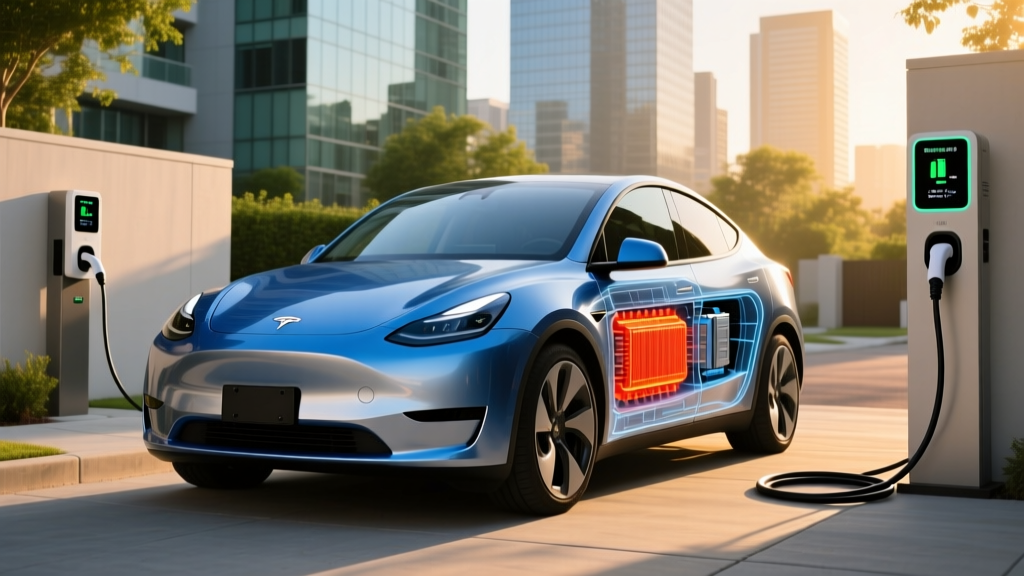
Regenerative braking feeds energy back into the battery, and the battery's chemistry determines how efficiently it accepts that charge — particularly at low and high states of charge (SoC).
| Model / Trim | Battery Capacity (usable) | Chemistry | Daily Charge Recommendation | Regen Behavior at High SoC |
|---|---|---|---|---|
| Model 3 RWD | ~60 kWh | LFP (CATL) | 100% daily OK | Reduced above ~95% |
| Model 3 Long Range | ~78 kWh | NMC (Panasonic) | 80% daily | Noticeably reduced above ~85% |
| Model Y Long Range | ~78 kWh | NMC (Panasonic) | 80% daily | Noticeably reduced above ~85% |
| Model S / X | ~95 kWh | NMC (Panasonic) | 80% daily | Reduced above ~85% |
This table reveals an important practical point: regen is weakest when the battery is nearly full. If you charge your NMC Tesla to 100% before a downhill mountain descent, you'll notice significantly less regenerative deceleration — the battery simply can't accept more charge efficiently at high SoC. The car will blend in friction brakes to compensate, but the deceleration feel changes. Tesla's navigation system actually warns you about this when it detects a route with significant elevation loss shortly after a full charge.
LFP batteries (used in the Model 3 RWD) tolerate regular 100% charging better than NMC, which means LFP owners who charge to full daily will experience consistent regen behavior for most of their driving. The trade-off is lower overall energy density and slightly less range.
Charging Speed, Performance & Key Specs
While regenerative braking extends your effective range between charges, you'll still need to plug in. Here's the complete charging and performance picture for the 2026 Tesla lineup:
| Spec | Model 3 RWD | Model 3 LR AWD | Model Y LR AWD | Model S LR | Model X LR |
|---|---|---|---|---|---|
| Max DC Fast Charge | 170 kW | 250 kW | 250 kW | 250 kW | 250 kW |
| 10–80% DC Time | ~25 min | ~22 min | ~24 min | ~27 min | ~30 min |
| Level 2 Home (11.5 kW) | ~30 mi/hr | ~44 mi/hr | ~40 mi/hr | ~41 mi/hr | ~35 mi/hr |
| 0–60 mph | 5.8 sec | 4.2 sec | 4.8 sec | 3.1 sec | 3.8 sec |
| Horsepower | 271 hp | 346 hp | 384 hp | 670 hp | 670 hp |
| Drivetrain | RWD | AWD Dual Motor | AWD Dual Motor | AWD Dual Motor | AWD Dual Motor |
| Connector | NACS (native) | NACS (native) | NACS (native) | NACS (native) | NACS (native) |
Tesla uses the NACS (North American Charging Standard) connector natively, giving access to the Tesla Supercharger network — over 25,000 stalls across North America. With adapters, Teslas can also use CCS1-equipped public chargers (Electrify America, EVgo), though charge speeds may vary depending on the adapter and station capability.
Charging curve reality: The "250 kW" peak rate is not sustained for the full session. Teslas typically hit peak power between 10–30% SoC, then taper progressively. The 10–80% times above reflect the actual integrated charge curve, not a simple division of kWh by peak kW. Above 80%, charging slows dramatically to protect battery health — expect the final 20% to take as long as the first 70%.
Pricing, Tax Credits & Value
| Model / Trim | Base MSRP | §30D Credit Eligible? | Effective Price (with credit) |
|---|---|---|---|
| Model 3 RWD | $38,990 | Yes — up to $7,500 | ~$31,490* |
| Model 3 Long Range AWD | $45,990 | Yes — up to $7,500 | ~$38,490* |
| Model Y Long Range AWD | $44,990 | Yes — up to $7,500 | ~$37,490* |
| Model S Long Range | $79,990 | No — exceeds MSRP cap | $79,990 |
| Model X Long Range | $79,990 | No — exceeds MSRP cap | $79,990 |
*Effective price assumes full $7,500 IRS §30D federal tax credit eligibility. Actual credit depends on buyer income limits (AGI caps: $150K single / $300K joint), battery critical-mineral and component sourcing requirements, and point-of-sale transfer election. MSRP caps: $55,000 for sedans (Model 3), $80,000 for SUVs/trucks (Model Y). Always verify current-year eligibility with a tax professional.
Warranty, Cargo Space & Practical Ownership
Battery & Drive Unit Warranty: Tesla covers the battery pack and drive unit for 8 years / 100,000 miles on the Model 3 RWD, and 8 years / 120,000 miles on Long Range and Model S/X variants. The warranty guarantees at least 70% capacity retention over that period. Tesla's basic vehicle limited warranty is 4 years / 50,000 miles.
Cargo & Passenger Space:
- Model 3: 23 cu ft trunk + frunk combined; rear legroom 35.2 in. Adequate for two adults and luggage, tight for three-across car seats.
- Model Y: 76 cu ft with rear seats folded; 30.2 cu ft behind rear seats. Rear legroom 41.6 in. Genuine family-hauler capacity with optional third-row (small children only).
- Model S: 28 cu ft rear cargo + frunk; rear legroom 41.7 in. Premium sedan comfort with hatchback utility.
- Model X: Up to 91 cu ft with seats folded; available in 5-, 6-, or 7-seat configurations. Falcon-wing rear doors aid car-seat access.
Standout Tech: Tesla's 15.4-inch center touchscreen runs the entire vehicle interface — no physical instrument cluster. Over-the-air updates add features regularly. Autopilot (basic lane-keeping and adaptive cruise) is standard; Full Self-Driving (Supervised) is an $8,000 add-on or $99/month subscription. FSD is SAE Level 2 — the driver must remain fully attentive at all times. This is not autonomous driving.
Tesla Autopilot and FSD (Supervised) are SAE Level 2 driver-assistance systems. They do not make the vehicle self-driving. The driver must keep hands on the wheel (or demonstrate attentiveness via the cabin camera), monitor the road, and be prepared to take over instantly. These systems perform well on well-marked highways but can struggle with construction zones, faded lane markings, unusual intersections, and adverse weather. Treat them as advanced cruise control, not a replacement for an engaged driver.
Pros, Cons & Who Should Buy a Tesla
Pros
- Aggressive regen enables genuine one-pedal driving; reduces brake pad wear to 100K+ miles
- Supercharger network: the most reliable and extensive DC fast-charging network in North America
- Class-leading efficiency (kWh/100mi) across the lineup
- OTA updates continuously improve the vehicle post-purchase
- Strong resale value relative to most EV competitors
- Model 3 RWD at ~$31,490 after credit is one of the most affordable EVs available
Cons
- No adjustable regen strength — one setting for all drivers
- Build quality inconsistency (panel gaps, paint) still reported by some owners
- Touchscreen-only interface frustrates some drivers (no physical buttons for climate, wipers)
- Insurance costs 20–40% higher than comparable ICE vehicles in many states
- FSD purchase price ($8,000) rarely justified by current Level 2 capability
- Model S/X priced out of federal tax credit eligibility
Best For:
- Model 3 RWD: Budget-conscious commuters who want maximum value, city driving where regen shines, and access to the Supercharger network for occasional road trips.
- Model 3 Long Range: Daily commuters with longer one-way distances (40+ miles) and those in cold climates who need the range buffer.
- Model Y Long Range: Families needing SUV cargo space, car-seat room, and the flexibility of road-trip charging. The best-selling Tesla for good reason.
- Model S/X: Buyers prioritizing performance, luxury, and maximum range who aren't dependent on the federal tax credit.
Frequently Asked Questions
Can I turn off regenerative braking in a 2026 Tesla?
No. Tesla removed the adjustable regen strength option in 2020–2021 software updates and has not reintroduced it. All 2026 Teslas ship with a single, strong regen profile. You can modulate the feel by feathering the accelerator rather than lifting completely, but you cannot coast freely as you would in an ICE vehicle or some competing EVs with adjustable regen.
Does regenerative braking eliminate the need for brake pad replacement?
Not entirely, but it dramatically extends brake pad life. Most Tesla owners report original brake pads lasting 100,000–150,000 miles because regen handles the majority of deceleration. However, the friction brakes still need periodic inspection — calipers can seize from underuse, and Tesla recommends occasional deliberate hard braking to keep rotors clean, especially in wet climates.
Why does my Tesla feel like it has weaker regen sometimes?
Three primary causes: (1) The battery is at a high state of charge — regen is reduced above ~85–95% SoC because the battery can't accept charge as quickly. (2) The battery is cold — below ~50°F, the battery's charge-acceptance rate drops, reducing regen strength until the pack warms up. (3) You're driving downhill with a full charge — the car will display a "regen limited" notification and blend in friction brakes.
How much range does regenerative braking actually add?
In heavy stop-and-go city traffic, regen can improve effective range by 10–20% compared to steady-state highway driving. This is already partially captured in the EPA's city MPGe rating, which is typically higher than the highway rating for Teslas. On a flat highway with no deceleration events, regen contributes essentially zero additional range.
Does a Tesla qualify for the federal EV tax credit in 2026?
The Model 3 (both RWD and Long Range) and Model Y Long Range qualify for up to $7,500 under IRS §30D, provided the buyer meets income caps ($150K single / $225K head of household / $300K joint AGI), the vehicle's MSRP is under the cap ($55K for sedans, $80K for SUVs), and the battery meets critical-mineral and component sourcing requirements. The credit can be transferred to the dealer at point of sale as an instant discount. Model S and X exceed the sedan MSRP cap and are not eligible. Always verify current-year rules with a tax professional, as sourcing requirements tighten annually.