Why Buyers Are Searching for a 'Rebadge Tesla'
If you've been searching for a rebadge Tesla, you're not alone. A small but persistent slice of EV shoppers wants Tesla's proven powertrain efficiency, Supercharger network access, and software polish — but wrapped in a different badge, body style, or dealership experience. Maybe it's a preference for traditional dealer service departments, a desire for physical controls, or simply brand loyalty to a legacy automaker.
Here's the reality as of 2026: no automaker currently sells a rebadged Tesla. Tesla does not license its platform, powertrains, or battery packs to other manufacturers the way Magna Steyr or Foxconn build vehicles for multiple brands. Every Tesla is a Tesla.
However, several 2026 EVs have closed the gap significantly on the metrics that made Tesla dominant: efficiency (kWh/100 mi), DC fast-charge speed, software quality, and now — thanks to the widespread adoption of the North American Charging Standard (NACS) — access to Tesla's Supercharger network. Below, we profile the two closest contenders that effectively deliver a Tesla-rivaling experience under a different badge: the 2026 Hyundai Ioniq 5 and the 2026 Ford Mustang Mach-E.
2026 Hyundai Ioniq 5: The Efficiency Benchmark
| Spec | SE Standard Range (RWD) | SEL/Limited (AWD) |
|---|---|---|
| EPA Range | 245 mi | 290 mi |
| Battery (usable) | 58 kWh (LFP) | 77.4 kWh (NMC) |
| Efficiency | 127 MPGe / 26 kWh/100mi | 110 MPGe / 30 kWh/100mi |
| Peak DC Fast Charge | 175 kW | 240 kW |
| 10–80% DCFC Time | ~24 min | ~18 min |
| Level 2 Home Charge | 10.9 kW (~38 mi/hr) | 10.9 kW (~38 mi/hr) |
| 0–60 mph | 7.4 sec | 4.5 sec |
| Horsepower | 168 hp | 320 hp |
| Drivetrain | RWD | Dual-motor AWD |
| Cargo (behind rear seats) | 27.2 cu ft (59.3 cu ft folded) | |
| Rear Legroom | 39.4 in | |
| Battery Warranty | 10 yr / 100,000 mi | |
| Base MSRP | ~$42,600 | ~$47,400 (SEL AWD) |
Charging: 800V Architecture Makes the Difference
The Ioniq 5's E-GMP platform runs on an 800-volt electrical architecture — one of the few non-Tesla EVs to do so. This enables peak DC fast-charging rates of up to 240 kW on the AWD Long Range model, meaning a 10–80% session takes roughly 18 minutes at a compatible 350 kW charger (like Electrify America or select EVgo stations). The charge curve holds above 150 kW through about 55% SoC before tapering — a meaningful advantage over 400V competitors that peak lower and taper earlier.
For the 2026 model year, Hyundai equips the Ioniq 5 with a native NACS charge port, meaning direct plug-in access to Tesla Superchargers without an adapter. This was the single biggest gap between Tesla and legacy EVs, and it's now closed.
At home on a Level 2 (240V/48A) circuit, the onboard 10.9 kW charger adds roughly 38 miles of range per hour — a full overnight charge from 10% to 100% takes about 7–8 hours.
What It Does Better (and Worse) Than a Tesla Model Y
The Ioniq 5 offers a more comfortable ride than the Model Y, with a notably quieter cabin at highway speeds. Physical climate controls and a more conventional infotainment layout appeal to buyers who find Tesla's all-touchscreen approach distracting. Hyundai's 10-year/100,000-mile battery warranty also outlasts Tesla's 8-year/120,000-mile coverage on paper, though Tesla's degradation data remains strong in practice.
Where it falls short: the Ioniq 5 lacks a frunk (front trunk), its rear visibility is compromised by the thick C-pillar, and its ADAS suite (Highway Driving Assist 2) is competent but not as feature-rich as Tesla's Autopilot/FSD (Supervised) — and it requires hands on the steering wheel more frequently. The Ioniq 5 also cannot match the Model Y's cargo volume (27.2 cu ft vs. 30.2 cu ft behind the second row).
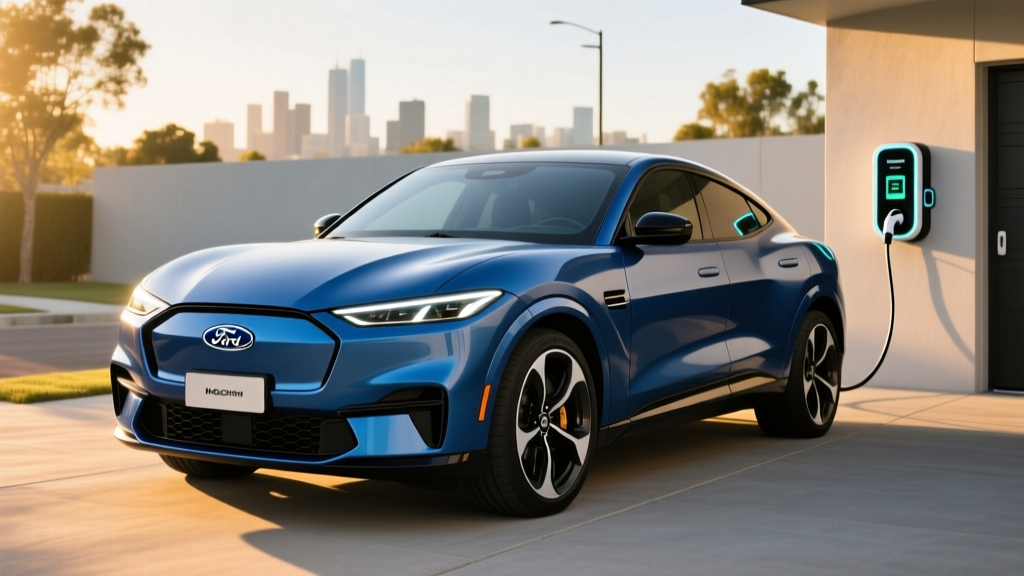
2026 Ford Mustang Mach-E: The Driver's Crossover
| Spec | Select RWD | Premium AWD (ER) | GT |
|---|---|---|---|
| EPA Range | 250 mi | 320 mi | 290 mi |
| Battery (usable) | 70 kWh (NMC) | 91 kWh (NMC) | 91 kWh (NMC) |
| Efficiency | 105 MPGe | 101 MPGe | 93 MPGe |
| Peak DC Fast Charge | 150 kW | 170 kW | 170 kW |
| 10–80% DCFC Time | ~32 min | ~36 min | ~36 min |
| Level 2 Home Charge | 10.5 kW (~35 mi/hr) | 10.5 kW (~35 mi/hr) | 10.5 kW (~35 mi/hr) |
| 0–60 mph | 6.3 sec | 5.1 sec | 3.5 sec |
| Horsepower | 266 hp | 346 hp | 480 hp |
| Drivetrain | RWD | Dual-motor AWD | Dual-motor AWD |
| Cargo (behind rear seats) | 29.7 cu ft (59.7 cu ft folded) | ||
| Rear Legroom | 38.9 in | ||
| Battery Warranty | 8 yr / 100,000 mi | ||
| Base MSRP | ~$39,995 | ~$48,995 | ~$56,995 |
Charging and Supercharger Access
The 2026 Mach-E ships with a native NACS port, granting direct Supercharger access. Peak DC charging tops out at 170 kW on Extended Range trims — adequate but not class-leading. The larger 91 kWh battery means 10–80% sessions stretch to roughly 36 minutes, longer than the Ioniq 5 despite the Hyundai's smaller pack. The charge curve is relatively flat, holding near peak through about 50% SoC.
At home on Level 2, the Mach-E's 10.5 kW onboard charger adds about 35 miles per hour. Ford's BlueCruise (hands-free on pre-qualified divided highways) is standard on Premium and GT trims and remains one of the better Level 2 systems available, though it covers fewer mapped highway miles than GM's Super Cruise.
Federal Tax Credit: What You'll Actually Pay
Under IRS §30D rules for 2026, the new clean vehicle credit offers up to $7,500, but eligibility depends on three moving targets:
- MSRP caps: SUVs/crossovers must be at or below $80,000; sedans at or below $55,000.
- Buyer income caps: Modified AGI ≤ $150,000 (single), $225,000 (head of household), $300,000 (joint).
- Battery sourcing: Critical minerals and battery components must meet escalating domestic/free-trade-partner thresholds. These requirements tighten annually and can disqualify specific trims mid-year.
| Vehicle / Trim | MSRP | Est. §30D Credit | Effective Price |
|---|---|---|---|
| Ioniq 5 SE Std Range RWD | $42,600 | $3,750–$7,500* | $35,100–$38,850 |
| Ioniq 5 SEL AWD | $47,400 | $3,750–$7,500* | $39,900–$43,650 |
| Mach-E Select RWD | $39,995 | $3,750–$7,500* | $32,495–$36,245 |
| Mach-E Premium AWD ER | $48,995 | $3,750–$7,500* | $41,495–$45,245 |
| Tesla Model Y Long Range AWD (baseline) | $44,990 | $3,750–$7,500* | $37,490–$41,240 |
*Credit amount depends on battery-sourcing compliance at time of purchase. The credit can be transferred to the dealer as a point-of-sale discount. Always verify current eligibility on the IRS clean vehicle credit page before purchasing. See a tax professional for personal eligibility.
Tech, Driver Assistance, and Software
Tesla's software ecosystem — over-the-air updates, the mobile app, Sentry Mode, Dog Mode, and the Supercharger routing integration — remains the most seamless in the industry. Neither the Ioniq 5 nor the Mach-E fully replicates this cohesion.
That said, the gap has narrowed. Hyundai's Digital Key 2 lets you use a phone or smartwatch as a key, and the Ioniq 5's 12.3-inch dual-screen setup supports wireless Apple CarPlay and Android Auto (something Tesla still does not offer natively). The Mach-E's 15.5-inch portrait screen running SYNC 4A is responsive, supports wireless CarPlay/Android Auto, and integrates with FordPass for remote preconditioning and charge scheduling.
On driver assistance, the hierarchy is clear: Tesla's FSD (Supervised) offers the broadest feature set but requires constant driver attention and remains an SAE Level 2 system. Ford's BlueCruise offers genuine hands-free driving on 130,000+ miles of mapped divided highways. Hyundai's HDA2 requires hands-on-wheel contact but provides smooth lane-centering and adaptive cruise.
Who Should Buy What: The Decision Framework
Choose the Hyundai Ioniq 5 if: You prioritize the fastest DC charging in the segment, prefer a quieter and more comfortable ride than the Model Y, want a 10-year battery warranty, and mostly drive in urban/suburban environments where its 290-mile range is ample.
Choose the Ford Mustang Mach-E if: You want the longest EPA range in this comparison (320 mi), prefer a sportier driving experience, value hands-free highway driving via BlueCruise, and need maximum cargo space (29.7 cu ft with a frunk).
Stick with the Tesla Model Y if: Software integration, Supercharger routing seamlessness, and over-the-air feature updates are your top priorities — and you don't mind the minimalist interior or lack of Apple CarPlay.
Pros and Cons at a Glance
Hyundai Ioniq 5 Pros & Cons
Pros:
- Fastest 10–80% charging in class (~18 min)
- 800V architecture future-proofs for higher-power chargers
- 10-year/100,000-mile battery warranty
- Comfortable ride, quiet cabin
- Native NACS (Supercharger access)
- Wireless CarPlay/Android Auto
Cons:
- No frunk
- Thick C-pillar hurts rear visibility
- Standard Range trim has limited highway range (~200 mi real-world)
- ADAS requires frequent hands-on-wheel contact
Ford Mustang Mach-E Pros & Cons
Pros:
- 320-mile EPA range (Extended Range AWD)
- BlueCruise hands-free highway driving
- Sporty handling, GT does 0–60 in 3.5 sec
- Practical frunk + 29.7 cu ft cargo
- Native NACS (Supercharger access)
- Available starting ~$39,995
Cons:
- Slower DC charging (~36 min 10–80%)
- Firm ride on GT trim
- 8-year battery warranty (shorter than Hyundai)
- Efficiency drops significantly on GT trim
Frequently Asked Questions
Is there any car that is a rebadged Tesla?
No. As of 2026, Tesla does not license its platform or powertrains to other automakers. No rebadged Tesla exists. However, vehicles like the Ioniq 5 and Mach-E now match or exceed Tesla on specific metrics (charging speed, range, warranty) while offering different design philosophies.
Can non-Tesla EVs use Tesla Superchargers in 2026?
Yes. The 2026 Hyundai Ioniq 5 and Ford Mustang Mach-E both feature native NACS charge ports, allowing direct Supercharger access without an adapter. Other EVs with CCS ports can access select Supercharger stalls using a Tesla-approved adapter, though compatibility varies by station.
What is the real-world range of the Ioniq 5 and Mach-E?
The Ioniq 5 AWD delivers roughly 245–260 miles highway in fair weather, dropping to 195–215 miles in freezing cold. The Mach-E Premium AWD ER achieves 270–290 miles highway, dropping to 220–250 miles in winter. City and suburban driving with regenerative braking often matches or exceeds EPA ratings.
Do the Ioniq 5 and Mach-E qualify for the $7,500 federal tax credit?
Both vehicles are below the $80,000 SUV MSRP cap and are assembled in ways that can qualify, but the actual credit amount ($3,750 or $7,500) depends on battery-sourcing compliance at the time of purchase, which changes throughout the year. Buyer income caps also apply ($150K single / $300K joint). Verify on IRS.gov before buying.
Which charges faster — the Ioniq 5 or the Mach-E?
The Ioniq 5 charges significantly faster. Its 800V architecture enables a 240 kW peak and a ~18-minute 10–80% session. The Mach-E peaks at 170 kW and requires ~36 minutes for the same session, largely because its larger 91 kWh battery takes longer to fill despite the lower peak rate.
Is the Tesla Model Y still the best choice?
It depends on your priorities. The Model Y Long Range AWD (EPA 310 mi, ~$44,990) remains the benchmark for software integration, Supercharger routing, and efficiency (123 MPGe). But the Ioniq 5 charges faster, the Mach-E offers more range and hands-free driving, and both provide Apple CarPlay — a feature Tesla still lacks. The gap has closed enough that the "best" EV is now genuinely a matter of preference rather than a default Tesla answer.