The 2026 Tesla Model 3: Refined Cabin Meets Proven Efficiency
The Tesla Model 3 received a comprehensive refresh for the 2024 model year (internally dubbed "Highland"), and the 2026 Model 3 carries forward those upgrades with minor trim and software updates. For shoppers researching the 2026 Tesla Model 3 interior, the headline is a noticeably quieter, more premium cabin that finally addresses long-standing complaints about build quality and road noise. But beyond the ventilated seats and ambient lighting, the Model 3 remains one of the most efficient electric sedans on the market, with EPA range reaching 341 miles on the Long Range AWD trim.
This guide covers every number that matters — from real-world range expectations and DC fast-charging curves to federal tax credit eligibility under current IRS §30D rules — so you can decide whether the Model 3 still earns its spot against rivals like the Hyundai Ioniq 6, BMW i4, and Polestar 2.
2026 Tesla Model 3 Interior: Materials, Space, and Tech
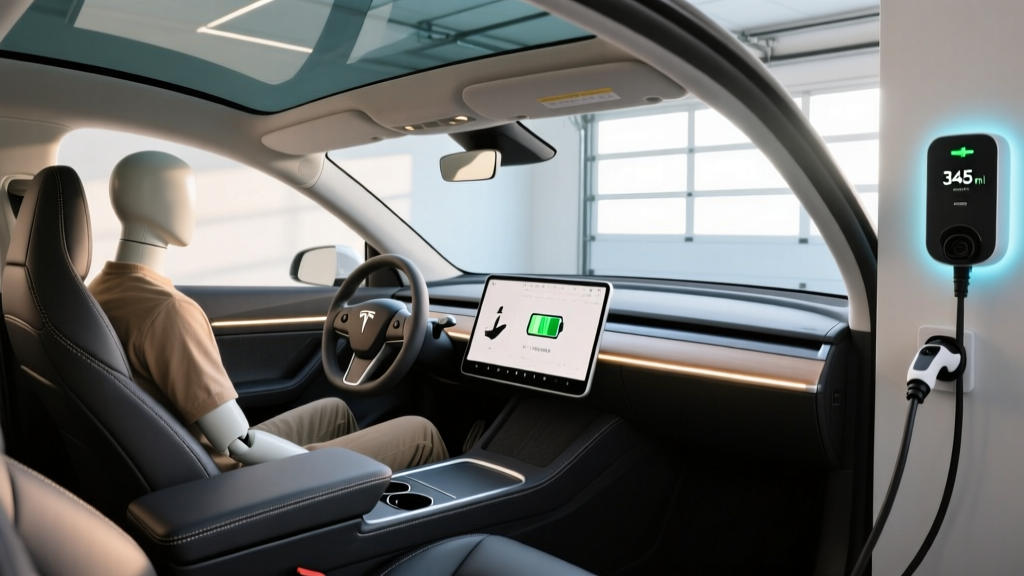
Step into the 2026 Model 3 and the transformation from pre-2024 cars is immediate. Tesla replaced the hard, scratchy plastics of earlier models with soft-touch materials across the dashboard, door panels, and center console. A full-width ambient lighting strip runs across the dash and doors, customizable in color and intensity. The 15.4-inch center touchscreen remains the command hub for virtually every vehicle function — climate, mirrors, glovebox, and driver-assist settings — with no physical buttons or stalks (turn signals are now on the steering wheel rim).
Cabin Dimensions and Comfort
| Dimension | Model 3 (2026) | Hyundai Ioniq 6 |
|---|---|---|
| Front legroom | 42.7 in | 41.7 in |
| Rear legroom | 35.2 in | 35.7 in |
| Front headroom | 40.3 in | 38.6 in |
| Rear headroom | 37.8 in | 37.3 in |
| Cargo (trunk + frunk) | 21.0 cu ft + 3.1 cu ft | 12.3 cu ft (no frunk) |
Rear-seat space is adequate for adults under 6 feet but tighter than the Ioniq 6 or BMW i4 Gran Coupe. The panoramic glass roof creates an airy feel, though it does reduce headroom slightly compared to cars with steel roofs. Cargo capacity totals 24.1 cubic feet when combining the rear trunk (21.0 cu ft) with the front trunk, or "frunk" (3.1 cu ft) — enough for two carry-ons and a week's groceries, but not class-leading.
Infotainment and Driver-Assist Tech
The Model 3 runs Tesla's proprietary infotainment OS, which is responsive and feature-rich but lacks Apple CarPlay and Android Auto. Navigation, media, and a built-in web browser are all native. Tesla's Basic Autopilot (traffic-adaptive cruise and lane-centering) is standard; Full Self-Driving (Supervised) remains an $8,000 option. To be clear, FSD is an SAE Level 2 driver-assist system — the driver must remain attentive and hands-on at all times. It is not autonomous driving.
- Ventilated front seats (new for Highland refresh, standard on Long Range/Performance)
- Rear 8-inch touchscreen for climate and media control
- Power-folding, auto-dimming, heated side mirrors
- 17-speaker premium audio with immersive sound
- Dashcam and Sentry Mode with USB-C recording
- No Apple CarPlay or Android Auto
- Turn signals on steering wheel rim take weeks to build muscle memory
- No physical climate knobs — all adjustments via touchscreen
- Rear visibility is compromised by the sloping roofline and small rear window
Range, Battery, and Efficiency
The 2026 Model 3 is offered in three trims, each with distinct battery chemistry and range characteristics:
| Trim | Battery (usable kWh) | Chemistry | Drivetrain | EPA Range | MPGe (city/hwy/combined) |
|---|---|---|---|---|---|
| RWD (Standard Range) | 60 kWh | LFP | RWD | 272 mi | 132 / 117 / 125 |
| Long Range AWD | 82 kWh | NMC | Dual-motor AWD | 341 mi | 134 / 119 / 127 |
| Performance | 82 kWh | NMC | Dual-motor AWD | 315 mi | 113 / 100 / 107 |
The RWD trim uses a lithium iron phosphate (LFP) battery, which offers longer cycle life and can be charged to 100% daily without accelerating degradation — a practical advantage for commuters. The Long Range and Performance trims use nickel-manganese-cobalt (NMC) chemistry for higher energy density, but Tesla recommends daily charging to 80% for longevity.
EPA estimates assume a mix of city and highway driving at moderate temperatures. In practice:
Long Range AWD: Expect ~290–310 miles on a mixed highway trip at 70 mph. In cold weather (below 30°F), range can drop 20–30%, yielding ~240–270 miles. City driving with regen braking can exceed EPA estimates, reaching 350+ miles in mild conditions.
RWD: Real-world highway range sits around 230–250 miles; cold weather reduces this to ~190–210 miles.
The Model 3's heat pump (standard on all trims) mitigates cold-weather loss better than many competitors, but physics still applies — battery chemistry slows in the cold.
Efficiency is a Model 3 hallmark. The Long Range AWD achieves 127 MPGe combined, translating to roughly 26 kWh per 100 miles — among the best in the premium electric sedan segment. For comparison, the Hyundai Ioniq 6 SE Long Range delivers 140 MPGe combined, while the BMW i4 eDrive40 returns 109 MPGe.
Charging Speed: DC Fast, Level 2, and Level 1
Charging speed is where the Model 3's 800V-class electrical architecture (technically ~400V nominal, but optimized for high charge rates) pays dividends. Here's the full breakdown:
| Charging Level | Power / Rate | Time or Miles Added | Notes |
|---|---|---|---|
| DC Fast Charge (V3 Supercharger) | Peak 250 kW | 10–80% in ~25 min (Long Range) | Speeds taper above 60% SoC; expect ~150 kW average from 10–80% |
| DC Fast Charge (CCS adapter) | Peak 250 kW (at compatible stations) | Similar to Supercharger | Requires Tesla CCS adapter ($175); works at Electrify America, EVgo, etc. |
| Level 2 (240V, 48A home charger) | 11.5 kW | ~44 miles per hour of charging | Full charge in ~7–8 hours (Long Range) |
| Level 2 (240V, 32A Mobile Connector) | 7.7 kW | ~30 miles per hour | Standard Mobile Connector with NEMA 14-50 adapter |
| Level 1 (120V, 12A) | 1.4 kW | ~4–5 miles per hour | Emergency/trickle only; ~60+ hours for full charge |
The 10–80% DC fast-charge time of roughly 25 minutes for the Long Range is competitive but no longer class-leading — the Hyundai Ioniq 6 (800V architecture) achieves 10–80% in ~18 minutes at a 350 kW charger. The Model 3's charge curve is well-managed: it sustains close to peak rate up to ~40% SoC, then tapers progressively. On a road trip, plan for 20–25 minute stops at V3 Superchargers (250 kW) every 200–250 miles to stay in the fast-charging sweet spot.
For home charging, a 48A Level 2 wall connector on a 60A circuit delivers the best experience — waking up to a full battery every morning. Installation costs vary widely: expect $500–$1,500 if your electrical panel has capacity, or $2,000–$4,000+ if a panel upgrade is needed. Always consult a licensed electrician for a site-specific quote.
Performance and Driving Dynamics
| Trim | Horsepower | 0–60 mph | Top Speed | Drivetrain |
|---|---|---|---|---|
| RWD | 283 hp | 5.8 sec | 125 mph | Rear-wheel drive |
| Long Range AWD | 346 hp | 4.2 sec | 125 mph | Dual-motor AWD |
| Performance | 510 hp | 2.9 sec | 163 mph | Dual-motor AWD |
Even the base RWD Model 3 feels quick around town, with instant torque delivery and a low center of gravity that makes it tossable on back roads. The Long Range adds dual-motor all-wheel drive for confident acceleration in rain and light snow. The Performance trim, with its adaptive dampers, track-tuned suspension, and 510 hp, is a legitimate sports sedan that embarrasses many combustion rivals at stoplights.
Ride quality on the refreshed Model 3 is substantially improved. Tesla retuned the suspension and added acoustic glass (front and rear) to cut road noise by roughly 30% compared to pre-2024 models. It's still firmer than a BMW i4 or Mercedes EQB, but no longer punishing on rough pavement.
Pricing, Trims, and Federal Tax Credit Eligibility
| Trim | Base MSRP | As-Tested (typical options) | Est. Price After §30D Credit* |
|---|---|---|---|
| RWD | $38,990 | $39,990 (with paint, no FSD) | $31,490 (if eligible for $7,500) |
| Long Range AWD | $45,990 | $48,490 (paint, wheels) | $38,490 (if eligible for $7,500) |
| Performance | $52,990 | $54,490 | $47,490 (if eligible for $5,000–$7,500) |
*Federal tax credit eligibility under IRS §30D is subject to multiple requirements. The credit is available as a point-of-sale rebate (transferred to the dealer) or claimed on your tax return. Always verify current-year rules at IRS.gov.
§30D Tax Credit Requirements (2026)
- MSRP cap: Sedars must have an MSRP at or below $55,000. The RWD and Long Range Model 3 qualify; the Performance trim may exceed the cap depending on options.
- Buyer income limits: Modified AGI must not exceed $150,000 (single), $225,000 (head of household), or $300,000 (joint).
- Battery sourcing: A percentage of critical minerals and battery components must be sourced from the U.S. or free-trade-agreement countries. Tesla's U.S.-built batteries have generally met these thresholds for the full $7,500 credit, but sourcing rules tighten annually — verify at purchase.
- Vehicle assembly: Final assembly must occur in North America. All U.S.-market Model 3 vehicles are assembled in Fremont, California, or Austin, Texas.
Some Model 3 configurations may qualify for only $3,750 (half credit) if battery-component sourcing falls short of the annual threshold. Your tax professional can confirm eligibility based on your specific situation and the vehicle's battery sourcing documentation.
Warranty and Ownership Costs
| Coverage | Term |
|---|---|
| Basic vehicle warranty | 4 years / 50,000 miles |
| Battery & drive unit (RWD, LFP) | 8 years / 100,000 miles (70% minimum capacity retention) |
| Battery & drive unit (Long Range/Performance, NMC) | 8 years / 120,000 miles (70% minimum capacity retention) |
Tesla's battery warranty guarantees at least 70% capacity retention over the warranty period. If degradation exceeds 30%, Tesla will repair or replace the battery to bring it above that threshold. In practice, Tesla batteries have shown strong longevity — many Model 3 owners report 5–8% degradation over 100,000 miles, well within warranty limits. Out-of-warranty battery replacement costs range from $12,000 to $16,000 depending on the pack, though this is rarely needed within the first 150,000+ miles based on fleet data.
Insurance premiums for the Model 3 tend to be higher than average for its class — expect $1,800–$2,800 annually depending on your location, driving record, and trim. Tesla offers its own insurance product in many states, which uses real-time driving data (Safety Score) to set premiums; safe drivers may see meaningful savings.
Who the 2026 Tesla Model 3 Is For
- Tech-forward commuters who value over-the-air updates, Supercharger network access, and a minimalist cabin.
- Efficiency seekers who want maximum miles per kWh — the Model 3 Long Range is among the most efficient AWD electric sedans available.
- Apartment dwellers with workplace charging — the RWD's LFP battery tolerates daily 100% charges, and 272 miles of range covers most commutes comfortably.
- Performance enthusiasts on a budget — the Performance trim delivers supercar acceleration at a fraction of the price.
- You need a spacious rear seat for tall passengers or car seats (look at the Hyundai Ioniq 6 or BMW i4).
- You rely on Apple CarPlay or Android Auto for navigation and media.
- You frequently drive in extreme cold without garage parking — range loss is real, though mitigated by the heat pump.
- You want physical buttons and knobs for climate and volume control.
Pros, Cons, and Verdict
- Class-leading efficiency (127 MPGe combined, Long Range)
- Access to Tesla Supercharger network (17,000+ U.S. stalls)
- LFP battery option (RWD) allows daily 100% charging
- Significantly improved cabin quietness and materials post-refresh
- Strong resale value relative to EV segment average
- Over-the-air updates add features post-purchase
- No Apple CarPlay or Android Auto
- Rear seat is snug for tall adults
- Steering-wheel turn signals require adaptation
- Higher insurance costs than segment average
- FSD ($8,000) remains Level 2 — not autonomous
- DC fast-charge speed (250 kW peak) lags 800V rivals
The 2026 Tesla Model 3 remains the default recommendation for buyers entering the electric sedan market. Its combination of efficiency, Supercharger access, and now a genuinely pleasant interior makes it hard to fault on paper. The Long Range AWD at $45,990 (potentially $38,490 after the federal credit) is the sweet spot — 341 miles of EPA range, dual-motor traction, and a premium cabin. If rear-seat space or CarPlay are non-negotiable, test-drive the Ioniq 6 and BMW i4 before committing. Otherwise, the Model 3 still sets the benchmark.
Frequently Asked Questions
What is the real-world range of the 2026 Tesla Model 3?
The EPA rates the Long Range AWD at 341 miles, but real-world highway driving at 70 mph typically yields 290–310 miles. In cold weather (below 30°F), expect 240–270 miles. City driving with regenerative braking can exceed the EPA estimate in mild conditions. The RWD trim delivers roughly 230–250 real-world highway miles.
How fast does the Model 3 charge at home and on the road?
On a V3 Supercharger (250 kW peak), the Long Range charges from 10–80% in approximately 25 minutes. At home on a 48A Level 2 Wall Connector (11.5 kW), you'll add about 44 miles of range per hour, fully recharging overnight in 7–8 hours. A standard 32A Mobile Connector adds ~30 miles per hour.
Does the 2026 Tesla Model 3 qualify for the federal EV tax credit?
Most Model 3 configurations qualify for the full $7,500 federal tax credit under IRS §30D, provided the buyer meets income limits ($150K single / $300K joint) and the vehicle's battery sourcing meets annual thresholds. The Performance trim's MSRP may exceed the $55,000 sedan cap with options. Verify eligibility at IRS.gov and with your tax professional before purchasing. The credit can be applied as a point-of-sale rebate.
Is the Tesla Model 3 worth buying over the Hyundai Ioniq 6 or BMW i4?
The Model 3 wins on Supercharger network access, efficiency, and software. The Ioniq 6 offers more rear-seat space, faster 800V charging (10–80% in ~18 min), and CarPlay. The BMW i4 provides a more traditional luxury interior with physical controls and a quieter ride. If Supercharger reliability and Tesla's ecosystem matter most, the Model 3 is still the choice. If you prioritize space or CarPlay, cross-shop the Ioniq 6.
How long will the Model 3 battery last?
Tesla warranties the Long Range/Performance battery for 8 years or 120,000 miles (70% minimum capacity retention). Fleet data suggests most Model 3 batteries retain 90%+ capacity at 100,000 miles. LFP batteries in the RWD trim offer even longer cycle life and tolerate daily 100% charges. Out-of-warranty replacement costs $12,000–$16,000 but is rarely needed within 150,000+ miles.
What does the 2026 Model 3 interior feel like compared to older models?
The 2026 (Highland-refreshed) interior is a significant upgrade: softer materials, ambient lighting, ventilated front seats, acoustic glass, and a rear touchscreen. Road noise is reduced by roughly 30%. It still lacks physical buttons — everything routes through the 15.4-inch center screen — and turn signals moved to the steering wheel rim, which takes adjustment.