Quick Answer: Is the Ram EV Truck Worth Buying in 2026?
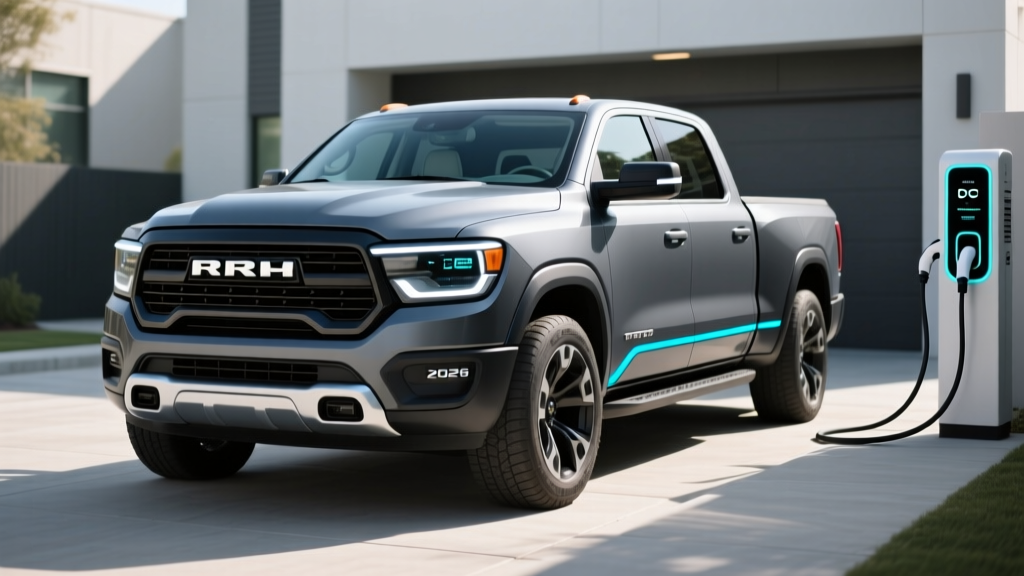
The 2026 Ram 1500 REV is Ram's first all-electric full-size pickup, built on the STLA Frame platform with up to 350 miles of EPA-estimated range (with the optional larger battery pack), peak DC fast charging up to 350 kW, and a starting MSRP around $58,000 before incentives. It's a serious work-and-lifestyle truck that undercuts the Ford F-150 Lightning on base price while rivaling it on range. However, buyers should weigh real-world highway range (expect 270–300 miles), home charging installation costs ($1,200–$2,500 for a Level 2 setup), and the current state of federal tax credit eligibility under IRS §30D sourcing rules before committing. If you need a daily-driver truck with home charging access and moderate towing needs, the Ram 1500 REV is a strong contender. If you regularly tow over 7,000 lbs or live in a charging desert, a PHEV or gas truck may still serve you better.
2026 Ram 1500 REV: Core Specs at a Glance
After multiple production delays, the Ram 1500 REV enters the 2026 model year as a genuine competitor in the electric truck segment. Here are the confirmed and estimated specifications based on Ram's latest disclosures and STLA Frame platform data:
| Specification | Standard Battery (Est.) | Extended Battery (Est.) |
|---|---|---|
| Usable Battery Capacity | ~168 kWh (NMC) | ~229 kWh (NMC) |
| EPA-Estimated Range | ~350 miles | ~500 miles (target) |
| Real-World Highway Range | ~270–300 miles | ~380–420 miles |
| Peak DC Fast Charge Rate | Up to 350 kW | Up to 350 kW |
| 10–80% DC Fast Charge Time | ~23 minutes (est.) | ~30 minutes (est.) |
| Level 2 Charge Rate (AC) | ~11.5 kW | ~11.5 kW |
| Horsepower | ~654 hp (dual motor) | ~654 hp (dual motor) |
| 0–60 mph | ~4.4 seconds | ~4.4 seconds |
| Max Towing Capacity | ~14,000 lbs (est.) | ~14,000 lbs (est.) |
| Max Payload | ~2,700 lbs (est.) | ~2,300 lbs (est.) |
| Starting MSRP (base Tradesman) | ~$58,000 | ~$68,000+ |
| Battery Warranty | 8 years / 100,000 miles | |
Important caveat on range: The 500-mile target for the extended battery pack is Ram's stated goal and has not been independently EPA-verified as of this writing. The standard 168 kWh pack delivering ~350 miles EPA is the more realistic benchmark for buyers planning around range. In cold weather (below 30°F), expect 15–25% range reduction, meaning the standard pack could deliver 260–295 miles in winter conditions. Highway driving at 75+ mph also reduces efficiency compared to the EPA combined cycle.
Charging the Ram 1500 REV: What You Actually Need
The Ram 1500 REV's charging capability is one of its strongest selling points on paper — the 800-volt architecture enables peak charging speeds up to 350 kW at compatible DC fast chargers. But understanding the difference between kW (the rate of power delivery, like water pressure) and kWh (the energy stored in the battery, like tank size) is essential for planning your charging routine.
| Charging Level | Power | Miles Added per Hour | Use Case |
|---|---|---|---|
| Level 1 (120V household) | ~1.4 kW | ~3–4 miles | Overnight trickle; emergency top-ups |
| Level 2 (240V home/workplace) | ~11.5 kW | ~30–35 miles | Daily home charging; full overnight fill |
| DC Fast Charge (public) | Up to 350 kW (peak) | ~700+ miles/hr (peak) | Road trips; rapid 10–80% top-ups |
Real-world charging curve reality: The 350 kW peak rate is not sustained across the entire session. Like all EVs, the Ram 1500 REV will taper charging speed significantly above 80% state of charge (SoC) to protect battery longevity. Expect the 10–80% session to average closer to 180–220 kW on a 350 kW-capable charger, with the final 80–100% top-up adding considerable time. For daily driving, charging to 80% at home on Level 2 is optimal for battery health and convenience.
Home charging installation: Most Ram 1500 REV owners will want a Level 2 home charger. Here's what to budget:
| Component | Estimated Cost Range |
|---|---|
| Level 2 EVSE hardware (32A–48A) | $400–$750 |
| Electrician labor (240V circuit install) | $600–$1,500 |
| Permit fees (varies by locality) | $50–$200 |
| Electrical panel upgrade (if needed, 200A) | $1,500–$3,500 |
| Total (no panel upgrade) | $1,050–$2,450 |
| Total (with panel upgrade) | $2,550–$5,950 |
Always hire a licensed electrician for the final installation and spec confirmation. Homes with existing 200-amp panels and nearby garage outlet locations will be on the lower end; older homes with 100-amp service or long conduit runs will cost more. The IRS residential clean energy credit may cover 30% of home charging equipment costs (up to $1,000) — consult a tax professional for eligibility.
Ram 1500 REV vs. Gas Truck vs. F-150 Lightning: Cost Comparison
The decision to buy an electric truck isn't just about the sticker price — it's about total cost of ownership over 5 years. Here's how the Ram 1500 REV stacks up against its gas counterpart and the Ford F-150 Lightning:
| Factor | Ram 1500 REV (Std Battery) | Ram 1500 Gas (5.7L HEMI) | Ford F-150 Lightning (Std Range) |
|---|---|---|---|
| Base MSRP | ~$58,000 | ~$44,000 | ~$55,000 |
| Federal Tax Credit (§30D) | Up to $7,500* | $0 | Up to $7,500* |
| Effective Starting Price | ~$50,500* | ~$44,000 | ~$47,500* |
| Fuel/Energy Cost per Mile | ~$0.04–$0.06 (home) | ~$0.15–$0.20 (gas) | ~$0.04–$0.06 (home) |
| 5-Year Fuel/Energy (15k mi/yr) | ~$3,000–$4,500 | ~$11,250–$15,000 | ~$3,000–$4,500 |
| 5-Year Maintenance (est.) | ~$1,500–$2,000 | ~$3,500–$4,500 | ~$1,500–$2,000 |
| 5-Year Insurance (est. avg) | ~$9,000–$11,000 | ~$7,000–$8,500 | ~$8,500–$10,500 |
| Estimated 5-Year Total Cost | ~$64,000–$70,000 | ~$65,750–$72,000 | ~$60,500–$64,500 |
*Tax credit eligibility under IRS §30D depends on buyer income caps, vehicle MSRP caps ($80,000 for trucks), battery component sourcing, and critical mineral requirements. The credit can be transferred to the dealer at point of sale as of 2024+. Always verify current-year eligibility with your tax advisor.
Key takeaway: The Ram 1500 REV's higher upfront cost is substantially offset by fuel and maintenance savings over 5 years, especially for high-mileage drivers. However, EV insurance premiums run 15–30% higher than gas equivalents due to repair costs and battery replacement valuations. The F-150 Lightning currently holds a slight edge in total cost due to its lower base price and established dealer network, but the Ram's larger standard battery and 800V architecture offer range and charging advantages on paper.
Real-World Ownership: What First-Time EV Truck Buyers Need to Know
Buying an electric truck involves considerations that don't apply to gas pickups. Here's what the brochures won't tell you:
Home Charging Is Almost Mandatory
While public DC fast charging networks (Tesla Superchargers with NACS adapters, Electrify America, EVgo) are expanding, relying solely on public charging is expensive ($0.30–$0.50/kWh vs. $0.12–$0.18/kWh at home) and inconvenient. If you live in an apartment without charging access or park on the street, an EV truck will be a daily friction point. Confirm your charging situation before purchasing.
Towing Crushes Range
The Ram 1500 REV's ~14,000-lb max towing rating is impressive, but towing at capacity can cut range by 40–50%. A 350-mile truck becomes a 175–210-mile truck when pulling a heavy trailer. For frequent long-distance towing, a gas or diesel truck remains more practical today. The Ram 1500 REV is best suited for light-to-moderate towing (boat, small camper, utility trailer under 5,000 lbs) and excels as a daily driver and job-site commuter.
Cold Weather Is Real
Lithium-ion batteries lose efficiency in cold temperatures. In sub-freezing climates (think Minnesota, Montana, New England winters), expect 15–25% range reduction and slower DC charging speeds until the battery warms up. The Ram 1500 REV is expected to include battery preconditioning — a system that warms the pack before you arrive at a fast charger — but cold-weather range loss is a physics limitation, not a software fix. Plan accordingly if you live in a cold climate.
The Frunk Is a Genuine Truck Feature
Without an engine, the Ram 1500 REV offers a front trunk (frunk) with estimated 15+ cubic feet of lockable, weather-sealed storage — useful for tools, job-site gear, or groceries. Combined with the bed, this gives the REV a cargo versatility advantage over gas trucks.
Federal Tax Credit and Incentives: What You Actually Qualify For
The federal EV tax credit under IRS §30D can reduce the effective price of the Ram 1500 REV by up to $7,500, but eligibility is not automatic. Here's the 2026 checklist:
- MSRP cap: The truck must have an MSRP at or below $80,000 (trucks/vans/SUVs). Most Ram 1500 REV trims should qualify, but fully loaded Laramie/Limited models may exceed this cap.
- Buyer income limits: Adjusted gross income must not exceed $150,000 (single), $225,000 (head of household), or $300,000 (married filing jointly).
- Battery sourcing requirements: The credit is split into two $3,750 halves — one for critical mineral sourcing and one for battery component manufacturing. These requirements tighten annually, and some EVs lose partial or full credit eligibility year to year. Check the latest fueleconomy.gov listings for current status.
- Point-of-sale transfer: Since 2024, you can transfer the credit to the dealer at purchase, reducing your out-of-pocket cost immediately rather than waiting for a tax refund.
- Final assembly: The vehicle must undergo final assembly in North America. The Ram 1500 REV is assembled in Sterling Heights, Michigan, satisfying this requirement.
State and local incentives vary widely — some states offer additional rebates of $1,000–$5,000, while others offer none. Check your state's energy office or DMV for current programs.
Common Ram EV Truck Misconceptions — Fact vs. Fiction
| Myth | Fact |
|---|---|
| "Electric trucks can't tow anything." | The Ram 1500 REV targets ~14,000 lbs max towing. Range drops significantly while towing, but capability is real for light-to-moderate loads. |
| "The battery will need replacing in 5 years." | Modern NMC batteries are warrantied for 8 years/100,000 miles with a capacity retention threshold (typically 70%). Real-world degradation data from similar platforms shows 10–15% capacity loss over 150,000+ miles. |
| "Charging takes hours on road trips." | A 10–80% DC fast charge at a 350 kW station takes roughly 23–30 minutes. Plan stops around meals or rest breaks, similar to gas road trips with slightly longer pauses. |
| "EVs are worse for the environment because of battery mining." | While battery production has a higher upfront carbon footprint, lifecycle analyses consistently show EVs produce fewer total emissions over their lifetime, even on fossil-heavy grids. The gap widens as grids decarbonize. |
| "I'll save money immediately." | Higher insurance premiums, home charger installation, and potentially higher registration fees in some states offset early fuel savings. Break-even typically occurs in year 2–4 depending on mileage and electricity rates. |
Decision Framework: Should You Buy the Ram 1500 REV?
Choose the Ram 1500 REV if:
- You have reliable home charging access (garage or driveway with 240V capability)
- Your daily driving is under 200 miles round-trip with occasional longer road trips
- You tow light-to-moderate loads (under 5,000 lbs) most of the time
- You want low running costs and minimal maintenance for a work-commute truck
- You value instant torque, a quiet cabin, and frunk storage for job-site gear
- You qualify for the federal tax credit, bringing the effective price closer to a gas truck
Choose a gas or PHEV truck instead if:
- You regularly tow heavy trailers (7,000+ lbs) over long distances
- You live in an apartment or park on-street with no charging access
- You frequently drive in remote areas with sparse DC fast charging infrastructure
- Your budget is firm below $45,000 and you can't absorb the higher upfront cost
- You live in an extreme cold climate and can't tolerate 20%+ winter range loss
- You need a truck today — confirm Ram 1500 REV delivery timelines with your local dealer, as initial production volumes may be limited
Frequently Asked Questions
What is the real-world range of the Ram 1500 REV?
The standard battery pack targets ~350 miles EPA. In real-world highway driving at 70–75 mph, expect 270–300 miles. In cold weather (below 30°F), plan for 260–295 miles. The extended battery pack targets ~500 miles EPA, but this figure is preliminary and not yet EPA-verified.
How long does it take to charge the Ram 1500 REV at home?
On a Level 2 home charger (~11.5 kW), a full charge from empty takes roughly 15–20 hours for the standard pack. In practice, most owners plug in nightly and top up 30–50% daily, which takes 5–8 hours overnight — well within a normal sleep cycle.
Does the Ram 1500 REV qualify for the $7,500 federal tax credit?
It is expected to qualify for up to $7,500 under IRS §30D, subject to battery sourcing requirements, buyer income caps, and the $80,000 MSRP cap for trucks. Eligibility can change as sourcing rules tighten annually. Verify current status on fueleconomy.gov and consult a tax professional before purchasing.
Can I use Tesla Superchargers with the Ram 1500 REV?
Ram has indicated the 1500 REV will use the NACS (North American Charging Standard) connector or offer a CCS-to-NACS adapter, granting access to the Tesla Supercharger network. Confirm the connector configuration with your dealer at the time of purchase, as this may vary by model year and trim.
How does the Ram 1500 REV compare to the Ram 1500 Ramcharger?
The Ramcharger is a separate model — an extended-range electric vehicle (EREV) with a gas engine that acts as a generator but does not drive the wheels directly. It offers electric-only range (~69 miles estimated) plus gas-generated range for 600+ total miles. If you need unlimited range without charging stops, the Ramcharger is the better fit; if you want a pure EV with zero tailpipe emissions and lower running costs, the REV is the answer.
What does the Ram 1500 REV battery replacement cost?
Full battery pack replacement costs are not yet published for the REV, but comparable large-pack EVs (150+ kWh) range from $15,000–$30,000 out of warranty. The 8-year/100,000-mile battery warranty should cover premature degradation (below ~70% capacity). Most EV batteries outlast their warranty periods by significant margins based on current degradation data.