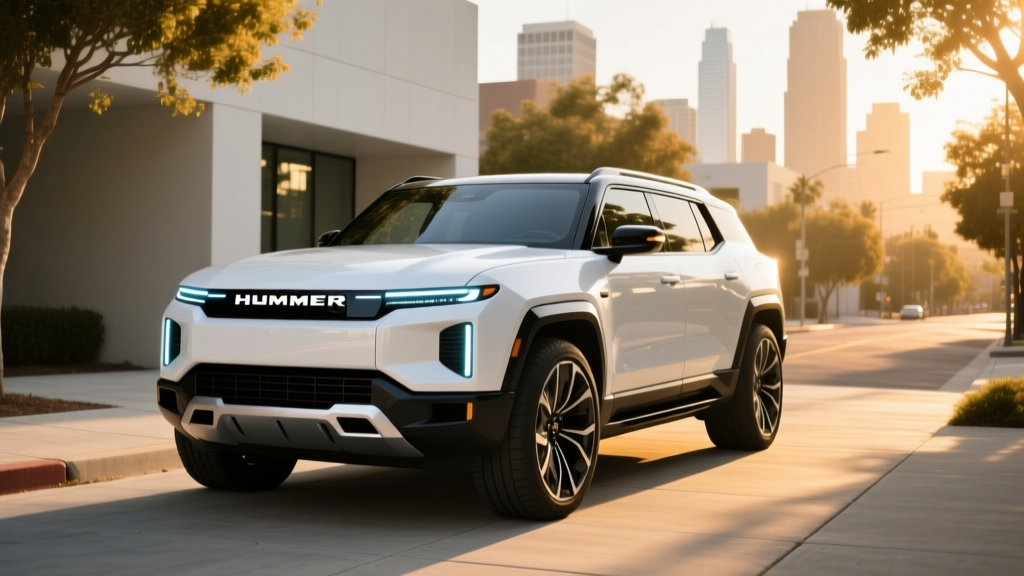
You've seen the headline: a Hummer EV lease $699 per month. For a vehicle with over 1,000 horsepower, 329 miles of EPA range, and a curb weight north of 9,000 pounds, that monthly figure sounds almost too good to be true. But a lease payment is only the tip of the ownership iceberg. To determine whether this deal genuinely saves you money — or quietly drains your wallet through insurance premiums, electricity costs, and end-of-lease surprises — we need to run the full five-year numbers.
Below, we dissect every cost layer of owning or leasing the GMC Hummer EV Pickup (Edition 1 / 3X trim), from the federal §30D tax credit eligibility to the real-world cost per mile driven. We'll also answer whether that $699 lease is structured in a way that lets you capture the federal incentive, because how you acquire the vehicle changes the math entirely.
| EPA Range | 329 miles (est. ~275-290 mi real-world highway) |
| Battery | ~246 kWh gross / ~212 kWh usable, Ultium NMC (nickel-manganese-cobalt) |
| Peak DC Charge Rate | ~350 kW (10-80% in ~35 min on a capable station) |
| Level 2 Rate | 19.2 kW (adds ~52 mi/hr) |
| Horsepower | 830 hp (Watts to Freedom mode) |
| 0-60 mph | ~3.0 seconds |
| MPGe | 47 MPGe combined (fueleconomy.gov) |
| Base MSRP | ~$104,500 (3X Pickup, before destination) |
| Battery Warranty | 8 years / 100,000 miles |
The $699 Hummer EV Lease: What's Actually Included?
A $699/month lease on a $100,000+ vehicle typically comes with specific parameters that you need to verify before signing:
- Term: Usually 36 months
- Mileage allowance: Often 10,000 miles/year (30,000 total) — exceeding this costs $0.25-$0.30/mile at lease-end
- Due at signing: First month's payment + acquisition fee + any down payment (commonly $5,000-$7,500 capitalized cost reduction to hit $699)
- Disposition fee: ~$595 at lease-end if you don't purchase or lease another GM vehicle
The critical question for the Hummer EV specifically: does the lease structure allow the federal tax credit to apply? Under IRS §30D rules, the clean vehicle credit goes to the purchaser who takes title. In a standard consumer lease, the leasing company (GM Financial) holds the title, not you. This means the $7,500 credit technically goes to the lessor — and they may or may not pass it through as a capitalized cost reduction. Always ask the dealer explicitly whether the lease quote already factors in the federal credit being applied to your deal. If it doesn't, your effective cost is $7,500 higher than advertised.
An alternative: some buyers use a lease-to-purchase or structured installment sale that transfers title at signing, making the buyer eligible for §30D directly. This is worth discussing with the dealer's finance department.
Do I Qualify for the Federal EV Tax Credit?
The IRS §30D Clean Vehicle Credit offers up to $7,500 for qualifying new EVs, but eligibility hinges on several requirements that can disqualify buyers or vehicles. Here's the current-year checklist:
- Adjusted Gross Income (AGI) caps: $300,000 joint filers / $225,000 head of household / $150,000 single filers
- MSRP cap: Vans, SUVs, and pickup trucks — $80,000 maximum MSRP. ⚠ The Hummer EV Pickup at ~$104,500 MSRP exceeds this cap, making it ineligible for §30D when purchased.
- Battery component sourcing: Battery components must be manufactured or assembled in North America (phased percentages increase annually)
- Critical minerals: A percentage of critical minerals must be sourced from the US or FTA-partner countries
- Point-of-sale transfer: Eligible buyers can transfer the credit to the dealer for an immediate price reduction at purchase
- One credit per VIN: The credit is claimed once per vehicle, not per owner
Source: IRS.gov — Credits for New Clean Vehicles. Rules are subject to legislative change; consult a tax professional for your specific situation.
What this means for the Hummer EV: Because the Hummer EV Pickup's MSRP exceeds $80,000, it does not qualify for the §30D new-vehicle credit when purchased outright. This is a dealbreaker for buyers counting on $7,500 in federal savings. However, the commercial clean vehicle credit (§45W) operates under different rules and may apply in certain leasing structures where the lessor claims the credit — which is why some lease deals can still be attractively priced despite the MSRP cap issue. Again, confirm with the dealer exactly how the incentive flows in your specific contract.
Charging vs. Gas: The Per-Mile Cost Reality
The Hummer EV's efficiency is, predictably, poor by EV standards. At 47 MPGe combined and a ~212 kWh usable battery, this truck consumes roughly 2.1-2.3 kWh per mile under mixed driving. That's roughly 4-5x the consumption of a Tesla Model Y. Here's how that translates to real cost:
| Scenario | Cost/Mile | Annual (12,000 mi) |
|---|---|---|
| Hummer EV — Home L2 charging ($0.14/kWh avg) | $0.31 | $3,720 |
| Hummer EV — DC fast charging ($0.40/kWh avg) | $0.88 | $10,560 |
| Gas truck (16 MPG combined, $3.50/gal) | $0.22 | $2,640 |
| Gas truck (16 MPG combined, $4.50/gal) | $0.28 | $3,360 |
Assumes 2.2 kWh/mile for the Hummer EV. Home charging rate based on national residential average; DC fast charging rates vary widely by network (EIA electricity pricing data).
This is the counterintuitive finding: the Hummer EV can actually cost more to "fuel" than a gas truck if you rely heavily on DC fast charging, because its enormous battery and low efficiency multiply the per-kWh cost. The savings only materialize if you charge predominantly at home on residential electricity rates. If you live in an apartment without home charging access, or if your utility charges $0.25+/kWh (as in parts of California, New England, and Hawaii), the Hummer EV's energy cost will significantly exceed a gas equivalent.
For context, a more efficient EV like the Ford F-150 Lightning (extended range, ~2.0 kWh/mile) or Rivian R1T (~2.2 kWh/mile) sits in a similar consumption bracket, so this isn't unique to the Hummer — it's a function of heavy, full-size electric trucks generally.
Five-Year Total Cost of Ownership
Let's model a realistic five-year ownership scenario. We'll use the lease structure as the acquisition method and assume 10,000 miles/year (matching a typical lease), home charging at $0.14/kWh, and national-average insurance and maintenance costs for a luxury EV pickup.
| Category | Year 1 | Year 2 | Year 3 | Year 4 | Year 5 | 5-Yr Total |
|---|---|---|---|---|---|---|
| Lease payments ($699/mo × 12) | $8,388 | $8,388 | $8,388 | — | — | $25,164 |
| Due at signing (down + fees) | $6,500 | — | — | — | — | $6,500 |
| Post-lease payments (Yr 4-5, refinanced or new lease est.) | — | — | — | $9,600 | $9,600 | $19,200 |
| Charging (home L2, 10k mi/yr) | $3,100 | $3,100 | $3,100 | $3,100 | $3,100 | $15,500 |
| Insurance | $4,800 | $4,600 | $4,400 | $4,200 | $4,000 | $22,000 |
| Maintenance & tires | $400 | $600 | $800 | $1,500 | $2,000 | $5,300 |
| Disposition / lease-end fees | — | — | $595 | — | $595 | $1,190 |
| TOTAL | $23,188 | $16,688 | $17,283 | $18,400 | $19,295 | $94,854 |
Five-year estimated total: ~$94,850 for 50,000 miles of driving, or roughly $1.90/mile all-in. This assumes you transition into a comparable lease or purchase for years 4-5 after the initial 36-month term. If you simply return the vehicle after 3 years and walk away, your 3-year cost is approximately $55,000-$58,000 for 30,000 miles.
Maintenance: Where the EV Actually Saves You
The Hummer EV's maintenance costs are meaningfully lower than a gas-powered heavy-duty truck, even though it's not zero. Here's what you avoid and what you still pay for:
| Item | Hummer EV | Gas HD Truck |
|---|---|---|
| Oil changes (8-10 over 5 years) | $0 | $800-$1,200 |
| Transmission fluid / service | $0 | $300-$500 |
| Brake pads (regen extends life significantly) | $0-$400 | $800-$1,500 |
| Coolant / spark plugs / air filters | $0-$200 | $400-$800 |
| Tires (heavy EV wears tires faster) | $2,000-$3,500 | $1,200-$2,000 |
| Cabin air filter, wipers, misc. | $300-$500 | $300-$500 |
| Estimated Total | $2,300-$4,600 | $3,800-$6,500 |
The net maintenance savings is roughly $1,500-$2,500 over five years, primarily from eliminating oil changes and extending brake pad life through regenerative braking. However, the Hummer EV's extreme weight (9,046 lbs curb weight) accelerates tire wear significantly. Budget for at least one full set of replacement tires during a 50,000-mile ownership period — and these are large, specialty EV-rated tires costing $350-$500 each.
Insurance: The Hidden EV Cost Premium
EV insurance costs consistently run 15-30% higher than equivalent gas vehicles, and the Hummer EV sits at the extreme end of this spectrum. Expect annual premiums of $4,000-$5,500 depending on your state, driving record, and coverage level. Several factors drive this:
- Repair costs: The Ultium battery pack, specialized structural components, and advanced ADAS sensors (cameras, radar, ultrasonic) are expensive to replace after a collision
- Vehicle value: At $100,000+ MSRP, comprehensive and collision coverage premiums scale accordingly
- Specialized labor: Fewer body shops are certified for high-voltage EV repairs, increasing labor rates
- Crash severity: A 9,000-lb vehicle causes more damage to other vehicles in multi-car incidents, increasing liability exposure
Always obtain insurance quotes before signing a lease. A $699/month lease quickly becomes $1,050+/month when you add realistic insurance premiums. Some insurers offer EV-specific discounts (safe driver, bundled home charging equipment), so shop at least three carriers.
Depreciation and Resale: The EV Uncertainty Factor
EV depreciation has been volatile since 2022. After a sharp correction in 2023-2024 that saw some EVs lose 40-50% of their value in the first year, the market has stabilized somewhat — but full-size electric trucks remain a risky bet for residual value. Key considerations:
- Leasing protects you: With a lease, the residual risk belongs to GM Financial, not you. If the Hummer EV's resale value collapses, that's the lessor's problem at lease-end. This is arguably the strongest argument for leasing over buying this particular vehicle.
- Purchase depreciation: If you bought a Hummer EV at $104,500, industry estimates suggest 45-55% depreciation over 5 years, leaving a residual value of roughly $47,000-$57,000. That's $47,000-$57,000 in depreciation cost alone.
- Battery health perception: As the vehicle ages, buyer concern about out-of-warranty battery replacement ($30,000-$40,000+ for a pack this size) will suppress resale values, even though the 8-year/100,000-mile warranty provides coverage during the typical first-ownership period.
- Technology obsolescence: Solid-state batteries, faster-charging architectures, and next-generation platforms may make current Ultium-based vehicles feel dated by 2028-2029.
State, Local, and Utility Incentives
State, local, and utility EV incentives vary significantly by jurisdiction and change frequently. The following examples are illustrative — always verify current availability with your state energy office, utility provider, and the DOE Alternative Fuels Data Center.
- California (CVRP): Previously offered up to $7,000 for income-qualified buyers; program funding and eligibility change annually
- Colorado: State tax credit up to $5,000 for EVs with MSRP under $80,000 (Hummer EV excluded by price cap)
- Utility rebates: Many utilities offer $500-$1,500 rebates for home Level 2 charger installation; some offer time-of-use (TOU) rate discounts that reduce charging costs by 30-50% during off-peak hours
- HOV lane access: Several states grant EVs single-occupant carpool lane access, which has tangible commute-time value
The Hummer EV's high MSRP disqualifies it from many state incentive programs with price caps. Check your specific state's rules before factoring state credits into your purchase math.
Frequently Asked Questions
How much does it really cost to own a Hummer EV over 5 years?
Based on our lease scenario with 10,000 miles/year and home charging, expect approximately $94,000-$98,000 over five years including lease payments, charging, insurance, maintenance, and fees. That works out to roughly $1.90/mile all-in. If you only hold the initial 3-year lease, plan for $55,000-$58,000 over 30,000 miles.
Does the Hummer EV qualify for the $7,500 federal tax credit?
No — not when purchased by a consumer. The §30D credit has an $80,000 MSRP cap for pickups and SUVs, and the Hummer EV starts around $104,500. In a lease, the leasing company may qualify for a commercial vehicle credit (§45W) and may pass savings through as a lower lease payment, but this is not guaranteed. Always confirm with the dealer how incentives are applied to your specific lease structure.
How much do I save on fuel and maintenance compared to a gas truck?
Surprisingly, you may not save on fuel. At 2.2 kWh/mile, the Hummer EV costs $0.31/mile to charge at home and $0.88/mile on DC fast chargers. A comparable gas truck at 16 MPG costs $0.22-$0.28/mile. You save $1,500-$2,500 on maintenance over five years (no oil changes, less brake wear), but tire costs are higher due to the vehicle's extreme weight.
Are EVs more expensive to insure?
Yes, typically 15-30% more. For the Hummer EV specifically, expect $4,000-$5,500/year due to its high MSRP, expensive battery and sensor repairs, and the higher crash severity associated with a 9,000-lb vehicle. Always get quotes before committing.
How well does the Hummer EV hold its value?
Full-size electric trucks face uncertain residual values. Industry estimates suggest 45-55% depreciation over 5 years for a purchase scenario. This is one reason leasing is often recommended for the Hummer EV — it shifts depreciation risk to the lessor. The 8-year/100,000-mile battery warranty provides some protection, but out-of-warranty battery replacement costs ($30,000-$40,000+) will weigh on long-term resale values.
Is the $699/month Hummer EV lease a good deal?
It depends on what's included. If the $699 already factors in all available incentives and the due-at-signing is reasonable (under $7,000), it's a competitive entry into a six-figure vehicle. But when you add insurance ($350-$450/month), home charging ($260/month), and plan for tire replacement, your real monthly cost of driving is closer to $1,300-$1,500/month. Compare that total against your alternatives before signing.