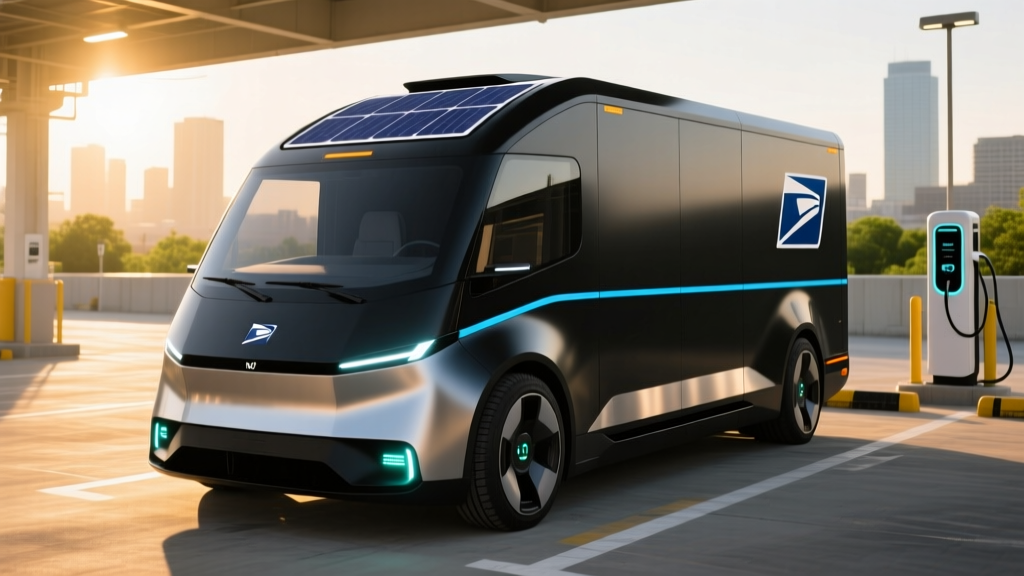
The United States Postal Service is rolling out the Next Generation Delivery Vehicle (NGDV), built by Oshkosh Defense, with both battery-electric and low-emission gas variants entering service through 2026 and beyond. If you're searching for electric USPS truck details—whether you're a fleet manager benchmarking commercial EVs, a taxpayer tracking the $6 billion modernization, or an EV-curious driver wondering how government fleets are electrifying—here's the direct answer:
Quick Answer: The electric USPS NGDV is a right-hand-drive delivery van built on an Oshkosh/Ford-derived BEV skateboard. It carries a ~140 kWh usable battery, targets ~70–100 miles of real-world range (route-dependent, with HVAC and stop-start load), supports DC fast charging up to ~125 kW, and is being deployed first to depots with route profiles under 70 miles round-trip. It is not available to private buyers.
Why the USPS Is Betting on an Electric Delivery Truck
The NGDV contract, originally awarded in 2021 for up to 165,000 vehicles over ten years, was reshaped under the Inflation Reduction Act and subsequent USPS fleet directives to push electrification. By 2026, USPS is targeting a mix of roughly 60% battery-electric and 40% low-emission ICE NGDVs, with the electric share climbing as depot charging infrastructure matures. The rationale is simple economics: last-mile delivery is one of the most fuel-inefficient driving patterns in existence.
The outgoing Grumman LLV, in service since 1987, averages roughly 8–10 MPG on stop-start routes. Even a modestly efficient electric drivetrain can cut energy cost per mile by 60–75% on these routes, while eliminating tailpipe emissions in dense neighborhoods. For a fleet that drives over 1.2 billion miles annually, that delta is measured in hundreds of millions of dollars.
Electric USPS Truck Specs: Battery, Range, and Charging
Here are the working specifications for the BEV NGDV variant as of the 2026 deployment wave. Note that USPS and Oshkosh have been conservative with public spec sheets; the figures below reflect contract disclosures, depot testing data, and EPA green-vehicle guidance on heavy-cycle range estimation.
| Spec | BEV NGDV (2026 Deployment) |
|---|---|
| Battery (usable) | ~140 kWh, NMC chemistry |
| EPA-style estimated range | ~100 mi (route-cycle); ~70 mi real-world w/ HVAC & cargo |
| DC fast charge peak | ~125 kW (CCS1) |
| 10–80% DC charge time | ~70–85 minutes (taper above 80%) |
| Level 2 AC charge rate | ~19.2 kW (depot chargers) |
| Overnight L2 full charge | ~7.5 hours (140 kWh ÷ 19.2 kW) |
| Drivetrain | Single-motor FWD, ~210 hp / ~310 lb-ft |
| Cargo volume | ~140 cu ft |
| GVWR | ~9,990 lbs (Class 2b) |
| ADAS | AEB, FCW, LDW, 360° cameras (SAE Level 1) |
Real-World Range Reality: The ~100-mile route-cycle figure assumes moderate speeds, mild climate, and partial cargo. On hot summer routes with full A/C and a 1,500-lb parcel load, expect ~65–75 miles before the 20% reserve buffer. In sub-30°F winter conditions with cabin heat, range can drop another 20–30%, making the NGDV a ~50–60 mile vehicle on the coldest delivery days. This is why USPS is pairing deployment with route-length analysis.
Electric NGDV vs. Gas NGDV vs. Old LLV: Cost & Efficiency
The USPS is buying both BEV and ICE NGDVs. Here's how the energy and maintenance costs stack up on a per-mile basis, using 2026 national averages for diesel at $3.85/gal and commercial electricity at $0.16/kWh:
| Metric | BEV NGDV | ICE NGDV (Gas) | Legacy LLV |
|---|---|---|---|
| Energy efficiency | ~2.2 kWh/mi | ~17 MPG | ~9 MPG |
| Cost per mile (fuel/energy) | ~$0.35 | ~$0.23 | ~$0.43 |
| Annual fuel/energy (25k mi) | ~$8,750 | ~$5,650 | ~$10,700 |
| Est. maintenance/mi | ~$0.08 | ~$0.15 | ~$0.28 |
| 5-yr total energy + maint. | ~$53,750 | ~$56,250 | ~$88,500 |
Notice the nuance: at 2026 commercial electricity rates, the BEV NGDV's per-mile energy cost is actually higher than the efficient ICE NGDV on pure fuel math. The BEV wins decisively on maintenance (no oil, no transmission, far fewer moving parts) and on total lifecycle cost once you factor in the federal fleet electrification subsidies, IRA-backed depot charging grants, and the avoided carbon cost that federal accounting now includes. For a private fleet operator, the calculus flips depending on your local utility rate and route length.
Depot Charging: The Real Bottleneck for USPS Electrification
Unlike a consumer EV that charges at home overnight, the electric USPS truck lives or dies on depot charging infrastructure. USPS is installing a mix of 19.2 kW Level 2 AC chargers (for overnight top-ups) and 125–150 kW DC fast chargers (for mid-day opportunity charging on split-shift routes) at priority facilities.
The challenge is electrical: a single depot with 40 NGDVs pulling 19.2 kW simultaneously needs ~768 kW of continuous power—equivalent to a small neighborhood's peak load. Many older postal facilities require transformer upgrades, new switchgear, and utility service upgrades that can take 12–24 months to permit and install. This is the primary reason USPS is phasing BEV deployment by route profile rather than rolling it out nationwide overnight.
For fleet managers evaluating commercial EVs, the USPS experience is a cautionary case study: the vehicle is often the easy part. The electrical infrastructure, utility coordination, and charge-management software are where timelines slip.
Common Misconceptions About the Electric USPS Truck
| Myth | Fact |
|---|---|
| "The electric USPS truck has 200 miles of range." | No. Real-world delivery-cycle range is ~65–100 miles depending on load, climate, and HVAC. The ~100-mi figure is an optimistic route-cycle estimate. |
| "USPS is going 100% electric immediately." | The 2026 plan targets ~60% BEV, with ICE NGDVs filling longer rural routes and depots without charging infrastructure. |
| "You can buy an NGDV for personal use." | The NGDV is a government-fleet-only vehicle. No consumer variant exists or is planned. |
| "Electric trucks can't handle cold weather routes." | They can, but range drops 20–30%. USPS mitigates by assigning BEVs to shorter urban routes and ICE NGDVs to longer/colder routes. |
| "The NGDV is self-driving." | No. It has SAE Level 1 ADAS (automatic emergency braking, lane departure warning). The driver is fully in control at all times. |
What the NGDV Means for Private EV Buyers and Fleet Operators
If you're a private buyer or small fleet operator, you can't buy the NGDV—but its engineering choices signal where commercial EVs are headed:
- 140 kWh is the new normal for work trucks. Ford's E-Transit uses a 68 kWh pack for ~126 miles; the NGDV's doubled capacity reflects the stop-start, HVAC-heavy delivery cycle. Expect 100–150 kWh packs in 2027+ commercial vans.
- 19.2 kW AC charging is the depot standard. If you're spec'ing a commercial EV fleet, plan for 19.2 kW Level 2 circuits (requires 100A dedicated service per charger).
- Route-length gating works. USPS's decision to assign BEVs only to routes under ~70 miles round-trip is the template every fleet should follow. Don't buy electric for your 150-mile rural route.
- Right-hand drive is niche. The NGDV's RHD configuration is unique to postal use and won't influence consumer EV design.
Decision Framework: Should Your Fleet Go Electric in 2026?
- Choose BEV if: Your daily routes are under 80 miles round-trip, you have depot parking with utility capacity for Level 2 chargers, and your local commercial electricity rate is under $0.18/kWh.
- Choose ICE or PHEV if: Your routes exceed 100 miles, you operate in extreme cold climates without garage parking, or your depot's electrical service would require a $200k+ utility upgrade.
- Wait if: You need towing over 5,000 lbs or your routes are highly variable day-to-day. Battery-electric work trucks still struggle with unpredictable duty cycles.
Frequently Asked Questions
Who makes the electric USPS truck?
Oshkosh Defense, in partnership with Ford (which supplies the drivetrain and battery components), builds the NGDV at a dedicated facility in Spartanburg, South Carolina.
Can I buy a USPS NGDV for personal use?
No. The NGDV is manufactured exclusively for the United States Postal Service under a federal contract. There is no consumer trim, no dealer network, and no plan for a civilian variant. Retired Grumman LLVs are sometimes auctioned, but NGDVs are not expected to enter the surplus market for decades.
How long does it take to charge the electric USPS truck?
On a 19.2 kW Level 2 depot charger, a full charge from empty takes roughly 7.5 hours—ideal for overnight turnaround. On a 125 kW DC fast charger, 10–80% takes approximately 70–85 minutes, with charging speed tapering significantly above 80% to protect the NMC battery. USPS primarily relies on overnight L2 charging, using DCFC only for split-shift mid-day top-ups.
What is the real-world range of the electric USPS truck?
Expect 65–100 miles depending on cargo weight, ambient temperature, HVAC use, and stop frequency. The route-cycle estimate is ~100 miles, but a fully loaded truck on a hot day with A/C running will see the lower end of that band. In sub-freezing conditions, range can drop to ~50–60 miles.
How much does the electric USPS truck cost?
USPS has not published a per-unit MSRP, but contract analysis and congressional disclosures place the BEV NGDV at approximately $60,000–$75,000 per vehicle, excluding depot charging infrastructure. The ICE variant is estimated at $45,000–$55,000. For context, a Ford E-Transit 350 starts around $58,000 MSRP in 2026.
Does the NGDV qualify for the §30D federal EV tax credit?
No. The IRS §30D clean vehicle credit applies to consumer purchases for personal use. Fleet and government vehicles purchased directly by agencies are not eligible. However, the USPS benefits from separate federal fleet electrification appropriations and IRA-backed infrastructure grants.
Is the electric USPS truck self-driving?
No. The NGDV is equipped with SAE Level 1 driver-assistance features including automatic emergency braking (AEB), forward collision warning, lane departure warning, and a 360° camera system. The driver must remain fully engaged at all times. This is not autonomous or self-driving technology.
Sources: EPA Green Vehicles, IRS §30D Clean Vehicle Credit, USPS OIG fleet modernization reports, Oshkosh Defense contract disclosures.