The short answer: Quick electric cars like the Tesla Model 3 Performance (0-60 in 2.9 seconds, EPA 315 miles, ~$52,990) and Hyundai Ioniq 5 N (0-60 in 3.3 seconds, EPA 260 miles, ~$67,500) offer supercar-level acceleration with daily-driver practicality. But expect to pay a $10,000-$25,000 premium over base trims, sacrifice 10-15% of range versus efficiency-focused variants, and face higher insurance costs. If you can charge at home and your daily driving is under 200 miles, a quick EV delivers thrilling performance with lower per-mile energy costs than any gas equivalent. If you frequently road-trip in cold climates or rely solely on public charging, the speed premium may not justify the range trade-off.
The Real Cost of Quick EVs: Purchase Price, Energy, and Ownership
Performance EVs carry a noticeable premium, but the total cost of ownership picture is more nuanced than the sticker price alone. Let's look at what you actually spend over five years.
| Cost Factor | Tesla Model 3 Performance | BMW M340i xDrive (Gas) | Hyundai Ioniq 5 N |
|---|---|---|---|
| Base MSRP (2026) | $52,990 | $58,700 | $67,500 |
| Federal Tax Credit (§30D) | Up to $7,500 (income/MSRP/sourcing rules apply) | $0 | $0 (MSRP exceeds $55k car cap) |
| Effective Purchase Price | ~$45,490 | $58,700 | $67,500 |
| Annual Energy/Fuel (12k miles) | ~$540 (home charging, $0.13/kWh) | ~$1,800 (premium, $3.50/gal, 26 MPG) | ~$620 (home charging) |
| 5-Year Energy/Fuel Total | ~$2,700 | ~$9,000 | ~$3,100 |
| Annual Insurance (avg) | ~$2,400 | ~$1,900 | ~$2,800 |
| 5-Year Maintenance | ~$1,200 | ~$4,500 | ~$1,500 |
| 5-Year Total Cost | ~$61,390 | ~$81,700 | ~$86,100 |
The Model 3 Performance wins on total cost thanks to the §30D credit and low energy costs. The Ioniq 5 N, positioned as a track-capable performance SUV, costs more upfront and doesn't qualify for the federal credit because its MSRP exceeds the IRS §30D $55,000 cap for sedans/hatchbacks (it's classified as an SUV, where the cap is $80,000 — but its battery sourcing may not meet critical minerals requirements). Always verify current-year eligibility on IRS.gov before counting on the credit.
Performance Specs: 0-60 Times, Range, and Charging Speed
Quick EVs leverage instant electric torque to hit 0-60 mph times that rival six-figure supercars. But performance comes with range and charging trade-offs you should understand.
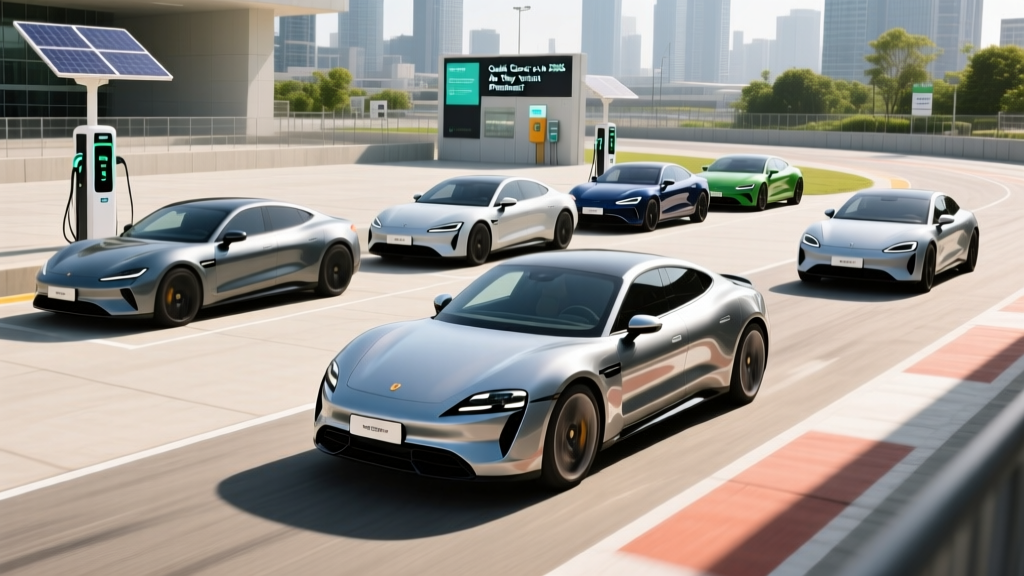
| Spec | Tesla Model 3 Performance | Porsche Taycan 4S | Hyundai Ioniq 5 N | BMW M3 Competition (Gas) |
|---|---|---|---|---|
| 0-60 mph | 2.9 sec | 3.8 sec | 3.3 sec | 3.5 sec |
| Horsepower | 510 hp | 562 hp | 641 hp (N Grin Boost) | 503 hp |
| EPA Range | 315 miles | 246 miles | 260 miles | ~350 miles (gas tank) |
| Battery Capacity | 82 kWh (NMC) | 105 kWh (NMC, 2026 refresh) | 84 kWh (NMC) | N/A |
| Peak DC Charge Rate | 250 kW | 320 kW | 240 kW | N/A |
| 10-80% DC Charge Time | ~25 min | ~18 min | ~18 min | 5 min (gas fill) |
| Efficiency (MPGe) | 121 MPGe | 87 MPGe | 97 MPGe | 19 MPG combined |
Real-world range reality: The EPA 315-mile figure for the Model 3 Performance assumes mixed driving at moderate temperatures. Expect 250-270 miles on a highway road trip at 75 mph, and as little as 210-230 miles in sub-freezing weather (battery chemistry loses 15-30% capacity in cold, plus cabin heating draws significant energy). The Ioniq 5 N's 260-mile EPA rating drops to roughly 200-220 miles highway, and aggressive track driving can deplete the battery in under 100 miles.
Charging speed matters more than peak kW numbers suggest. The Porsche Taycan's 320 kW peak is impressive, but it sustains high charge rates longer due to its 800-volt architecture, meaning real 10-80% times beat the spec sheet. The Model 3 and Ioniq 5 use 400-volt systems that peak early and taper more aggressively above 60% state of charge. On a road trip, the Taycan's charging curve advantage translates to 5-7 fewer minutes per stop.
EV vs Gas Performance Cars: The Comparison That Matters
The traditional argument against electric performance cars was weight and handling. That gap has narrowed significantly. The Model 3 Performance weighs 4,065 lbs — heavy by sports sedan standards, but Tesla's adaptive dampers and low center of gravity (battery pack mounted under the floor) deliver cornering that feels more agile than the number suggests.
The BMW M3 Competition, by contrast, weighs 3,840 lbs and offers sharper steering feedback and a more engaging driver experience on twisty back roads. But it can't match the Tesla's instant torque delivery. At a stoplight, the Model 3 Performance walks away from the M3 for the first 60 mph; past 100 mph, the BMW's power advantage and lighter weight let it catch up.
For most daily driving — highway merges, city acceleration, passing maneuvers — the EV's instant torque is more useful than peak horsepower. You access 100% of an electric motor's torque from 0 RPM, with no turbo lag, no transmission downshift delay, no waiting for the engine to hit its power band.
Home Charging, Climate, and Real Ownership Considerations
Quick EVs demand robust home charging to realize their convenience advantage. Here's what you need to know before buying.
Home charging requirements: A Level 2 home charger (240V, 40-48 amps) adds roughly 30-44 miles of range per hour of charging. For a Model 3 Performance with a depleted battery, a full overnight charge (8-10 hours) restores 100% of range. Installation costs range from $500-$2,500 depending on your electrical panel capacity and the distance from panel to garage. If your home has a 100-amp panel, you may need a $1,500-$3,000 upgrade to 200 amps — get a quote from a licensed electrician before committing to the car.
Apartment dwellers and street parkers: If you can't install home charging, a quick EV becomes significantly less convenient. Public DC fast charging works (10-80% in 18-25 minutes), but relying on it daily adds time, cost (DC fast charging runs $0.30-$0.50/kWh vs $0.13/kWh at home), and wear on the battery. Consider whether your lifestyle supports EV ownership before prioritizing performance.
Cold climate impact: In temperatures below 32°F, expect 15-30% range loss due to battery chemistry limitations and cabin heating demands. The Model 3's heat pump (standard equipment) mitigates this better than resistive heating systems, but physics wins in extreme cold. If you live in Minnesota or Maine and frequently drive 200+ miles in winter, a quick EV's reduced range may push you into charging-anxiety territory.
Driving patterns: Quick EVs shine in stop-and-go traffic (regenerative braking recovers energy) and short-to-medium commutes. If your daily driving is under 150 miles and you charge at home overnight, you'll start every day with a full "tank" and never visit a gas station. If you regularly drive 300+ miles in a day, plan for one or two 20-30 minute DC fast charging stops.
Common Misconceptions About Quick Electric Cars
| Myth | Fact |
|---|---|
| "EV batteries degrade quickly and cost $20,000 to replace" | Modern NMC batteries lose 10-15% capacity over 8-10 years. Federal law mandates 8-year/100,000-mile battery warranties (capacity retention above 70%). Most owners never replace the battery. |
| "Quick EVs can't handle long road trips" | A Model 3 Performance can cover 600 miles in a day with two 25-minute charging stops. The Tesla Supercharger network has 50,000+ global connectors. Road trips require planning but are entirely feasible. |
| "Electric cars are slow once you're above 60 mph" | EVs do lose some acceleration advantage at high speeds (no multi-gear transmission), but the Model 3 Performance hits 100 mph in under 8 seconds. For legal highway driving, EVs have more than enough power. |
| "You'll save money immediately with an EV" | Upfront cost is higher (even after tax credits), and insurance premiums run 15-25% more for performance EVs. Savings accumulate over 3-5 years through lower fuel and maintenance costs. |
| "All quick EVs qualify for the $7,500 federal tax credit" | The §30D credit has MSRP caps ($55k for cars, $80k for SUVs/trucks), income limits ($150k single/$300k joint), and battery sourcing requirements. Many performance EVs exceed the MSRP cap or fail sourcing rules. |
Decision Framework: Should You Buy a Quick Electric Car?
Buy a quick EV if:
- You can install Level 2 home charging (garage or driveway with 240V access)
- Your daily driving is under 200 miles, and you're willing to plan road-trip charging
- You value instant torque and quiet, smooth acceleration over engine sound and manual shifting
- You qualify for the §30D tax credit (check income limits and vehicle eligibility on IRS.gov)
- You're replacing a gas performance car and want lower per-mile energy costs
Consider a gas or hybrid performance car instead if:
- You live in an apartment or park on the street with no charging access
- You frequently drive 300+ miles in a day, especially in cold climates
- You prioritize steering feel, lightweight handling, and track-day durability over straight-line acceleration
- The $10,000-$25,000 performance premium doesn't fit your budget
- You want a manual transmission or the engagement of a high-revving gas engine
Consider a non-performance EV if:
- You want EV benefits (low running costs, instant torque, home charging) but don't need sub-4-second 0-60 times
- Maximizing range and minimizing purchase price matter more than acceleration (a base Model 3 Long Range hits 0-60 in 4.9 seconds, costs ~$42,990, and delivers 363 miles EPA range)
- Insurance costs for performance variants strain your budget
Frequently Asked Questions
Do quick electric cars have enough range for road trips?
Yes, with planning. The Model 3 Performance's 315-mile EPA range (expect 250-270 real-world highway miles) means you'll stop every 200-240 miles to charge for 20-25 minutes. On a 600-mile trip, that's two charging stops adding roughly 45 minutes total. Use apps like A Better Routeplanner to map charging before you leave.
Will launching my EV hard damage the battery?
Occasional hard acceleration won't harm modern EV batteries — they're engineered for high-current discharge. But repeated track use (like the Ioniq 5 N's N Grin Boost mode) generates significant heat, which accelerates long-term degradation. If you plan frequent track days, expect slightly faster capacity loss and monitor battery health via the car's state-of-health readout.
Are quick EVs more expensive to insure?
Yes. Performance variants typically cost 15-25% more to insure than base models due to higher repair costs, greater horsepower, and driver demographics. Get insurance quotes before buying — the difference can be $400-$800 per year.
Do I need a special charger for a quick EV?
No. Quick EVs use the same charging hardware as standard models. A 48-amp Level 2 home charger (hardwired, 240V) works for all current EVs and costs $500-$800 for the unit plus $500-$1,500 for installation. DC fast charging uses public infrastructure — no special equipment needed.
Which quick EV offers the best value?
The Tesla Model 3 Performance delivers the best combination of acceleration (2.9 seconds), range (315 miles EPA), charging infrastructure access (Tesla Superchargers), and effective price (~$45,490 after the §30D credit, if you qualify). The Hyundai Ioniq 5 N is more engaging to drive but costs $20,000 more and sacrifices range. The Porsche Taycan 4S offers prestige and superior charging speed but starts at $90,000+.
Quick electric cars in 2026 deliver performance that would have seemed impossible a decade ago, with daily-driver practicality and lower running costs than gas equivalents. But they demand home charging access, realistic range expectations, and a willingness to pay a performance premium. If those boxes check out, a quick EV offers the most accessible supercar-level acceleration ever built — and you'll never pay for an oil change again.