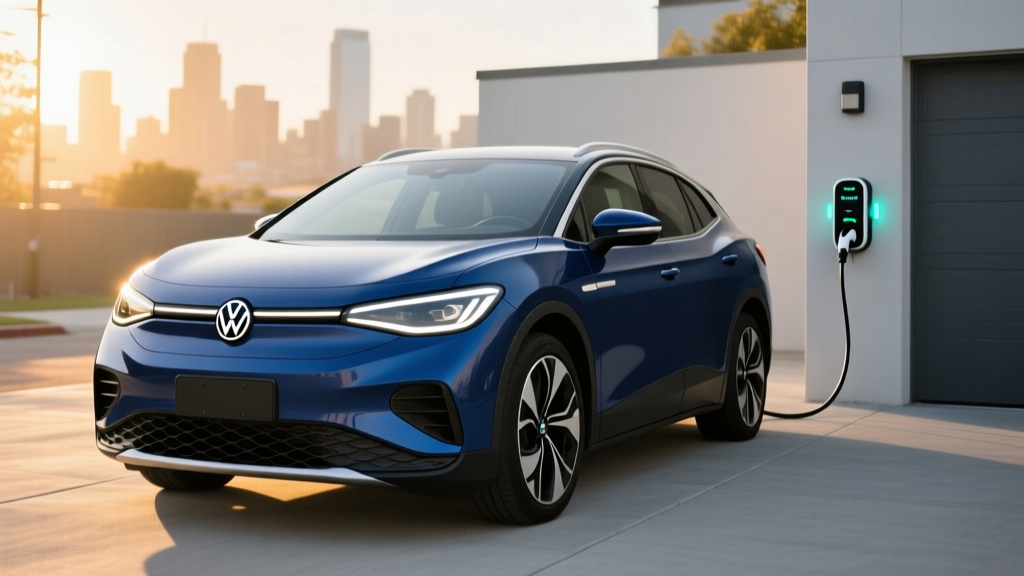
The Volkswagen ID.4 occupies a rare sweet spot in the compact electric SUV segment: it is spacious enough for a young family, priced aggressively after incentives, and backed by one of the longest battery warranties in the business. But with aggressive lease cash and shifting federal tax credit rules, finding the best ID.4 deals requires knowing exactly which trim to target, which incentives stack, and where the vehicle's real-world limitations lie. This review gives you the exact numbers you need to negotiate.
2026 VW ID.4 At a Glance: Specs That Matter
| Spec | Standard Range (RWD) | Pro / Pro S (RWD) | AWD Pro / Pro S |
|---|---|---|---|
| EPA Range | 206 mi | 291 mi | 263 mi |
| Battery (usable) | 62 kWh (NMC) | 82 kWh (NMC) | 82 kWh (NMC) |
| Horsepower | 201 hp | 282 hp | 335 hp |
| 0–60 mph | ~8.5 sec | ~7.0 sec | ~5.4 sec |
| Max DC Fast Charge | 140 kW | 170 kW | 170 kW |
| 10–80% DCFC Time | ~28 min | ~28 min | ~28 min |
| Level 2 Home Charging | 10.8 kW (~37 mi/hr) | 11 kW (~37 mi/hr) | 11 kW (~37 mi/hr) |
| Combined MPGe | 99 MPGe | 104 MPGe | 98 MPGe |
| Base MSRP | ~$39,735 | ~$43,735 | ~$47,735 |
Sources: EPA fueleconomy.gov, Volkswagen USA. MSRP excludes destination; specs reflect 2026 model year.
Real-World Range vs. the EPA Sticker
EPA Estimate: 291 miles (Pro RWD with 82 kWh battery)
Real-World Expectation: ~240–260 mi on highway road trips (70+ mph); ~200–220 mi in cold weather (below 30°F with cabin heat). City and suburban driving with regen braking gets you closest to the 291-mi sticker.
The ID.4 Pro's 291-mile EPA rating is legitimate for mixed suburban driving, but EV range is a moving target. On a flat 70-mph highway loop in mild weather (65°F), expect the ID.4 Pro to deliver roughly 250–260 miles before you need to plug in. Push speeds to 80 mph or tackle mountain grades, and that shrinks toward 220 miles.
Cold weather is the ID.4's Achilles' heel. The SUV uses a resistance heater in many configurations rather than a full heat pump (standard on AWD trims, optional or absent on some RWD builds). In sub-freezing temperatures, plan for 25–30% range loss — meaning a 291-mile car becomes a ~200-mile car. If you live in the northern tier, the AWD model's heat pump is worth the premium for efficiency alone, not just traction.
The Standard Range model's 206-mile EPA rating is honest but limiting. Real-world highway range drops to roughly 165–175 miles, making it strictly a commuter and city vehicle. For road trips, you will be stopping every 2 hours.
Charging Speed: DC Fast and Home Level 2
Volkswagen rates the ID.4 Pro and AWD models at a peak 170 kW on DC fast chargers. The Standard Range model peaks at 140 kW. Here is what that actually means at the plug:
| Charging Level | Power (kW) | Speed (miles of range per hour) | Notes |
|---|---|---|---|
| Level 1 (120V household) | ~1.2 kW | ~3–4 mi/hr | Emergency/trickle only |
| Level 2 (240V home) | 10.8–11 kW | ~35–37 mi/hr | Full charge overnight (~8–9 hrs for 82 kWh) |
| DC Fast Charge (Pro/AWD) | Peak 170 kW | ~650+ mi/hr at peak | 10–80% in ~28 min; tapers above 80% |
| DC Fast Charge (Std Range) | Peak 140 kW | ~500+ mi/hr at peak | 10–80% in ~28 min |
A critical nuance: kW is power (how fast energy flows), kWh is energy (battery capacity). The ID.4's 82 kWh battery charged at a sustained 170 kW would fill in under 30 minutes — but no EV sustains peak rate. The ID.4 holds close to 170 kW from roughly 10–30% State of Charge (SoC), then steps down through the curve. From 80–100%, charging slows dramatically to protect battery health, adding 15–20 minutes for that final 20%. Plan road-trip stops around the 10–80% window for the best time efficiency.
At home on a 48-amp Level 2 charger (the most common residential setup on a 60-amp circuit), the ID.4 adds about 37 miles of range per hour. A full overnight charge from 10% takes roughly 8.5 hours for the 82 kWh pack. Home charging installation typically costs $800–$2,000 depending on panel capacity and run length — budget accordingly.
Performance, Drivetrain, and Daily Driving
The ID.4 is not a performance SUV, and it does not pretend to be. The rear-wheel-drive Pro model's 282 hp and ~7.0-second 0–60 time are adequate for merging and passing, with the instant torque characteristic of all EVs making it feel quicker in city driving than the stopwatch suggests.
The AWD variant, with dual motors producing 335 hp and a 5.4-second 0–60, transforms the character of the car. It is genuinely quick, and the added front motor provides confident traction in rain and snow. The AWD model also gains a heat pump as standard equipment, improving cold-weather efficiency and cabin warm-up times.
Ride quality is a strength. The ID.4's suspension tuning is compliant and well-damped, absorbing highway expansion joints and broken pavement without crashing through to the cabin. Steering is light and numb — this is a comfort-oriented SUV, not a canyon carver. The turning circle is tight (31.5 ft curb-to-curb), making it easy to park in urban environments.
Regenerative braking deserves a callout: the ID.4 offers adjustable regen via steering-wheel paddles, but it does not offer true one-pedal driving to a full stop in the default mode. Some EV drivers accustomed to the strong regen of a Nissan Leaf or Tesla will find the ID.4's coasting behavior unfamiliar. You adapt quickly, but it is a notable calibration choice by VW.
Pricing, Trim Levels, and ID.4 Deals
Volkswagen's 2026 ID.4 lineup breaks down into four main tiers. Here is what you will actually pay, and where the best deals live:
| Trim | Drivetrain | Base MSRP | Est. §30D Credit | Effective Price* |
|---|---|---|---|---|
| Standard Range | RWD | ~$39,735 | Up to $7,500 | ~$32,235 |
| Pro | RWD | ~$43,735 | Up to $7,500 | ~$36,235 |
| Pro S | RWD | ~$47,235 | Up to $7,500 | ~$39,735 |
| AWD Pro | AWD | ~$47,735 | Up to $7,500 | ~$40,235 |
| AWD Pro S Plus | AWD | ~$53,235 | Up to $7,500 | ~$45,735 |
*Effective price assumes full $7,500 federal tax credit via point-of-sale transfer. Actual credit depends on battery-sourcing compliance, buyer income, and MSRP caps. Verify current eligibility at IRS.gov §30D.
Where the deals are: The ID.4 Pro RWD at roughly $36,200 after the federal credit is the value sweet spot. You get 291 miles of range, 282 hp, and a well-equipped cabin. VW has historically offered aggressive lease cash (often $5,000–$7,500 through VW Credit), which can make leasing cheaper than buying in some markets. Compare the lease money factor and residual to the purchase APR — in some cases, a lease with buyout at term-end can undercut the outright purchase price.
Dealer discounts vary regionally. In competitive metro markets (Los Angeles, New York, Atlanta), expect $1,500–$3,000 off MSRP on in-stock units. In lower-volume regions, sticker price is more common. Always negotiate on the out-the-door price before incentives, not after.
Federal Tax Credit Eligibility: §30D Rules
The ID.4 qualifies for the federal clean vehicle credit, but eligibility is not automatic for every buyer. Under current IRS §30D rules, you must clear several hurdles:
- MSRP Cap: The ID.4, classified as an SUV, must have an MSRP at or below $80,000. All current trims clear this easily.
- Buyer Income Cap: Modified adjusted gross income (MAGI) must not exceed $150,000 (single), $225,000 (head of household), or $300,000 (joint filers).
- Battery Sourcing: A percentage of critical minerals and battery components must be sourced from the U.S. or free-trade-agreement countries. VW has shifted significant battery production to North America (via partnerships with SK On and others), but the exact credit amount (full $7,500 vs. partial $3,750) can shift based on annual sourcing thresholds. Confirm the current sourcing status on the VIN-specific lookup at fueleconomy.gov.
- Point-of-Sale Transfer: You can now transfer the credit to the dealer at purchase, reducing your down payment directly. This is a major cash-flow advantage over waiting for a tax refund.
State and local incentives stack on top. States like Colorado, California, and New Jersey offer additional rebates of $1,000–$5,000. Check your state energy office or AFDC state incentive database for current programs.
Interior, Cargo, and Tech
The ID.4's cabin is roomy and practical. Rear legroom measures 37.6 inches — competitive with the Hyundai Ioniq 5 and Toyota RAV4 — and the flat floor (no transmission tunnel) makes the middle seat usable for adults on shorter trips. Cargo volume is 30.3 cubic feet behind the rear seats and 64.2 cu ft with the 60/40 split folded, enough for a full Costco run or two mountain bikes with wheels removed.
There is no frunk (front trunk), which is a missed opportunity in this segment. The Ioniq 5 and Ford Mustang Mach-E both offer front storage for charging cables or a bag of groceries.
Infotainment runs on VW's latest ID. Software 4.0, a meaningful improvement over the laggy, frustrating ID. Software 2.x that plagued early 2021–2023 models. The 12.9-inch center display is responsive, the menu logic is cleaner, and wireless Apple CarPlay and Android Auto are standard. The capacitive-touch slider controls for volume and climate remain a complaint — they are unlit at night and lack tactile feedback. Physical buttons would be a significant quality-of-life improvement.
Driver assistance comes via VW's IQ.DRIVE suite, which includes adaptive cruise control with stop-and-go, lane centering, and emergency braking. This is a SAE Level 2 system — meaning you must keep your hands on the wheel and eyes on the road at all times. It is not self-driving. The lane centering is competent on highways but can hunt in faded lane markings. It does not match the hands-free confidence of GM's Super Cruise or Ford's BlueCruise on mapped highways.
Warranty and Long-Term Ownership
Volkswagen backs the ID.4 with one of the most comprehensive EV warranties available:
- Battery: 8 years / 100,000 miles, guaranteed to retain at least 70% of original capacity
- Powertrain: 8 years / 100,000 miles
- Bumper-to-Bumper: 4 years / 50,000 miles
- Roadside Assistance: 3 years / 36,000 miles
The 70% capacity retention threshold is standard for the industry (matching Tesla, Hyundai, and Ford). Real-world degradation data from 2021–2024 ID.4 owners suggests the 82 kWh NMC packs are losing roughly 2–4% capacity per year under normal use — meaning most owners will retain 85%+ capacity at the 8-year mark, well above the warranty floor.
The ID.4 has earned strong safety marks: a 5-Star Overall rating from NHTSA and an IIHS Top Safety Pick+ designation (when equipped with specific headlights). These are critical data points for family buyers.
Pros and Cons: The Honest Scorecard
- Class-leading rear-seat and cargo space
- 291-mi EPA range (Pro RWD) is genuinely road-trip capable
- Competitive pricing after federal + state incentives
- Strong 8-yr/100k-mi battery and powertrain warranty
- Comfortable, compliant ride quality
- Top Safety Pick+ from IIHS; 5-star NHTSA
- Improved ID. Software 4.0 infotainment
- No front trunk (frunk)
- Capacitive-touch sliders are frustrating, unlit at night
- No true one-pedal driving in default mode
- Heat pump not standard on all RWD trims (cold-weather efficiency hit)
- Charging speed (170 kW peak) trails Hyundai/Kia's 800V architecture (~240 kW)
- Steering feel is numb; not engaging for enthusiasts
How the ID.4 Stacks Up Against Key Rivals
| Attribute | VW ID.4 Pro | Hyundai Ioniq 5 SEL | Tesla Model Y LR | Ford Mach-E Premium |
|---|---|---|---|---|
| EPA Range | 291 mi | 303 mi | 320 mi | 290 mi |
| Peak DCFC | 170 kW | 240 kW (800V) | 250 kW | 150 kW |
| 10–80% Time | ~28 min | ~18 min | ~25 min | ~35 min |
| Cargo (rear seats up) | 30.3 cu ft | 27.2 cu ft | 30.2 cu ft | 29.7 cu ft |
| Base MSRP (approx.) | $43,735 | $46,650 | $46,630 | $48,995 |
| Heat Pump | AWD only | Standard | Standard | Standard |
The ID.4 wins on: interior volume, starting price, and warranty length. It is the most affordable entry point into a 290+ mile electric SUV with a full-size back seat.
The ID.4 loses on: DC fast-charge speed (the Ioniq 5's 18-minute 10–80% session is a road-trip game-changer) and software polish (Tesla's interface remains the benchmark). If you road-trip frequently and prioritize short charging stops, the Ioniq 5 or Model Y serve you better.
Who Should Buy the ID.4?
⚠️ Look Elsewhere If: You take frequent 400+ mile road trips (the Ioniq 5's faster charging saves hours), you live in a frigid climate without access to the AWD/heat-pump trim, or you demand cutting-edge tech and hands-free driving features (look at the Mach-E with BlueCruise or Model Y with FSD Supervised).
Frequently Asked Questions
What is the real-world range of the VW ID.4?
The ID.4 Pro RWD is EPA-rated at 291 miles. In real-world highway driving at 70 mph in mild weather, expect 250–260 miles. In cold weather (below 30°F), plan for 200–220 miles due to battery resistance and cabin heating demands. The Standard Range model delivers roughly 165–175 real-world highway miles.
How fast does the ID.4 charge at home and on the road?
On a DC fast charger, the ID.4 Pro and AWD models peak at 170 kW, reaching 10–80% in approximately 28 minutes. At home on a Level 2 (240V, 48-amp) charger, the ID.4 charges at up to 11 kW, adding roughly 37 miles of range per hour — a full overnight charge takes about 8.5 hours for the 82 kWh battery.
How much does the ID.4 cost after the federal tax credit?
With the full $7,500 federal §30D credit applied at point of sale, the ID.4 Pro RWD drops from ~$43,735 to approximately $36,235. The Standard Range model can fall to ~$32,235. Eligibility depends on buyer income caps ($150K single / $300K joint), MSRP limits ($80K for SUVs), and current battery-sourcing compliance. Always verify at IRS.gov before purchasing.
Does the VW ID.4 qualify for the federal EV tax credit?
Yes, the ID.4 currently qualifies, but the exact amount ($3,750 or $7,500) depends on battery component and critical-mineral sourcing requirements that update annually. The MSRP and buyer-income thresholds are easily met by all trims and most buyers. Check the VIN-specific eligibility tool at fueleconomy.gov for the most current determination.
Is the ID.4 worth buying vs. the Ioniq 5 or Model Y?
It depends on your priorities. The ID.4 offers the most interior space and the lowest effective price after incentives, making it the value leader. The Hyundai Ioniq 5 charges significantly faster (18 min vs. 28 min, 10–80%), which matters for road-trippers. The Tesla Model Y offers the longest range (320 mi) and best software/Supercharger network access. If price and cabin space are your top criteria, the ID.4 is the strongest choice.
What are the biggest drawbacks of the ID.4?
The most common owner complaints center on the capacitive-touch climate and volume sliders (unlit, imprecise), the lack of a front trunk, and the absence of true one-pedal driving. DC fast-charge speed (170 kW) also trails rivals with 800-volt architectures. The heat pump is not standard on all RWD trims, which hurts cold-weather efficiency unless you opt for AWD.