The Short Answer: Cayenne EV Interior & Ownership
The 2026 Porsche Cayenne EV interior centers on a curved 14.25-inch digital instrument cluster, a 12.6-inch curved center touchscreen, and an available 10.9-inch front-passenger display — all housed behind a flat floor that unlocks more rear legroom and cargo versatility than the outgoing gas Cayenne. Expect roughly 300–310 miles of EPA range, 800V architecture supporting up to ~270 kW peak DC fast charging (10–80% in approximately 22 minutes), and a starting MSRP near $89,000 before incentives. Real-world highway range will land closer to 250–270 miles at 75 mph, with further loss in sub-freezing climates.
Inside the 2026 Cayenne EV: Screens, Materials & Layout
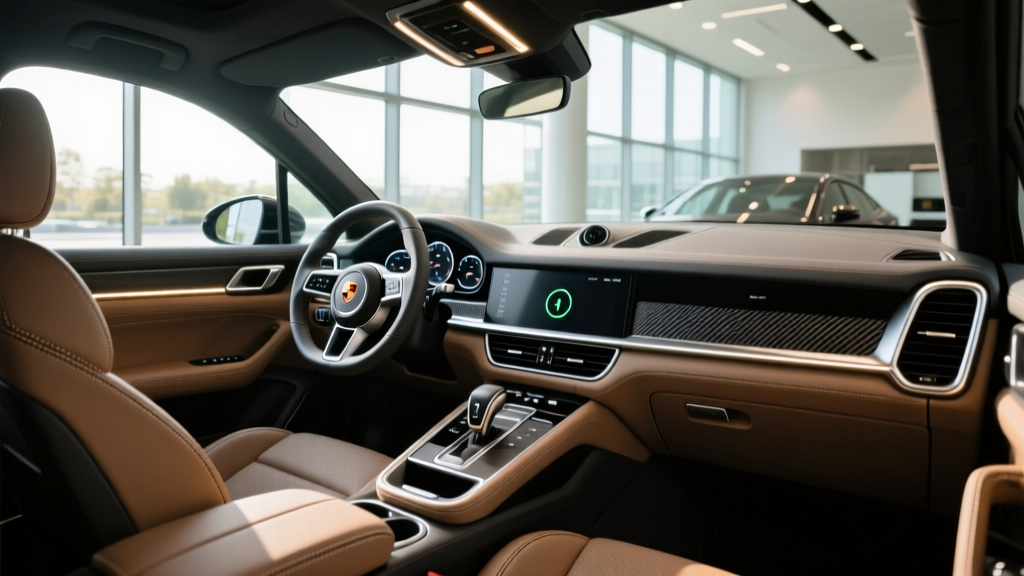
Porsche's electric Cayenne adopts the brand's latest digital cockpit language, moving away from the analog-digital hybrid cluster of the Taycan toward a fully configurable curved display. The driver faces a 14.25-inch screen with configurable drive modes, navigation overlays, and real-time energy-flow graphics. The center stack is dominated by a 12.6-inch curved touchscreen angled toward the driver, controlling climate, media, and vehicle settings. An optional 10.9-inch passenger display lets the front occupant manage entertainment without distracting the driver.
Material quality remains flagship-grade: standard leatherette with available full-grain leather, open-pore wood, and carbon-fiber trim. The flat-floor EV architecture eliminates the gas Cayenne's transmission tunnel, giving rear passengers a more usable center seating position and slightly improved foot room. Cargo volume behind the rear seats is estimated at approximately 26–28 cubic feet, expanding to roughly 60 cubic feet with the 40/20/40 split rear seats folded — competitive with the BMW iX and slightly more practical than the Tesla Model X's sloping roofline design.
Range, Charging & Powertrain: The Numbers That Matter
The 2026 Cayenne EV rides on Porsche's Premium Platform Electric (PPE), co-developed with Audi and shared with the electric Macan. This 800V architecture is the backbone of its charging performance.
| Spec | 2026 Cayenne EV (Base AWD Est.) | Cayenne EV Turbo (Est.) |
|---|---|---|
| Battery (usable) | ~96 kWh, NMC | ~96 kWh, NMC |
| EPA Range | ~300–310 mi | ~270–285 mi |
| Peak DC Fast Charge | ~270 kW | ~270 kW |
| 10–80% DC Time | ~22 min | ~22 min |
| Level 2 AC Charge | 11 kW (std) / 22 kW (opt) | 11 kW (std) / 22 kW (opt) |
| Horsepower | ~402 hp | ~844 hp (Launch Control) |
| 0–60 mph | ~4.7 sec | ~2.5 sec |
| Base MSRP | ~$89,000 | ~$148,000 |
The 800V system means the Cayenne EV can accept peak rates of ~270 kW at a compatible 350 kW DC fast charger (Electrify America, EVgo 350 stations). However, charging curves taper: expect peak rates between 10–40% SoC, with a gradual decline above 60% and a steep drop above 80%. A full 10–80% session takes approximately 22 minutes under ideal thermal conditions. Preconditioning the battery via the navigation-routed charging feature is essential for hitting peak rates — arriving cold at a charger can add 5–10 minutes to your session.
Cayenne EV vs. Gas Cayenne: Cost & Experience Compared
Many shoppers cross-shopping the Cayenne EV are current gas Cayenne owners or are considering the ICE version. Here's how the economics stack up over five years of ownership at 12,000 miles per year.
| Factor | 2026 Cayenne EV (Base) | 2026 Cayenne Gas (Base V6) |
|---|---|---|
| Base MSRP | ~$89,000 | ~$82,000 |
| Fuel/Energy (5 yr) | ~$4,800 (home L2, $0.14/kWh) | ~$14,400 ($4.00/gal, 19 MPG combined) |
| Maintenance (5 yr) | ~$2,500 | ~$5,500 |
| Insurance (5 yr est.) | ~$16,000 | ~$14,000 |
| Federal Tax Credit (§30D) | $0–$7,500 (see below) | $0 |
| Est. 5-Year Total | ~$112,300 (before credit) | ~$115,900 |
The EV variant carries a higher sticker but recoups cost through dramatically lower energy and maintenance expenses. No oil changes, no transmission fluid, and reduced brake wear from regenerative braking keep service visits minimal. Insurance runs higher on the EV due to repair costs and battery valuation — expect quotes 10–15% above the gas model.
Federal Tax Credit: Does the Cayenne EV Qualify?
Under current IRS §30D rules, the Cayenne EV faces several eligibility hurdles:
- MSRP Cap: SUVs must be priced at or below $80,000 to qualify. The base Cayenne EV at ~$89,000 exceeds this threshold — meaning most trims will NOT qualify for the federal credit.
- Buyer Income Limits: Modified AGI caps of $300,000 (joint), $225,000 (head of household), $150,000 (single).
- Battery Sourcing: Critical-mineral and battery-component requirements must be met, with percentages increasing annually through 2029.
- Point-of-Sale Transfer: If eligible, the credit can be applied at purchase rather than claimed on your tax return.
Bottom line: At its projected pricing, the Cayenne EV is unlikely to qualify for the $7,500 federal credit. Consult a tax professional and check the latest IRS guidance before purchase.
Real-World Ownership: Charging, Climate & Daily Use
Owning a Cayenne EV — or any 800V luxury EV — demands realistic planning around your charging situation and driving patterns.
Home Charging: A Level 2 home charger (240V, 48A/11.5 kW) adds roughly 35–40 miles of range per hour of charging. A full overnight session (8 hours) restores ~280–320 miles — enough for virtually any daily commute. Installation costs range from $800–$2,500 depending on panel proximity and whether your home's 200A electrical panel needs an upgrade to support a dedicated 60A circuit. The optional 22 kW onboard charger cuts Level 2 times nearly in half but requires a 100A-capable charger and compatible electrical infrastructure.
Public Charging: The Cayenne EV uses the NACS (Tesla-style) connector as standard for 2026, granting access to Tesla Superchargers with a built-in port — no adapter needed. Combined with Electrify America, EVgo, and other networks, long-distance travel is viable but requires route planning. On a 400-mile trip, expect one 20–25 minute charging stop.
Cold Climate Owners: If you live where winters regularly drop below 30°F, budget 20–30% range loss on short trips where the cabin and battery must heat from cold. Garaging the vehicle and preconditioning while plugged in dramatically reduces this penalty. The standard heat pump is a significant advantage over EVs without one.
Apartment/No-Home-Charging Buyers: Without reliable home or workplace Level 2 access, the Cayenne EV's 22-minute DC fast-charge sessions become a weekly chore rather than a road-trip convenience. Evaluate your local public charging infrastructure honestly before committing.
Decision Framework: Is the Cayenne EV Right for You?
Choose the Cayenne EV if:
- You have home Level 2 charging and drive under 250 miles daily
- You want Porsche driving dynamics with zero tailpipe emissions
- You value the latest digital cockpit and premium interior materials
- You're willing to pay a premium over the gas Cayenne for lower operating costs
Stick with the gas Cayenne or consider a PHEV alternative if:
- You lack home charging access and your area has sparse DC infrastructure
- You regularly tow over 5,000 lbs (EV towing range drops 40–50%)
- The $89,000+ MSRP without tax credit eligibility stretches your budget
- You frequently drive 500+ mile trips in regions with charging deserts
Common Cayenne EV Misconceptions
| Myth | Fact |
|---|---|
| "It charges at 270 kW the entire session" | Peak rate occurs at low SoC (~10–40%); the curve tapers progressively above 60%. Average rate over a 10–80% session is closer to ~180–200 kW. |
| "The Cayenne EV qualifies for the $7,500 tax credit" | At ~$89,000 MSRP, it exceeds the $80,000 SUV cap under current §30D rules. |
| "I'll get 310 miles on the highway" | EPA range is a mixed-cycle estimate. Sustained 75-mph driving yields ~250–270 miles; cold weather drops it further. |
| "EV maintenance is free" | Tires, cabin filters, brake fluid, wiper fluid, and 12V battery replacement still apply. Budget ~$500/year. |
Frequently Asked Questions
Does the Cayenne EV interior have a front trunk (frunk)?
Yes, the PPE platform provides a modest frunk estimated at 3–4 cubic feet — enough for charging cables, a small bag, or groceries. It's smaller than the Taycan's frunk due to the Cayenne's front-axle motor and HVAC packaging.
What is the battery warranty on the 2026 Cayenne EV?
Porsche covers the high-voltage battery for 8 years or 100,000 miles, guaranteeing a minimum of 70% state of health (capacity retention) over that period. This aligns with the federal minimum but falls short of Hyundai/Kia's 10-year/100,000-mile coverage.
Can the Cayenne EV use Tesla Superchargers?
Yes. For 2026, Porsche has adopted the NACS connector as standard, meaning native compatibility with Tesla's Supercharger network — no adapter required. This is a significant advantage over CCS-equipped vehicles that need an adapter for Supercharger access.
How does the Cayenne EV compare to the electric Macan?
Both share the PPE platform, but the Cayenne EV is larger, offers more cargo space (~26–28 cu ft vs. ~18 cu ft), and targets a higher price tier. The Macan EV starts around $75,000 and may qualify for the federal tax credit; the Cayenne EV likely will not.
Is the Cayenne EV's interior quieter than the gas version?
Significantly so. Without engine, exhaust, and transmission noise, the EV cabin is noticeably quieter at all speeds. Porsche adds acoustic glass and enhanced sound insulation to manage wind and tire noise, making it one of the quietest luxury SUVs on the market at highway speeds.