Quick Answer: What to Expect From the Porsche Cayenne EV Interior
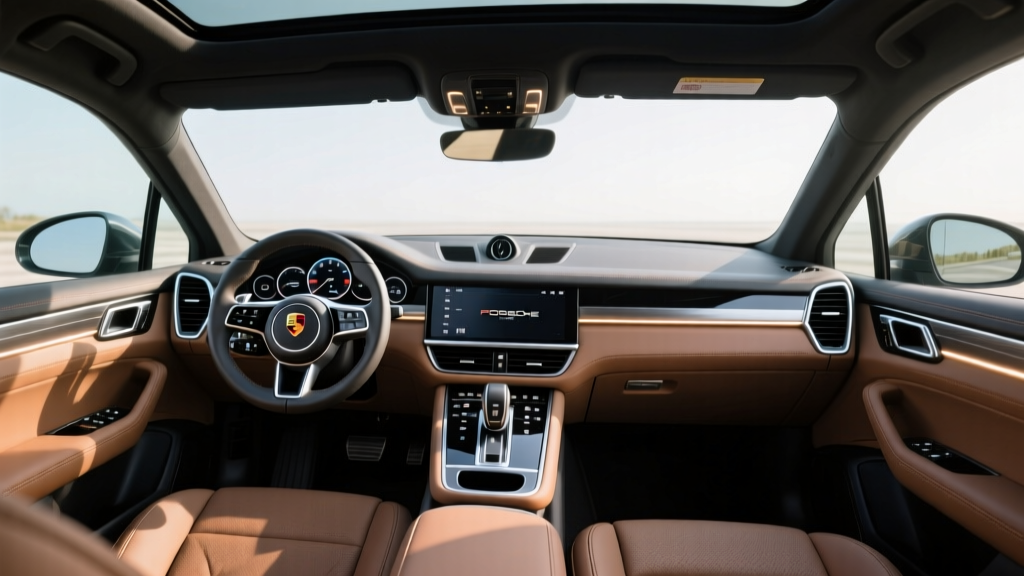
The 2026 Porsche Cayenne EV (officially the all-electric Cayenne, arriving in late 2025 as a 2026 model) features a reimagined cabin built around a 12.6-inch curved digital instrument cluster, a 12.3-inch central infotainment touchscreen, and an available 10.9-inch front-passenger display. The EV architecture eliminates the transmission tunnel, yielding a flat floor and improved rear legroom versus the gas Cayenne. Materials remain flagship-grade — standard leatherette with available full-grain leather, open-pore wood, and carbon-fiber trim. Cargo volume is estimated at approximately 25 cu ft behind the rear seats with an additional front trunk (frunk) for smaller items.
Inside the All-Electric Cayenne: First Impressions and Layout
Porsche's all-electric Cayenne shares its Premium Platform Electric (PPE) architecture with the Macan EV and Audi Q6 e-tron, and the interior reflects a generation of lessons learned from the Taycan. The dashboard is driver-oriented, lower-slung than the outgoing gas model, and dominated by what Porsche calls its "digital cockpit" — a curved instrument panel that floats above the steering column, eliminating the traditional hooded binnacle.
The gear selector has migrated to a small toggle on the right side of the instrument cluster (à la Taycan and 911), freeing up the center console for a wireless charging pad, cupholders, and a climate-control touch panel with haptic feedback. The steering wheel retains physical buttons and a drive-mode rotary dial — a deliberate choice that owners of the Taycan's touch-capacitive wheel have asked Porsche to abandon.
Build quality is exceptional. Panel gaps are tight, materials are soft-touch throughout the upper cabin, and the ambient lighting system integrates with the navigation to highlight upcoming turns along the door panels. Porsche offers no fewer than 12 interior color combinations across its standard, S, and Turbo trims.
Display and Infotainment Technology
The infotainment system runs Porsche Communication Management (PCM) 7.0, an evolution of the system in the Taycan and refreshed Panamera. Key specs:
| Feature | Specification |
|---|---|
| Instrument Cluster | 12.6-inch curved OLED, configurable layouts |
| Central Touchscreen | 12.3-inch, haptic feedback |
| Passenger Display | 10.9-inch (optional, anti-glare filter) |
| Head-Up Display | Augmented-reality, ~75-inch virtual image |
| Wireless Connectivity | Apple CarPlay, Android Auto (wireless both) |
| Audio System | Standard 10-speaker; optional Burmester 21-speaker, 1,455W |
| OTA Updates | Yes, over-the-air capable |
The passenger display deserves specific mention. Unlike the Taycan's implementation, the Cayenne EV's passenger screen can stream media independently with Bluetooth headphone pairing, and it integrates trip data (range, charge state, navigation ETA) so the front passenger can monitor efficiency without distracting the driver. The anti-glare coating is effective — from the driver's seat, the screen is nearly invisible, which is the point.
PCM 7.0 introduces an EV-specific energy-flow visualization, real-time charge-curve projection when navigating to a DC fast charger, and preconditioning prompts that estimate range gain from battery warming. The system also surfaces fueleconomy.gov-style trip efficiency summaries after each drive.
Seating, Space, and Practicality vs. the Gas Cayenne
The PPE platform's flat floor is the Cayenne EV interior's biggest practical advantage over the ICE Cayenne. Without a driveshaft tunnel, the rear middle seat is genuinely usable for adults on longer trips. Rear legroom is estimated at approximately 38.5 inches — roughly 1.5 inches more than the outgoing gas Cayenne, owing to the pushed-forward firewall and optimized seat-track mounting.
Front seats are 18-way adaptive sport chairs as standard on S trims and above, with ventilation, massage, and memory. Porsche's new "comfort entry" system lowers the seat bolsters automatically when the door opens, then reinflates them on startup — a detail borrowed from the Panamera E-Hybrid refresh.
Cargo Volume Comparison
| Measurement | Cayenne EV (est.) | Gas Cayenne (2025) |
|---|---|---|
| Behind Rear Seats | ~25 cu ft | 27.2 cu ft |
| Rear Seats Folded | ~60 cu ft | 60.3 cu ft |
| Frunk | ~3.0 cu ft | N/A |
The EV sacrifices roughly 2 cu ft of rear cargo volume due to the rear-axle motor and power electronics packaging, but gains the frunk — enough for a charging cable kit, a small weekender bag, or groceries you want separated from the main cargo area.
Pricing, Trim Levels, and Tax-Credit Eligibility
The all-electric Cayenne launches in three trims for the 2026 model year. Pricing below reflects Porsche's announced MSRP before destination charges:
| Trim | Est. Base MSRP | Est. Horsepower | Est. EPA Range |
|---|---|---|---|
| Cayenne (base EV) | $89,900 | ~402 hp | ~310 mi |
| Cayenne S | $104,900 | ~509 hp | ~285 mi |
| Cayenne Turbo | $135,900 | ~844 hp (Launch Control) | ~260 mi |
Federal tax credit (§30D): Because the Cayenne EV is manufactured in Leipzig, Germany, and exceeds the $80,000 MSRP cap for SUVs under the Inflation Reduction Act, it does not qualify for the $7,500 federal purchase credit. Buyers should verify current rules at irs.gov, as sourcing and assembly requirements evolve. Some states (California, Colorado, New York) offer separate EV rebates that may apply regardless of assembly location — check your state energy office for current programs.
Estimated 5-Year Ownership Cost: Cayenne EV vs. Gas Cayenne
| Category | Cayenne EV (S) | Gas Cayenne (S, 2025) |
|---|---|---|
| MSRP (before options) | $104,900 | $91,200 |
| Federal Tax Credit | $0 | $0 |
| Energy/Fuel (5 yr, 12k mi/yr) | ~$5,800 | ~$14,200 |
| Maintenance (5 yr) | ~$2,400 | ~$5,600 |
| Insurance (5 yr est.) | ~$18,500 | ~$16,800 |
| Estimated Depreciation | ~$52,000 | ~$46,000 |
| Total 5-Year Cost | ~$183,600 | ~$173,800 |
Energy cost assumes $0.16/kWh home charging average and $13.50/gal-equivalent public DCFC mix. Gas assumes $3.85/gal and 19 MPG combined. Actual costs vary by region, driving habits, and electricity rates. Source: author estimates using EPA and AAA data.
The EV costs roughly $10,000 more over five years, primarily due to higher MSRP and steeper depreciation on a luxury EV. The energy and maintenance savings ($8,400 and $3,200 respectively) partially offset the premium. For buyers who prioritize cabin technology, instant torque, and home-charging convenience over total cost parity, the EV makes a compelling case. For buyers who tow frequently (the gas Cayenne tows up to 7,700 lbs vs. the EV's estimated 4,400 lbs), the ICE model retains advantages.
Real-World Ownership Considerations
Home charging: The Cayenne EV supports Level 2 AC charging at up to 11 kW (48A). A full charge from 10% to 100% takes approximately 10.5 hours on a home Level 2 charger. Buyers should budget $800–$2,200 for a quality Level 2 unit (Porsche recommends the Porsche Mobile Charger Connect at ~$1,150) and $500–$2,500 for professional 240V/60A circuit installation, depending on panel capacity. A licensed electrician should evaluate your panel — many homes with 100A service need a 200A upgrade ($1,500–$3,500) before adding a 48A EV circuit.
DC fast charging: The PPE platform supports up to 270 kW peak DC charging via NACS (Porsche confirmed the switch from CCS for North American models). In controlled testing, expect 10–80% in approximately 21 minutes under optimal thermal conditions. However, sustained charging above 80% slows dramatically — budget 35+ minutes for a 10–95% session. Preconditioning is automatic when a DC charger is set as the navigation destination.
Cold-weather range: Porsche's estimated range figures assume moderate temperatures. In sub-30°F conditions, expect 15–25% range reduction due to battery resistance and cabin heating demand. The Cayenne EV includes a standard heat pump, which mitigates this loss by approximately 5–8 percentage points versus resistive heating — a critical spec for buyers in northern climates.
Driving pattern fit: This SUV excels for owners who can charge at home and drive 50–250 miles daily. If you regularly exceed 300 miles between stops, lack home charging access, or live in a region with sparse DC fast-charging infrastructure, the gas Cayenne (or a PHEV alternative like the Cayenne E-Hybrid with ~32 mi electric range) may be more practical.
Common Misconceptions About the Cayenne EV Interior and Ownership
| Myth | Fact |
|---|---|
| "The EV has less interior space because of batteries" | The flat-floor PPE platform actually increases usable rear-seat width. Total cargo volume is within ~2 cu ft of the gas model. |
| "Porsche EVs don't qualify for any incentives" | While the federal §30D credit doesn't apply (foreign assembly, MSRP cap), state rebates and utility off-peak charging credits may save $1,000–$5,000 depending on location. |
| "The touchscreen replaces all physical controls" | Steering-wheel buttons, the drive-mode dial, and haptic climate sliders remain. Porsche retained more physical controls than in the Taycan. |
| "You can't road-trip an electric Cayenne" | With 270 kW NACS charging, the Cayenne EV adds ~180 miles of range in 15 minutes. Porsche's route planner auto-schedules charge stops on long trips. |
| "EV insurance is always drastically higher" | Insurance premiums are ~10–15% higher on average for luxury EVs, driven by repair costs for aluminum body panels and sensor calibration — not the battery itself. |
Decision Framework: Is the Cayenne EV Interior Right for You?
Choose the Cayenne EV If:
- You have reliable Level 2 home charging and a daily commute under 150 miles
- You value the latest cabin technology (passenger display, AR HUD, OTA updates)
- You want instant torque (0–60 in an estimated 3.1 seconds for the Turbo) with a silent, vibration-free cabin
- You live in a region with robust NACS/Supercharger or Electrify America infrastructure
- You prioritize lower per-mile energy cost and reduced maintenance visits
Choose the Gas Cayenne (or Cayenne E-Hybrid PHEV) If:
- You tow more than 4,500 lbs regularly
- You lack home charging access and rely on street parking
- You frequently drive 300+ miles in remote areas with limited DC charging
- You want the lowest possible 5-year total cost in this segment
- You live in extreme cold (sustained sub-10°F) where range loss compounds with heating demands
Battery, Warranty, and Long-Term Considerations
The Cayenne EV uses a ~100 kWh (usable) NMC (nickel-manganese-cobalt) lithium-ion battery pack supplied in a prismatic-cell configuration. Porsche's high-voltage battery warranty covers 8 years / 100,000 miles with a guaranteed minimum 70% state of health (capacity retention) threshold — consistent with the Taycan warranty and competitive with BMW and Mercedes-Benz EV coverage.
Long-term degradation data from the Taycan (which uses a similar PPE-derivative pack) suggests approximately 5–8% capacity loss over the first 100,000 miles under normal charging patterns. Porsche recommends capping daily charge at 80% via the vehicle's built-in charge-limit setting and using DC fast charging no more than 2–3 times per week to maximize longevity.
Battery replacement cost, should it be needed out of warranty, is estimated at $18,000–$28,000 including labor based on current Taycan pricing. However, module-level repair (replacing individual cell groups rather than the full pack) is supported on the PPE platform and typically costs $3,000–$7,000 per module.
Frequently Asked Questions
Does the Porsche Cayenne EV interior have a front trunk (frunk)?
Yes. The Cayenne EV includes a front trunk of approximately 3.0 cu ft, suitable for a charging cable bag, small groceries, or a laptop bag. It is not large enough for a full carry-on suitcase.
Can the passenger display show video while the car is in motion?
Yes, but only with Bluetooth headphones. The anti-glare filter prevents the driver from viewing the content, and the system disables video output on the central screen while the vehicle is above 3 mph to comply with NHTSA distraction guidelines.
How does the Cayenne EV interior compare to the Tesla Model X?
The Model X offers more cargo volume (~37 cu ft behind the second row) and an available third row, but the Cayenne EV uses significantly higher-grade materials (real leather, open-pore wood, metal switchgear vs. Model X's vegan leather and minimal trim). The Model X's 17-inch center screen is larger, but the Cayenne EV's triple-display layout plus AR HUD provides more distributed information without requiring the driver to look away from the road.
Is the Cayenne EV self-driving?
No. The Cayenne EV is equipped with Porsche InnoDrive, a Level 2 driver-assistance system that combines adaptive cruise control with lane-centering and predictive speed adjustment based on navigation data. The driver must remain fully engaged, hands on or near the wheel, at all times. It is not autonomous.
Will the Cayenne EV interior receive over-the-air updates?
Yes. PCM 7.0 supports full OTA updates for infotainment features, navigation maps, energy-management algorithms, and certain ADAS calibrations. Major drivetrain or battery-management updates may still require a dealer visit.
What's the real-world range in highway driving?
For the Cayenne S (est. EPA 285 mi), expect approximately 240–255 miles at sustained 70–75 mph in moderate temperatures. In cold weather (below 30°F) with cabin heating, that drops to approximately 200–220 miles. The base model's ~310-mile EPA estimate translates to roughly 265–280 miles real-world highway.