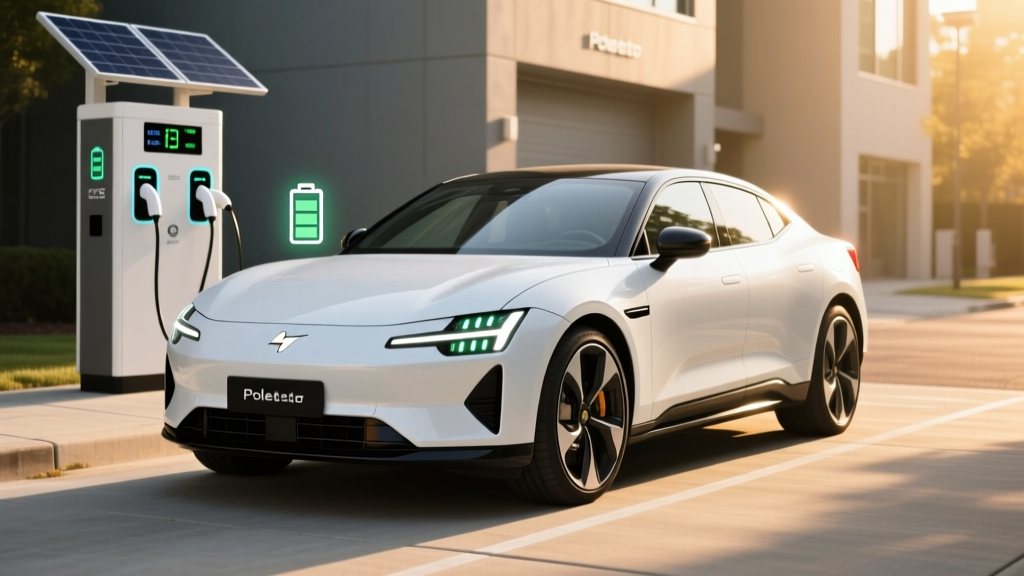
If you are researching a Polestar order in 2026, the Polestar 4 is likely at the top of your list. The midsize electric SUV coupe slots between the compact Polestar 2 and the flagship Polestar 3, targeting buyers who want a performance-oriented crossover with coupe-like styling and a tech-forward cabin. With a unique design that ditches the traditional rear window in favor of a camera-based digital rearview mirror, the Polestar 4 stands out in a crowded segment that includes the Tesla Model Y, BMW iX, and Genesis Electrified GV70.
This guide covers everything you need to know before configuring and submitting your Polestar 4 order — from real-world range expectations and DC fast-charging behavior to federal tax credit eligibility under IRS §30D rules. All specs reflect the 2026 model year.
Polestar 4 at a Glance: Core Specifications
| Spec | Long Range Single Motor | Long Range Dual Motor |
|---|---|---|
| EPA Range (est.) | ~300 miles | ~270 miles |
| Battery Capacity | 100 kWh (usable), NMC | 100 kWh (usable), NMC |
| Drivetrain | RWD | AWD (dual motor) |
| Horsepower | 272 hp | 544 hp |
| 0-60 mph | ~7.1 seconds | ~3.8 seconds |
| Max DC Fast Charge | 200 kW | 200 kW |
| 10-80% DC Charge Time | ~30 minutes | ~30 minutes |
| Level 2 Home Charge Rate | 11 kW (~35 mi/hr) | 11 kW (~35 mi/hr) |
| MPGe (combined, est.) | ~98 MPGe | ~89 MPGe |
| Base MSRP | $59,990 | $65,990 |
Real-World Range: What the EPA Number Doesn't Tell You
EPA Estimated Range: ~300 miles (Single Motor) / ~270 miles (Dual Motor)
Real-World Expectation: Plan for 250-270 miles on sustained highway driving at 70+ mph in the single-motor variant. In cold weather (below 30°F), expect a 15-25% reduction, bringing effective range to roughly 210-250 miles depending on cabin heating use and terrain. The dual-motor AWD variant will see a more pronounced drop on highway runs due to higher energy consumption — budget for 220-240 miles in mixed conditions.
The Polestar 4's 100 kWh (usable) NMC (nickel manganese cobalt) battery pack provides a solid energy buffer. NMC chemistry offers higher energy density than LFP (lithium iron phosphate), which is why Polestar can package this capacity in a relatively sleek platform. However, NMC batteries benefit from staying between 20-80% state of charge for daily use to minimize long-term degradation — reserve 100% charges for road trips.
The heat pump comes standard on all 2026 Polestar 4 trims, which helps mitigate cold-weather range loss compared to EVs without one. In our experience with similar 100 kWh NMC packs in Scandinavian EVs, preconditioning the battery before DC fast charging in winter is essential — without it, peak charge rates can drop significantly below the 200 kW peak.
Charging Speed: DC Fast Charging and Home Level 2
Charging speed is where the Polestar 4's 800-volt architecture shows its value. The 200 kW peak DC fast-charge rate is competitive with the segment, though it falls short of the Hyundai Ioniq 5's 240 kW peak on its E-GMP platform. Here is how charging breaks down across levels:
| Charging Level | Power / Voltage | Speed (Approx.) | Notes |
|---|---|---|---|
| Level 1 (120V household) | ~1.4 kW | ~4-5 miles per hour | Emergency/trickle only |
| Level 2 (240V home) | 11 kW | ~35 miles per hour | Full charge in ~9-10 hours |
| DC Fast Charge | 200 kW peak | 10-80% in ~30 min | Tapers above 80% SoC |
Charging curve reality check: The 200 kW peak is typically sustained between roughly 10-40% state of charge. Beyond 60%, the curve tapers progressively — expect 100-120 kW in the 60-80% band, and below 50 kW once you pass 80%. This is normal behavior for NMC packs with active thermal management, but it means that charging from 80-100% on a road trip adds disproportionately more time. For highway travel, the 10-80% window is your practical fast-charge range.
For home Level 2 charging, the 11 kW onboard charger means you will need a 48-amp or 60-amp dedicated circuit to take full advantage. A full overnight charge (10-100%) takes approximately 9-10 hours, which is adequate for daily replenishment. The Polestar 4 uses the NACS (North American Charging Standard) connector for 2026, granting access to Tesla Supercharger stations via the native port — a significant advantage over CCS-only vehicles now that the Supercharger network dominates DC fast-charging reliability rankings.
Performance and Driving Dynamics
The dual-motor Polestar 4 is a seriously quick SUV. With 544 horsepower and a 3.8-second 0-60 mph time, it outpaces the BMW iX xDrive50 (4.4 seconds) and lands close to the Tesla Model Y Performance (3.5 seconds). The single-motor RWD variant at 272 hp and 7.1 seconds is adequate for commuting and daily driving, though it lacks the urgency of its AWD sibling.
Polestar tunes its chassis with an emphasis on composed, confidence-inspiring handling rather than outright sportiness. The double-wishbone front and multi-link rear suspension, combined with the low center of gravity from the floor-mounted battery pack, deliver flat cornering and minimal body roll. Steering is precise if slightly numb — a common trait in electric SUVs with heavy front ends.
Regenerative braking offers adjustable levels through the infotainment system, including a one-pedal driving mode that brings the car to a complete stop. The brake pedal feel is more consistent than many competitors that struggle with blending regenerative and friction braking.
Interior Space, Cargo, and Technology
The Polestar 4's coupe-SUV silhouette creates a trade-off between style and rear-seat practicality. Here are the key dimensions:
- Cargo volume (rear seats up): ~18.7 cu ft
- Cargo volume (rear seats folded): ~49 cu ft
- Frunk (front trunk): ~0.5 cu ft (small storage compartment for cables)
- Rear legroom: ~37.8 inches
- Front legroom: ~41.3 inches
The cargo area is smaller than the Tesla Model Y (~30 cu ft behind the rear seats) due to the sloping roofline, which will matter for families hauling strollers or bulky gear. Rear headroom is also tighter than boxier SUVs, though the panoramic glass roof helps the cabin feel open.
The digital rearview mirror is the Polestar 4's most talked-about feature. With no traditional rear window, a roof-mounted camera feeds a high-definition display where the rearview mirror would normally sit. The image is clear and wide-angle, and it eliminates the rear blind spot created by headrests and cargo. However, some drivers report a brief adjustment period to the latency and depth perception of the digital feed, especially in heavy rain where the camera lens can accumulate water.
The infotainment system runs on Android Automotive OS with Google built-in (Google Maps, Google Assistant, Google Play Store). The 15.4-inch center touchscreen is responsive, and the 10.2-inch digital driver display is clear. A 14.7-inch heads-up display projects navigation and speed onto the windshield. Wireless Apple CarPlay is supported. The available Harman Kardon or Naim audio systems deliver excellent sound quality.
Driver-assistance features include adaptive cruise control with stop-and-go, lane centering, blind-spot monitoring, and automated emergency braking. Polestar's Pilot Pack offers highway driving assist functionality — this is an SAE Level 2 system, meaning the driver must remain attentive and keep hands on the wheel at all times. It is not autonomous driving.
Pricing, Trims, and Federal Tax Credit Eligibility
The 2026 Polestar 4 lineup starts at $59,990 for the Long Range Single Motor and $65,990 for the Long Range Dual Motor, before destination charges. Key option packages include the Plus Pack (premium audio, heated rear seats, 360-degree camera), the Pilot Pack (enhanced driver assists), and the Nappa Pack (upgraded leather interior with ventilated seats).
| Trim | Base MSRP | As-Tested (Typical) | §30D Credit Potential | Effective Price |
|---|---|---|---|---|
| Long Range Single Motor | $59,990 | $63,500 | Up to $7,500* | ~$56,000 |
| Long Range Dual Motor | $65,990 | $71,000 | Up to $7,500* | ~$63,500 |
*Federal tax credit caveats: Under IRS §30D rules, the full $7,500 credit requires meeting both critical minerals and battery component sourcing thresholds, which shift annually. The Polestar 4's MSRP falls under the $80,000 SUV/truck cap. Buyer income limits apply: modified AGI cannot exceed $150,000 (single), $225,000 (head of household), or $300,000 (joint). The credit can be transferred to the dealer as a point-of-sale discount starting in 2024. Always verify current-year eligibility on fueleconomy.gov and consult a tax professional before relying on credit amounts.
Polestar's manufacturing location (vehicles are produced in China for the US market) has historically complicated battery-sourcing compliance under §30D. As of the 2026 model year, check the latest IRS guidance to confirm whether the Polestar 4 qualifies for the full, partial, or no credit — this can shift with supply-chain changes and regulatory updates.
Pros, Cons, and Who Should Order the Polestar 4
Pros
- Striking coupe-SUV design with premium build quality
- 544 hp dual-motor variant delivers sports-car acceleration
- Standard NACS connector — native Supercharger access
- Google Android Automotive OS is intuitive and well-integrated
- Standard heat pump improves cold-weather efficiency
- 300-mile EPA range (single motor) is competitive for the segment
Cons
- Cargo space (~18.7 cu ft) is tight for a midsize SUV
- Digital rearview mirror requires an adjustment period
- Federal tax credit eligibility uncertain due to China manufacturing
- Pricing starts near $60K — not budget-friendly
- Rear headroom compromised by coupe roofline
- 200 kW peak DC charge rate trails some competitors (Ioniq 5: 240 kW)
Best for: Design-conscious professionals and couples who prioritize style, performance, and technology over maximum cargo utility. The dual-motor variant suits enthusiasts who want a quick daily driver. The single-motor variant fits commuters covering 40-80 miles daily with home charging access.
Consider alternatives if: You regularly carry rear-seat passengers who need generous headroom, haul bulky cargo, or need guaranteed federal tax credit eligibility (the Tesla Model Y and Ford Mustang Mach-E have more established credit qualification).
Warranty and Ownership Costs
Polestar provides a competitive warranty package for the 2026 model year:
- Battery warranty: 8 years / 100,000 miles (whichever comes first), covering capacity retention below 70% of original capacity
- Powertrain warranty: 8 years / 100,000 miles
- Limited vehicle warranty: 4 years / 50,000 miles
- Corrosion warranty: 12 years, unlimited mileage
The 70% battery capacity retention threshold is industry-standard, matching Tesla and most European automakers. Real-world NMC degradation data from similar platforms suggests approximately 10-12% capacity loss over 100,000 miles with normal use patterns (avoiding frequent 100% charges and DC fast charging exclusively).
Insurance premiums for the Polestar 4 tend to run 15-25% higher than comparable gas-powered midsize SUVs, consistent with the EV segment. Get quotes before ordering — premiums vary significantly by state and driving history.
Frequently Asked Questions About Ordering a Polestar 4
What is the real-world range of the Polestar 4?
The EPA estimates approximately 300 miles for the single-motor and 270 miles for the dual-motor variant. In real-world highway driving at 70+ mph, expect 250-270 miles (single motor) and 220-240 miles (dual motor). Cold weather below 30°F can reduce range by 15-25%.
How fast does the Polestar 4 charge at home and on DC fast chargers?
On a Level 2 home charger (240V, 11 kW), the Polestar 4 adds approximately 35 miles of range per hour, with a full charge taking about 9-10 hours. On DC fast chargers, it peaks at 200 kW, achieving a 10-80% charge in roughly 30 minutes. The charge rate tapers significantly above 80% SoC.
Does the Polestar 4 qualify for the federal EV tax credit?
Eligibility under IRS §30D depends on current-year battery sourcing and critical minerals requirements, buyer income caps, and the vehicle's MSRP (which falls under the $80,000 SUV cap). Because the Polestar 4 is manufactured in China, full credit eligibility has been uncertain — always verify on irs.gov and fueleconomy.gov for the current model year before ordering.
How much does the Polestar 4 cost after tax credits?
The single-motor starts at $59,990 and the dual-motor at $65,990 before options and destination. If you qualify for the full $7,500 federal credit, effective pricing drops to approximately $52,490 and $58,490 respectively. However, credit eligibility is not guaranteed — verify before relying on it in your budget.
Is the Polestar 4 worth buying vs. the Tesla Model Y or BMW iX?
The Polestar 4 offers a more distinctive design, premium interior materials, and strong dual-motor performance compared to the Model Y, but with less cargo space and a less established Supercharger-equivalent charging advantage (though NACS helps). Against the BMW iX, the Polestar 4 is less expensive and sportier but offers less rear-seat room. It's worth a test drive if you value design differentiation and Android Automotive integration.
What connector does the 2026 Polestar 4 use?
The 2026 Polestar 4 comes equipped with the NACS (North American Charging Standard) connector natively, providing direct access to Tesla Supercharger stations without an adapter. This is a significant advantage for public charging reliability.
How long does a Polestar 4 order take to deliver?
Delivery timelines vary by region and configuration. As of 2026, typical lead times range from 2-4 months from order to delivery for standard configurations. Check with your local Polestar Space (retail location) for current estimates, as supply chain factors and shipping from the manufacturing facility can affect timelines.