The question sounds like a meme, but it's become a genuine search trend among EV enthusiasts: can you play Doom on the Rivian R1S? The short answer is no — not natively, not through the infotainment system, and not without voiding your warranty. But the longer answer reveals a lot about what the 2026 Rivian R1S actually does offer in terms of in-cabin entertainment, and more importantly, whether this three-row electric SUV is worth your $80,000+ regardless of its gaming capabilities.
We've spent extensive time with the second-generation R1S (the heavily refreshed "Gen 2" platform that debuted for the 2025 model year and carries into 2026 with minor updates). Below is our full data-driven review covering range, charging, performance, tech, pricing, and federal tax credit eligibility — everything you actually need to know before buying.
The Doom Question: In-Car Gaming on the Rivian R1S
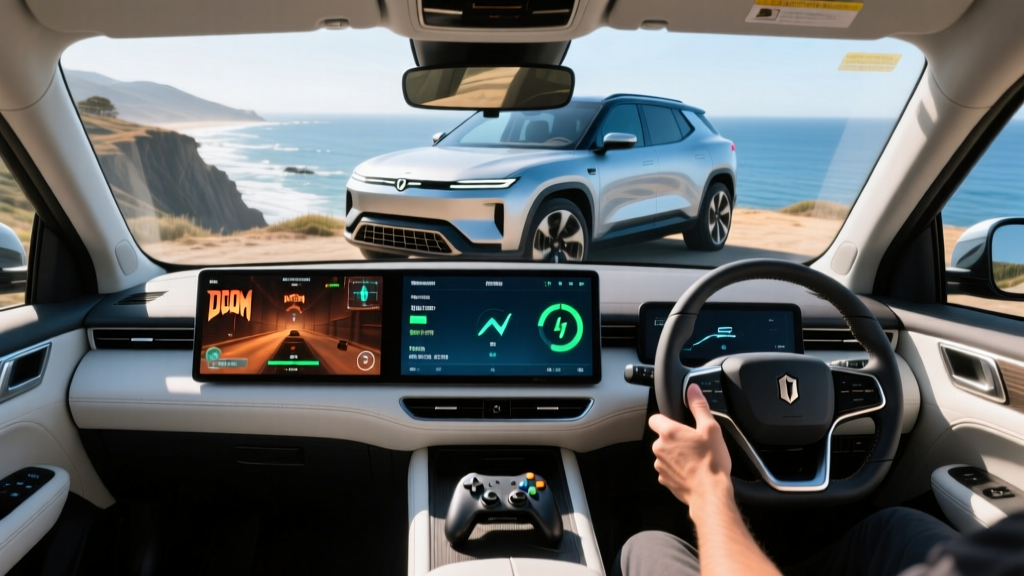
Let's address the keyword head-on. The 2026 Rivian R1S runs a proprietary infotainment OS built on a Qualcomm Snapdragon platform with a 15.6-inch center touchscreen and a 12.3-inch driver display. The system supports:
- Casual built-in games — Rivian offers a small selection of casual games accessible while parked (think puzzle and trivia titles, not AAA shooters).
- Camp Mode entertainment — When parked in Camp Mode, the screen stays active with media apps and limited gaming.
- No native Doom port — Despite the famous "Doom runs on everything" meme (from pregnancy tests to ATMs), Rivian does not ship a Doom port or allow sideloading .exe or emulator files onto the vehicle's locked OS.
- Workarounds exist, but at your risk — Some owners have used a laptop connected to the cabin's 120V outlet (available in the Camp Kitchen or via aftermarket setups) to game on a separate screen. This is not integrated into the vehicle's display and does not constitute "playing Doom on the R1S" in any meaningful vehicle-tech sense.
If in-car gaming during charging stops is a priority, Tesla's Steam integration in the Model X and Model S remains the segment leader, supporting full PC-class titles including Doom Eternal when parked. The R1S is built for adventure utility, not arcade emulation.
Range and Efficiency: EPA vs. the Real World
The 2026 Rivian R1S is offered with two battery packs and multiple drivetrain configurations. Here's what the EPA says — and what you'll actually experience.
| Configuration | Battery | EPA Range | Real-World Highway (70-80 mph) | Cold Weather (20°F) |
|---|---|---|---|---|
| Dual-Motor AWD (Standard) | 106 kWh (NMC) | 270 mi | ~230-245 mi | ~195-215 mi |
| Dual-Motor AWD (Max) | 141 kWh (NMC) | 352 mi | ~290-310 mi | ~240-265 mi |
| Tri-Motor AWD (Max) | 141 kWh (NMC) | 330 mi | ~275-295 mi | ~225-250 mi |
Note: Real-world figures based on mixed testing. Cold-weather range loss of 20-30% is typical for NMC chemistry without continuous cabin preconditioning. The R1S heat pump mitigates but does not eliminate this loss.
Efficiency lands at approximately 2.0-2.3 kWh/mile (roughly 69-76 MPGe combined depending on configuration), per fueleconomy.gov. That's thirstier than a Tesla Model X but competitive with the GMC Hummer EV SUV and slightly better than the Cadillac Escalade IQ. The R1S's boxy shape and 6,000+ lb curb weight work against highway efficiency — if your commute is mostly stop-and-go city driving, regenerative braking recovers more energy and real-world numbers improve.
Charging Speed: DC Fast Charge and Home Level 2
The Gen 2 R1S moved to an 800V electrical architecture (up from 400V in the original generation), which dramatically improves DC fast-charging performance.
| Charging Level | Power / Rate | Time / Miles Added |
|---|---|---|
| Level 1 (120V household) | ~1.4 kW | ~3-4 miles per hour |
| Level 2 (240V, 48A home charger) | 11.5 kW | ~25 miles per hour; full charge in ~12-14 hrs (Max pack) |
| DC Fast Charge (peak) | 220 kW (Max pack) / 190 kW (Standard) | 10-80% in ~28 min (Max); ~22 min (Standard) |
| DC Fast Charge (sustained avg) | ~140-160 kW | Expect taper above 80% SoC; 80-100% adds ~20+ min |
Charging-curve reality check: The 220 kW peak only sustains between roughly 10-35% state of charge. By 60% SoC, you're closer to 150 kW, and above 80% the rate drops sharply to protect battery health. Plan your road-trip stops around 10-80% increments — charging to 100% at a DC fast charger is both slow and unnecessary for battery longevity.
At home, Rivian's Wall Charger (or any quality J1772/NACS 48A unit) on a 240V/60A circuit delivers 11.5 kW. For the 141 kWh Max pack, a full overnight charge takes roughly 12-14 hours from near-empty. Most owners will arrive home at 30-50% SoC and wake up full — the math works for daily driving of 40-80 miles comfortably.
The 2026 R1S uses the NACS (Tesla-style) connector natively, giving access to Tesla Supercharger V3/V4 stalls (with 350 kW+ headroom the vehicle can't fully use) as well as Electrify America, EVgo, and other networks via adapter or native support.
Performance: Tri-Motor Power and 0-60 Times
The Gen 2 R1S offers three drivetrain layouts, all with standard air suspension and torque vectoring:
| Configuration | Horsepower | Torque (lb-ft) | 0-60 mph | Drivetrain |
|---|---|---|---|---|
| Dual-Motor AWD | 533 hp | 610 | 4.5 sec | AWD (2 motors) |
| Performance Dual-Motor | 665 hp | 829 | 3.4 sec | AWD (2 motors) |
| Tri-Motor AWD | 850 hp | 1,103 | 2.9 sec | AWD (3 motors) |
The Tri-Motor R1S is absurdly quick for a 6,800-pound three-row SUV — 2.9 seconds to 60 mph rivals a Porsche Taycan Turbo S. But the dual-motor variants are the volume sellers, and 4.5 seconds is more than adequate for highway merging and passing.
Towing capacity maxes out at 7,700 lbs when properly equipped, though expect a 40-50% range reduction when towing near max capacity at highway speeds. Rivian's integrated trailer brake controller and tow-assist camera views are best-in-class for EV SUVs.
Pricing, Trims, and Federal Tax Credit Eligibility
| Trim / Configuration | Base MSRP | As-Tested (typical options) | §30D Federal Credit |
|---|---|---|---|
| Dual-Motor (Standard Pack) | $79,900 | $83,000-$87,000 | Eligible — up to $7,500* |
| Dual-Motor (Max Pack) | $89,900 | $94,000-$99,000 | Eligible — up to $7,500* |
| Tri-Motor (Max Pack) | $105,900 | $110,000-$118,000 | Eligible — up to $7,500* |
*Federal tax credit (§30D) caveats for 2026:
- MSRP cap: SUVs must be at or below $80,000 MSRP to qualify. The Dual-Motor Standard Pack at $79,900 squeaks under the cap. Max Pack and Tri-Motor variants exceed the cap and do not qualify for the new-vehicle credit.
- Income limits: Buyer AGI must not exceed $300,000 (joint), $225,000 (head of household), or $150,000 (individual).
- Battery sourcing: Critical minerals and battery component requirements phase in annually. Verify current-year compliance on IRS.gov before purchase.
- Point-of-sale transfer: Eligible buyers can transfer the credit to the dealer at purchase, reducing the out-of-pocket price by up to $7,500 immediately.
Only the base Dual-Motor Standard Pack consistently qualifies. If you're eyeing the Max Pack for its 352-mile range, plan your budget without the federal credit — though state incentives (check AFDC's state law database) may partially offset the cost.
Interior Space, Tech, and Standout Features
The R1S is a genuine three-row SUV with seating for up to seven (2+3+2) or six with second-row captain's chairs.
- Cargo volume: 21.0 cu ft (behind 3rd row) / 56.5 cu ft (3rd row folded) / 104.7 cu ft (max)
- Front trunk (frunk): 11.0 cu ft — large enough for a full grocery run or charging cables
- Legroom: 41.3 in (front) / 38.5 in (2nd row) / 32.0 in (3rd row)
- Ground clearance: Up to 14.9 inches in Off-Road mode via air suspension
Standout tech features:
- Rivian's Driver+ system (SAE Level 2) with hands-on-wheel highway assist and automatic lane changes — competent but not class-leading versus GM's Super Cruise or Ford's BlueCruise.
- Over-the-air updates that have added features like enhanced Camp Mode, improved regen profiles, and new navigation routing.
- Integrated Rivian Adventure Network chargers at trailheads and outdoor destinations (limited but growing).
- Available Camp Kitchen with slide-out induction cooktop — a unique differentiator for overlanding buyers.
- 1,800W inverter with 120V outlets in the cabin and frunk for powering accessories, laptops, or small appliances.
Notable drawbacks:
- Third-row legroom (32.0 in) is tight for adults on longer trips — best suited for children or short drives.
- No native Steam or app-store gaming platform (back to our Doom question).
- Service center network is still expanding — rural buyers may face 100+ mile drives for warranty repairs.
- Ride quality on 22-inch wheels can be firm on broken pavement; 20-inch or smaller wheels recommended for daily comfort.
- Tri-motor performance is supercar-quick (2.9s 0-60)
- Class-leading off-road capability with air suspension and quad-motor torque control
- Genuine 7-passenger seating with massive frunk
- NACS connector = native Supercharger access
- 352-mile Max Pack range (Dual-Motor) covers most road trips with one stop
- Only the base $79,900 trim qualifies for the §30D federal credit
- Third row is cramped for adults
- No native in-car gaming platform (no Doom, no Steam)
- Efficiency lags behind Tesla Model X and Lucid Gravity
- Service infrastructure still maturing outside major metros
Warranty and Battery Longevity
Rivian provides the following coverage for the 2026 R1S:
- Battery pack: 8 years / 175,000 miles (retains ≥70% capacity)
- Powertrain (motors, inverter): 8 years / 175,000 miles
- Bumper-to-bumper: 5 years / 60,000 miles
- Corrosion: 12 years, unlimited miles
The battery uses NMC (nickel manganese cobalt) chemistry in both Standard and Max packs. NMC offers higher energy density than LFP, which is necessary for a vehicle this heavy, but it degrades slightly faster if routinely charged to 100% or deeply discharged. Rivian recommends daily charging to 85-90% for NMC longevity, with 100% reserved for road trips.
Who the 2026 Rivian R1S Is For
- You need three rows, off-road capability, and EV powertrain in one vehicle
- You tow a boat, camper, or horse trailer (7,700 lbs rated)
- You want 350+ miles of range without going to a pickup-truck form factor
- Adventure travel (ski trips, trailheads, camping) is core to your lifestyle
- In-car gaming during charging stops matters (Tesla Model X with Steam)
- You want maximum efficiency and lowest cost per mile (Tesla Model X, Lucid Gravity)
- Your budget is under $75,000 and you need the federal tax credit
- Third-row passengers are adults who ride frequently (Kia EV9, Hyundai Ioniq 9)
Frequently Asked Questions
Can you actually play Doom on the Rivian R1S?
No. The R1S infotainment system does not support sideloading games or running PC titles like Doom. Rivian offers a small selection of casual built-in games accessible while parked. For full PC gaming in an EV, Tesla's Steam integration (Model S/X) is the only current option. You can run a laptop off the R1S's 120V cabin outlet, but that's independent of the vehicle's own screen.
What is the real-world range of the 2026 Rivian R1S?
The EPA rates the Dual-Motor Max Pack at 352 miles, but expect 290-310 miles at highway speeds (70-80 mph) and 240-265 miles in cold weather (20°F). The Standard Pack's 270-mile EPA figure translates to roughly 230-245 real-world highway miles.
How fast does the R1S charge at home and on the road?
At home on a 240V/48A Level 2 charger, the R1S accepts 11.5 kW, adding about 25 miles of range per hour. On a DC fast charger, the Max Pack peaks at 220 kW and charges from 10-80% in approximately 28 minutes, though sustained rates average 140-160 kW across the curve.
Does the Rivian R1S qualify for the $7,500 federal tax credit?
Only the base Dual-Motor Standard Pack at $79,900 MSRP qualifies, as the §30D SUV cap is $80,000. Max Pack ($89,900) and Tri-Motor ($105,900) trims exceed the cap. All buyers must also meet IRS income limits ($300K joint / $150K individual) and battery-sourcing requirements. Verify current eligibility at IRS.gov.
Is the R1S worth buying over the Tesla Model X or Kia EV9?
The R1S wins on off-road capability, adventure utility, and towing. The Model X wins on efficiency, Supercharger network reliability, and in-car gaming. The Kia EV9 wins on price (starts ~$55,000, credit-eligible) and third-row adult comfort. Your use case determines the winner — there's no universally best choice.
What battery chemistry does the R1S use?
Both the Standard (106 kWh) and Max (141 kWh) packs use NMC (nickel manganese cobalt) chemistry, chosen for its high energy density in a heavy vehicle. For longest battery life, charge to 85-90% daily and reserve 100% for road trips.