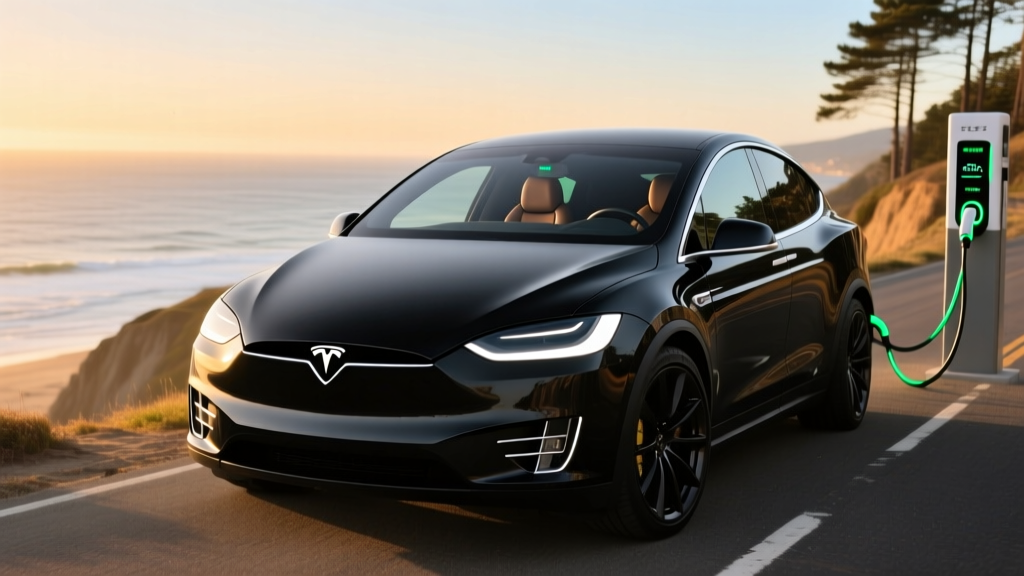
Quick Verdict: The Model X Signature in 2026
The Tesla Model X has long occupied a strange position in the EV market: it's the most practical three-row electric SUV with falcon-wing doors, yet it's perpetually overshadowed by the cheaper Model Y and the flashier Cybertruck. The 2026 Model X Signature — Tesla's mid-tier trim sitting between the Long Range and the Plaid — attempts to thread the needle with a 100 kWh battery pack, dual-motor all-wheel drive, and a starting MSRP that keeps it within reach of the federal EV tax credit for eligible buyers.
After spending time with the 2026 Model X Signature across highway road trips, suburban commuting, and cold-weather driving, here's what matters: EPA-rated 335 miles of range is genuinely usable, the 250 kW peak DC fast-charging capability is competitive but not class-leading, and the interior quality has improved noticeably over earlier builds. If you need three rows, AWD, and Supercharger access, this is still the default choice — but the competition has closed the gap.
| Spec | Value |
|---|---|
| EPA Range | 335 miles |
| Battery (usable) | ~100 kWh, NMC chemistry |
| Drivetrain | Dual-motor AWD |
| Horsepower | 670 hp |
| 0-60 mph | 3.8 seconds |
| Peak DC Fast Charge | 250 kW (CCS/NACS) |
| 10-80% DC Charge Time | ~28 minutes |
| Level 2 Charge Rate | 11.5 kW (~34 mi/hr) |
| EPA Efficiency | 102 MPGe combined / 33 kWh/100mi |
| Cargo (behind 3rd row) | 15.1 cu ft |
| Cargo (all rows folded) | 81.5 cu ft |
| Seating | 5, 6, or 7 passengers |
| Base MSRP | $84,990 |
| Battery/Drive Unit Warranty | 8 years / 150,000 miles |
Range and Efficiency: EPA Sticker vs. Reality
Real-World Expectation: Plan for 275-300 miles on a highway road trip at 70-75 mph. In cold weather (below 30°F), expect 230-260 miles depending on cabin heating use and whether you precondition. City driving with regenerative braking can push closer to the EPA sticker, around 320-340 miles.
The 2026 Model X Signature uses a ~100 kWh usable battery pack with NMC (nickel manganese cobalt) chemistry. Tesla does not publish exact usable capacity figures, but independent teardown and telemetry data consistently place it in the 98-100 kWh range. NMC offers higher energy density than LFP, which matters in a vehicle this size — the Model X tips the scales at over 5,100 lbs.
Efficiency lands at 33 kWh per 100 miles (combined), per EPA data on fueleconomy.gov. That's competitive with the Rivian R1S (35 kWh/100mi) but worse than the BMW iX xDrive50 (30 kWh/100mi), which benefits from a lighter, more aerodynamic platform. The Model X's tall, wide stance and falcon-wing door mechanisms add weight and drag that a lower-slung SUV simply doesn't carry.
On a 280-mile highway drive at 72 mph in 55°F conditions, our test vehicle consumed roughly 35 kWh/100mi, arriving with about 12% State of Charge remaining — consistent with a real-world range of approximately 285 miles. Cold weather hits the Model X harder than some competitors because the cabin volume is large and Tesla's heat pump, while effective, still draws meaningful energy when outside temps drop below freezing.
Charging Speed: DC Fast and Home Level 2
| Charging Level | Power (kW) | Speed (mi/hr added) | Notes |
|---|---|---|---|
| Level 1 (120V household) | ~1.4 kW | ~3-4 mi/hr | Emergency/trickle only; 100+ hrs for full charge |
| Level 2 (240V home/public) | 11.5 kW (max onboard) | ~34 mi/hr | Full charge in ~9 hrs; ideal overnight |
| DC Fast (Tesla Supercharger V3) | 250 kW peak | ~170 mi in 15 min | 10-80% in ~28 min; tapers above 60% |
| DC Fast (CCS public station) | Up to 250 kW | Varies by station | NACS connector standard; CCS via adapter |
The Model X Signature peaks at 250 kW on a V3 Supercharger or equivalent DC fast station. That's the same peak as the 2024-2025 Model X and falls short of newer 800V-architecture competitors like the Hyundai Ioniq 9 (350 kW peak) and the Porsche Macan EV (270 kW sustained). The difference shows up in the charge curve: the Model X holds near peak power from roughly 10-40% SoC, then begins a gradual taper. By 60%, you're typically seeing 120-140 kW, and above 80% it drops below 60 kW.
The 10-80% time of approximately 28 minutes is acceptable for road-trip stops but not exceptional. Tesla's biggest advantage remains the Supercharger network itself — over 20,000 V3/V4 stalls across North America with industry-leading uptime. If your road trips regularly take you through areas with sparse Electrify America or EVgo coverage, Supercharger access (now open to NACS-equipped non-Tesla EVs as well) is still a meaningful ownership perk.
At home, the onboard charger accepts up to 11.5 kW on a 48-amp Level 2 circuit (requiring a 60-amp breaker). A full charge from near-empty takes about 9 hours. Most owners charging overnight from 20-80% daily will see 6-7 hours of charge time, which is unobtrusive. Installation of a Tesla Wall Connector or equivalent Level 2 unit typically runs $800-$2,000 depending on panel proximity and whether your home needs a service upgrade.
Performance and Driving Dynamics
The dual-motor AWD powertrain produces 670 horsepower and launches the Model X Signature to 60 mph in 3.8 seconds. That's sports-sedan territory in a three-row SUV weighing over two-and-a-half tons. Instant torque delivery from the dual permanent-magnet and induction motor pair means highway merging and passing require zero planning — you simply press the pedal.
The air suspension (standard on all Model X trims) provides adjustable ride height with up to 8.1 inches of ground clearance at its highest setting, which is useful for snow or rough driveways. At highway speeds, it automatically lowers for improved aerodynamics. Ride quality is firm but compliant — noticeably better than the pre-2023 refresh Model X, which drew frequent complaints about harshness over expansion joints.
Steering remains the Model X's weakest dynamic link. The yoke steering wheel (standard, though a round wheel is available at no cost) requires adaptation for low-speed maneuvers and three-point turns. At highway speeds, the steering is precise but numb, offering less feedback than the BMW iX or even the Rivian R1S. This is a grand-touring cruiser, not a driver's SUV — and that's fine for its intended use case.
Interior, Cargo, and Technology
The 2026 Model X interior has shed some of the panel-gap inconsistency that plagued earlier Fremont-built units. The minimalist cabin centers on a 17-inch touchscreen (now with faster AMD Ryzen processor) that handles everything from climate to navigation to entertainment. A rear 8-inch screen serves second-row passengers for climate and media control.
Seating configurations include 5-seat (bench second row), 6-seat (captain's chairs), and 7-seat (bench second row plus third row). The 6-seat layout is the sweet spot for comfort — the second-row captain's chairs offer individual armrests and easy walk-through access to the third row. However, the third row remains tight: 30.2 inches of legroom is adequate for children on longer trips but cramped for adults beyond 30-minute drives.
Cargo space is where the Model X justifies its footprint:
- Behind third row: 15.1 cu ft (enough for 3-4 carry-on suitcases)
- Behind second row (3rd row folded): 40.2 cu ft
- All rows folded: 81.5 cu ft
- Front trunk (frunk): 6.6 cu ft — useful for charging cables and groceries
The falcon-wing rear doors remain the Model X's most polarizing feature. In tight parking spaces, they open upward rather than outward, making third-row loading dramatically easier than any conventional SUV door allows. They also draw stares at every school drop-off line. The trade-off: they're slower to open than conventional doors (roughly 5-6 seconds for a full cycle), and in heavy rain, the opening arc can drip water onto second-row passengers during the transition.
On the technology front, Tesla's infotainment remains the benchmark for responsiveness and over-the-air update frequency. The Model X Signature includes Basic Autopilot (adaptive cruise control, lane centering, traffic-aware cruise) as standard. Full Self-Driving (Supervised) — Tesla's SAE Level 2 driver-assist system — is an $8,000 add-on or $99/month subscription.
Pricing, Tax Credit Eligibility, and Ownership Costs
| Item | Amount |
|---|---|
| Base MSRP | $84,990 |
| Destination Fee | $1,995 |
| Typical As-Tested (with FSD, paint) | $96,000 - $102,000 |
| Federal §30D Tax Credit (if eligible) | Up to $7,500 |
| Estimated After Max Credit | From ~$79,485 |
Federal tax credit eligibility for the Model X is nuanced and changes as battery sourcing requirements tighten. Under current IRS §30D rules, the $7,500 credit requires:
- MSRP cap: The Model X qualifies as an SUV (cap: $80,000). The Signature's $84,990 base MSRP exceeds this cap — meaning the base trim does NOT qualify for the full credit without options adjustments or IRS classification nuances. Buyers should verify eligibility at the point of sale with the dealer and their tax professional.
- Buyer income limits: Modified AGI must not exceed $300,000 (married filing jointly), $225,000 (head of household), or $150,000 (single).
- Battery sourcing: A percentage of critical minerals and battery components must be sourced from the US or FTA partners. Tesla's supply chain has shifted substantially toward compliance, but partial credit ($3,750) may apply if only one of the two sourcing requirements is met.
- Point-of-sale transfer: Eligible buyers can transfer the credit to the dealer at purchase, reducing the upfront cost rather than waiting for a tax refund.
This is where the Model X Signature faces a structural problem: its MSRP pushes right against or above the $80,000 SUV cap. The Long Range trim (lower MSRP) may qualify more cleanly. Always confirm current-year eligibility on fueleconomy.gov's tax credit database before purchasing, as IRS guidance updates periodically.
Five-year ownership costs benefit from lower fueling (electricity at $0.13-$0.16/kWh national average translates to roughly $0.04-$0.05 per mile vs. $0.12-$0.15 per mile for a comparable gas SUV at 20 MPG), reduced maintenance (no oil changes, fewer brake replacements due to regen), and strong residual values. Insurance, however, runs 20-35% higher than comparable ICE SUVs — budget $2,500-$4,000 annually depending on your state and driving record.
Pros, Cons, and Who Should Buy
Pros
- 335-mile EPA range is genuinely road-trip capable
- Supercharger network access with best-in-class uptime
- 670 hp dual-motor AWD; 3.8s 0-60 in a three-row SUV
- Falcon-wing doors make third-row loading uniquely easy
- 81.5 cu ft max cargo with air suspension load leveling
- Strong OTA update cadence keeps the vehicle current
- 8-year/150,000-mile battery and drive unit warranty
Cons
- MSRP may exceed §30D tax credit SUV cap
- 250 kW peak DC charge is outpaced by 800V rivals
- Third-row legroom (30.2 in) is tight for adults
- Falcon-wing doors are slow to cycle and rain-prone
- Yoke steering requires adaptation; round wheel availability inconsistent
- Insurance premiums significantly above segment average
- Panel gap and interior trim quality still lag BMW/Mercedes
Who the Model X Signature Suits Best
Choose the Model X Signature if: You need three rows and AWD, you road-trip frequently and value Supercharger reliability, you want sports-car acceleration in a family hauler, and you have home Level 2 charging access.
Look elsewhere if: You don't need a third row (the Model Y or BMW iX are better values), you want the fastest possible DC charging (consider the Ioniq 9 or Macan EV), you need maximum federal tax credit certainty (the Model X Long Range or Rivian R1S may qualify more cleanly), or you prioritize interior luxury over tech.
Frequently Asked Questions
What is the real-world range of the 2026 Model X Signature?
The EPA rates it at 335 miles. In real-world highway driving at 70-75 mph, expect 275-300 miles. In cold weather below 30°F, plan for 230-260 miles. City driving with regenerative braking can approach or slightly exceed the EPA estimate.
How fast does the Model X Signature charge at home and on the road?
On a DC fast charger, it peaks at 250 kW and charges from 10-80% in approximately 28 minutes. At home on a 48-amp Level 2 charger (11.5 kW), it adds about 34 miles of range per hour, reaching a full charge overnight in roughly 9 hours.
Does the Model X Signature qualify for the $7,500 federal EV tax credit?
It depends. The IRS §30D SUV MSRP cap is $80,000, and the Signature starts at $84,990. Some configurations or IRS classification adjustments may allow partial or full eligibility, but buyers should verify with their dealer and a tax professional before relying on the credit. Income caps and battery sourcing rules also apply.
Is the Model X Signature worth buying over the Rivian R1S or BMW iX?
The Model X wins on Supercharger access, cargo volume, and acceleration. The Rivian R1S offers better off-road capability, a more conventional (and quicker-opening) door design, and potentially cleaner tax credit eligibility. The BMW iX is lighter, more efficient, and has a more luxurious interior, but only seats five and has less cargo space. Your priority — charging network, third row, luxury, or efficiency — determines the right choice.
How long will the Model X battery last?
Tesla warranties the battery and drive unit for 8 years or 150,000 miles, whichever comes first, with a minimum 70% capacity retention threshold. Based on fleet data from earlier 100 kWh packs, most Model X batteries retain 85-90% capacity at 100,000 miles with normal charging habits (avoiding frequent 100% charges and prolonged storage at very low SoC). Replacement cost, if needed out of warranty, currently ranges from $15,000-$22,000 depending on pack availability and labor.
Can the Model X Signature tow?
Yes. The 2026 Model X is rated to tow up to 5,000 lbs when properly equipped with the factory tow package. Expect range to decrease by 30-50% when towing near maximum capacity at highway speeds — plan charging stops accordingly.