Search "Nvidia Tesla" and you'll find a tangled web of supply-chain history, AI ambitions, and silicon rivalry. Nvidia once supplied the Drive PX 2 computer that powered Tesla's early Autopilot hardware (Hardware 2.5). Tesla then pivoted to its own custom FSD Computer (Hardware 3 and now Hardware 4/AI5), severing the Nvidia pipeline for in-vehicle inference. But in 2026, the Nvidia-Tesla relationship is alive and well — just upstream of the car itself. Nvidia's H100 and next-gen Blackwell GPUs train the neural networks that run on every Tesla's onboard computer, power the Dojo supercomputer, and underpin the simulation environments where Full Self-Driving (Supervised) is validated before it ever touches a public road.
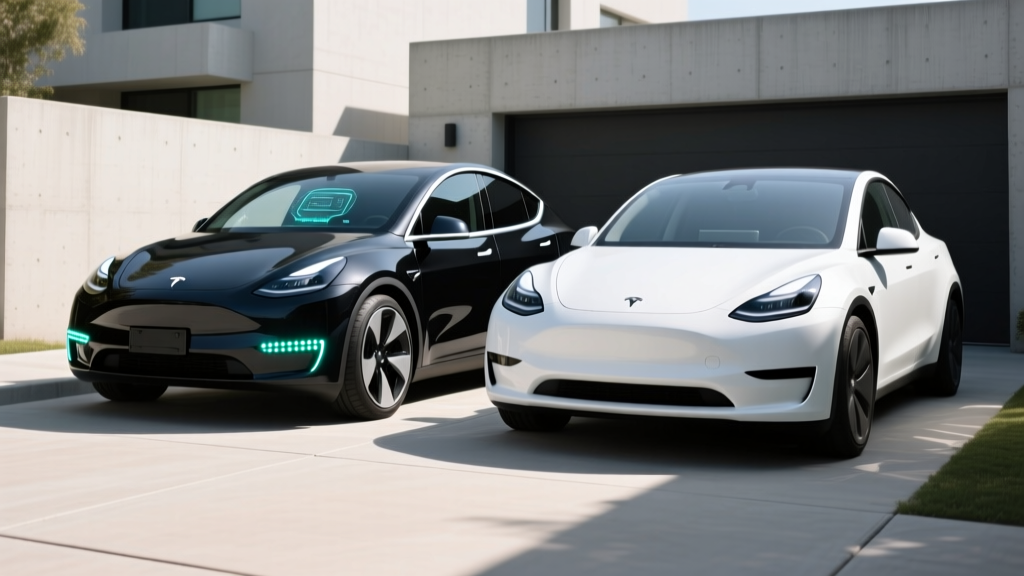
For buyers, the practical question isn't which silicon brand sits in the glovebox computer — it's whether the Tesla Model 3 and Model Y, running Nvidia-trained AI stacks in 2026, deliver on range, charging, and daily usability. This review breaks down both vehicles through that lens, with exact numbers and real-world caveats.
2026 Tesla Model 3: Specs, Range, and the AI Stack
| Attribute | Long Range AWD | Performance |
|---|---|---|
| EPA Range | 341 mi | 315 mi |
| Battery (usable) | ~75 kWh, NMC | ~75 kWh, NMC |
| Drivetrain | Dual-motor AWD | Dual-motor AWD |
| Horsepower | ~346 hp | ~510 hp |
| 0-60 mph | 4.2 sec | 2.9 sec |
| MPGe (combined) | 132 MPGe | 118 MPGe |
| Efficiency | 25 kWh/100 mi | 28 kWh/100 mi |
| Base MSRP | $47,740 | $54,740 |
| Cargo Volume | 23 cu ft (trunk + frunk) | 23 cu ft |
| Rear Legroom | 35.2 in | 35.2 in |
The refreshed "Highland" Model 3, now well into its second model year, uses Tesla's NMC (nickel-manganese-cobalt) pouch cells for Long Range and Performance trims. The base RWD variant, which Tesla has periodically offered with an LFP (lithium iron phosphate) prismatic battery from CATL, provides lower energy density but superior cycle life — a trade-off worth understanding if you plan to keep the car past 150,000 miles.
2026 Tesla Model Y: The Volume Leader Under the Nvidia-Trained Hood
| Attribute | Long Range AWD | Performance |
|---|---|---|
| EPA Range | 320 mi | 295 mi |
| Battery (usable) | ~75 kWh, NMC | ~75 kWh, NMC |
| Drivetrain | Dual-motor AWD | Dual-motor AWD |
| Horsepower | ~384 hp | ~510 hp |
| 0-60 mph | 4.8 sec | 3.5 sec |
| MPGe (combined) | 122 MPGe | 111 MPGe |
| Base MSRP | $46,630 | $53,630 |
| Cargo Volume | 72 cu ft (rear seats folded) | 72 cu ft |
| Rear Legroom | 41.6 in | 41.6 in |
The Juniper-refreshed Model Y (introduced for the 2025 model year and carried into 2026) brought a quieter cabin, revised suspension tuning, ambient lighting, and ventilated front seats. Under the skin, the same Hardware 4 computer processes camera feeds through neural networks trained on Nvidia GPU clusters in Tesla's data centers. The result: FSD (Supervised) in 2026 handles more edge cases — construction zones, unprotected left turns, lane merges — but remains a SAE Level 2 system requiring constant driver attention.
Charging Speeds: DC Fast, Level 2, and the Supercharger Advantage
| Charging Level | Power / Rate | Miles Added per Hour | Notes |
|---|---|---|---|
| Level 1 (120V) | ~1.4 kW | 3–5 mi/hr | Emergency / trickle only |
| Level 2 (240V, 48A) | 11.5 kW | ~44 mi/hr | Home Wall Connector; full charge overnight |
| DC Fast (Supercharger V4) | Peak 250 kW | ~200 mi in 15 min | 10–80% in ~25 min; tapers sharply above 80% |
| DC Fast (CCS adapter, non-Tesla) | Up to 250 kW | Variable | Requires Tesla CCS adapter; network-dependent |
Tesla's 250 kW peak DC rate is strong but not class-leading — the Hyundai Ioniq 5 and Porsche Taycan hit 350 kW peaks. Where Tesla wins is sustained throughput: the battery preconditioning routine (trigger automatically when you navigate to a Supercharger) warms the pack to the optimal temperature, enabling the car to hold high charge rates longer. Expect the 10–80% session to average roughly 170–190 kW in practice, not the 250 kW peak. Above 80% State of Charge, the curve tapers aggressively to protect cell longevity — a 90% top-up can add another 10 minutes.
Home Level 2 charging via the Tesla Wall Connector at 48 amps is the ownership sweet spot. Budget $800–$1,500 for a professional install on an existing 60A circuit; panel upgrades (200A service) can push total cost to $2,500–$4,000. Always get a quote from a licensed electrician before committing.
Pricing, Trims, and the 2026 Federal Tax Credit Picture
| Model / Trim | Base MSRP | As-Tested (typical) | §30D Credit Eligibility |
|---|---|---|---|
| Model 3 RWD (if offered) | ~$38,990 | $39,500–$42,000 | Potentially eligible — LFP battery sourcing under review |
| Model 3 Long Range AWD | $47,740 | $50,000–$55,000 | Under MSRP cap; credit depends on buyer income + battery sourcing |
| Model 3 Performance | $54,740 | $56,000–$60,000 | Under $55K sedan cap — may NOT qualify |
| Model Y Long Range AWD | $46,630 | $49,000–$54,000 | Under $80K SUV cap; income + sourcing apply |
| Model Y Performance | $53,630 | $55,000–$60,000 | Under $80K SUV cap; income + sourcing apply |
The IRS §30D clean vehicle credit offers up to $7,500, split between critical-mineral and battery-component requirements. For 2026, buyer income caps remain $150,000 single / $300,000 joint. MSRP caps are $55,000 for sedans (Model 3) and $80,000 for SUVs (Model Y). The point-of-sale transfer option lets you apply the credit as a down-payment reduction at delivery — but only if the vehicle's battery sourcing qualifies in that model year. Tesla publishes a tax credit guide on its site; cross-reference with the IRS and consult a tax professional before assuming eligibility.
Warranty, Battery Longevity, and Ownership Costs
Tesla covers the Model 3 and Model Y with a 4-year/50,000-mile basic warranty and an 8-year/120,000-mile battery and drive unit warranty (Long Range and Performance). The warranty guarantees at least 70% capacity retention over that period. Real-world degradation data from fleet aggregators shows NMC packs typically lose 8–12% capacity over the first 100,000 miles, with the steepest drop in the first 15,000 miles before leveling off.
If you're charging at home on Level 2 and keeping daily State of Charge between 20–80%, Tesla's NMC packs should outlast the vehicle's economic life. LFP packs (on RWD trims when available) tolerate daily 100% charging and show even slower degradation — a strong argument for high-mileage commuters who don't need the extra range of the Long Range variant.
Insurance is a real cost factor: Tesla insurance averages 20–35% above equivalent ICE sedans and crossovers, according to industry data. Tesla's own insurance product (available in most states) uses real-time driving data to price premiums, which can benefit safe drivers but penalize hard braking or frequent Autopilot disengagements.
Who Should Buy — and Who Should Look Elsewhere
Choose the Model Y if: You need cargo space (72 cu ft with seats folded), rear-seat room for car seats or adults, or plan family road trips. The 320-mile EPA range and Supercharger network make it the default electric family hauler.
Look elsewhere if: You need a truck bed (Rivian R1T, Ford F-150 Lightning), three-row seating (Kia EV9), or a luxury interior that matches the price (BMW i4, Genesis Electrified G80). Tesla's minimalist cabin and panel-gap consistency remain common complaints.
- Supercharger network — still the most reliable DC fast-charging ecosystem in North America
- Class-leading efficiency (kWh/100 mi) translates to lower charging costs
- Over-the-air updates continuously add features post-purchase
- Strong real-world range with heat pump standard
- Hardware 4 computer provides future-proofed ADAS capability
- No physical buttons — everything through the touchscreen, including mirror and steering-wheel adjustments
- Panel gaps and paint quality inconsistent vs. legacy luxury brands
- FSD (Supervised) is $8,000 extra and remains Level 2, not autonomous
- Rear visibility in Model 3 is compromised; no rear wiper on Model Y
- Insurance premiums above segment average
Frequently Asked Questions
Does Nvidia make the chips inside 2026 Tesla vehicles?
No. Tesla designs its own FSD Computer (Hardware 4, with AI5 in development) for in-vehicle neural-network inference. Nvidia's role is upstream: its H100 and Blackwell GPUs train the models in Tesla's data centers and power the Dojo supercomputer project. The relationship is one of AI infrastructure, not in-car hardware supply.
What is the real-world range of the 2026 Model 3 and Model Y?
Model 3 Long Range: EPA 341 miles; expect 270–290 highway, 220–240 in cold weather. Model Y Long Range: EPA 320 miles; expect 255–275 highway, 210–230 in cold. City driving with regenerative braking pushes numbers closer to EPA estimates.
How fast does a Tesla charge at home and on the road?
At home on a 48A Level 2 Wall Connector (11.5 kW), you add roughly 44 miles per hour — a full overnight charge. On a V4 Supercharger, peak rate is 250 kW, with a 10–80% session taking about 25 minutes. Preconditioning is automatic when navigating to a charger.
Does the 2026 Tesla Model Y qualify for the $7,500 federal tax credit?
Eligibility depends on three factors: buyer income (≤$300K joint / $150K single), vehicle MSRP (under $80K for SUVs — Model Y qualifies), and battery component/critical-mineral sourcing, which changes annually. The point-of-sale transfer lets you apply the credit at delivery if all criteria are met. Verify current-year rules at IRS.gov and with a tax professional.
Is Tesla's FSD actually self-driving?
No. FSD (Supervised) is an SAE Level 2 driver-assist system. It can handle highway lane changes, city intersections, and parking, but you must remain engaged — hands near the wheel, eyes on the road, ready to take over instantly. Camera-based monitoring enforces attention. No consumer Tesla is autonomous.
How does Tesla compare to the Hyundai Ioniq 5 or BMW i4?
The Ioniq 5 offers faster peak DC charging (350 kW, 10–80% in ~18 min) and an 800V architecture, but its public charging network access is less seamless than Tesla's Supercharger ecosystem. The BMW i4 delivers a more premium interior and traditional controls, at a higher price and lower efficiency. Tesla wins on software integration and charging infrastructure; rivals win on interior quality and charging speed.
What's the battery replacement cost out of warranty?
Out-of-warranty Tesla battery replacements run $12,000–$16,000 depending on pack size and labor. However, real-world data shows most Tesla NMC and LFP packs retain 85–90% capacity at 150,000 miles, making full replacement rare within typical ownership periods.
The Nvidia-Tesla story in 2026 is an AI training partnership, not a badge on the dash. What matters at the dealership is whether the Model 3 or Model Y fits your range needs, charging access, and budget after credits. On those metrics — with exact numbers in hand — Tesla's volume leaders remain strong but no longer unchallenged.