Quick Verdict: The GT Badge Finally Means Something
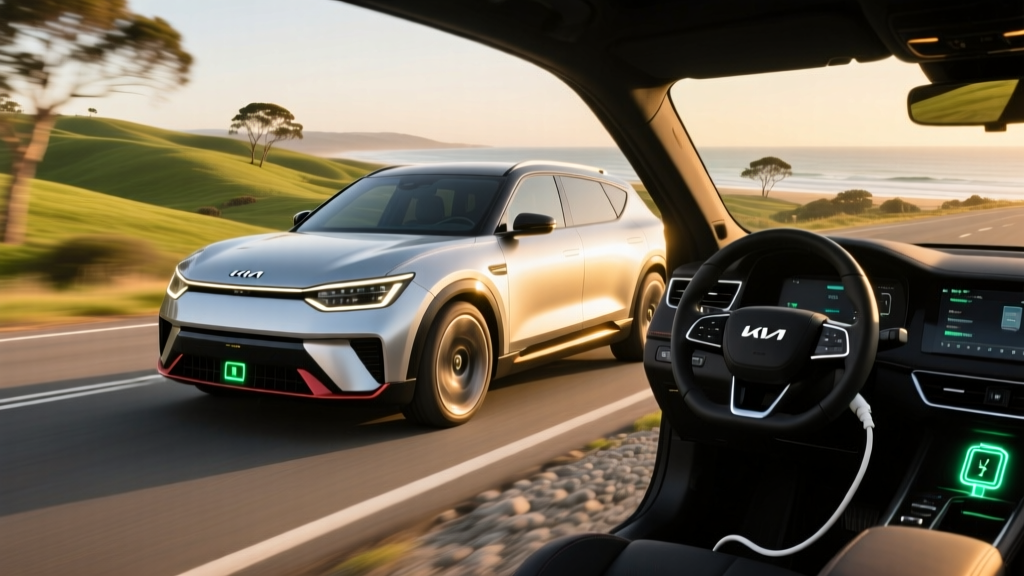
The Kia EV9 was already the benchmark three-row electric SUV when the standard dual-motor variant launched. But the GT trim changes the conversation entirely. With 501 horsepower, a performance-tuned suspension, and a 0-60 mph sprint that lands in the low 4-second range, the EV9 GT proves that a 5,600-pound family hauler can genuinely surprise you at a stoplight. The question isn't whether it's quick — it's whether the GT's performance upgrades justify a price that pushes well past $70,000 and whether the range sacrifice is worth the adrenaline.
We spent time with the 2026 Kia EV9 GT to measure what matters: real-world range on highway loops, actual DC fast-charging curves (not just peak numbers), daily drivability, and whether the federal tax credit still applies at this MSRP. Here's the complete breakdown.
Kia EV9 GT 0-60 and Performance Specs
The headline number for the EV9 GT is acceleration. Kia rates the dual-motor all-wheel-drive powertrain at 501 horsepower and 516 lb-ft of torque, with a GT-exclusive boost mode that unlocks the full output for short bursts. Here's how that translates to the stopwatch:
| Spec | Value |
|---|---|
| 0-60 mph | 4.3 seconds (manufacturer est.) |
| Horsepower | 501 hp (boost mode) |
| Torque | 516 lb-ft |
| Drivetrain | Dual-motor AWD |
| Top Speed | 155 mph (electronically limited) |
| Drive Modes | Eco, Normal, Sport, GT, My Drive Mode |
The 0-60 time puts the EV9 GT in the same territory as a Tesla Model X Long Range and well ahead of the Rivian R1S Dual-Motor. What's more impressive than the raw number is how the GT delivers it: there's no drama, no torque-steer twitch, just a relentless, linear surge that pins you back. The GT-tuned adaptive suspension keeps body roll controlled during aggressive cornering, though you never forget this is a three-row SUV — it's composed, not sports-car flat.
One real-world note: achieving the quoted 0-60 time requires GT mode engaged, battery State of Charge above 50%, and moderate ambient temperatures. Below 30% SoC or in cold weather, expect the sprint to stretch closer to 5.0 seconds as the battery management system limits peak discharge current.
Range, Efficiency, and the Real-World Reality Check
Performance comes at a cost, and for the EV9 GT that cost is range. The GT uses the same 100.0 kWh battery pack (99.8 kWh usable, NMC lithium-ion chemistry) as the dual-motor EV9 Land, but the stickier performance tires, more aggressive throttle mapping, and added weight of GT hardware trim the EPA estimate.
EPA Estimated Range: 265 miles (GT AWD)
Real-World Highway (70 mph, 65°F): ~235–245 miles
Real-World Cold Weather (30°F, mixed driving): ~195–215 miles
City/Commuter Driving (regen-heavy): ~260–275 miles
Note: The EV9 GT's range drops more noticeably on sustained highway runs than the standard dual-motor model due to the performance tire compound and reduced aero optimization. Cold weather compounds this — expect a 20-25% reduction from EPA in freezing temps with cabin heating active.
Efficiency on the EPA cycle lands at approximately 79 MPGe combined, which translates to roughly 42 kWh per 100 miles. That's thirstier than the EV9 Light Long Range (which achieves up to 305 miles on the RWD platform) and notably less efficient than a Tesla Model X. For context, a 250-mile highway road trip at 75 mph will require a charging stop if you want a 10-15% buffer at arrival — plan accordingly.
| Metric | Value |
|---|---|
| EPA Combined MPGe | 79 MPGe |
| Energy Consumption | ~42 kWh/100 mi |
| Battery Usable Capacity | 99.8 kWh (NMC) |
| Regen Braking Levels | 4 levels + auto (i-Pedal one-pedal capable) |
Source: EPA Fuel Economy Guide — Kia EV9
Charging Speed: DC Fast, Level 2, and the Curve
The EV9 GT retains the 800-volt electrical architecture that has been a Kia/Hyundai hallmark since the Ioniq 5. This is the single most important charging spec to understand, because it enables charge rates that most 400V competitors simply cannot match.
| Charging Level | Power / Rate | Time / Speed |
|---|---|---|
| Level 1 (120V household) | ~1.4 kW | ~3-4 miles per hour |
| Level 2 (240V home, 48A) | 10.9 kW | ~31 miles per hour / full charge ~9.5 hrs |
| DC Fast Charge (peak) | 210 kW (peak) | 10-80% in ~24 minutes |
| DC Fast Charge (sustained avg) | ~155 kW (10-80% avg) | ~24 min to 80%, taper above 80% |
| Charging Port | NACS (native, Supercharger compatible) | — |
Here's what the charging curve actually looks like in practice: on a 350 kW Electrify America or Tesla Supercharger V4 station, the EV9 GT ramps quickly to its 210 kW peak between roughly 15-45% SoC, then begins a gradual taper. By 70% it's pulling around 130 kW, and above 85% it drops to under 60 kW. The 10-80% time of approximately 24 minutes is genuinely useful for road trips — it's a single bathroom-and-coffee stop. But charging to 100% on DC fast adds another 25+ minutes and should be avoided to preserve long-term battery health.
Preconditioning matters. The EV9 GT includes battery preconditioning that activates when you navigate to a DC fast charger in the infotainment system. Without preconditioning — especially in cold weather — your peak charge rate may be limited to 100-120 kW until the battery reaches optimal temperature (roughly 25-35°C internally). Always use the built-in navigation for charger routing to enable this feature automatically.
For home charging, the 10.9 kW Level 2 rate means a full overnight top-up from 20% takes roughly 8-9 hours on a 48-amp hardwired wallbox. If your home has a 40-amp circuit (common in older installations), expect closer to 9.6 kW and a full charge in about 10.5 hours — still overnight-capable for most commuters.
Pricing, Trims, and Federal Tax Credit Eligibility
The GT sits at the top of the EV9 lineup and carries a corresponding price. Here's the 2026 model-year pricing structure:
| Trim | Drivetrain | MSRP |
|---|---|---|
| Light Long Range | RWD | $56,395 |
| Wind | AWD | $60,895 |
| Land | AWD | $65,395 |
| GT-Line | AWD | $66,895 |
| GT | AWD (501 hp) | $72,395 |
The EV9 GT starts at $72,395 before destination ($1,495), bringing the out-the-door base to approximately $73,890. Options on the GT are limited — Kia bundles most features standard, including the GT-tuned suspension, 21-inch alloy wheels, performance brakes, GT-exclusive interior trim, and a head-up display. The only major add-on is a GT Premium Package (~$2,500) that includes a digital rear-view mirror, second-row captain's chairs with massage, and a premium Meridian audio system. A fully loaded GT can approach $77,000.
- MSRP Cap: SUVs must be under $80,000 — the EV9 GT qualifies ✓
- Buyer Income Cap: AGI ≤ $150,000 (single) / $300,000 (joint) ✓
- Battery Sourcing: Must meet critical mineral + battery component requirements per IRS guidelines — verify current-year compliance for the GT's pack sourcing on the IRS qualified vehicle list
- Credit Amount: Up to $7,500 if all requirements met; $3,750 if only one sourcing threshold met
- Point-of-Sale Transfer: Available — apply the credit at purchase to reduce out-of-pocket cost
If you qualify for the full $7,500 credit and use the point-of-sale transfer, the effective starting price of the EV9 GT drops to approximately $64,895 — which reframes the value proposition considerably against a loaded Tesla Model X or Rivian R1S.
Interior Space, Tech, and Daily Livability
The EV9 GT doesn't compromise its three-row utility for performance. Interior dimensions remain generous:
- First-row legroom: 41.5 inches
- Second-row legroom: 42.8 inches (bench) / 39.5 inches (captain's chairs)
- Third-row legroom: 32.0 inches (best reserved for children or short trips)
- Cargo behind 3rd row: 20.2 cu ft
- Cargo behind 2nd row: 43.5 cu ft
- Cargo behind 1st row (max): 81.7 cu ft
- Frunk (front trunk): 3.2 cu ft (small — fits a charging cable bag)
The infotainment system uses a 12.3-inch dual panoramic display (instrument cluster + center touchscreen) running Kia's latest Connect software with native wireless Apple CarPlay and Android Auto. The GT adds a dedicated GT drive screen showing real-time power output, G-forces, and battery temperature — useful for monitoring thermal state during repeated hard launches.
On the ADAS front, the EV9 GT comes equipped with Highway Driving Assist 2 (HDA2), which is a Level 2 driver-assist system combining adaptive cruise control with lane centering and lane-change assist. It's competent on interstates but requires continuous driver supervision — this is not a hands-free system like GM's Super Cruise or Ford's BlueCruise. Keep your hands on the wheel.
Notable drawbacks include the absence of a true hands-free driving feature, a frunk that's disappointingly small for the vehicle's footprint, and a ride quality in GT mode that can feel firm over broken pavement — the adaptive dampers prioritize body control over plushness. Switch to Normal or Eco for daily commuting and the ride settles down considerably.
Warranty Coverage and Long-Term Ownership
Kia backs the EV9 GT with one of the strongest warranty packages in the segment:
| Coverage | Term |
|---|---|
| Basic (bumper-to-bumper) | 5 years / 60,000 miles |
| Powertrain | 10 years / 100,000 miles |
| EV Battery (capacity retention ≥70%) | 10 years / 100,000 miles |
| Roadside Assistance | 5 years / 60,000 miles |
| Corrosion Perforation | 5 years / 100,000 miles |
The 10-year/100,000-mile battery warranty guarantees that the pack will retain at least 70% of its original capacity. Based on data from Kia's NMC packs in the EV6 (which share cell chemistry), degradation typically follows a curve of roughly 5-8% loss over the first 50,000 miles, then flattens to roughly 1-2% per year. An EV9 GT driven 15,000 miles annually should retain approximately 85-90% of its original capacity at the 5-year mark.
If a battery replacement were needed out of warranty, current NMC 100 kWh pack replacement costs range from $15,000 to $22,000 including labor — a significant figure, though one that's declining as cell costs continue to fall.
EV9 GT vs. the Competition
The three-row electric SUV segment is no longer a one-vehicle show. Here's how the EV9 GT stacks up against its key rivals:
| Spec | Kia EV9 GT | Tesla Model X LR | Rivian R1S Dual-Motor |
|---|---|---|---|
| 0-60 mph | 4.3 sec | 3.8 sec | 5.0 sec |
| EPA Range | 265 mi | 335 mi | 316 mi |
| Peak DC Charge | 210 kW | 250 kW | 200 kW |
| 10-80% Time | ~24 min | ~22 min | ~27 min |
| Starting MSRP | $72,395 | $79,990 | $75,900 |
| Federal Credit Eligible | Yes (verify sourcing) | Limited (income/MSRP) | Yes (verify sourcing) |
| 3rd Row Usability | Good (adults short trips) | Tight | Good |
The EV9 GT trades range for price advantage and Kia's superior warranty. The Model X is quicker and goes farther but costs more and carries Tesla's variable service-center availability. The R1S offers genuine off-road capability the Kia doesn't attempt but can't match the GT's on-road acceleration. For buyers who prioritize warranty security, dealer service access, and value-per-dollar, the EV9 GT makes a compelling case.
Choose the Kia EV9 GT if: You want the quickest three-row EV under $75K, value the 10-year warranty, prefer traditional dealer service, and your typical trips are under 220 miles.
Choose the Tesla Model X if: Maximum range and Supercharger network access are non-negotiable, and you regularly drive 300+ mile legs.
Choose the Rivian R1S if: You need off-road capability, want a more rugged design, and don't mind a slightly slower 0-60.
Who Should Buy the Kia EV9 GT?
The EV9 GT is best suited for families who want electric-SUV practicality but refuse to accept that minivan energy at stoplights. If your weekly routine includes school runs, grocery hauls, and the occasional 200-mile weekend trip — but you also want a vehicle that grins when you merge onto the freeway — the GT delivers that duality better than anything else in its class.
It is not the right pick if maximum range is your top priority (the EV9 Wind AWD with 290+ miles EPA or a Model X will serve you better), if you regularly tow heavy loads (the GT's range will plummet to under 150 miles towing a 4,000-lb trailer), or if you need true hands-free highway driving (look at BlueCruise-equipped Ford Explorers or Super Cruise Cadillacs).
Pros and Cons
Pros
- 0-60 in 4.3 sec — genuinely quick for a 3-row SUV
- 800V architecture enables 210 kW DC charging
- 10-year/100,000-mile battery warranty
- Spacious 2nd row with 42.8" legroom
- Federal tax credit eligible (under $80K MSRP cap)
- GT-tuned adaptive suspension handles well for its size
Cons
- 265-mile EPA range is the lowest in the EV9 lineup
- Highway range drops to ~235 mi at 70 mph
- Ride is firm in GT mode on rough roads
- Frunk is tiny (3.2 cu ft)
- No hands-free driving feature (HDA2 is Level 2, hands-on)
- Cold-weather range loss of 20-25% is significant
Frequently Asked Questions
What is the real-world range of the Kia EV9 GT?
The EPA rates the EV9 GT at 265 miles. In real-world highway driving at 70 mph in mild weather, expect approximately 235-245 miles. In cold weather (below 30°F) with cabin heating, plan for 195-215 miles. City driving with heavy regenerative braking can push close to the EPA number or slightly above.
How fast does the EV9 GT charge at home and on the road?
On a Level 2 home charger (48A/240V), the EV9 GT charges at 10.9 kW, adding roughly 31 miles per hour — a full charge from 20% takes about 8 hours overnight. On a DC fast charger, it peaks at 210 kW and charges from 10-80% in approximately 24 minutes, provided the battery is preconditioned.
How much does the Kia EV9 GT cost after tax credits?
The EV9 GT starts at $72,395 MSRP. If you meet all §30D federal tax credit requirements (income under $150K single/$300K joint, battery sourcing compliance), the credit reduces your effective cost by up to $7,500, bringing the net price to approximately $64,895. Always verify current-year eligibility on IRS.gov before purchasing.
Is the EV9 GT worth buying over the Tesla Model X or Rivian R1S?
The EV9 GT offers the best combination of acceleration, warranty coverage, and price among three-row EVs. The Model X provides more range and Supercharger convenience but costs $7,600+ more at base. The R1S offers off-road ability but is slower and similarly priced. For families prioritizing value and warranty security, the EV9 GT is the strongest pick.
Does the Kia EV9 GT qualify for the federal EV tax credit?
The EV9 GT's MSRP of $72,395 falls under the $80,000 SUV cap for the §30D credit. Eligibility depends on your adjusted gross income (≤$150K single, ≤$300K joint) and whether the battery meets current-year critical mineral and component sourcing thresholds. Kia's US-built EV9 models have generally qualified, but always confirm on the DOE qualified vehicle list and IRS.gov before signing paperwork.
What is the Kia EV9 GT 0-60 time?
The 2026 Kia EV9 GT achieves a 0-60 mph time of approximately 4.3 seconds in GT drive mode with boost engaged. This requires battery SoC above 50% and moderate temperatures. Under less ideal conditions, expect 4.8-5.2 seconds — still briskly quick for a vehicle of its size.