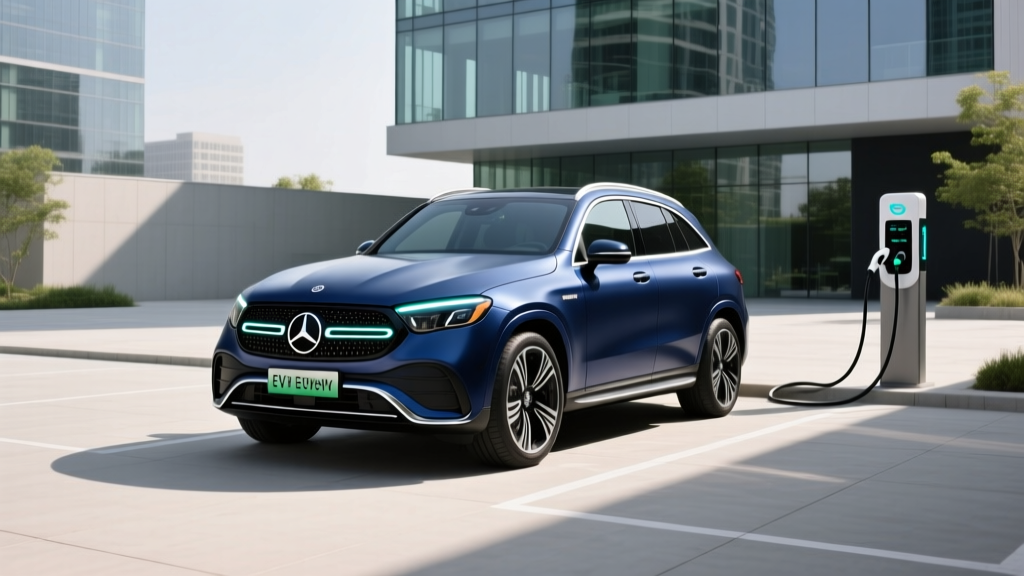
If you are researching the new GLC electric variant (Mercedes-Benz's upcoming electric compact luxury SUV built on the MMA platform, often previewed as the Concept CLA-Class SUV or a GLC-equivalent EV), the practical answer is this: expect an EPA-estimated range between 280 and 320 miles for the dual-motor AWD trims, a starting MSRP hovering around $62,000 to $68,000, and DC fast-charging capability peaking near 250 kW on an 800-volt architecture. Real-world highway range will likely land closer to 250–280 miles, and cold-weather efficiency losses of 20–30% are typical for this segment. Federal §30D tax credit eligibility is uncertain until final battery sourcing is confirmed by Mercedes-Benz and validated against current IRS rules.
Quick Answer: Should You Wait for the New GLC Electric?
Buy the gas GLC now if: You need a vehicle immediately, frequently tow more than 3,500 lbs, or live in a region with sparse DC fast-charging infrastructure.
Wait for the new GLC electric if: You have home Level 2 charging access, drive under 300 miles daily, want lower running costs, and can wait for 2026/2027 model availability and confirmed tax-credit eligibility.
What Is the New GLC Electric, Exactly?
Mercedes-Benz is restructuring its EV naming convention. The current EQC (sold in limited markets and effectively discontinued in the U.S.) is being replaced by a new generation of electric SUVs built on the Mercedes Modular Architecture (MMA). This platform supports an 800-volt electrical system, next-generation battery chemistries including LFP (lithium iron phosphate) for base trims and NMC (nickel manganese cobalt) for long-range variants, and significantly improved efficiency targets of approximately 4.0–4.5 miles per kWh.
The new GLC-class electric SUV is expected to slot between the smaller GLA/GLB-class EVs and the larger EQE/EQS SUVs. It directly competes with the BMW iX3 (next generation), Audi Q6 e-tron, Tesla Model Y, and the Genesis Electrified GV70. Unlike the outgoing EQC, which used a modified MFA2 platform adapted for electrification, the MMA platform is EV-native — meaning better interior packaging, a lower center of gravity, and more efficient thermal management.
Projected Specs: Range, Battery, and Charging
Because the production version has not been officially released in the U.S. as of early 2026, the following figures are based on Mercedes-Benz's announced MMA platform targets, European WLTP previews, and industry analysis. EPA estimates will differ from WLTP, typically running 10–15% lower.
| Specification | Base RWD (Est.) | Dual-Motor AWD (Est.) | Performance AWD (Est.) |
|---|---|---|---|
| Battery (usable kWh) | ~72 kWh (LFP) | ~85 kWh (NMC) | ~85 kWh (NMC) |
| EPA Range (est.) | ~310 mi | ~290 mi | ~270 mi |
| Real-World Highway Range | ~270 mi | ~250 mi | ~230 mi |
| Peak DC Charge Rate | ~220 kW | ~250 kW | ~250 kW |
| 10–80% DC Charge Time | ~28 min | ~22 min | ~22 min |
| Level 2 AC Charge (11 kW) | ~7.5 hrs | ~8.5 hrs | ~8.5 hrs |
| 0–60 mph | ~6.8 sec | ~5.2 sec | ~3.9 sec |
| Horsepower | ~268 hp | ~380 hp | ~490 hp |
| Connector | NACS (native Tesla Supercharger access expected) | ||
Real-World Range Reality Check
The EPA sticker will show one number; your actual experience will vary. On a 75°F day at 65 mph on flat terrain, expect to achieve roughly 90–95% of the EPA estimate. At 80 mph, drop that to 80–85%. In 20°F winter conditions with cabin heating, plan for 65–80% of the EPA figure — meaning a 290-mile EPA rating could deliver as little as 190–230 miles. The MMA platform's standard heat pump should mitigate this somewhat compared to resistive heating, but physics is physics.
EV vs. Gas GLC: Total Cost of Ownership
The most common question from buyers cross-shopping the new GLC electric against the conventional GLC 300 (2.0L turbo, 258 hp, EPA 27 mpg combined) is whether the EV premium pays for itself. Here's a realistic 5-year breakdown assuming 12,000 miles/year and national-average energy costs.
| Cost Category | GLC Electric (AWD Est.) | GLC 300 Gas (AWD) |
|---|---|---|
| Base MSRP | $65,000 | $49,500 |
| Federal Tax Credit (§30D) | $0–$7,500 (pending sourcing) | $0 |
| Effective Purchase Price | $57,500–$65,000 | $49,500 |
| Fuel/Energy (5 yrs, 60k mi) | $3,600–$5,400 | $9,900 |
| Maintenance (5 yrs) | ~$1,800 | ~$4,200 |
| Insurance (5 yrs avg.) | ~$11,400 | ~$9,600 |
| Estimated Depreciation | ~$26,000 | ~$22,000 |
| 5-Year Total | $100,300–$107,000 | $95,200 |
Key takeaways: The EV saves roughly $4,500–$6,300 in fuel and $2,400 in maintenance over five years. However, higher insurance premiums (typically 15–25% more for luxury EVs), a higher purchase price, and potentially steeper depreciation narrow the gap. If the full $7,500 §30D credit applies, the EV's 5-year cost drops to roughly $92,800–$99,500, making it competitive or cheaper. Without the credit, the gas GLC remains less expensive to own over five years for most buyers.
For detailed EPA data on the current GLC lineup, see fueleconomy.gov. For current §30D credit rules including MSRP caps ($80,000 for SUVs), buyer income limits ($300,000 MFJ / $150,000 single), and battery-sourcing requirements, consult the IRS clean vehicle credits page.
Charging at Home and on the Road
The new GLC electric is expected to ship with a native NACS (North American Charging Standard) port, giving it direct access to Tesla's Supercharger network — currently the most reliable DC fast-charging infrastructure in the U.S. with over 25,000 stalls. This is a significant advantage over CCS-only vehicles that rely on Electrify America or EVgo, where uptime and connector reliability remain inconsistent.
Home Charging: What You Actually Need
Most GLC electric buyers will need a Level 2 home charger to make ownership practical. Here's what that entails:
- Equipment: A 48-amp Level 2 wallbox (e.g., ChargePoint Home Flex, Tesla Wall Connector) costs $500–$800.
- Electrical panel: You need a 240V/60A circuit. If your panel is maxed out (common in older homes with 100A service), a panel upgrade to 200A runs $1,500–$3,500.
- Installation: Licensed electrician labor for a straightforward run is $600–$1,500; complex runs through walls or long conduit distances push this to $2,000–$4,000.
- Total typical cost: $1,100–$2,300 for a simple install; $2,500–$5,500 if a panel upgrade is needed.
- Charging speed at home: At 11.5 kW, you'll recover approximately 35–40 miles of range per hour — enough to fully recharge overnight from a 30% state of charge.
If you cannot install a home charger (apartment living, street parking), public Level 2 and DC fast-charging must cover your needs. At current public DC fast-charging prices of $0.35–$0.55/kWh, your "fuel" cost rises to $0.09–$0.14 per mile — approaching the gas GLC's $0.14–$0.17/mile at $3.70/gallon. Home charging at $0.13–$0.18/kWh is where the real savings live: roughly $0.03–$0.05 per mile.
Tax Credit Eligibility: The §30D Minefield
The federal §30D clean vehicle credit offers up to $7,500 for qualifying new EVs, but eligibility is not guaranteed for the new GLC electric. Here's the checklist as of 2026:
- MSRP cap: Vehicle MSRP must not exceed $80,000 for SUVs (the GLC electric should clear this).
- Buyer income cap: Modified AGI must be ≤$300,000 (married filing jointly), ≤$225,000 (head of household), or ≤$150,000 (single).
- Battery sourcing: At least 80% of critical minerals must be sourced from the U.S. or FTA partners; 100% of battery components must be manufactured or assembled in North America (phased in through 2028). Mercedes-Benz has not yet confirmed whether the MMA battery packs will meet these thresholds.
- FEOC restriction: No battery components or critical minerals from a "foreign entity of concern" (primarily targeting Chinese supply chains).
- Point-of-sale transfer: If eligible, the credit can be applied at purchase to reduce the sale price directly.
Given Mercedes-Benz's global supply chain, there is a realistic possibility that some trims or model years will qualify for only $3,750 (meeting one of two sourcing thresholds) or $0. Confirm eligibility on the IRS website or with your dealer at the time of purchase — do not assume the full credit.
Common Misconceptions About the GLC Electric
| Myth | Fact |
|---|---|
| "It's a self-driving car." | Mercedes-Benz Drive Pilot is a Level 2 driver-assistance system (Level 3 in very limited, approved conditions in Nevada and California at speeds under 40 mph). You must remain engaged and ready to take over at all times. This is not Level 4 autonomy. |
| "The battery will need replacing in 5 years." | Modern NMC and LFP packs are warrantied for 8 years/100,000 miles (minimum 70% capacity retention per federal mandate). Real-world degradation data from similar platforms shows approximately 8–12% capacity loss over 8 years with normal use. |
| "I'll save $7,500 no matter what." | The §30D credit depends on battery sourcing, your income, and the vehicle's MSRP. Many luxury EVs have failed to qualify for the full amount since 2024 sourcing rules tightened. |
| "Fast charging always takes 15 minutes." | The peak 250 kW rate applies only between roughly 10–40% state of charge. Above 80%, charging slows dramatically to protect the battery. A full 10–80% session takes approximately 22 minutes; 10–100% can take 45+ minutes. |
| "It charges on any network." | With a native NACS port, you'll have access to Tesla Superchargers and NACS-equipped public stations. CCS-only stations will require an adapter (if provided). CHAdeMO stations are essentially irrelevant for this vehicle. |
Decision Framework: Is the New GLC Electric Right for You?
Choose the GLC Electric If:
- You have reliable home Level 2 charging or workplace charging.
- Your daily driving is under 150 miles round-trip, with occasional 250-mile road trips.
- You value low operating costs and minimal scheduled maintenance.
- You live in a state with additional EV incentives (check AFDC state incentive database).
- You want access to Tesla Superchargers via NACS without adapters.
Choose the Gas GLC 300 If:
- You lack home charging and public infrastructure in your area is sparse.
- You regularly drive in extreme cold (below 10°F) where range loss exceeds 30%.
- You tow frequently (the gas GLC rates up to 3,500 lbs; the EV's rating is TBD but typically lower for this class).
- You need a vehicle now and cannot wait for production ramp-up.
- Your 5-year ownership budget prioritizes lower upfront cost over operating savings.
Frequently Asked Questions
When will the new GLC electric be available in the U.S.?
Mercedes-Benz has announced the MMA platform with production beginning in 2025 for European markets. U.S. deliveries of the GLC-class electric SUV are expected in late 2026 as a 2027 model year vehicle. Exact timing depends on EPA certification and homologation.
Will the GLC electric qualify for the $7,500 federal tax credit?
It depends on final battery sourcing decisions. The MSRP and vehicle classification are likely to qualify, but the critical-minerals and battery-component sourcing requirements under §30D are stringent. Mercedes-Benz has not confirmed compliance. Check the fueleconomy.gov tax credit lookup once the vehicle is officially listed.
How does it compare to the Tesla Model Y?
The Model Y Long Range AWD offers 310 miles EPA range, starts at approximately $48,000, charges at up to 250 kW (10–80% in ~20 min), and qualifies for the full $7,500 credit. The GLC electric will cost significantly more but offers a more premium interior, Mercedes-Benz's MBUX infotainment, and a more traditional luxury SUV driving character. If budget is the primary driver, the Model Y wins on value. If luxury and brand prestige matter, the GLC electric fills a gap Tesla does not address.
What's the warranty on the battery?
Expect Mercedes-Benz's standard EV warranty: 8 years or 100,000 miles, whichever comes first, with a minimum 70% state-of-health guarantee. This is consistent across the luxury EV segment and mandated as a baseline by federal emissions warranty rules.
Can I charge at Tesla Superchargers?
Yes — with the native NACS port expected on MMA-platform vehicles, you will have direct access to Tesla's Supercharger network without an adapter, using the Mercedes me app or Tesla's app for payment and session management.