Quick Answer: Should You Buy a New BMW Electric Vehicle?
BMW's 2026 EV lineup — the i4, i5, i7, and iX — targets buyers who want BMW driving dynamics in an electric package. Prices range from roughly $52,200 (i4 eDrive35) to $124,200 (i7 M70). EPA range spans 263–321 miles depending on model and trim. All models charge on the NACS connector with access to the Tesla Supercharger network. However, due to BMW's battery sourcing, most 2026 BMW EVs do not qualify for the full $7,500 §30D federal tax credit — a critical factor that changes the value equation versus gas BMWs and competitors like Tesla and Hyundai that do qualify.
The 2026 BMW EV Lineup: Specs at a Glance
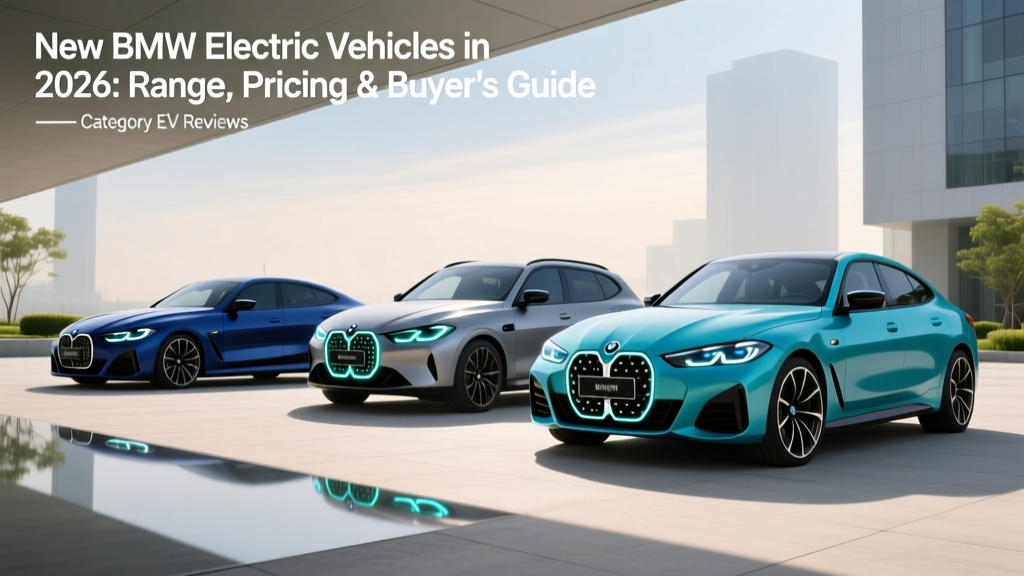
BMW has consolidated its electric portfolio around the i4 sedan, i5 midsize sedan, i7 flagship luxury sedan, and iX SUV. The i3 compact has been discontinued, and the next-generation i3 (Neue Klasse) is not expected until 2027. Here is exactly what you can buy today:
| Model | Trim | Battery (kWh usable) | EPA Range | Peak DC Charge | 10–80% | 0–60 mph | HP | Base MSRP |
|---|---|---|---|---|---|---|---|---|
| i4 | eDrive35 | 70.2 (NMC) | 301 mi | 180 kW | ~31 min | 5.5 sec | 281 | $52,200 |
| i4 | eDrive40 | 81.5 (NMC) | 318 mi | 200 kW | ~28 min | 5.5 sec | 335 | $57,200 |
| i4 | M50 | 81.5 (NMC) | 263 mi | 200 kW | ~28 min | 3.7 sec | 536 | $67,300 |
| i5 | eDrive40 | 81.2 (NMC) | 295 mi | 205 kW | ~30 min | 5.7 sec | 335 | $66,800 |
| i5 | xDrive40 | 81.2 (NMC) | 266 mi | 205 kW | ~30 min | 4.4 sec | 389 | $70,200 |
| i5 | M60 | 81.2 (NMC) | 256 mi | 205 kW | ~30 min | 3.7 sec | 593 | $84,100 |
| i7 | eDrive50 | 101.7 (NMC) | 318 mi | 195 kW | ~34 min | 5.4 sec | 449 | $105,700 |
| i7 | M70 | 101.7 (NMC) | 291 mi | 195 kW | ~34 min | 3.5 sec | 650 | $124,200 |
| iX | xDrive50 | 111.5 (NMC) | 321 mi | 195 kW | ~35 min | 4.4 sec | 516 | $87,100 |
| iX | M60 | 111.5 (NMC) | 288 mi | 195 kW | ~35 min | 3.6 sec | 610 | $108,900 |
Sources: EPA fueleconomy.gov, BMW USA spec sheets. All figures are manufacturer-estimated or EPA-rated for the 2026 model year. Actual range varies with temperature, terrain, and driving style.
Real-World Range: What the EPA Sticker Doesn't Tell You
EPA range estimates are a useful baseline, but BMW's EVs — like all EVs — lose efficiency under real-world conditions. Here is what to expect:
Real-World Range Expectations
Highway driving (70–80 mph): Expect a 10–15% reduction from EPA. An i4 eDrive40 rated at 318 miles will deliver roughly 270–285 miles on a sustained highway run.
Cold weather (below 32°F): NMC batteries lose 15–25% range in freezing temperatures without preconditioning. The iX xDrive50's 321-mile EPA rating can drop to 240–270 miles in January conditions. BMW's heat pump (standard on all models) mitigates cabin energy draw but does not eliminate the battery's cold-chemistry penalty.
Mountain/high-altitude driving: Regenerative braking partially recovers energy on descents, but sustained climbs can reduce range by 20–30%. Plan conservatively if you live in Colorado or the Sierras.
All BMW EVs use NMC (nickel manganese cobalt) chemistry, which offers higher energy density than LFP (lithium iron phosphate) but is more sensitive to extreme cold. BMW recommends preconditioning the battery — activated automatically when you navigate to a DC fast charger — to optimize the charge curve. Skip preconditioning, and your peak charge rate may drop from 200 kW to 80–100 kW in cold weather.
Charging Speed and the NACS Advantage
Starting with the 2025 model year, BMW transitioned to the NACS (North American Charging Standard) connector across all new EVs. This gives you native access to the Tesla Supercharger network — over 25,000 stalls in North America — without an adapter.
| Charging Level | Power (kW) | Approximate Miles Added per Hour | Best Use Case |
|---|---|---|---|
| Level 1 (120V household) | 1.4–1.9 kW | 3–5 miles | Overnight top-up, emergencies |
| Level 2 (240V home/public) | 7.4–11 kW | 20–35 miles | Daily home charging, workplace |
| DC Fast Charge | 180–205 kW (peak) | ~600–750 miles/hour equivalent | Road trips; 10–80% in 28–35 min |
Charge curve reality check: BMW's peak charge rates (180–205 kW depending on model) are sustained only between approximately 10–50% state of charge. Above 50%, the rate tapers progressively; above 80%, it drops to roughly 40–60 kW to protect battery health. This is why manufacturers quote 10–80% times rather than 0–100%. If you regularly charge past 80% on road trips, budget an extra 15–20 minutes for that final 20%.
For home charging, BMW's Wallbox Professional Level 2 unit delivers up to 11 kW (48 amps) on a 240V/60A circuit. Installation typically costs $800–$2,500 depending on panel capacity and run length. If your home has a 100-amp electrical panel, expect an additional $1,500–$3,000 for a panel upgrade to 200 amps — a common requirement in older homes.
The Tax Credit Problem: Why BMW EVs Are at a Disadvantage
This is the single most important financial consideration for new BMW electric vehicles in 2026, and it is where many buyers get surprised.
§30D Federal EV Tax Credit Requirements (2026)
- Income caps: AGI ≤ $150,000 (single), $225,000 (head of household), $300,000 (joint)
- MSRP caps: ≤ $55,000 for sedans (i4, i5, i7); ≤ $80,000 for SUVs (iX)
- Battery sourcing: Critical minerals and battery components must meet escalating domestic/free-trade-partner thresholds
- Assembly: Vehicle must undergo final assembly in North America
- Point-of-sale transfer: Credit can be applied at purchase or claimed on tax return
Here is where BMW EVs struggle: BMW assembles the i4 and i5 in Dingolfing, Germany, not in North America. The iX is also built in Dingolfing. The i7 is assembled in Germany as well. This means none of BMW's current EVs qualify for the §30D federal tax credit, regardless of your income or the vehicle's MSRP.
This is a massive $7,500 disadvantage compared to qualifying competitors. A Tesla Model 3 Long Range (assembled in Fremont, CA) or a Hyundai Ioniq 6 (assembled in Ellabell, GA) can qualify for the full $7,500 credit if you meet income and sourcing requirements. That credit can be transferred at the point of sale, effectively reducing the purchase price on the spot.
Always verify current eligibility on fueleconomy.gov and consult a tax professional. IRS rules under irs.gov are subject to change and include complex battery-sourcing requirements.
BMW EV vs. Gas BMW: 5-Year Cost of Ownership
Without the federal tax credit, the math shifts. Let's compare a 2026 BMW i4 eDrive40 against its closest gas counterpart, the BMW 430i Gran Coupe, over five years and 75,000 miles.
| Cost Category | BMW i4 eDrive40 (EV) | BMW 430i Gran Coupe (Gas) |
|---|---|---|
| Base MSRP | $57,200 | $49,900 |
| Federal Tax Credit | $0 (not eligible) | $0 |
| Effective Purchase Price | $57,200 | $49,900 |
| Energy/Fuel (75k miles) | $4,125 (home charging at $0.15/kWh) | $11,250 (30 MPG, $4.50/gal) |
| Maintenance (5 years) | $1,800 (no oil, fewer brake replacements) | $4,500 (oil, filters, brake pads) |
| Insurance (avg. 5 years) | $12,500 (EVs typically 15–20% higher) | $10,500 |
| Total 5-Year Cost | $75,625 | $76,150 |
The i4 breaks roughly even over five years — but only if you charge primarily at home. If you rely on public DC fast charging (averaging $0.40–$0.60/kWh), your energy cost jumps to $11,000–$16,500, making the EV significantly more expensive to operate than the gas car.
The iX tells a different story. Its $87,100 starting price is roughly $10,000 more than a gas BMW X5 xDrive40i, and the higher MSRP pushes insurance and depreciation costs up. Without the tax credit, the iX is a lifestyle and performance choice, not a cost-savings play.
Common Misconceptions About BMW EVs
| Myth | Fact |
|---|---|
| "BMW EVs are just gas BMWs with batteries stuffed in." | BMW uses a flexible CLAR platform that integrates the battery into the floor structure. While not a dedicated EV skateboard like Hyundai's E-GMP, the packaging is purposeful — low center of gravity, near 50/50 weight distribution, and standard adaptive suspension on most trims. |
| "I can charge to 100% every night without worry." | NMC batteries degrade faster when held at 100% for extended periods. BMW recommends setting a daily charge limit of 80–90% and charging to 100% only before long trips. The iDrive system lets you set this easily. |
| "BMW's battery will need replacing in 5 years." | BMW provides an 8-year/100,000-mile battery warranty guaranteeing at least 70% capacity retention. Independent data from older BMW i3 and i4 fleets shows degradation of approximately 8–12% over 100,000 miles — well within warranty thresholds. Full battery replacement, if ever needed, costs $15,000–$25,000 depending on model. |
| "I don't need home charging — public chargers are everywhere." | Public DC fast charging costs 2.5–4x more per kWh than home charging and adds wear to the battery from repeated high-rate charging. If you cannot install a Level 2 charger at home, a BMW EV becomes significantly more expensive and less convenient to own. |
Driving Dynamics: Where BMW Earns Its Reputation
BMW's electric vehicles are engineered to feel like BMWs first and EVs second. The i4 M50, for example, delivers 536 hp and a 3.7-second 0–60 time, but the real story is the chassis tuning. The adaptive M suspension, variable sport steering, and rear-biased all-wheel drive (on xDrive models) give these cars a tautness that competitors like the Tesla Model 3 and Mercedes EQE lack.
The iX M60 is a 5,500-pound SUV that hustles to 60 mph in 3.6 seconds, but it also rides with genuine compliance over rough pavement — a balance that few electric SUVs achieve. The air suspension is standard, and the cabin isolation at highway speed is exceptional.
One honest limitation: the i4 and i5, built on the CLAR architecture shared with gas models, have a transmission tunnel hump in the rear floor that compromises rear-seat footroom. A dedicated EV platform (like the upcoming Neue Klasse) would eliminate this. If rear-seat space matters, test-sit before buying.
BMW's Driver-Assistance Tech: Level 2, Not Self-Driving
SAE Automation Level: Level 2 (Partial Automation)
BMW's Driving Assistant Professional is a Level 2 driver-assistance system. It combines adaptive cruise control, lane-centering steering, and automatic lane changes on highways. You must keep your hands on the wheel and eyes on the road at all times. This is not autonomous driving — it is an advanced cruise and steering aid that reduces fatigue on long trips.
BMW's system is competent but trails Tesla's Autopilot in highway lane-change smoothness and falls short of GM's Super Cruise in hands-free highway capability (Super Cruise allows hands-off on pre-mapped divided highways; BMW does not). The i7 offers an optional Highway Assistant that permits hands-off driving at speeds up to 85 mph on select divided highways — but only when the system confirms driver attention via an interior camera. This is still classified as Level 2+ by SAE standards.
What BMW's Driving Assistant Does NOT Do
- Navigate city streets autonomously
- Stop at traffic lights or stop signs without driver input
- Allow you to look away from the road (the driver-monitoring camera will alert and disengage)
- Handle construction zones, unmapped roads, or severe weather reliably
Decision Framework: Is a BMW EV Right for You?
Choose a BMW EV If:
- You prioritize driving dynamics, build quality, and cabin refinement over maximum range-per-dollar
- You have access to home Level 2 charging (a 240V/48A circuit is ideal)
- You live in a region with reliable DC fast-charging infrastructure (Electrify America, Tesla Superchargers via NACS)
- You value BMW's dealer service network and can absorb higher insurance premiums
- The $7,500 tax credit is not a dealbreaker for your budget
Choose a Competitor If:
- You need the $7,500 federal tax credit to make the numbers work → consider Tesla Model 3/Y, Hyundai Ioniq 5/6, Ford F-150 Lightning, Chevrolet Equinox EV
- Maximum range is your top priority → Lucid Air (up to 516 mi EPA), Tesla Model S (402 mi EPA)
- You want a dedicated EV platform with flat-floor packaging and maximum interior volume → Hyundai Ioniq 5, Kia EV6, Rivian R1S
- You cannot install home charging and will rely on public infrastructure → consider a PHEV like the BMW X5 xDrive50e instead
Frequently Asked Questions
Do any new BMW electric vehicles qualify for the $7,500 federal tax credit in 2026?
No. As of 2026, all BMW EVs sold in the United States are assembled in Germany (Dingolfing plant), which disqualifies them from the §30D Clean Vehicle Credit regardless of MSRP or buyer income. BMW's planned Mexican EV production (Neue Klasse) is not yet online. Some state-level incentives may still apply — check your state's energy office or afdc.energy.gov for local programs.
How does a BMW EV compare to a Tesla in terms of charging convenience?
With the 2025 transition to NACS connectors, BMW EVs now have native access to Tesla Supercharger stalls. This is a major improvement over the previous CCS-only setup. However, Tesla's integrated navigation-to-charger preconditioning and payment ecosystem remains more seamless than BMW's iDrive charging integration. Expect to use the BMW app or the Supercharger app separately.
What is the real-world highway range of the BMW i4 eDrive40?
The EPA rates the i4 eDrive40 at 318 miles. In real-world highway testing at 70–75 mph in moderate temperatures (60–75°F), expect approximately 275–290 miles. In cold weather (below 32°F), that drops to roughly 240–265 miles. The i4's relatively efficient 3.5–3.8 kWh/mile consumption helps, but aerodynamic drag at highway speed is the primary range killer for all EVs.
Is BMW's battery warranty competitive?
BMW's 8-year/100,000-mile battery warranty with a 70% capacity retention guarantee is industry-standard. It matches Tesla, Hyundai/Kia, and Ford. Some competitors, like Rivian, offer the same terms. It is not best-in-class — Tesla also provides 8 years but with unlimited miles on some models — but it is adequate. Independent fleet data shows BMW's NMC packs degrade approximately 8–12% over 100,000 miles, well within the warranty threshold.
Should I buy a BMW EV or a BMW plug-in hybrid?
If you cannot charge at home, frequently drive more than 300 miles in a single day, or live in an area with sparse DC fast-charging infrastructure, a BMW PHEV like the X5 xDrive50e (38 miles electric-only range, then seamless gas operation) may be the more practical choice. If you charge at home and your daily commute is under 200 miles, the EV saves significantly on fuel and maintenance over time — assuming you accept the higher upfront cost and the lack of a federal tax credit.
What does it cost to charge a BMW EV at home vs. public chargers?
At the national average residential electricity rate of $0.16/kWh, fully charging an i4 eDrive40's 81.5 kWh battery costs approximately $13.04 — good for roughly 270 real-world miles, or about $0.048 per mile. Public DC fast charging averages $0.40–$0.60/kWh, pushing the cost to $32–$49 per full charge, or $0.12–$0.18 per mile. By comparison, a BMW 430i at 30 MPG and $4.50/gallon costs about $0.15 per mile. Home charging is the economic linchpin of EV ownership.
Bottom Line
BMW's 2026 electric vehicles are genuinely well-engineered cars that deliver the brand's hallmark driving dynamics in electric form. The i4 is a compelling sport sedan, the i5 fills the midsize luxury niche, the i7 is a legitimate S-Class EV rival, and the iX is one of the best-driving electric SUVs available. The NACS connector and Supercharger access resolve the previous charging-network concern.
However, the inability to access the $7,500 federal tax credit places BMW EVs at a concrete financial disadvantage versus domestically assembled competitors. Buyers should run the numbers carefully: if you can charge at home, the five-year total cost of ownership is competitive; if you rely on public charging, the math tilts toward gas or a qualifying EV. Test-drive the car, verify your home electrical capacity for Level 2 installation, and check your state's incentive programs before signing.