Quick Answer: Is the Mustang Mach-E Interior Worth the Switch?
The 2026 Ford Mustang Mach-E pairs a spacious, tech-forward cabin — anchored by a 15.5-inch portrait SYNC 4A touchscreen, 16.5 cubic feet of rear cargo (57.6 cu ft folded), and a front trunk (frunk) — with EPA ranges up to 320 miles on the Extended Range RWD model. Starting at $39,995 before incentives, the Mach-E's interior quality and daily drivability rival gas crossovers in its class, while its EV powertrain cuts per-mile fuel costs roughly in half for buyers with Level 2 home charging access. The trade-off: some hard-touch plastics on lower door panels and a learning curve with the screen-dependent HVAC controls.
If you've searched for electric Mustang interior details, you're likely weighing the Mach-E against traditional pony-car expectations — or against rivals like the Tesla Model Y, Hyundai IONIQ 5, and Chevrolet Equinox EV. This guide walks through the cabin experience, real-world ownership economics, and the specific numbers you need before committing to Ford's electric Mustang.
Inside the 2026 Mach-E: Cabin Layout and Materials
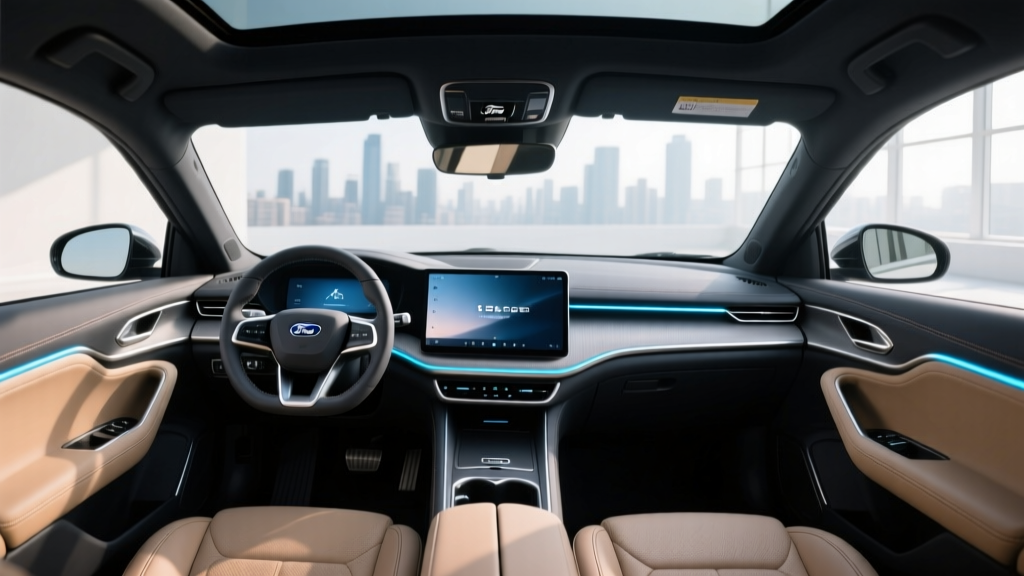
Ford designed the Mach-E interior around a floating 15.5-inch portrait touchscreen running SYNC 4A, which handles navigation, climate, media, and vehicle settings. A 10.2-inch digital instrument cluster sits behind the steering wheel, showing speed, range, and driver-assist status. The minimalist dashboard uses a mix of soft-touch materials on the upper surfaces and a fabric-wrapped instrument panel that gives the cabin a modern, airy feel.
Front passengers get 43.3 inches of legroom and 40.4 inches of headroom (with the panoramic fixed-glass roof, which slightly reduces headroom to 39.3 inches). Rear-seat passengers have 38.9 inches of legroom — competitive with the Tesla Model Y's 41.6 inches but tighter than a midsize SUV like the Hyundai Palisade. Three adults across the back bench is tight; two adults ride comfortably with a fold-down center armrest.
Materials quality lands in the upper-middle tier of the compact electric crossover segment. The upper dashboard and door uppers feature soft-touch padding, while lower door pockets and the center console sides use harder plastics — a cost-saving choice Ford shares with most rivals in this price bracket. The ActiveX synthetic leather seats (standard on most trims) are durable and easy to clean, though some buyers prefer the optional perforated ActiveX with contrast stitching on the Premium trim.
Screen, Software, and the Digital Cockpit Experience
The SYNC 4A system is one of the Mach-E's strongest interior selling points. Wireless Apple CarPlay and Android Auto are standard, and the native navigation includes EV-specific route planning that factors in battery state of charge, elevation, and available DC fast chargers along your route. The system supports over-the-air (OTA) updates, meaning Ford has progressively refined the interface since the 2021 launch year.
One common critique: climate controls live entirely on the touchscreen. There are no physical knobs for temperature or fan speed, which frustrates some drivers who prefer tactile feedback. Ford did add a small volume knob below the screen in recent model years, addressing one of the most frequent complaints. The available head-up display (standard on GT trims) projects speed and navigation directions onto the windshield, partially offsetting the need to glance down at the cluster.
Ford's BlueCruise hands-free highway driving system (SAE Level 2 — driver must remain attentive) works on over 130,000 miles of pre-mapped divided highways. It's a strong competitor to GM's Super Cruise, though it requires an active subscription after the initial trial period. NHTSA reminds buyers that Level 2 systems require continuous driver supervision; these are not self-driving systems.
Cargo, Frunk, and Practical Storage Numbers
The Mach-E offers 29.7 cubic feet of cargo space behind the rear seats and 57.6 cubic feet with the rear seats folded flat, according to fueleconomy.gov. That's competitive with the Tesla Model Y (30.2 / 72.1 cu ft) but less than the Hyundai IONIQ 5 (27.2 / 59.3 cu ft with seats folded — though the IONIQ 5 has a more usable rectangular load floor).
The front trunk (frunk) adds a drainable storage compartment ideal for wet gear, charging cables, or a small cooler. It's a feature gas Mustangs obviously can't match, and it's one of the everyday conveniences EV buyers quickly come to rely on. A power liftgate is standard on Premium and GT trims, optional on Select.
Range, Charging, and Efficiency: The Numbers That Matter
The 2026 Mustang Mach-E lineup offers multiple battery and drivetrain configurations. Here are the key specifications:
| Trim / Config | Battery (kWh usable) | Chemistry | EPA Range (mi) | Real-World Expectation | Peak DC Charge (kW) | 10–80% Time | 0–60 mph | Base MSRP |
|---|---|---|---|---|---|---|---|---|
| Select RWD (Standard Range) | 75.7 | NMC | 250 | ~210–230 mi (hwy/cold) | 150 kW | ~38 min | 6.3 sec | $39,995 |
| Premium RWD (Extended Range) | 91.0 | NMC | 320 | ~270–295 mi (hwy/cold) | 150 kW | ~41 min | 5.8 sec | $46,995 |
| Premium AWD (Extended Range) | 91.0 | NMC | 290 | ~245–265 mi | 150 kW | ~41 min | 5.1 sec | $49,995 |
| GT AWD (Extended Range) | 91.0 | NMC | 280 | ~240–260 mi | 150 kW | ~41 min | 3.5 sec | $59,995 |
Real-world range caveat: EPA estimates assume mixed driving. On sustained highway trips at 75 mph, expect 10–15% less range. In freezing temperatures (below 32°F), range can drop 20–30% due to battery heating demands and cabin HVAC load. The Mach-E's heat pump (standard on Extended Range models) partially mitigates cold-weather losses, but buyers in northern climates should budget for this reduction.
Charging curve reality: The 150 kW peak DC fast-charge rate is sustained roughly from 10% to 50% state of charge, then tapers progressively. A 10–80% session at a 150+ kW Electrify America or Tesla Supercharger (with NACS adapter) takes approximately 38–41 minutes. Charging above 80% slows dramatically to protect battery longevity — plan to charge to 80% on road trips and move on.
Level 2 home charging at 48 amps (11.5 kW) on a Ford Connected Charge Station or equivalent adds roughly 30 miles of range per hour, meaning a full Standard Range battery replenishes in about 8 hours and an Extended Range in roughly 10 hours. This is the backbone of daily EV ownership: plug in at night, wake up with a full battery.
Ownership Costs: Mach-E vs. Gas Crossover Comparison
The Mach-E competes on price with gas crossovers like the Honda CR-V Hybrid, Toyota RAV4, and Subaru Outback — but the ownership math shifts significantly when you factor in fuel, maintenance, and available tax credits.
| Cost Factor (5-Year Estimate) | Mustang Mach-E Premium RWD | Toyota RAV4 XLE AWD (Gas) | Toyota RAV4 Prime (PHEV) |
|---|---|---|---|
| Base MSRP | $46,995 | $33,995 | $43,690 |
| Est. Federal Tax Credit (§30D) | Up to $7,500* | $0 | Up to $7,500* |
| Effective Purchase Price | ~$39,495 | $33,995 | ~$36,190 |
| Fuel / Energy (5 yr, 75K mi) | ~$4,200 (home charging)** | ~$9,400 (gas @ $3.50/gal, 28 MPG) | ~$5,800 (mixed gas + electric) |
| Maintenance (5 yr) | ~$1,800 | ~$3,600 | ~$3,000 |
| Insurance (5 yr avg) | ~$9,500 | ~$7,200 | ~$8,100 |
| 5-Year Total Cost (est.) | ~$54,995 | ~$54,195 | ~$53,090 |
* Federal EV tax credit eligibility under IRS §30D depends on buyer income caps ($150K single / $300K joint), vehicle MSRP caps ($55K for SUVs/crossovers), and battery critical-mineral and component sourcing requirements. Point-of-sale transfer is available at participating dealers. Always verify current-year eligibility with a tax professional.
** Home charging cost assumes $0.14/kWh national average electricity rate. Public DC fast charging costs significantly more ($0.35–$0.55/kWh), which would raise the Mach-E 5-year energy cost to approximately $6,500–$8,000 if used exclusively.
The takeaway: the Mach-E's higher sticker price is substantially offset by the tax credit and dramatically lower energy and maintenance costs. Over five years, total cost of ownership is nearly identical to a gas RAV4 — and the gap widens further in years 6–10 as EV maintenance stays low while gas powertrains require increasing service.
Common Misconceptions About the Mach-E (and EVs Generally)
| Myth | Fact |
|---|---|
| "The battery will need replacement in 5 years." | Ford's high-voltage battery warranty covers 8 years / 100,000 miles with a capacity retention threshold of 70%. Real-world NMC degradation data shows most EV batteries retain 85–90% capacity at 100K miles. Replacement is rare and costs $12,000–$18,000 if needed out of warranty. |
| "You can't road-trip in an EV." | With 150 kW DC fast charging and the expanding Tesla Supercharger network (accessible via Ford's included NACS adapter on 2025+ models), road-tripping is practical. A 300-mile trip requires one 25–30 minute charging stop. |
| "EVs are worse in winter." | Range drops 20–30% in freezing temps — this is real. But the Mach-E's heat pump, battery preconditioning, and heated seats/steering wheel make it fully functional. Many cold-climate owners report no issues with daily commuting when home charging is available. |
| "The Mach-E isn't a 'real' Mustang." | The GT Performance Edition hits 480 hp and 3.5-second 0–60 times — faster than most V8 gas Mustangs. The nameplate is controversial among enthusiasts, but the performance numbers are real. |
| "I need a special electrical panel to charge at home." | A standard 240V / 60-amp circuit (NEMA 14-50) supports Level 2 charging at up to 48 amps. Most homes with a 200-amp electrical panel can accommodate this without a panel upgrade, though installation costs $800–$2,000 depending on wiring distance. A licensed electrician should assess your panel. |
Decision Framework: Is the Mach-E the Right EV for You?
Choose the Mustang Mach-E if:
- You have access to Level 2 home charging (garage, driveway, or workplace) and drive under 80 miles per day — meaning you'll rarely need public charging.
- You value a mainstream dealer network for service and warranty work, rather than Tesla's direct-to-consumer model.
- You want a crossover with car-like driving dynamics, strong acceleration (especially the GT), and a tech-forward interior without paying luxury-brand prices.
- You qualify for the §30D federal tax credit (income and MSRP caps met) or live in a state with additional EV rebates.
Consider a different vehicle if:
- You live in an apartment or lack reliable home/workplace charging and your area has sparse public DC fast-charging infrastructure. A plug-in hybrid like the RAV4 Prime may suit you better.
- You regularly tow over 2,500 lbs (the Mach-E maxes out at 1,500 lbs for Standard Range and 2,200 lbs for Extended Range — less than many gas SUVs).
- You need three-row seating or maximum cargo volume — look at the Kia EV9 or Rivian R1S instead.
- You prioritize the absolute fastest DC charging speeds. The Hyundai IONIQ 5 and Kia EV6 peak at 240 kW on 800V architecture, delivering 10–80% in ~18 minutes vs. the Mach-E's ~40 minutes.
First-Time EV Buyer Essentials
If the Mach-E is your first electric vehicle, here's what to prepare for:
- Install a Level 2 home charger before delivery day. Budget $800–$2,000 for a licensed electrician to install a 240V outlet or hardwired EVSE. This single step transforms EV ownership from a hassle into a convenience.
- Set your charge limit to 80% for daily driving. NMC batteries last longest when not held at 100% for extended periods. Charge to 100% only before long road trips.
- Download charging network apps now. FordPass integrates with major networks, but having Electrify America, EVgo, and ChargePoint apps on your phone ensures you can activate chargers anywhere.
- Use preconditioning. The Mach-E can warm or cool its battery while plugged in before a drive or fast-charge session, improving efficiency and charging speed. Schedule this through the FordPass app.
- Expect insurance to be 15–25% higher than a comparable gas crossover. EV repair costs and parts pricing drive premiums up. Shop quotes before buying.
Frequently Asked Questions
Does the Mustang Mach-E qualify for the $7,500 federal tax credit in 2026?
Eligibility depends on the specific trim's MSRP (must be under $55,000 for SUVs under §30D), your adjusted gross income (under $150K single / $300K joint filer), and whether the battery meets critical-mineral and component sourcing thresholds. The Select and Premium RWD trims generally fall under the MSRP cap, while the GT at $59,995 exceeds it. Ford's dealer network supports point-of-sale credit transfer, reducing your purchase price at the dealership. Always confirm eligibility on the IRS clean vehicle credits page and with your tax professional.
How does the Mach-E interior compare to the Tesla Model Y?
The Mach-E offers a more traditional cockpit layout with a separate instrument cluster and more physical material variety. The Model Y is more minimalist (single center screen, no instrument cluster) and has slightly more rear legroom (41.6 vs. 38.9 inches) and cargo volume (72.1 vs. 57.6 cu ft). The Mach-E's SYNC 4A interface is more intuitive for first-time EV buyers, while Tesla's software ecosystem and Supercharger network remain advantages.
What's the real cost to charge a Mach-E at home?
The Extended Range battery holds 91 kWh usable. A full charge from 0–100% at the national average of $0.14/kWh costs approximately $12.74. Most daily driving uses 20–40 kWh (costing $2.80–$5.60), far less than the $15–$20 a gas car burns for equivalent miles. Over a year of 15,000 miles, home charging costs roughly $840 vs. $1,875 for gasoline at 28 MPG combined and $3.50/gallon.
Is the Mach-E battery liquid-cooled?
Yes. The Mach-E uses an active liquid thermal management system that heats and cools the high-voltage battery pack. This improves longevity, sustains fast-charging speeds, and maintains performance in extreme temperatures — a significant advantage over passive air-cooled EV batteries.
Can I use Tesla Superchargers with the Mach-E?
Yes. Starting with the 2025 model year, Ford includes a NACS adapter that allows Mach-E owners to access Tesla's Supercharger network (V3 and V4 stalls). The adapter supports up to the Mach-E's 150 kW peak charge rate. This dramatically expands the available DC fast-charging network, particularly in rural areas where Superchargers are often the only reliable option.