Can Your EV Really Tow an Electric Boat? The Quick Answer
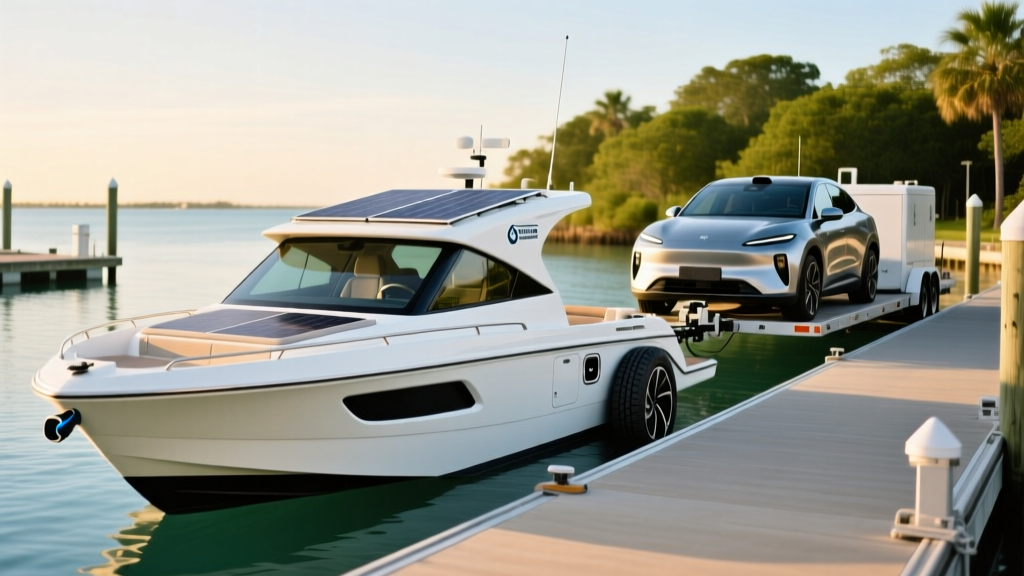
Short answer: Yes — several 2026 EVs can tow the lightweight electric boats produced by companies like St. Pete Beach Electric Boat Co., but expect a 30–50% reduction in driving range while towing. Most electric boats from boutique Gulf Coast manufacturers weigh between 1,500 and 3,500 lbs (including trailer), which falls within the towing capacity of popular electric trucks and SUVs like the Ford F-150 Lightning (7,700 lbs max), Rivian R1T (11,000 lbs max), and Hyundai Ioniq 5 (3,500 lbs with tow package). The critical numbers that matter: your EV's rated tow capacity, the combined weight of boat plus trailer, and how much range you're willing to sacrifice on the trip to the marina.
If you've been researching electric boating options along Florida's Gulf Coast — perhaps stumbling across St. Pete Beach Electric Boat Co. or similar boutique electric marine manufacturers — you've likely hit a second question immediately after the first: "Can I actually tow this thing with my electric vehicle?" This guide breaks down the real physics, costs, and ownership logistics of pairing an EV with a light electric boat, using hard numbers rather than marketing claims.
Understanding the Towing Math: EV Capacity vs. Electric Boat Weight
Electric boats from small Gulf Coast manufacturers typically use compact LFP (lithium iron phosphate) battery packs ranging from 10 to 40 kWh, powering electric outboard motors rated between 5 kW and 30 kW. These boats are significantly lighter than their gas-powered counterparts because they eliminate the heavy internal combustion engine, fuel tank, and exhaust systems. A typical 18–22 foot electric day boat from a boutique builder weighs 1,200–2,200 lbs dry. Add a galvanized or aluminum trailer (400–800 lbs), and your total towed weight lands between 1,600 and 3,000 lbs for most models.
| Vehicle (2026) | Max Tow Capacity | EPA Range | Est. Range While Towing 2,500 lbs | Battery (kWh) | Base MSRP |
|---|---|---|---|---|---|
| Ford F-150 Lightning (Ext. Range) | 7,700 lbs | 320 mi | ~175–210 mi | 131 kWh (NMC) | $62,995 |
| Rivian R1T (Dual Motor, Max Pack) | 11,000 lbs | 410 mi | ~230–275 mi | 141 kWh (NMC) | $87,900 |
| Chevrolet Silverado EV (4WT) | 8,000 lbs | 380 mi | ~210–250 mi | 200 kWh (NMC) | $62,300 |
| Hyundai Ioniq 5 (Tow Pkg) | 3,500 lbs | 305 mi | ~165–195 mi | 84 kWh (NMC) | $49,200 |
| Tesla Cybertruck (AWD) | 11,000 lbs | 340 mi | ~190–225 mi | 123 kWh (NMC) | $79,990 |
The range reduction during towing is not a mystery — it's physics. Pulling a trailer increases aerodynamic drag (the boat and trailer create a large, un-streamlined profile) and rolling resistance. EPA testing at fueleconomy.gov doesn't include towing scenarios, so manufacturer range estimates are for the vehicle alone. Independent testing by EV reviewers consistently shows a 30–50% range penalty when towing near half the vehicle's rated capacity.
The Real Cost: EV Towing vs. Gas Truck Towing
Towing is where EVs reveal their most interesting economic tradeoff: you'll burn through electricity faster than during normal driving, but the per-mile cost still undercuts gasoline in most markets. Here's the breakdown for a typical 40-mile round trip to a marina, towing a 2,500 lb boat-and-trailer combo:
| Vehicle | Efficiency While Towing | Energy Cost (FL Avg) | Trip Cost | Annual (26 trips) |
|---|---|---|---|---|
| F-150 Lightning (towing) | ~1.8 kWh/mi | $0.14/kWh (home) | $10.08 | $262 |
| F-150 Gas (3.5L EcoBoost, towing) | ~10 MPG | $3.15/gal | $12.60 | $328 |
| Rivian R1T (towing) | ~2.0 kWh/mi | $0.14/kWh (home) | $11.20 | $291 |
| Silverado Gas 5.3L (towing) | ~11 MPG | $3.15/gal | $11.45 | $298 |
Florida's average residential electricity rate hovers around $0.14/kWh as of early 2026 (check your local utility for exact rates). The savings per trip are modest — roughly $1–3 — but compound over a boating season. The bigger financial advantage of the EV emerges in maintenance: no transmission fluid, no spark plugs, no oil changes, and regenerative braking that extends pad life significantly, even under towing loads.
Real-World Ownership: What Marina Trips Actually Look Like
Towing an electric boat with an EV introduces logistical considerations that don't appear in spec sheets. Here's what first-time buyers should map out before committing:
Home Charging Is Non-Negotiable for Towing Duty
If you plan to tow regularly, a Level 2 home charger (240V, 32–48 amps, delivering 7.7–11.5 kW) is essential. After a towing trip that depletes 40–50% of your battery, you need to recover that energy overnight. A Level 2 charger adds roughly 25–35 miles of range per hour, meaning an 8-hour overnight session restores 200–280 miles — enough for most towing scenarios. Relying on Level 1 (120V, ~1.3 kW) would require 30+ hours to recover the same energy.
The Boat Ramp Charging Desert
Here's the honest limitation: most public boat ramps do not have EV charging infrastructure. If your marina trip depletes your battery below comfortable levels, you'll need to plan a DC fast-charging stop on the return route. The F-150 Lightning can accept up to 150 kW on DC fast chargers, adding roughly 100 miles of range in 20 minutes — but that's range for normal driving, not towing. The IRS §30D tax credit can help offset the cost of your EV purchase, but check current-year eligibility rules including MSRP caps ($80,000 for trucks, $55,000 for cars/SUVs), buyer income limits ($300,000 joint / $150,000 single), and battery sourcing requirements.
Florida Climate: A Hidden Advantage
One factor working in your favor along the Gulf Coast: warm weather preserves EV range. Cold-weather range loss (which can hit 20–30% in northern states) is essentially a non-issue in St. Petersburg, where winter lows rarely drop below 50°F. Your EPA-rated range holds much closer to real-world performance year-round compared to EV owners in the Midwest or Northeast.
First-Time EV Buyer Decision Framework: Is This the Right Setup?
Choose an EV for Boat Towing If:
- You have access to Level 2 home charging (garage or driveway with 240V circuit)
- Your boat + trailer combo weighs under 4,000 lbs (most electric day boats qualify)
- Your typical marina trip is under 80 miles one-way
- You want lower per-mile towing costs and reduced maintenance
- You value the ability to power boat accessories from your EV's V2L (vehicle-to-load) capability — the F-150 Lightning's Pro Power Onboard can run 2.4–9.6 kW of devices
Stick With Gas or Hybrid If:
- Your boat + trailer exceeds 5,000 lbs (larger vessels, heavy cabin cruisers)
- You frequently tow 150+ miles to remote lakes or coastal areas with sparse charging
- You lack home charging access and depend entirely on public infrastructure
- You need maximum range flexibility without route planning around DC fast chargers
Common Misconceptions About EVs and Towing
| Myth | Fact |
|---|---|
| "EVs can't tow anything heavy" | The Rivian R1T tows 11,000 lbs; the Cybertruck matches it. Electric motors deliver peak torque from 0 RPM, making them excellent tow vehicles. |
| "Towing will destroy the battery" | Towing increases cycle count but modern thermal management systems protect battery health. Expect normal degradation curves (8–12% over 8 years) even with regular towing. All major manufacturers warranty batteries for 8 years/100,000 miles minimum. |
| "You'll get stranded towing" | With proper trip planning and a 20% SoC buffer, modern EVs with 300+ mile range can handle 80–100 mile towing trips comfortably. Apps like A Better Routeplanner now include towing profiles. |
| "Electric boats are too heavy for EVs" | Electric boats are typically lighter than gas boats of the same length because electric drivetrains weigh far less than ICE engines plus fuel. A 20-foot electric day boat often weighs under 2,000 lbs. |
| "The tax credit covers any EV" | The §30D credit has strict MSRP caps, income limits, and battery mineral sourcing requirements. Many trucks qualify (up to $80K MSRP cap), but luxury trims can exceed limits. Always verify on irs.gov. |
Total 5-Year Ownership Cost: EV Truck vs. Gas Truck (With Towing)
Let's put real numbers to the ownership equation. This comparison assumes 12,000 miles/year of mixed driving (including 26 marina towing trips of 40 miles each), Florida electricity and gas prices, and standard insurance/maintenance estimates:
| Category | F-150 Lightning (Ext. Range) | F-150 Gas (3.5L EcoBoost) |
|---|---|---|
| Purchase Price (after est. §30D credit) | $55,495 | $54,000 |
| Fuel/Energy (5 years) | $5,800 | $10,200 |
| Maintenance (5 years) | $1,800 | $4,200 |
| Insurance (5 years) | $9,500 | $7,800 |
| Estimated Depreciation | $22,000 | $18,500 |
| 5-Year Total | $94,595 | $94,700 |
The totals are remarkably close — which is the honest story. EVs save significantly on fuel and maintenance but currently carry higher insurance premiums and steeper depreciation. The breakeven point shifts in the EV's favor if you can secure the full $7,500 federal tax credit, have access to cheap home electricity (under $0.12/kWh), or drive more than 15,000 miles annually.
What About the Electric Boat Itself?
If you're drawn to St. Pete Beach Electric Boat Co. or similar builders, the boat-side economics deserve equal scrutiny. Electric boats in the 18–22 foot range typically cost $25,000–$65,000 depending on battery size and motor power. Key specs to evaluate:
- Battery capacity: 10–40 kWh (LFP chemistry preferred for marine use — more cycle life, safer thermal profile, lower energy density trade-off is acceptable in a boat hull)
- Motor power: 5–30 kW continuous (equivalent to roughly 7–40 HP gas outboard)
- Range on water: 15–60 miles depending on speed and battery size (planing speed cuts range dramatically, just like MPG in a gas boat)
- Charging: Most electric boats charge from standard 120V or 240V shore power — a full charge takes 4–10 hours depending on pack size
- Maintenance advantage: No winterization, no fuel system, no impeller replacements, no lower unit gear oil. Annual maintenance costs drop to roughly $200–400 vs. $1,200–2,000 for gas outboards.
The synergy of an EV tow vehicle and an electric boat is compelling: both eliminate fossil fuel dependency, both have dramatically lower maintenance requirements, and both benefit from Florida's solar-rich grid (FPL's solar capacity continues expanding, making your electrons cleaner over time).
Frequently Asked Questions
Can I charge my EV while it's hooked up to the boat trailer?
Yes. The trailer connection doesn't interfere with the EV's charge port. You can plug in at home with the trailer attached, and many DC fast-charging stations have pull-through spots designed for vehicles towing trailers — though availability varies by network. Electrify America and Tesla Supercharger stations are increasingly adding pull-through configurations.
Does towing void my EV's battery warranty?
No. As long as you stay within the manufacturer's rated towing capacity, towing is a normal use case covered under the standard battery warranty (typically 8 years/100,000 miles with a 70% capacity retention threshold). Exceeding the rated tow capacity could potentially affect warranty claims.
What's the best EV for towing a small electric boat in Florida?
For boats under 3,000 lbs (trailer included), the Hyundai Ioniq 5 with tow package offers the best value at ~$49,200 MSRP and 305 miles EPA range. For heavier loads or longer trips, the Ford F-150 Lightning Extended Range provides 7,700 lbs towing capacity, V2L capability to power dock accessories, and 320 miles of range (expect ~180 while towing).
How does saltwater exposure affect EV towing components?
The EV itself is sealed against weather, but the hitch, wiring harness, and trailer brakes face the same corrosion risks as with any tow vehicle. Rinse the hitch and undercarriage with fresh water after boat ramp use in saltwater environments. Consider a stainless steel hitch receiver and dielectric grease on electrical connections.
Do I need a special driver's license to tow an electric boat with an EV?
No. In Florida, a standard Class E driver's license covers towing trailers under 10,000 lbs GVWR, which includes virtually all recreational electric boats and their trailers. No special endorsement is required.
What happens if my EV runs out of charge while towing?
The same thing that happens with a gas truck that runs out of fuel: you need roadside assistance. However, EVs provide extensive range warnings and will progressively limit power before complete shutdown. With a 20% SoC buffer habit and route planning apps, running out is avoidable. Most EV roadside assistance programs include flatbed towing to the nearest charger.