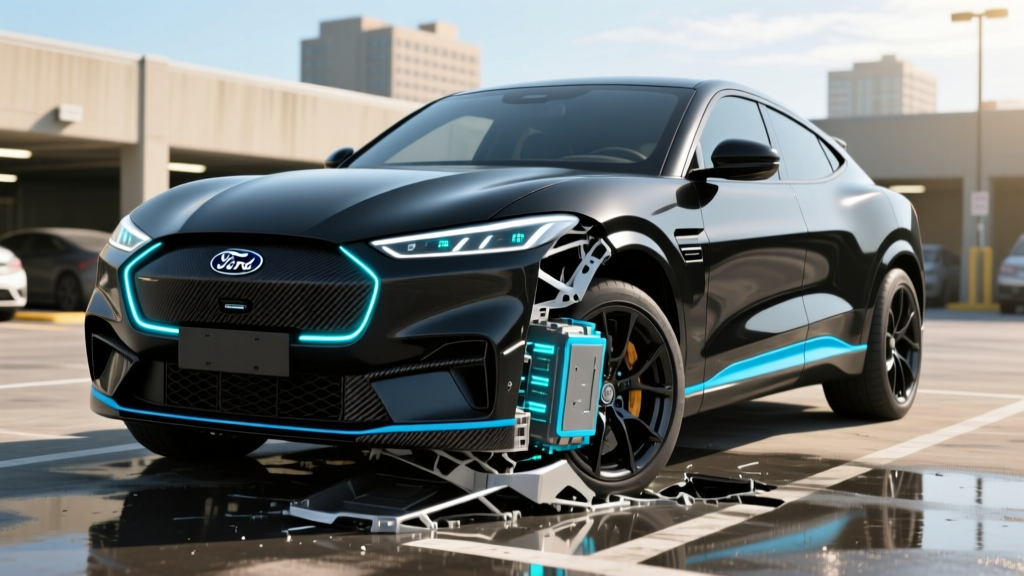
If you've searched "Mustang EV crash" you're likely weighing the safety of the Ford Mustang Mach-E against gas-powered alternatives — or reacting to a viral crash video. Here's the direct answer: the 2026 Ford Mustang Mach-E holds a 5-Star Overall NHTSA safety rating and an IIHS Top Safety Pick+ designation, placing it among the safest midsize electric SUVs on the road. EVs like the Mach-E carry structural advantages in crashes (low center of gravity, rigid battery enclosure) but introduce different post-collision considerations like high-voltage system isolation and battery replacement costs. Below, we break down every safety dimension with hard data.
Quick Safety Verdict: 2026 Mustang Mach-E
- NHTSA Overall: 5 Stars
- IIHS Rating: Top Safety Pick+ (when equipped with specific headlights)
- EV Fire Risk: Significantly lower than gasoline vehicles per NTSB data
- Key Concern: Post-crash battery repair costs can exceed $15,000–$25,000 if the pack is damaged
Crash Test Ratings: What the Data Actually Shows
The NHTSA awarded the Mustang Mach-E 5 stars overall, with 5 stars in frontal crash, 5 stars in side crash, and 4 stars in rollover resistance. The rigid battery pack mounted low in the chassis contributes to excellent structural integrity and a low rollover risk compared to similarly sized gas SUVs.
The Insurance Institute for Highway Safety (IIHS) named the Mach-E a Top Safety Pick+ when equipped with acceptable or good headlights. It earned "Good" ratings across all crashworthiness categories, including the updated moderate overlap front test — a stringent evaluation that many vehicles struggle with.
| Test | NHTSA | IIHS |
|---|---|---|
| Frontal Crash | 5 Stars | Good |
| Side Crash | 5 Stars | Good |
| Rollover | 4 Stars (14.9% risk) | N/A |
| Moderate Overlap Front (updated) | N/A | Good |
| Headlights | N/A | Acceptable/Good (trim-dependent) |
| Front Crash Prevention | N/A | Superior |
EV vs. Gas SUV Crash Safety: Structural Differences That Matter
Electric vehicles like the Mach-E differ fundamentally from gas-powered SUVs like the Ford Edge or Honda CR-V in crash dynamics. The battery pack — a 91 kWh usable NMC lithium-ion unit in the extended-range Mach-E — sits in a reinforced enclosure along the floor. This creates two measurable advantages:
- Lower center of gravity: Reduces rollover propensity. The Mach-E's 4-star rollover rating (14.9% risk) compares favorably to many gas SUVs in the same class.
- Increased structural rigidity: The battery enclosure acts as a stressed member, improving energy absorption in side impacts. There's no engine block to intrude into the cabin during frontal collisions — the front motor is compact, leaving more crumple zone.
| Metric | Mustang Mach-E (EV) | Ford Edge (Gas) | Honda CR-V (Gas) |
|---|---|---|---|
| NHTSA Overall | 5 Stars | 5 Stars | 5 Stars |
| Rollover Risk | 14.9% | 16.5% | 16.2% |
| Curb Weight | ~4,700 lbs | ~4,100 lbs | ~3,600 lbs |
| Fire Risk Post-Crash | Very Low | Higher (fuel system) | Higher (fuel system) |
| Front Crumple Zone | Extended (no large ICE block) | Standard | Standard |
One nuance: the Mach-E's extra weight (~600 lbs more than a comparable gas SUV) means it carries more kinetic energy in a collision. In a crash with a lighter vehicle, the heavier EV transfers more force to the other vehicle. This is physics, not a defect — it applies to all heavy vehicles, including large trucks and SUVs.
EV Battery Fire Risk: Separating Data from Headlines
Viral videos of EV fires create outsized perception of risk. The data tells a different story. According to National Transportation Safety Board analysis and AutoinsuranceEZ research using NTSB and Bureau of Transportation Statistics data:
- Gasoline vehicles: ~1,530 fires per 100,000 vehicles sold
- Hybrid vehicles: ~3,475 fires per 100,000 vehicles sold
- Electric vehicles: ~25 fires per 100,000 vehicles sold
EV battery fires are dramatically rarer but harder to extinguish when they occur. Lithium-ion thermal runaway requires specialized firefighting techniques —大量 water and extended cooling time. Most fire departments in major metro areas now train for this, but rural response may vary. Ford engineers designed the Mach-E's battery pack with individual cell isolation and a liquid cooling system to minimize thermal propagation risk.
| Myth | Fact |
|---|---|
| "EVs catch fire constantly" | EVs have ~1/60th the fire rate of gas vehicles per 100K sold |
| "A crash will cause an instant battery explosion" | Modern packs have cell-level isolation; thermal events typically develop slowly, allowing occupant evacuation |
| "First responders can't handle EV crashes" | Ford provides emergency response guides; most metro fire departments have high-voltage training |
| "EV repairs after a crash are impossible" | Body and suspension repairs are standard; battery damage is assessable but expensive if replacement is needed |
Post-Crash Costs: The Expensive Reality of Battery Damage
While the Mach-E excels at protecting occupants, post-crash economics can be brutal. If the battery enclosure is compromised or cells are damaged:
- Battery pack replacement: $15,000–$25,000+ depending on the extent of damage and whether modules can be individually replaced versus a full pack swap
- High-voltage system inspection: Mandatory after any significant collision, adding $1,000–$3,000 in diagnostic labor
- Insurance total-loss threshold: Many insurers total an EV when repair costs approach 70-75% of vehicle value — battery damage can push a moderate crash into total-loss territory
The Mach-E's 8-year/100,000-mile battery warranty covers defects and capacity loss below 70% but does not cover collision damage — that's your insurance company's responsibility. Before buying, verify that your insurer has clear EV repair protocols and that local body shops are certified for high-voltage vehicle work.
| Repair Category | Mustang Mach-E | Ford Edge (Gas) |
|---|---|---|
| Minor front-end (bumper, sensors) | $2,500–$5,000 | $1,800–$3,500 |
| Moderate front collision | $8,000–$18,000 | $5,000–$12,000 |
| Underbody/battery damage | $15,000–$25,000+ | $3,000–$8,000 (exhaust, fuel tank) |
| HV system diagnostic | $1,000–$3,000 | Not applicable |
| Average annual insurance premium | $2,400–$3,200 | $1,800–$2,400 |
ADAS and Crash Avoidance: Ford BlueCruise Capabilities
The best crash is the one that never happens. The 2026 Mach-E comes standard with Ford Co-Pilot360 2.0, which includes automatic emergency braking with pedestrian detection, blind-spot monitoring, rear cross-traffic alert, lane-keeping assist, and evasive steering assist.
SAE Automation Level: Level 2
Ford BlueCruise is a Level 2 driver-assistance system, not a self-driving feature. It provides hands-free driving on pre-mapped divided highways (over 130,000 miles of BlueCruise Hands-Free BlueZones), but the driver must remain attentive. A driver-facing camera monitors eye gaze and will issue warnings — then disengage — if you look away from the road. You are legally and physically responsible for the vehicle at all times.
BlueCruise earns high marks in IIHS front crash prevention evaluations, achieving "Superior" ratings for vehicle-to-vehicle and vehicle-to-pedestrian detection. The system can bring the Mach-E to a complete stop and can perform lane changes on command, but it will not navigate unmapped roads, construction zones, or complex urban intersections without full driver engagement.
What BlueCruise Does NOT Do
- Does not drive on non-divided highways or local streets hands-free
- Does not handle construction zones, temporary lane markings, or unmapped roads autonomously
- Does not eliminate driver responsibility — you must monitor traffic and road conditions
- Does not perform in severe weather (heavy rain, snow, fog) where sensor visibility is reduced
Ownership Cost Context: Safety Meets the Wallet
Safety ratings inform purchase decisions, but total ownership costs determine whether the Mach-E makes financial sense. Here's how a 2026 Mach-E Premium Extended Range AWD stacks up over 5 years:
| Category | Estimated Cost |
|---|---|
| Base MSRP | $48,995 |
| Federal Tax Credit (§30D, if eligible) | Up to $7,500 (income, MSRP, and battery sourcing rules apply — check IRS.gov) |
| Effective Purchase Price | ~$41,495 (with full credit) |
| Electricity (15,000 mi/yr, $0.16/kWh avg) | ~$4,200 over 5 years |
| Comparable Gas Cost (25 MPG, $3.40/gal) | ~$10,200 over 5 years |
| Maintenance (5 years) | ~$1,800 (no oil changes, fewer brake replacements) |
| Insurance (5 years) | ~$13,000–$16,000 |
| EPA Range | 312 miles (ER AWD) |
| Real-World Highway Range | ~250–270 miles; ~210–230 in cold weather |
The Mach-E's fuel savings (~$6,000 over 5 years vs. gas) partially offset its higher insurance premiums and potential post-crash battery repair costs. If you charge at home on a Level 2 system (7.7 kW home charger adds ~28 miles per hour of charging), your per-mile energy cost drops to roughly $0.05–$0.07, depending on your electricity rate.
Decision Framework: Should Crash Safety Data Change Your EV Choice?
Choose the Mustang Mach-E If:
- You prioritize top-tier crash ratings (5-star NHTSA, IIHS TSP+)
- You want an EV with a strong crumple zone design and low rollover risk
- You drive primarily in urban/suburban areas where collision speeds are moderate
- You have access to home Level 2 charging and a certified EV body shop nearby
- You qualify for the §30D federal tax credit (single filer MAGI ≤ $150K, joint ≤ $300K)
Reconsider or Compare Alternatives If:
- You live in a rural area far from EV-certified collision repair centers
- Your insurance quotes for the Mach-E exceed $3,500/year (shop around with EV-experienced insurers)
- You frequently drive in extreme cold where range drops 25-35% and icy-road crash risk is higher
- You need towing capacity beyond 2,600 lbs — consider the Ford F-150 Lightning or Rivian R1S
Frequently Asked Questions
Has the Mustang Mach-E had any crash-related recalls?
Ford has issued recalls for certain model-year Mach-E vehicles related to high-voltage battery contactor issues (which could cause sudden power loss, not fires in crashes) and windshield adhesion. Check NHTSA's recall database with your specific VIN before purchasing any used Mach-E. As of early 2026, no recalls have been issued specifically for crash-structure deficiencies.
How does the Mach-E's weight affect crash safety?
At approximately 4,700 lbs (Extended Range AWD), the Mach-E is heavier than comparable gas SUVs. In multi-vehicle collisions, heavier vehicles generally provide better occupant protection but transfer more force to lighter vehicles. This is a trade-off shared with all heavy EVs, including the Tesla Model Y and Hyundai Ioniq 5.
What happens to the battery in a serious crash?
The Mach-E's battery management system automatically disconnects the high-voltage circuit upon airbag deployment. First responders are trained to identify EV high-voltage cables (orange-sheathed) and cut points. If the battery enclosure is undamaged, the pack can often be reused. If cells are punctured or deformed, thermal runaway risk increases — the pack must be quarantined and assessed by a certified technician.
Is insurance more expensive for the Mach-E after crash claims?
EV insurance premiums are generally 15-30% higher than equivalent gas vehicles, driven primarily by higher repair costs (specialized labor, battery diagnostics, OEM parts requirements). However, the Mach-E's strong safety ratings help keep rates competitive within the EV segment. Bundling home and auto, maintaining a clean record, and choosing insurers with dedicated EV programs (like Progressive, State Farm, or specialized carriers) can reduce premiums.
How does the Mach-E compare to the Tesla Model Y on crash safety?
Both the Mach-E and Model Y hold 5-star NHTSA ratings and IIHS Top Safety Pick+ awards. The Model Y has slightly more real-world crash data due to higher sales volume. Both vehicles feature similar structural advantages (low CG, rigid battery floor, large crumple zones). The choice between them should hinge more on charging network access (Tesla Supercharger vs. open CCS/NACS networks), interior quality, and software preferences than on crash safety differences.