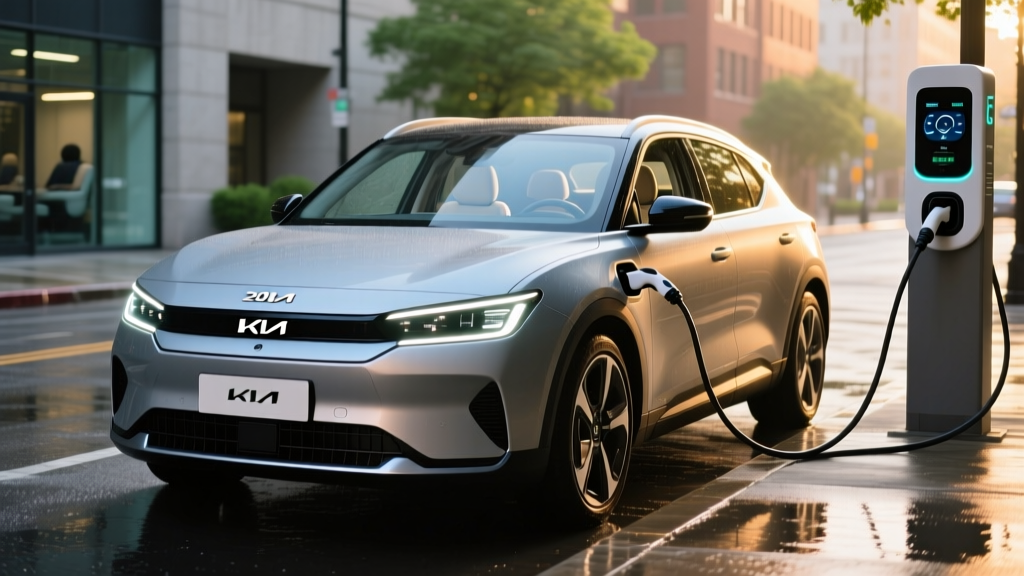
The compact electric sedan segment has been thin on options for US buyers, and the 2025 Kia EV4 aims to fix that. Built on a dedicated EV platform and positioned below the EV6 in Kia's lineup, the EV4 targets budget-conscious commuters who want a practical electric daily driver without stepping up to a crossover. After spending time with the specs, charging data, and pricing structure, here's what real buyers need to know before putting down a deposit.
The Long Range model carries an EPA-estimated 315 miles. In real-world highway driving at 70-75 mph, expect roughly 265-285 miles on a full charge. In freezing temperatures (below 30°F), that figure can drop to 230-250 miles due to increased cabin heating demand and reduced battery efficiency. The Standard Range model's 260-mile EPA estimate translates to approximately 220-235 miles highway and as low as 185-200 miles in cold conditions. If your commute is primarily city driving with heavy regenerative braking, you'll land closer to — or even slightly above — the EPA sticker.
Range, Battery, and Efficiency
The 2025 Kia EV4 offers two battery configurations. The Standard Range model uses a 58.3 kWh (usable) lithium iron phosphate (LFP) pack, while the Long Range steps up to a 77.4 kWh (usable) nickel-manganese-cobalt (NMC) battery. This chemistry split is deliberate: LFP offers longer cycle life and tolerance for daily 100% charging but sacrifices some energy density, while NMC delivers greater range in a similar package at the cost of preferring an 80% daily charge ceiling for longevity.
| Spec | Standard Range | Long Range |
|---|---|---|
| EPA Range | 260 miles | 315 miles |
| Battery (usable) | 58.3 kWh (LFP) | 77.4 kWh (NMC) |
| Efficiency | 129 MPGe / 26 kWh/100mi | 132 MPGe / 25 kWh/100mi |
| Drivetrain | RWD | RWD (AWD optional) |
| Horsepower | 168 hp | 225 hp (RWD) / 320 hp (AWD) |
| 0-60 mph | 7.8 sec | 6.2 sec (RWD) / 4.9 sec (AWD) |
| Max DC Charge Rate | 150 kW | 240 kW |
| 10-80% DC Time | ~28 min | ~18 min |
| Level 2 Rate | 10.9 kW (~36 mi/hr) | 10.9 kW (~36 mi/hr) |
| Cargo Volume | 15.3 cu ft trunk + 1.6 cu ft frunk | |
| Rear Legroom | 38.2 inches | |
The Long Range's 132 MPGe combined rating (fueleconomy.gov) is competitive for the segment, roughly matching the Hyundai Ioniq 6 and edging past the Tesla Model 3 RWD. The LFP Standard Range model's slightly lower efficiency reflects the chemistry's heavier weight per kWh, but the trade-off is meaningful: LFP batteries typically retain 90%+ capacity after 2,000 full charge cycles, making it a strong pick for high-mileage commuters who charge daily.
Charging Speed and Infrastructure
Charging speed is where the EV4 Long Range earns its keep. The 800V electrical architecture — shared with the EV6 and Ioniq 5 — enables a peak 240 kW DC fast-charge rate on compatible stations. On a 350 kW Electrify America or Tesla Supercharger (NACS adapter required for non-Tesla networks), the Long Range ramps from 10% to 80% in approximately 18 minutes under ideal thermal conditions.
However, peak kW is not sustained kW. The charge curve tapers noticeably above 60% state of charge, dropping to roughly 120-140 kW by the time you hit 70%, and falling further to under 60 kW past 85%. This is normal for NMC chemistry but worth understanding: if you're road-tripping and charging to 90%, that last 10% can add 15-20 minutes. Preconditioning the battery — which the EV4 does automatically when a DC fast charger is set as your navigation destination — is essential for hitting peak speeds in cold weather.
| Charge Level | Power | Miles Added Per Hour | Notes |
|---|---|---|---|
| Level 1 (120V) | ~1.4 kW | ~4-5 mi/hr | Emergency/top-up only |
| Level 2 (240V, 48A) | 10.9 kW | ~36 mi/hr | Full charge in ~7-8 hours |
| DC Fast (Long Range) | Peak 240 kW | ~650 mi/hr (peak) | 10-80% in ~18 min |
| DC Fast (Std Range) | Peak 150 kW | ~400 mi/hr (peak) | 10-80% in ~28 min |
For home charging, the 10.9 kW Level 2 rate is solid. A full overnight charge on a 48-amp Level 2 wallbox (requiring a 60-amp circuit) replenishes the Long Range battery in roughly 7-8 hours. Most EV4 buyers will want to budget $800-$1,500 for a quality Level 2 home charger installation, depending on panel proximity and local permit costs. If your home has a 100-amp electrical panel with limited spare capacity, a panel upgrade to 200 amps can add $1,500-$3,000 — get a licensed electrician's assessment before committing.
The EV4 ships with a NACS (Tesla-style) charge port for the US market, giving direct access to Tesla's Supercharger network. CCS adapters are available for legacy Electrify America and EVgo stations still transitioning their hardware.
Performance and Driving Dynamics
The EV4 isn't positioned as a performance EV, but the Long Range AWD variant's 4.9-second 0-60 mph time is genuinely quick for a compact sedan, and the instant torque delivery makes it feel faster than the number suggests in city driving. The RWD Long Range at 6.2 seconds is more than adequate for merging and passing.
Ride quality leans slightly firm — the low-slung battery pack gives the EV4 a low center of gravity and minimal body roll, but you'll feel sharper pavement imperfections more than in a Hyundai Elantra or Toyota Corolla. Steering is precise if somewhat numb, which is typical of electric power steering systems tuned for efficiency over feedback.
Regenerative braking offers multiple levels selectable via steering-wheel paddles, including a true one-pedal driving mode (i-Pedal) that brings the car to a full stop without touching the brake pedal. This is a standout feature for stop-and-go commuters and reduces brake wear significantly over time.
Interior, Tech, and Cargo Practicality
Inside, the EV4 uses Kia's latest dual-screen layout: a 12.3-inch digital instrument cluster and a 12.3-inch center infotainment display running the brand's connected navigation system with over-the-air updates. Wireless Apple CarPlay and Android Auto are standard across all trims. The center console features a floating bridge design that opens up storage underneath, and physical climate controls remain — a practical choice that avoids the touchscreen-only frustration found in some competitors.
Driver assistance comes via Kia's Highway Driving Assist 2 (HDA2), a Level 2 SAE system that combines adaptive cruise control with lane-centering on divided highways. It's competent for long-distance cruising but requires hands-on-wheel engagement and does not handle city streets or complex interchanges autonomously. Blind-spot monitoring, rear cross-traffic collision avoidance, and a surround-view monitor round out the safety suite.
Cargo space is a mixed story. The 15.3 cubic-foot trunk is competitive with a Honda Civic or Toyota Corolla, and the rear seats fold 60/40 for longer items. The 1.6 cu-ft frunk is small — useful for charging cables and a tire-inflation kit, but not meaningful luggage space. Rear legroom at 38.2 inches is generous for the compact segment and will accommodate adults comfortably on longer trips.
Pricing, Trims, and Federal Tax Credit
The 2025 Kia EV4 is offered in Wind (base), Wind AWD, and GT-Line trims, with the Standard Range available only in the Wind trim.
| Trim | Base MSRP | Est. Federal Credit | Effective Price |
|---|---|---|---|
| Wind (Std Range) | $33,990 | Up to $7,500* | ~$26,490* |
| Wind (Long Range) | $38,490 | Up to $7,500* | ~$30,990* |
| Wind AWD (Long Range) | $42,490 | Up to $7,500* | ~$34,990* |
| GT-Line (Long Range) | $44,990 | Up to $7,500* | ~$37,490* |
*Federal tax credit eligibility under IRS §30D depends on multiple factors that change frequently. As of current rules, the vehicle must have an MSRP at or below $55,000 (sedan cap), the buyer must meet adjusted gross income limits ($150K single / $300K joint), and the battery must satisfy critical-mineral and component-sourcing thresholds that tighten annually. The credit can now be transferred to the dealer at point of sale, effectively reducing your purchase price upfront — but confirm eligibility with your tax professional and the dealer before signing. Not all trims may qualify in every tax year.
Even without the full credit, the EV4 Wind Standard Range at roughly $33,990 before incentives undercuts most competitors in the electric sedan space and lands in territory where a state rebate or utility incentive can push the effective price well below $30,000.
Warranty and Long-Term Ownership
Kia backs the EV4 with a 5-year/60,000-mile limited vehicle warranty and a 10-year/100,000-mile battery and powertrain warranty. The battery warranty guarantees that the high-voltage pack will retain at least 70% of its original capacity during the coverage period — a standard threshold in the industry but one that Kia's longer 10-year term makes more valuable than the 8-year coverage offered by most competitors.
For the LFP Standard Range model, long-term degradation is likely to be minimal. Published LFP cycle-life data suggests these packs can exceed 3,000 cycles with less than 10% capacity loss, meaning a Standard Range EV4 could theoretically cover 300,000+ miles before approaching the 70% warranty threshold. The NMC Long Range pack will degrade slightly faster, but real-world data from the EV6 (which shares the same architecture) shows approximately 5-8% loss over the first 100,000 miles under normal use — well within warranty coverage.
Insurance costs for the EV4 are expected to run 10-15% higher than a comparably priced gas sedan, consistent with the EV segment average. Get quotes from your insurer before purchase to budget accurately.
Competitive Positioning
- You want a sub-$35K electric sedan with strong range and fast charging
- Your daily commute is under 60 miles round-trip and you can charge at home
- You value Kia's 10-year battery warranty and proven EV platform
- You prefer a traditional sedan profile over a crossover
- You need maximum cargo space — the EV4's 15.3 cu-ft trunk is adequate, not generous
- You tow — the EV4 is not rated for towing
- You frequently drive in extreme cold — the Standard Range LFP pack loses more range below freezing than NMC competitors
- You want the most advanced driver-assist tech — HDA2 is competent but not class-leading
Against the Tesla Model 3, the EV4 trades slightly lower range and a less expansive Supercharger-native network (pre-NACS adoption) for a lower entry price, more traditional interior controls, and a significantly longer battery warranty. The Hyundai Ioniq 6 shares the same platform and offers similar range but wears a polarizing exterior design and starts at a higher price. The upcoming next-gen Chevrolet Bolt sedan will compete on price but is expected to offer slower DC charging speeds.
- Strong value at the Wind Standard Range trim
- 800V architecture enables class-leading 240 kW DC charging (Long Range)
- LFP option for buyers who want maximum battery longevity
- 10-year/100,000-mile battery warranty
- NACS port provides direct Supercharger access
- Physical climate controls and intuitive infotainment
- Frunk is very small (1.6 cu ft)
- Standard Range DC charging tops out at 150 kW
- Ride quality is firm over rough pavement
- HDA2 requires hands-on engagement — not a hands-free system
- No towing capability
- AWD only available on Long Range at higher price
Frequently Asked Questions
What is the real-world range of the 2025 Kia EV4?
The Long Range EV4 is EPA-rated at 315 miles, but expect 265-285 miles in highway driving and 230-250 miles in cold weather. The Standard Range model's 260-mile EPA rating translates to roughly 220-235 miles highway and 185-200 miles in freezing conditions. City driving with regenerative braking can match or exceed the EPA estimate.
How fast does the EV4 charge at home and on the road?
At home on a 240V Level 2 charger (10.9 kW), the EV4 adds roughly 36 miles of range per hour, fully charging overnight in 7-8 hours. On DC fast chargers, the Long Range peaks at 240 kW and reaches 10-80% in about 18 minutes; the Standard Range peaks at 150 kW with a 10-80% time of approximately 28 minutes.
Does the 2025 Kia EV4 qualify for the $7,500 federal tax credit?
It can, but eligibility is not automatic. Under IRS §30D rules, the buyer must meet income caps ($150K single / $300K joint AGI), the vehicle MSRP must be at or below the $55,000 sedan cap (all EV4 trims qualify), and the battery must meet critical-mineral and component-sourcing requirements that tighten each year. The credit can be transferred at point of sale. Always verify with your tax professional and the dealer at time of purchase — rules change annually.
Is the Kia EV4 worth buying over a Tesla Model 3 or Hyundai Ioniq 6?
If price is a primary factor, the EV4 Wind Standard Range at ~$34K offers the lowest entry point in this segment. The Model 3 offers a more extensive native charging network and sharper performance, while the Ioniq 6 delivers similar specs with a more distinctive design at a higher price. The EV4's 10-year battery warranty and available LFP chemistry are strong differentiators for long-term ownership peace of mind.
What are the biggest drawbacks of the EV4?
The small frunk, firm ride quality, and 150 kW DC charge cap on the Standard Range model are the main compromises. There's no towing rating, and HDA2 — while competent — doesn't offer the hands-free capability of GM's Super Cruise or Ford's BlueCruise on mapped highways.
How long will the EV4 battery last?
Kia's 10-year/100,000-mile battery warranty covers capacity retention above 70%. The LFP Standard Range pack is expected to outlast this coverage significantly, with published data suggesting 3,000+ cycles (potentially 300,000+ miles) before meaningful degradation. The NMC Long Range pack should see 5-8% loss over the first 100,000 miles based on EV6 real-world data.