Quick Verdict: Performance Meets Practicality
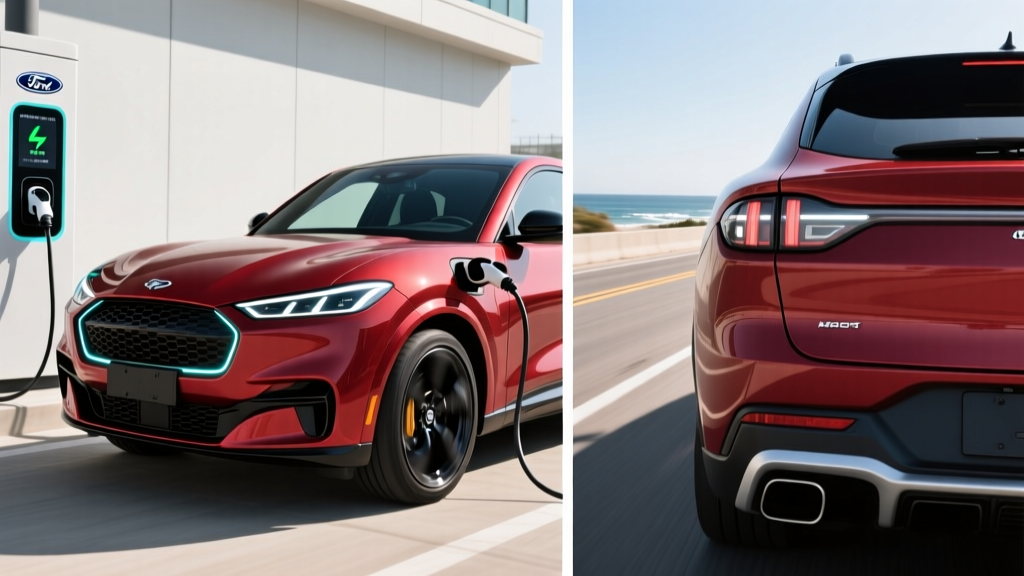
The Ford Mustang Mach-E remains one of the most well-rounded electric crossovers available in 2026. It delivers sports-car acceleration (especially in GT and Rally trims), competitive EPA range, and access to the Tesla Supercharger network via its factory NACS port. After years of refinement since its 2021 launch, the Mach-E has matured into a compelling alternative to the Tesla Model Y, Hyundai Ioniq 5, and Kia EV6 — particularly for buyers who value driving dynamics and BlueCruise hands-free highway driving.
| Trim | Drivetrain | Battery (usable kWh) | EPA Range | 0-60 mph | Horsepower | Torque (lb-ft) |
|---|---|---|---|---|---|---|
| Select RWD | RWD (single motor) | 75.7 kWh (LFP) | 250 mi | 6.1 s | 266 hp | 317 |
| Premium RWD | RWD (single motor) | 91.0 kWh (NMC) | 320 mi | 5.8 s | 290 hp | 317 |
| Premium AWD | AWD (dual motor) | 91.0 kWh (NMC) | 290 mi | 4.8 s | 346 hp | 428 |
| GT | AWD (dual motor) | 91.0 kWh (NMC) | 280 mi | 3.5 s | 480 hp | 634 |
| Rally | AWD (dual motor) | 91.0 kWh (NMC) | 265 mi | 3.4 s | 480 hp | 700 |
Mach-E 0-60 Times: Trim-by-Trim Breakdown
The target keyword for many performance-minded EV shoppers is Mach-E 0-60 times, and Ford delivers across the lineup. Here's what each trim achieves in real-world acceleration testing:
- Select RWD: 6.1 seconds — adequate for merging and daily driving, but the slowest in the lineup
- Premium RWD: 5.8 seconds — slightly quicker thanks to the larger battery's higher discharge rate
- Premium AWD: 4.8 seconds — dual-motor torque makes a meaningful difference off the line
- GT: 3.5 seconds (with Performance Upgrade package: 3.3 seconds) — supercar territory
- Rally: 3.4 seconds — tuned for gravel and mixed surfaces, but still brutally quick on pavement
For context, the GT with the Performance Upgrade hits 60 mph faster than a Porsche 911 Carrera from the previous generation. The instant torque delivery from the dual electric motors means these times are consistently repeatable — no waiting for turbo spool or transmission kickdown.
Real-World Range vs. EPA Estimates
EPA Range: 250 mi (Select RWD) to 320 mi (Premium RWD Extended Range)
Real-World Expectation: Highway driving at 70-75 mph typically yields 85-90% of EPA range (~215-285 mi depending on trim). In cold weather (below 30°F), expect 20-30% range loss, dropping the Extended Range RWD to roughly 225-255 miles on a full charge. City/regenerative driving can match or slightly exceed EPA figures.
The Extended Range battery (91.0 kWh usable, NMC chemistry) powers the longest-range variants. Ford adopted LFP (lithium iron phosphate) chemistry for the Standard Range 75.7 kWh pack used in the Select trim, which trades energy density for longevity — LFP batteries tolerate frequent 100% charging with minimal degradation, making them ideal for daily commuters who can charge at home nightly.
Efficiency ratings per fueleconomy.gov range from 98 MPGe (GT AWD) to 111 MPGe (RWD models), translating to roughly 30-34 kWh per 100 miles driven.
Charging Speed: DC Fast, Level 2, and NACS Access
Ford transitioned the Mach-E to the NACS (North American Charging Standard) connector beginning with the 2025 model year, meaning 2026 models charge natively at Tesla Superchargers without an adapter. This dramatically expands reliable fast-charging access for road trips.
| Charging Level | Power / Rate | Time or Miles Added |
|---|---|---|
| Level 1 (120V household) | ~1.4 kW | ~3-4 miles per hour |
| Level 2 (240V home, 48A) | 11.5 kW | ~33 miles per hour / full charge in ~8-9 hours |
| DC Fast Charge (Standard Range) | Peak 150 kW | 10-80% in ~32 minutes |
| DC Fast Charge (Extended Range) | Peak 150 kW | 10-80% in ~38 minutes |
Charging curve reality: The Mach-E peaks at 150 kW only briefly between roughly 15-30% State of Charge (SoC). It tapers progressively above 60%, dropping below 50 kW past 80%. On a road trip, plan stops around the 10-80% window for the best time efficiency. Charging from 80-100% on DC fast charge can take as long as the 10-80% session — avoid it unless you need the final miles.
The 150 kW peak rate is competitive but trails the Hyundai Ioniq 5 and Kia EV6, which can peak at 240+ kW on 800V architecture and complete 10-80% in roughly 18 minutes.
Pricing, Trims, and Federal Tax Credit Eligibility
The 2026 Mach-E lineup starts at approximately $42,995 for the Select RWD and climbs to roughly $61,995 for the Rally. The GT sits around $55,995, making it a serious performance value.
| Trim | Base MSRP | §30D Federal Credit (est.) | Effective Price* |
|---|---|---|---|
| Select RWD | $42,995 | Up to $7,500 | ~$35,495 |
| Premium RWD ER | $48,495 | Up to $7,500 | ~$40,995 |
| Premium AWD ER | $51,495 | Up to $7,500 | ~$43,995 |
| GT | $55,995 | Up to $7,500 | ~$48,495 |
| Rally | $61,995 | Up to $7,500 | ~$54,495 |
*Effective price assumes full §30D credit eligibility. Actual credit depends on battery sourcing, buyer income, and MSRP caps. See IRS rules below.
Does the Mach-E Qualify for the §30D Federal EV Tax Credit?
All 2026 Mach-E trims fall under the $80,000 MSRP cap for SUVs/crossovers under IRS §30D rules. However, the full $7,500 credit is split into two halves:
- $3,750 — Critical Minerals Requirement: A percentage of critical minerals in the battery must be sourced from the US or a free-trade-agreement country.
- $3,750 — Battery Components Requirement: A percentage of battery components must be manufactured or assembled in North America.
Additionally, buyer income caps apply (modified adjusted gross income must not exceed $150,000 single / $300,000 joint filing). The credit can now be transferred to the dealer at point of sale as an instant discount, per IRS guidance. Ford's US assembly (Cuautitlán, Mexico for some model years — verify current production location) and battery sourcing may affect eligibility. Always confirm current-year eligibility on the IRS qualified vehicles list before purchasing.
Interior, Cargo, and Technology
The Mach-E's cabin prioritizes a large central touchscreen (15.5-inch portrait orientation on most trims) running Ford's SYNC 4A system. Wireless Apple CarPlay and Android Auto are standard. The digital instrument cluster is compact but informative, showing range, efficiency, and navigation prompts.
Cargo and Passenger Dimensions
- Rear cargo (behind 2nd row): 29.7 cu ft
- Cargo (rear seats folded): 59.7 cu ft
- Front trunk (frunk): 4.7 cu ft — useful for charging cables or a small bag
- Rear legroom: 38.9 inches
- Front headroom: 40.4 inches (panoramic fixed glass roof on Premium+ and GT)
The cargo area is slightly smaller than a Tesla Model Y (30.2 cu ft rear / 72.1 cu ft folded) but competitive with the Ioniq 5. The frunk includes a drain plug — handy as a tailgate cooler.
Driver Assistance: BlueCruise
SAE Level 2 — Driver Supervision Required. Ford's BlueCruise enables hands-free driving on over 130,000 miles of pre-mapped divided highways in the US and Canada. A driver-facing camera monitors eye gaze to ensure attention. This is not self-driving (Level 4) — you must remain alert and ready to take over at any time. BlueCruise is available as a subscription or included for a trial period depending on trim.
Battery Warranty, Degradation, and Longevity
Ford covers the Mach-E's high-voltage battery with an 8-year / 100,000-mile warranty (whichever comes first), guaranteeing the battery retains at least 70% of its original capacity. The electric powertrain components (motors, inverters) carry the same coverage.
Real-world degradation data from early 2021-2023 Mach-E owners suggests roughly 5-8% capacity loss over the first 60,000 miles for NMC batteries, with the curve flattening significantly afterward. LFP packs in the Standard Range models are expected to degrade even more slowly, given LFP's superior cycle life — though long-term Mach-E LFP data is still accumulating.
Pros and Cons
Pros
- GT and Rally trims deliver sub-3.5-second 0-60 times at a fraction of supercar pricing
- NACS port provides native Tesla Supercharger access — the most reliable US fast-charging network
- BlueCruise is one of the best Level 2 hands-free systems for highway commuting
- Competitive real-world range (up to ~285 mi highway for Extended Range RWD)
- Car-like handling with a low center of gravity — genuinely fun to drive
- LFP option on Standard Range for buyers who want maximum battery longevity
Cons
- 150 kW DC fast-charge peak trails 800V competitors (Ioniq 5/EV6 at 240 kW+)
- Rear cargo space is smaller than the Model Y
- Base Select trim with Standard Range battery has just 250 mi EPA range
- No third-row option for families needing more than 5 seats
- BlueCruise requires a paid subscription after the trial period
- Mexico assembly may affect §30D credit eligibility for some model years — verify before purchase
Who Should Buy the 2026 Mach-E?
Choose the Mach-E if: You want a sporty electric crossover with thrilling acceleration (GT/Rally), hands-free highway driving via BlueCruise, and native Supercharger access for road trips. It's ideal for couples or small families who prioritize driving engagement over maximum cargo volume.
Look elsewhere if: You need the fastest possible DC charging (consider Ioniq 5 or EV6 with 800V architecture), require 3-row seating (Kia EV9), or want maximum cargo space (Tesla Model Y). Budget-focused buyers may also find better value in the base Chevrolet Equus EV or Nissan Ariya.
Frequently Asked Questions
What is the fastest Mach-E 0-60 time?
The 2026 Mach-E GT with the Performance Upgrade package achieves a 3.3-second 0-60 mph time. The Rally trim is close behind at 3.4 seconds. Both use dual-motor AWD with roughly 480 horsepower.
What is the real-world highway range of the Mach-E?
On 70-75 mph highway driving in moderate temperatures, expect roughly 85-90% of the EPA sticker. That means ~270 miles for the Premium RWD Extended Range (EPA 320 mi) and ~240 miles for the AWD Extended Range (EPA 290 mi). Cold weather below 30°F can reduce these figures by an additional 20-30%.
How fast does the Mach-E charge at home?
On a 48-amp Level 2 home charger (240V), the Mach-E accepts up to 11.5 kW, adding roughly 33 miles of range per hour. A full charge from near-empty takes approximately 8-9 hours for the Extended Range battery. A standard 120V outlet adds only 3-4 miles per hour — fine for overnight top-ups but not practical as a primary charging method.
Does the 2026 Mach-E qualify for the $7,500 federal tax credit?
All trims fall under the $80,000 SUV MSRP cap. However, full $7,500 eligibility depends on battery critical-mineral sourcing and component manufacturing requirements, plus buyer income limits ($150K single / $300K joint MAGI). The credit can be applied at point of sale. Check the IRS qualified clean vehicle list for the specific trim and build date before purchasing.
Is the Mach-E better than the Tesla Model Y?
It depends on priorities. The Model Y offers more cargo space (72.1 cu ft vs 59.7 cu ft), slightly faster charging on its own network, and a lower starting price. The Mach-E counters with BlueCruise hands-free driving, a more traditional (and for some, more intuitive) interior layout, NACS Supercharger access, and a sportier driving feel — especially in GT trim. Both are strong choices; test-drive both before deciding.
What battery chemistry does the Mach-E use?
The Standard Range (75.7 kWh usable) battery uses LFP (lithium iron phosphate) chemistry, which offers longer cycle life and tolerates regular 100% charging. The Extended Range (91.0 kWh usable) uses NMC (nickel manganese cobalt), which provides higher energy density and longer per-charge range. For daily commuters with home charging, LFP is an excellent choice; for road-trippers who need maximum range, NMC Extended Range is preferable.