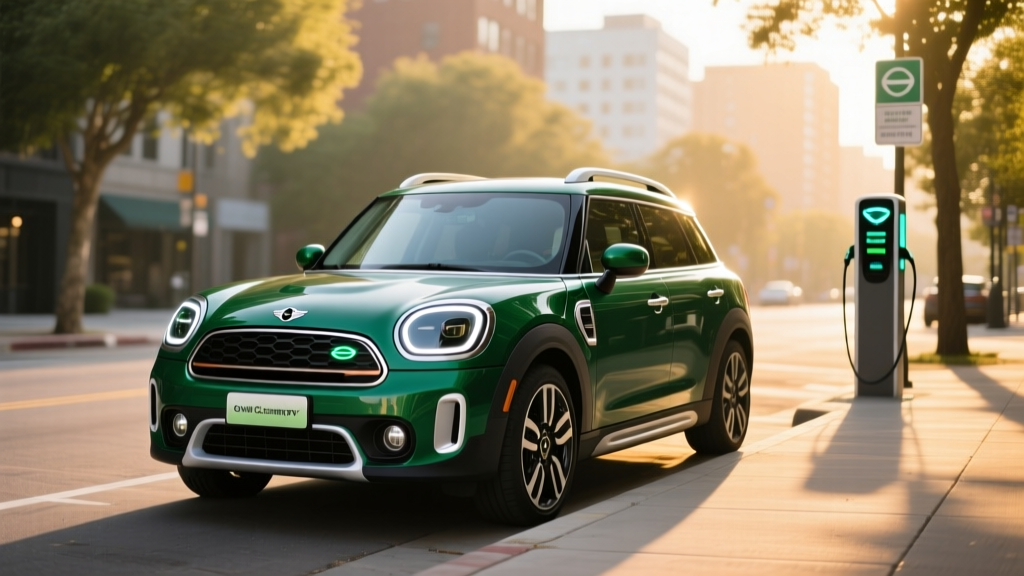
Quick Verdict: Is the MINI Countryman EV Worth It?
The 2026 MINI Countryman SE ALL4 delivers 245 miles of EPA-estimated range from a 66.5 kWh (usable) NMC battery, peaks at 130 kW DC fast charging (10–80% in ~30 minutes), and starts at $46,100 MSRP before incentives. It qualifies for a partial or full §30D federal tax credit depending on battery-sourcing compliance and buyer income — check current-year IRS rules. Compared to the gas Countryman S ALL4, the EV saves roughly $1,200–$1,800/year in fuel for average drivers but carries higher insurance premiums and a ~$10,000 higher starting price. If you have Level 2 home charging and drive under 200 miles daily, the Countryman EV is a practical, fun-to-drive small luxury crossover. If you rely solely on public charging or regularly drive 300+ miles in cold climates, the gas or hybrid Countryman may serve you better.
Range, Battery & Efficiency: Beyond the EPA Sticker
The Countryman SE ALL4 uses a 66.5 kWh usable lithium-ion NMC (nickel manganese cobalt) battery pack mounted in a skateboard platform shared with the BMW iX1/iX2. The EPA rates it at 245 miles combined, with an efficiency of approximately 98 MPGe (roughly 34 kWh/100 miles).
But EPA numbers assume mild conditions. Here's what to expect in the real world:
Real-World Range Expectations
- Mild weather, mixed driving: ~225–245 miles
- Highway-only at 75 mph: ~200–215 miles (aerodynamic drag cuts efficiency 10–15%)
- Cold weather (below 30°F): ~170–200 miles (battery resistance + cabin heating reduce range 15–25%)
- Worst case (cold + highway + hills): ~155–175 miles
The Countryman EV includes a heat pump as standard equipment, which reduces cold-weather HVAC energy draw by roughly 30% compared to resistive heating — a meaningful advantage in northern climates.
| Spec | Value |
|---|---|
| EPA Range | 245 miles |
| Battery (usable) | 66.5 kWh, NMC |
| Efficiency | 98 MPGe / ~34 kWh/100 mi |
| DC Fast Charge Peak | 130 kW |
| 10–80% DC Charge Time | ~30 minutes |
| Level 2 Charge Rate | 11 kW (AC onboard charger) |
| Level 2 Full Charge Time | ~6.5 hours |
| Horsepower | 313 hp (dual motor ALL4) |
| 0–60 mph | 5.4 seconds |
| Base MSRP (SE ALL4) | $46,100 |
| Battery Warranty | 8 years / 100,000 miles |
Charging Speed & Infrastructure: What Owners Actually Experience
The Countryman EV uses the CCS1 connector (as of the 2026 model year in the US — MINI has confirmed NACS adoption for future models, but current production uses CCS). This means access to Electrify America, EVgo, ChargePoint, and most non-Tesla DC fast-charging networks. Tesla Supercharger access requires an adapter (included by MINI for 2025+ models) or a CCS-to-NACS adapter purchased separately.
| Level | Power | Miles Added Per Hour | Typical Use Case |
|---|---|---|---|
| Level 1 (120V outlet) | ~1.4 kW | ~4 mi/hr | Overnight top-up, emergencies |
| Level 2 (240V, 48A) | 11 kW | ~32 mi/hr | Home daily charging, workplace |
| DC Fast Charge | 130 kW peak | ~150 mi in 30 min | Road trips, quick top-ups |
Charging-curve reality check: The 130 kW peak rate holds roughly from 10% to 45% State of Charge (SoC), then tapers. From 45–80%, expect ~65–80 kW average. Above 80%, the rate drops sharply to protect battery longevity — charging from 80–100% can take as long as 10–80%. For battery health and speed, plan road-trip stops around the 10–80% window.
Home charging setup: Most Countryman EV owners install a Level 2 wallbox (e.g., ChargePoint Home Flex, EnelX JuiceBox) on a 240V/60A circuit. Expect $800–$2,500 total for equipment and electrician labor, depending on panel proximity and local permit costs. If your home has a 100A electrical panel, a panel upgrade ($1,500–$3,000) may be required.
Countryman EV vs. Gas Countryman: Cost & Driving Comparison
The gas-powered Countryman S ALL4 (2.0L turbo, 241 hp) starts around $36,100 — roughly $10,000 less than the EV. But the total cost picture changes over five years.
| Category | Countryman SE ALL4 (EV) | Countryman S ALL4 (Gas) |
|---|---|---|
| Starting MSRP | $46,100 | $36,100 |
| Est. Federal Tax Credit | Up to $7,500* | $0 |
| Effective Purchase Price | ~$38,600 | $36,100 |
| Fuel/Energy (5 yrs, 15k mi/yr) | $3,750 (home charging)** | $9,400 (premium gas) |
| Maintenance (5 yrs) | ~$1,200 | ~$3,500 |
| Insurance (5 yrs, est.) | ~$11,500 | ~$9,200 |
| 5-Year Total Cost | ~$55,050 | ~$58,200 |
* §30D credit eligibility depends on MSRP caps (SUVs: $80,000), buyer income limits ($150K single / $300K joint AGI), and battery critical-mineral/battery-component sourcing requirements. Rules change frequently — verify at IRS.gov or consult a tax professional.
** Based on $0.15/kWh national average home electricity rate. Public DC fast charging at $0.35–$0.50/kWh raises 5-year energy cost to ~$6,500–$8,500.
The EV breaks even or pulls ahead within 3–4 years if you qualify for the full tax credit and charge primarily at home. Without the credit or with heavy public-charging reliance, the gas Countryman remains cheaper to own.
Ownership Realities: What First-Time EV Buyers Must Know
Buying the Countryman EV is not the same as buying a gas car. Here are the practical considerations that determine whether this car works for your life:
Home Charging Access Is Non-Negotiable for Most Buyers
If you can install a Level 2 charger at home (garage, driveway, or dedicated parking spot), the Countryman EV is effortless — plug in at night, wake up to 200+ miles every morning. If you live in an apartment or condo without charging access, you'll rely on public Level 2 and DC fast chargers, adding 30–60 minutes per week to your routine and significantly raising your per-mile energy cost.
Climate Matters More Than You Think
In Phoenix or Miami, expect near-EPA range year-round. In Minneapolis or Boston winters, budget 20–25% range loss. The Countryman's standard heat pump helps, but cabin heating in sub-20°F weather still draws 3–5 kW continuously. If your commute is under 60 miles round-trip, this is manageable. If you regularly drive 200+ miles in winter, plan charging stops.
Insurance Costs More for EVs
EV insurance premiums run 15–25% higher than equivalent gas vehicles due to higher repair costs (battery replacement, specialized body work). Expect to pay $150–$250/month depending on your profile. Get a quote before purchasing.
Maintenance Is Genuinely Lower
No oil changes, no spark plugs, no transmission fluid. Brake pads last 80,000+ miles thanks to regenerative braking. You'll still need tire rotations (EVs are heavier and wear tires faster), cabin air filter replacement, and brake fluid checks. Budget ~$200–$300/year in routine maintenance vs. $600–$800 for the gas Countryman.
Common Misconceptions About the Countryman EV
| Myth | Fact |
|---|---|
| "245 miles of range isn't enough." | The average American drives 37 miles/day (FHWA data). 245 miles covers 6+ days of average driving. Range matters for road trips, not commutes. |
| "The battery will need replacing in 5 years." | NMC batteries in modern thermal-managed packs typically retain 85–90% capacity after 100,000 miles. The Countryman's 8-year/100,000-mile battery warranty guarantees ≥70% retention. Full replacement (rare) costs ~$12,000–$16,000. |
| "It qualifies for the full $7,500 tax credit." | Credit eligibility depends on critical-mineral sourcing and battery-component manufacturing rules under §30D. MINI's parent company BMW has been restructuring supply chains, but the exact credit amount varies by model year and production batch. Check fueleconomy.gov for current status. |
| "Public charging is unreliable everywhere." | DC fast-charger uptime averages 85–90% on major networks like Electrify America. Reliability is highest in urban corridors and lowest in rural areas. Apps like PlugShare show real-time station status. |
| "It charges as fast as any other EV." | At 130 kW peak, the Countryman EV charges slower than a Hyundai Ioniq 5 (240 kW) or Tesla Model Y (250 kW). A 10–80% charge takes ~30 minutes vs. ~18 minutes for those competitors. Factor this into road-trip planning. |
Decision Framework: Should You Buy the Countryman EV?
Choose the Countryman EV If:
- You have Level 2 home charging (or can install it)
- Your daily driving is under 150 miles round-trip
- You want a premium small crossover with strong acceleration (313 hp, 5.4s 0–60)
- You qualify for at least a partial §30D tax credit (check IRS income and sourcing rules)
- You value lower running costs and less maintenance over the lowest purchase price
- You take road trips 2–4 times per year and can plan 30-minute DC fast-charge stops
Choose the Gas or Hybrid Countryman If:
- You cannot install home charging and public infrastructure in your area is sparse
- You regularly drive 300+ miles in a single trip, especially in winter
- Your budget is firmly under $40,000 and you don't qualify for tax credits
- You plan to keep the vehicle 10+ years and want to avoid any battery degradation concern
- You tow frequently (the EV's towing capacity is limited compared to gas variants)
Frequently Asked Questions
Does the MINI Countryman EV support Tesla Superchargers?
Yes, with an adapter. MINI includes a CCS-to-NACS adapter for 2025+ model years, enabling access to Tesla's V3 and V4 Supercharger stalls (150–250 kW). The Countryman will still be limited by its 130 kW onboard charge rate, so expect Supercharger sessions to peak at ~130 kW regardless of the stall's capability.
What is the real-world highway range at 75 mph?
Expect approximately 200–215 miles in mild weather at sustained highway speeds. EVs are less efficient at highway speeds than in city driving (the opposite of gas cars) because there's no regenerative braking benefit and aerodynamic drag increases with the square of velocity.
How long does a full Level 2 home charge take?
From near-empty to 100% on an 11 kW Level 2 charger: approximately 6.5 hours. In practice, most owners plug in at 40–60% SoC and reach 80–90% by morning — roughly 3–4 hours. Setting a charge limit to 80% for daily use extends long-term battery health.
Is the Countryman EV eligible for the federal tax credit in 2026?
Eligibility under IRS §30D depends on three factors: (1) the vehicle's MSRP must be ≤$80,000 (it qualifies as an SUV), (2) buyer AGI must be ≤$150K single / $225K head of household / $300K joint, and (3) the battery must meet critical-mineral and battery-component sourcing thresholds that increase each year. The point-of-sale transfer option lets you apply the credit as a down-payment reduction at the dealer. Verify current eligibility on IRS.gov and confirm with your tax professional.
How does the Countryman EV compare to the Volvo EX40 or Audi Q4 e-tron?
The Countryman EV (245 mi, $46,100, 130 kW charging) sits between the Volvo EX40 (~254 mi, ~$53,000, 200 kW charging) and the Audi Q4 e-tron (~242 mi, ~$50,000, 175 kW charging) in range but undercuts both on price. The MINI charges slower than both competitors. If charging speed is a priority, the EX40 has a meaningful advantage on road trips. If price and personality matter more, the Countryman wins.
What happens if the battery degrades significantly?
MINI's battery warranty guarantees at least 70% capacity retention for 8 years or 100,000 miles. If the battery falls below this threshold, MINI will repair or replace it at no cost. Real-world data from similar BMW/MINI NMC packs suggests most retain 85–90% after 100K miles. Out-of-warranty replacement, while rare, costs $12,000–$16,000 including labor.