Why Ford Mustang Mach-E Sales Are Making Headlines Again
If you've been tracking EV market share, you've likely noticed Ford Mustang Mach-E sales drawing attention in 2026 — partly because Ford restructured its EV division under Ford Model e, and partly because the Mach-E remains one of the few mainstream electric crossovers that actually delivers on range, charging speed, and daily usability without a luxury badge price. Sales have fluctuated as new competitors like the Hyundai Ioniq 5, Tesla Model Y refresh, and Chevrolet Equinox EV entered the picture, but the Mach-E continues to hold a distinct position: a practical, well-rounded electric SUV with BlueCruise hands-free capability and a starting price that still undercuts many rivals.
This review breaks down the 2026 Ford Mustang Mach-E lineup with exact EPA figures, real-world range expectations, charging data, and federal tax-credit eligibility — the numbers that actually matter when you're deciding whether to buy.
2026 Ford Mustang Mach-E: Spec Table at a Glance
| Spec | Select RWD (Std Range) | Premium AWD (Ext Range) | GT (Ext Range) |
|---|---|---|---|
| EPA Range | 250 mi | 320 mi | 280 mi |
| Battery (usable) | 70 kWh (LFP) | 91 kWh (NMC) | 91 kWh (NMC) |
| Horsepower | 266 hp | 346 hp | 480 hp |
| 0–60 mph | 6.1 sec | 5.1 sec | 3.5 sec |
| Drivetrain | RWD (single motor) | AWD (dual motor) | AWD (dual motor) |
| DC Fast Charge Peak | 135 kW | 150 kW | 150 kW |
| 10–80% DC Time | ~38 min | ~41 min | ~41 min |
| Level 2 Home Charge | 10.5 kW (~30 mi/hr) | 10.5 kW (~30 mi/hr) | 10.5 kW (~30 mi/hr) |
| MPGe (combined) | 101 MPGe | 98 MPGe | 86 MPGe |
| Base MSRP | $39,995 | $48,995 | $59,995 |
Source: fueleconomy.gov and Ford Motor Company 2026 model-year specifications.
Real-World Range vs. EPA Estimates: What Owners Actually See
The Mach-E Extended Range uses an NMC (nickel-manganese-cobalt) 91 kWh usable battery pack, which offers higher energy density but is more sensitive to extreme temperatures than LFP chemistry. The Standard Range model's 70 kWh LFP (lithium iron phosphate) pack tolerates cold somewhat better and can be charged to 100% regularly without degradation concerns — a meaningful advantage for daily commuters who need every available mile each morning.
Efficiency varies by trim: the Select RWD achieves 101 MPGe combined (33 kWh/100 mi), while the GT's performance tuning drops that to 86 MPGe (39 kWh/100 mi). For context, the Hyundai Ioniq 5 RWD returns 114 MPGe combined — a noticeable gap if efficiency is your top priority.
Charging Speed: DC Fast Charge and Home Level 2 Breakdown
Charging speed remains one of the Mach-E's weaker competitive points in 2026, especially against the Hyundai Ioniq 5 and Kia EV6, which both feature 800V architectures capable of 240+ kW peak charging. The Mach-E runs on a conventional 400V architecture.
| Charging Method | Power / Rate | Miles Added per Hour | Notes |
|---|---|---|---|
| Level 1 (120V household) | 1.2 kW | ~3 mi/hr | Emergency / overnight trickle only |
| Level 2 (240V home, 48A) | 10.5 kW | ~30 mi/hr | Full charge overnight (~9–10 hrs for Ext Range) |
| DC Fast Charge (Std Range) | 135 kW peak | ~180 mi/hr at peak | 10–80% in ~38 min; tapers sharply above 80% |
| DC Fast Charge (Ext Range) | 150 kW peak | ~200 mi/hr at peak | 10–80% in ~41 min; tapers sharply above 80% |
Charging-curve reality: The 150 kW peak on Extended Range models is sustained only between approximately 15–45% State of Charge. Above 60%, the rate drops to roughly 80–90 kW, and above 80% it falls below 40 kW. This is why Ford quotes 10–80% times rather than 0–100% — the final 20% can add another 35–45 minutes. On a road trip, plan to charge from 10–80% and move on rather than waiting for a full battery.
The Mach-E uses the NACS (North American Charging Standard) connector as of the 2025 model year, giving it native access to Tesla Supercharger stations — a significant infrastructure advantage over CCS-only vehicles. Ford's partnership with Tesla's Supercharger network means Mach-E owners can access over 20,000 fast-charger stalls nationwide without an adapter.
Performance, Drivetrain, and Daily Drivability
The Mach-E lineup spans practical commuter to legitimate performance crossover:
- Select RWD: 266 hp, single rear motor, 0–60 in 6.1 seconds. Adequate for merging and passing, tuned for efficiency.
- Premium AWD: 346 hp, dual motor, 0–60 in 5.1 seconds. The sweet spot for most buyers — confident acceleration with all-weather capability.
- GT: 480 hp, dual motor, 0–60 in 3.5 seconds. Genuinely quick, with MagneRide adaptive dampers and a sport-tuned suspension that transforms the driving experience.
All trims feature regenerative braking with a one-pedal driving mode that can bring the car to a complete stop. The steering is precise if slightly numb, and the low center of gravity (battery pack under the floor) keeps body roll well-controlled in corners.
Towing: When properly equipped, the Mach-E can tow up to 1,500 lbs — enough for a small utility trailer or a pair of dirt bikes, but not a camper. If you need serious towing (3,500+ lbs), the Rivian R1S or Ford F-150 Lightning are better choices.
Interior, Cargo Space, and Technology
The cabin is where the Mach-E shows its age relative to the 2025–2026 Hyundai Ioniq 5 and refreshed Tesla Model Y. Materials are acceptable for the price point — soft-touch dash, cloth or synthetic leather seats — but hard plastics appear on lower door panels and the center console. It doesn't feel premium, but it feels durable.
| Dimension | Measurement |
|---|---|
| Cargo (behind rear seats) | 29.7 cu ft |
| Cargo (rear seats folded) | 59.7 cu ft |
| Front trunk (frunk) | 4.7 cu ft (drainable, doubles as cooler) |
| Front legroom | 43.3 in |
| Rear legroom | 38.9 in |
| Front headroom | 40.4 in |
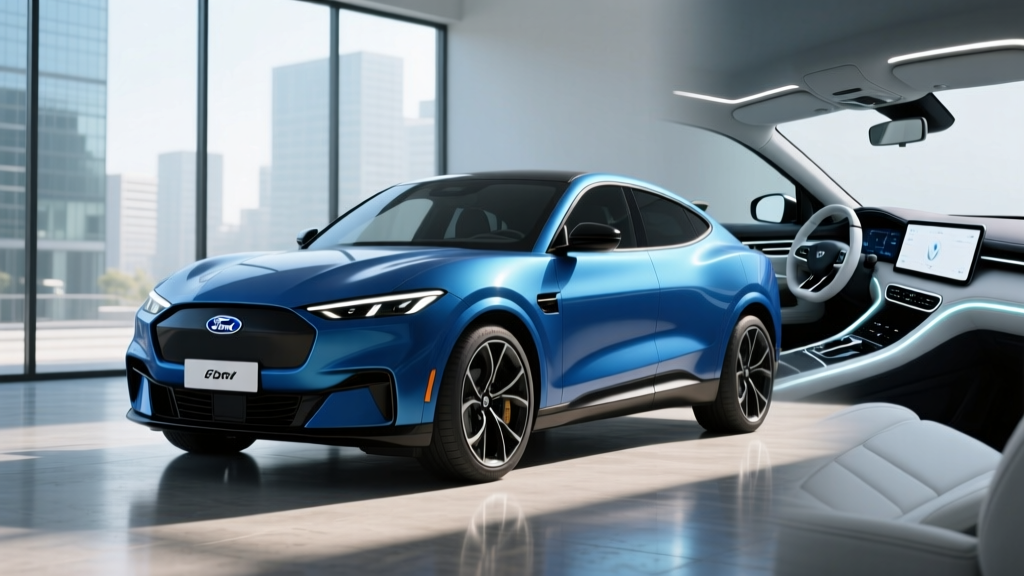
Infotainment: The centerpiece is a 15.5-inch vertical touchscreen running Ford's SYNC 4A system. It supports wireless Apple CarPlay and Android Auto, over-the-air updates, and integrates navigation with real-time charger availability. The interface is responsive, though the vertical layout means less horizontal map visibility than competitors' landscape screens.
BlueCruise: Ford's hands-free driver-assistance system (SAE Level 2) operates on over 130,000 miles of pre-mapped divided highways in the U.S. and Canada. A driver-facing camera monitors your eyes — you can remove your hands from the wheel, but you must remain attentive. BlueCruise is not autonomous driving; it's an advanced cruise-and-lane-centering system that reduces fatigue on long trips. Expect to pay approximately $2,100 for the BlueCruise package or $75/month via subscription after any included trial period.
Pricing, Trims, and Federal Tax Credit Eligibility
| Trim | Base MSRP | As-Tested (Typical Options) | Est. Price After §30D Credit |
|---|---|---|---|
| Select RWD (Std Range) | $39,995 | $41,500 | ~$32,495* |
| Premium RWD (Ext Range) | $45,995 | $48,500 | ~$38,495* |
| Premium AWD (Ext Range) | $48,995 | $52,000 | ~$41,495* |
| GT (Ext Range AWD) | $59,995 | $63,500 | ~$52,495* |
*Estimated price after the $7,500 federal EV tax credit (IRS §30D). Actual eligibility depends on buyer income, battery sourcing, and MSRP caps. See details below.
Federal EV Tax Credit (§30D) — Eligibility Checklist
The 2026 Mach-E may qualify for up to $7,500 under IRS §30D, but eligibility is not automatic. Current requirements include:
- MSRP cap: SUVs/crossovers must have an MSRP at or below $80,000. All Mach-E trims qualify.
- Buyer income cap: Modified adjusted gross income must not exceed $150,000 (single), $225,000 (head of household), or $300,000 (joint filers).
- Battery sourcing: A percentage of critical minerals and battery components must be sourced from the U.S. or free-trade-agreement partners. Ford has shifted some Mach-E battery supply chains to meet these thresholds, but partial credit ($3,750) may apply if only one of the two sourcing requirements is met.
- Point-of-sale transfer: As of 2024, eligible buyers can transfer the credit to the dealer at purchase, reducing the sale price upfront rather than waiting for a tax refund.
Verify current eligibility on IRS.gov and consult a tax professional before relying on the credit.
Warranty, Ownership Costs, and Long-Term Battery Outlook
Ford backs the Mach-E with a competitive warranty package:
- Bumper-to-bumper: 3 years / 36,000 miles
- Powertrain: 5 years / 60,000 miles
- Battery pack: 8 years / 100,000 miles (retains ≥70% of original capacity)
- BlueCruise hardware: Covered under the bumper-to-bumper warranty
The 70% capacity retention threshold over 8 years is standard for the industry but less generous than Hyundai's 8-year/100,000-mile battery warranty, which also uses a 70% floor. Real-world degradation data from Mach-E owners (aggregated by community forums and third-party trackers) suggests most Extended Range NMC packs lose approximately 5–8% capacity over the first 3 years / 60,000 miles — well within warranty limits. The Standard Range LFP pack shows even slower degradation, typically 3–5% over the same period, thanks to LFP's inherently longer cycle life.
Insurance: Expect annual premiums in the $1,600–$2,200 range depending on trim, location, and driving history. The GT commands higher rates due to its performance classification. Get quotes before purchasing — EV insurance costs can erase fuel savings if you're not careful.
Maintenance: EVs eliminate oil changes, spark plugs, and transmission fluid. Expect to budget for tire rotations, cabin air filters, brake fluid checks, and windshield washer fluid. Annual maintenance typically runs $200–$400, compared to $600–$1,000 for a comparable gas crossover.
Pros and Cons: The Honest Verdict
✓ Pros
- NACS connector = native Tesla Supercharger access (20,000+ stalls)
- BlueCruise hands-free driving on 130,000+ miles of highway
- LFP option on Standard Range = longer cycle life, 100% daily charging OK
- Competitive starting price ($39,995) before incentives
- Spacious rear seat (38.9 in legroom) and usable frunk
- Strong 0–60 across the lineup; GT is genuinely thrilling
✗ Cons
- DC fast-charge speed (150 kW peak) trails Ioniq 5/EV6 (240 kW)
- Interior materials feel dated vs. refreshed competitors
- Towing limited to 1,500 lbs
- Extended Range NMC pack degrades faster than LFP in extreme heat
- GT trim efficiency is mediocre (86 MPGe)
- BlueCruise subscription cost adds up over time
Who Should Buy the 2026 Ford Mustang Mach-E?
Choose the Mach-E if:
- You want a mainstream EV crossover with native Supercharger access and don't want a Tesla badge.
- You frequently drive long highway stretches where BlueCruise reduces fatigue.
- You need a practical family vehicle with 38.9 inches of rear legroom and ~30 cu ft of cargo.
- You want an LFP battery option (Standard Range) for daily 100% charging without degradation worry.
Look elsewhere if:
- Fastest possible DC charging is your top priority (consider Hyundai Ioniq 5 or Kia EV6).
- You need 3,500+ lbs of towing capacity (look at the F-150 Lightning or Rivian R1S).
- You want a premium interior at this price point (consider a used BMW iX or Volvo XC40 Recharge).
- You live in an area with no Supercharger or Electrify America coverage — verify your local charging infrastructure first.
Frequently Asked Questions
What is the real-world range of the 2026 Ford Mustang Mach-E?
The EPA rates the Extended Range AWD at 320 miles, but expect 265–285 miles in real-world highway driving and 220–245 miles in cold weather (below 30°F). The Standard Range RWD (EPA 250 mi) delivers approximately 205–225 miles on the highway. City driving with regenerative braking can push results closer to or slightly above EPA estimates.
How fast does the Mach-E charge at home and on the road?
At home on a 240V Level 2 charger (48A), the Mach-E adds approximately 30 miles of range per hour, fully recharging overnight in 9–10 hours (Extended Range). On DC fast chargers, the Extended Range peaks at 150 kW and charges from 10–80% in roughly 41 minutes. The Standard Range peaks at 135 kW with a 10–80% time of about 38 minutes. Charging slows significantly above 80% State of Charge.
Does the 2026 Mach-E qualify for the $7,500 federal EV tax credit?
It may, depending on your income, the specific battery pack's sourcing compliance, and current IRS rules. All trims fall under the $80,000 MSRP cap for SUVs. Buyer income must not exceed $150K (single) / $300K (joint). Battery critical-mineral and component sourcing requirements determine whether you receive the full $7,500 or a partial $3,750. The credit can be transferred to the dealer at point of sale. Verify on IRS.gov before purchasing.
Is the Mach-E worth buying vs. the Tesla Model Y or Hyundai Ioniq 5?
It depends on your priorities. The Mach-E offers BlueCruise, NACS Supercharger access, and a lower starting price than the Model Y Long Range. The Ioniq 5 charges significantly faster (240 kW peak, 10–80% in ~18 min) and has a more modern interior. The Model Y offers the most cargo space and the lowest energy consumption in the segment. If hands-free highway driving and non-Tesla branding matter to you, the Mach-E is compelling. If charging speed is paramount, test the Ioniq 5.
What are the biggest drawbacks of the Mach-E?
The primary limitations are DC fast-charge speed (150 kW peak vs. competitors at 240+ kW), an interior that feels a generation behind the newest rivals, a 1,500-lb towing limit, and the ongoing cost of BlueCruise after any trial period ends. The GT trim's efficiency (86 MPGe) also means more frequent charging on road trips compared to the RWD trims.
How long will the Mach-E battery last?
Ford warranties the battery for 8 years / 100,000 miles with a 70% minimum capacity retention guarantee. Real-world data from early 2021–2023 Mach-E owners shows NMC Extended Range packs losing approximately 5–8% capacity over the first 60,000 miles, while LFP Standard Range packs lose 3–5%. With proper care (avoiding prolonged 100% storage on NMC, limiting DC fast-charging frequency), most packs should deliver well over 150,000 miles before approaching the warranty threshold.