Why Milan Kovac Matters to Your Next Tesla Purchase
If you've searched Milan Kovac Tesla Wikipedia or dug into Tesla's engineering history, you've likely encountered the name Milan Kovac — a senior Autopilot software engineer whose work on Tesla's vision-based driver-assistance stack helped shape the neural-network architecture that now powers every 2026 Model Y, Model 3, Model S, and Model X rolling off the line. While Kovac isn't a household name like Elon Musk, his contributions to Tesla's transition from radar-based Autopilot to the pure Tesla Vision system are baked into the car you'd actually buy today.
This article bridges the gap between the engineering story and the product reality: a full 2026 Tesla Model Y review with the EPA range, charging speeds, pricing, and tax-credit data you need to decide whether to buy — and how the Autopilot/FSD system Kovac helped build actually performs in the real world.
2026 Tesla Model Y: Core Specifications at a Glance
| Spec | Value |
|---|---|
| EPA Range | 320 miles (Long Range AWD) |
| Battery Capacity | ~78 kWh usable (NMC chemistry, 2170 cells) |
| Drivetrain | Dual-Motor AWD |
| Horsepower | 384 hp combined |
| 0–60 mph | 4.8 seconds |
| Peak DC Fast Charge | 250 kW (V3 Supercharger) |
| 10–80% DC Charge Time | ~22 minutes |
| Level 2 Home Charge Rate | 11.5 kW (~44 miles/hr) |
| Efficiency | 122 MPGe / 28 kWh/100 mi |
| Cargo Volume | 30.2 cu ft (rear seats up) / 72.1 cu ft (folded) |
| Base MSRP | $44,990 (Long Range AWD) |
| Battery Warranty | 8 years / 120,000 miles |
Real-World Range vs. EPA Estimate
Tesla's thermal management system is among the best in the industry — a heat pump comes standard and helps mitigate winter losses compared to competitors using resistive heating. Still, no EV is immune to cold-weather chemistry limitations. If your commute is under 60 miles round-trip, the range buffer is generous. For road trips exceeding 250 miles between Superchargers, plan conservatively using the car's built-in trip planner, which factors in elevation, temperature, and speed.
Charging Speed: DC Fast, Level 2, and the Charge Curve
| Charging Level | Max Power | Rate | Notes |
|---|---|---|---|
| Level 1 (120V) | 1.4 kW | ~5 mi/hr | Emergency/trickle only |
| Level 2 (240V, 48A) | 11.5 kW | ~44 mi/hr | Home Wall Connector; ~7.5 hr for full charge |
| DC Fast (V3 Supercharger) | 250 kW peak | ~1,000 mi/hr peak | 10–80% in ~22 min; tapers sharply above 80% |
| DC Fast (V4 Supercharger) | Up to 350 kW* | Varies | *Model Y may not accept full 350 kW; ~250 kW sustained typical |
The Model Y's 250 kW peak charge rate on V3 Superchargers is well-established. What matters more for road-trip planning is the charge curve: the car pulls peak power only between roughly 10–45% State of Charge (SoC), then tapers progressively. From 80–100%, charging slows to under 30 kW. This is why Tesla's navigation system recommends charging to 80% at each stop — the last 20% can take as long as the first 70%.
For home charging, Tesla's Wall Connector at 48 amps on a 60-amp circuit delivers a full overnight replenishment. Installation typically costs $500–$2,000 depending on panel proximity and whether your home needs a 200-amp service upgrade. Always hire a licensed electrician and pull a permit.
Autopilot, FSD (Supervised), and Milan Kovac's Engineering Legacy
Milan Kovac's tenure at Tesla coincided with one of the most consequential engineering pivots in the company's history: the removal of radar sensors and the full commitment to Tesla Vision, a camera-and-neural-network-only approach to perception. Kovac, working within the Autopilot software team, contributed to the deep-learning pipelines that process input from the Model Y's 8-camera array to detect lane markings, vehicles, pedestrians, traffic signals, and road geometry.
For the 2026 buyer, this means:
- Autopilot (included): Traffic-Aware Cruise Control and Autosteer on marked highways. Competent for highway commuting but requires active supervision.
- FSD Supervised ($8,000 one-time or $99/mo): Adds automatic lane changes, Navigate on Autopilot (highway on/off-ramps), traffic light and stop sign recognition, and Autopark. City-street capability has improved substantially since 2024, but edge cases (construction zones, unusual intersections, adverse weather) still demand driver vigilance.
The system is data-hungry and improves via over-the-air updates. Owners who purchased FSD in prior years have seen meaningful capability gains — but the "supervised" label remains legally and practically accurate. For a deeper look at Tesla's engineering evolution, Tesla's official Autopilot page details current capabilities.
Pricing, Tax Credits, and Total Cost
| Trim | MSRP | Federal Credit (if eligible) | Effective Price |
|---|---|---|---|
| Long Range AWD | $44,990 | Up to $7,500 (§30D) | ~$37,490 |
| Performance AWD | $48,990 | Up to $7,500 (§30D) | ~$41,490 |
Federal tax credit eligibility under IRS §30D is not automatic. For 2026, the key requirements include:
- MSRP cap: SUVs/vans/pickups must be under $80,000 — the Model Y qualifies.
- Buyer income cap: AGI must not exceed $150,000 (single) / $300,000 (joint).
- Battery sourcing: Critical minerals and battery components must meet phased-in domestic/free-trade-agreement sourcing thresholds. Tesla's supply chain has adapted, but eligibility can shift — verify at IRS.gov before purchasing.
- Point-of-sale transfer: As of 2024, you can transfer the credit to the dealer at purchase, reducing your out-of-pocket cost immediately rather than waiting for tax filing.
Always confirm eligibility with a tax professional. State incentives (California, Colorado, New York, etc.) may stack on top — check your state's energy office for current programs.
Interior, Cargo, and Daily Usability
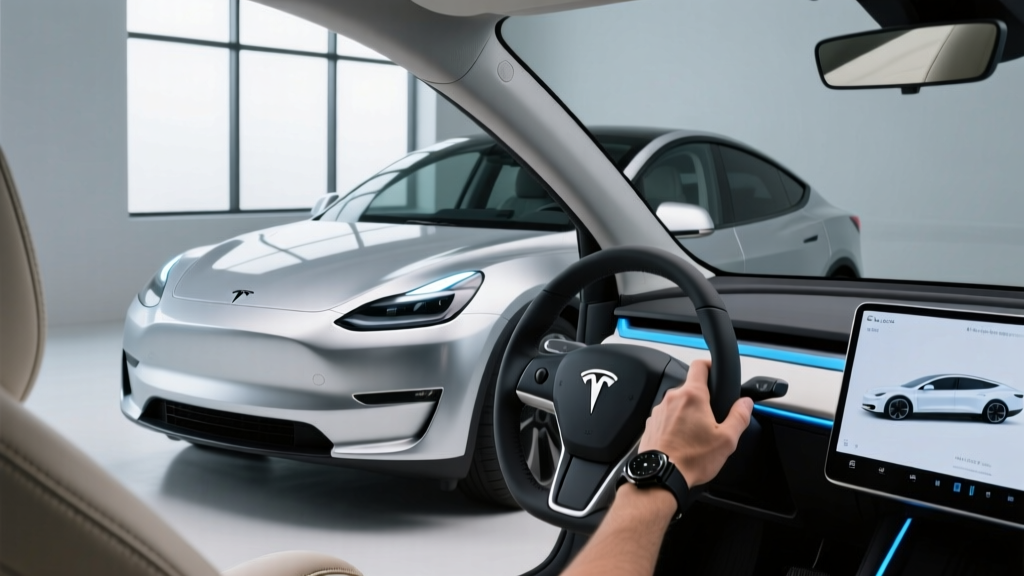
The 2026 Model Y interior continues Tesla's minimalist approach — a single 15.4-inch touchscreen handles navigation, climate, media, and vehicle settings. There is no instrument cluster; a slim secondary screen for rear passengers was added in the 2025 refresh.
- Front legroom: 41.8 inches
- Rear legroom: 37.5 inches (adequate for adults on shorter trips)
- Cargo (seats up): 30.2 cu ft — competitive with compact SUVs
- Cargo (seats folded): 72.1 cu ft — genuinely useful for furniture-scale hauling
- Frunk (front trunk): ~4.1 cu ft — good for charging cables and groceries
Ride quality improved with the 2025 suspension retuning, but the Model Y still transmits more road imperfections than a Hyundai Ioniq 5 or Ford Mustang Mach-E. Road noise at highway speed remains a common owner complaint. The panoramic glass roof is standard and provides an airy cabin, though it contributes to heat load in summer — preconditioning while plugged in is strongly recommended.
Pros, Cons, and Who Should Buy
✅ Pros
- Supercharger network access (17,000+ stations in North America)
- Class-leading efficiency (122 MPGe)
- Strong OTA update cadence — car improves over time
- Competitive 10–80% charge time (~22 min)
- Spacious cargo area with flat-load floor
- Standard heat pump for cold-climate efficiency
❌ Cons
- FSD ($8,000) remains Level 2 — not autonomous
- Minimalist interior lacks physical controls for climate/wipers
- No Apple CarPlay or Android Auto
- Road noise and firm ride on rough pavement
- Insurance premiums 20–40% higher than comparable ICE SUVs
- Glass roof contributes to cabin heat in summer
Who the Model Y suits best:
- Daily commuters with home Level 2 charging — the 320-mile range and 44 mi/hr home charge rate mean you rarely think about charging.
- Small families needing cargo versatility without stepping up to a Model X.
- Road-trip-capable buyers who value the Supercharger network's reliability over competitors still building out CCS infrastructure.
- Tech-forward buyers comfortable with a touchscreen-first interface and who see OTA updates as a feature, not a risk.
Look elsewhere if: you need Apple CarPlay, prefer physical buttons, tow heavy loads (3,500-lb limit is modest), or live in a charging desert without reliable DC fast-charging access.
Frequently Asked Questions
What is the real-world range of the 2026 Tesla Model Y?
The EPA rates it at 320 miles (Long Range AWD). Real-world highway driving yields 265–285 miles; cold weather can reduce that to 220–250 miles. City driving with regenerative braking often matches or exceeds the EPA figure. For authoritative efficiency data, see fueleconomy.gov.
How fast does the Model Y charge at home and on the road?
At home on a Level 2 Tesla Wall Connector (11.5 kW), you gain ~44 miles per hour — a full overnight charge from 20% takes about 7.5 hours. On a V3 Supercharger (250 kW peak), 10–80% takes approximately 22 minutes. The charge curve tapers significantly above 80% SoC.
How much does the Model Y cost after federal tax credits?
The Long Range AWD starts at $44,990. If you qualify for the full $7,500 §30D credit (income, MSRP, and battery sourcing requirements met), the effective price drops to ~$37,490. Verify eligibility at IRS.gov and consult a tax professional before purchase.
Is the Model Y worth buying vs. the Hyundai Ioniq 5 or Ford Mach-E?
The Model Y wins on Supercharger network access, efficiency, and cargo space. The Ioniq 5 offers faster 10–80% charging (18 min at 350 kW on E-GMP), Apple CarPlay, and a more comfortable ride. The Mach-E offers a more traditional interior layout. If Supercharger access and OTA improvements matter most, the Model Y remains the default choice. If ride quality and physical controls are priorities, cross-shop the Ioniq 5.
Who is Milan Kovac and why is he associated with Tesla?
Milan Kovac is a software engineer who worked on Tesla's Autopilot team, contributing to the neural-network and computer-vision systems that power Tesla Vision — the camera-only driver-assistance architecture in all current Tesla vehicles. His work is part of the engineering foundation behind the Autopilot and FSD (Supervised) features in the 2026 Model Y. While not a public-facing executive, his contributions are reflected in the perception stack every Tesla owner uses daily.
Does the Model Y qualify for the federal EV tax credit in 2026?
Yes, the Model Y is on the IRS eligible vehicle list, but buyer eligibility depends on your AGI (≤$150K single / ≤$300K joint), the vehicle's MSRP (under $80K for SUVs — the Model Y qualifies), and current battery-sourcing compliance. The credit can be transferred at point of sale. Rules are subject to legislative change — always verify current status before purchasing.