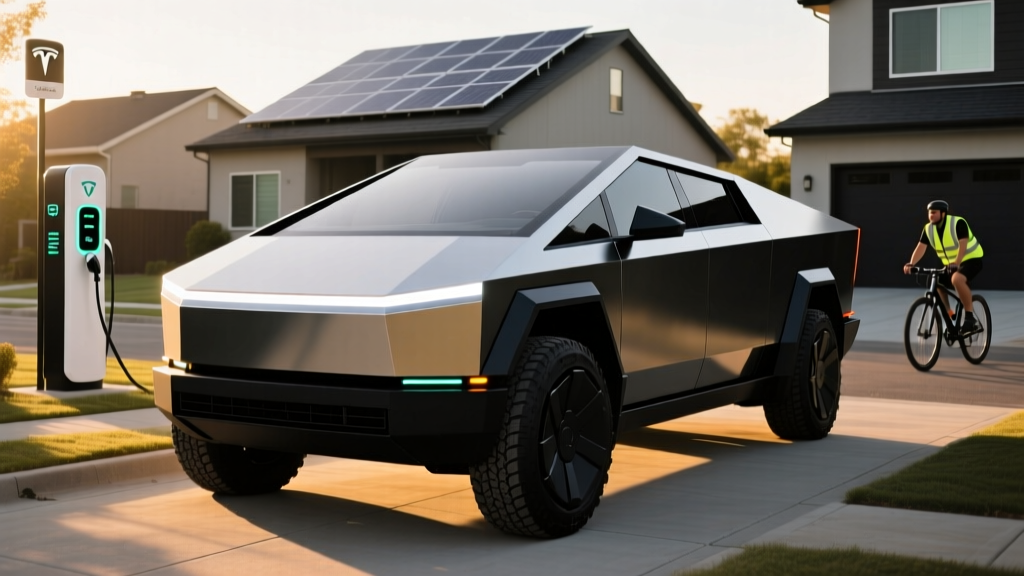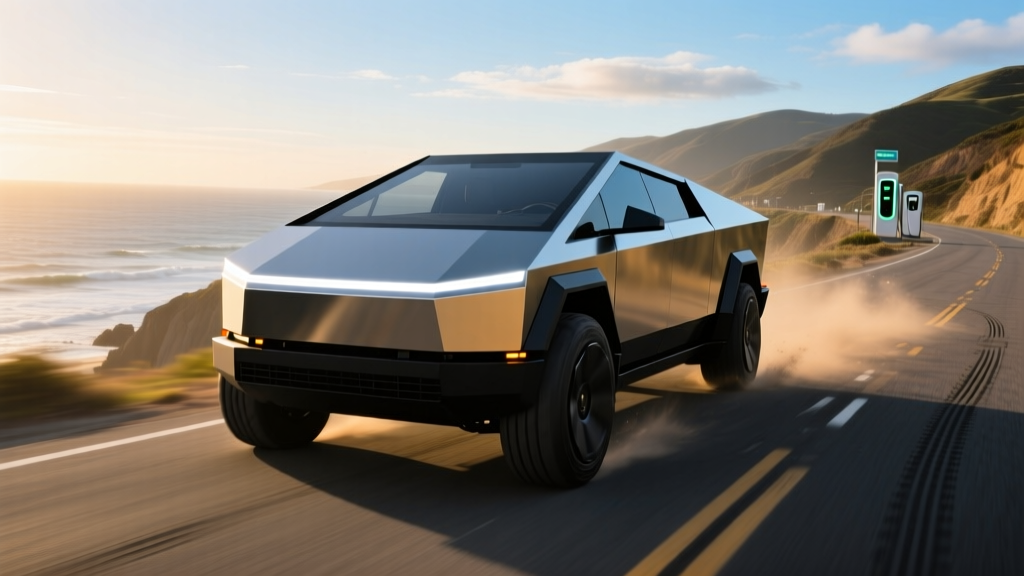
The Tesla Cybertruck is the most polarizing electric vehicle on the road, and its angular stainless-steel exoskeleton guarantees attention at every stoplight. But beyond the futuristic styling and viral drag races, buyers need hard data: How fast does it actually go? What's the real-world range? And does the charging infrastructure keep up with a vehicle this heavy? We break down every spec that matters for 2026 buyers considering the Cybertruck as a daily driver, work truck, or weekend hauler.
Cybertruck Top Speed and Acceleration: The Numbers
The question on many performance-minded truck buyers' minds: what is the Tesla Cybertruck top speed? Tesla electronically limits all current Cybertruck variants to 130 mph. That figure applies across the lineup — the Rear-Wheel Drive, All-Wheel Drive, and Cyberbeast trims. While 130 mph won't challenge a Porsche Taycan on a unrestricted autobahn, it's competitive within the electric truck segment, where the Ford F-150 Lightning tops out around 110 mph and the Rivian R1T reaches approximately 120 mph.
Where the Cybertruck truly separates itself is off the line. The tri-motor Cyberbeast variant produces 845 horsepower and rockets from 0 to 60 mph in just 2.6 seconds (with rollout subtracted, per Tesla's testing methodology). The dual-motor All-Wheel Drive model delivers 600 hp and a 3.9-second 0-60 time. Even the base Rear-Wheel Drive, with a single motor, posts a respectable 6.5-second sprint. These figures make the Cybertruck one of the quickest production pickups ever sold, regardless of powertrain.
| Trim | Drivetrain | Horsepower | 0-60 mph | Top Speed | Towing Capacity |
|---|---|---|---|---|---|
| Rear-Wheel Drive | RWD (single motor) | ~315 hp | 6.5 sec | 130 mph | 7,500 lbs |
| All-Wheel Drive | AWD (dual motor) | 600 hp | 3.9 sec | 130 mph | 11,000 lbs |
| Cyberbeast | AWD (tri-motor) | 845 hp | 2.6 sec | 130 mph | 11,000 lbs |
The 130 mph governor is a pragmatic choice. The Cybertruck's 6,600+ lb curb weight (Cyberbeast) and high center of gravity mean that sustained high-speed driving would drain the battery at an alarming rate and generate significant tire heat. Tesla's engineering team clearly prioritized usable acceleration and towing stability over top-end speed.
EPA Range and Real-World Efficiency
Range is where Cybertruck ownership requires realistic expectations. The angular stainless-steel body, while striking, creates a drag coefficient (estimated ~0.39 Cd) that works against highway efficiency. Combined with the vehicle's substantial weight, the EPA estimates fall well short of Tesla's sedan lineup.
All-Wheel Drive: EPA 340 miles → Expect ~270-290 miles highway (70-75 mph), ~240-260 miles in cold weather (below 32°F).
Cyberbeast: EPA 320 miles → Expect ~255-275 miles highway, ~220-245 miles in cold weather.
Rear-Wheel Drive: EPA 250 miles → Expect ~200-220 miles highway, ~175-195 miles in cold weather.
Real-world range is derived from observed highway efficiency of 2.0-2.4 miles/kWh, cold-weather battery preconditioning losses, and the truck's poor aerodynamic profile at sustained speed. Data sourced from fueleconomy.gov and independent EV testing.
The Cybertruck AWD's efficiency rating sits at approximately 51 MPGe combined (roughly 68 kWh/100 miles), according to EPA data. That's thirsty by EV standards — for comparison, a Tesla Model Y Long Range achieves 119 MPGe. The physics are straightforward: moving 6,600+ lbs of stainless steel through air at highway speed requires enormous energy. Owners planning frequent highway road trips should plan charging stops accordingly.
| Trim | EPA Range | Est. Highway Range | Est. Cold-Weather Range | MPGe (Combined) | kWh/100 mi |
|---|---|---|---|---|---|
| Rear-Wheel Drive | 250 mi | ~200-220 mi | ~175-195 mi | ~46 MPGe | ~73 |
| All-Wheel Drive | 340 mi | ~270-290 mi | ~240-260 mi | ~51 MPGe | ~68 |
| Cyberbeast | 320 mi | ~255-275 mi | ~220-245 mi | ~48 MPGe | ~70 |
Battery Capacity, Chemistry, and Longevity
The Cybertruck AWD and Cyberbeast use a ~123 kWh (usable) NMC (nickel-manganese-cobalt) battery pack. Tesla has not published official cell-level chemistry details, but teardown analysis and supply-chain reporting indicate high-nickel NMC cells, likely sourced from Panasonic's 4680 cell production lines. NMC chemistry offers higher energy density than LFP (lithium iron phosphate), which is necessary to push a 6,600-lb truck past 300 miles of range — but it comes with trade-offs.
NMC batteries typically degrade faster than LFP over thousands of charge cycles and are more sensitive to sustained high states of charge. Tesla recommends daily charging to 80% for NMC packs and reserving 100% charges for trips. The Cybertruck's battery and drive unit warranty covers 8 years or 120,000 miles, whichever comes first, with a minimum 70% capacity retention threshold. That's slightly better mileage coverage than the industry-standard 8-year/100,000-mile warranty, reflecting Tesla's confidence in the 4680 cell architecture.
For buyers concerned about long-term degradation: industry data suggests NMC packs lose roughly 10-15% capacity over 150,000 miles under normal use patterns (mix of Level 2 home charging with occasional DC fast charging). Heavy DC fast charging use, frequent 100% charges, and extreme temperature exposure accelerate this curve.
Charging Speed: DC Fast, Level 2, and the Charge Curve
Charging a 123 kWh battery is a time commitment, and the Cybertruck's peak charging rate matters less than its sustained charging curve. Here's what buyers need to know:
| Charging Level | Power | Speed / Time | Notes |
|---|---|---|---|
| DC Fast Charging (peak) | ~250 kW | ~145 miles in 15 min (claimed) | Peak rate only; tapers significantly above 60% SoC |
| DC Fast Charging (10-80%) | Sustained avg ~150-180 kW | ~30-35 minutes | Preconditioning required for best speeds |
| Level 2 Home (48A / 11.5 kW) | 11.5 kW | ~37 miles per hour of charging | Requires Tesla Wall Connector or equivalent on 60A circuit |
| Level 2 Home (32A / 7.7 kW) | 7.7 kW | ~25 miles per hour of charging | Standard 40A circuit; full overnight charge ~16 hrs |
| Level 1 (120V / 12A) | 1.4 kW | ~4-5 miles per hour | Emergency/trickle only; impractical for daily use |
The ~250 kW peak DC fast-charge rate sounds competitive, but the Cybertruck's massive 123 kWh battery means that even at peak power, filling from 10% to 80% takes roughly 30-35 minutes at a V3 Supercharger. The charge curve is the critical detail: like all lithium-ion packs, the Cybertruck's charging speed tapers dramatically above 60% state of charge. Expect to see 250 kW only in the 10-30% SoC window; by 70%, you'll likely be at 80-100 kW, and above 85%, speeds drop below 50 kW. This is physics, not a Tesla flaw — but it means road-trip charging stops are longer than marketing materials suggest.
For home charging, the Tesla Wall Connector on a 60-amp circuit delivers 48 amps (11.5 kW), adding roughly 37 miles of range per hour. An overnight session (10 hours) recovers about 370 miles — more than enough to refill the pack from near-empty. Buyers should budget for a 240V dedicated circuit installation, which typically costs $600-$2,000 depending on panel proximity and local permitting. A panel upgrade to 200A service may be necessary in older homes and can add $1,500-$3,500.
Pricing, Trims, and Federal Tax Credit Eligibility
The Cybertruck's pricing has shifted significantly since its 2023 unveiling. As of the 2025-2026 model year, here's where the lineup stands:
| Trim | Base MSRP | Federal §30D Credit | Effective Price After Credit |
|---|---|---|---|
| Rear-Wheel Drive | $60,990 | Not eligible (MSRP exceeds $80,000 truck cap — see note) | $60,990 |
| All-Wheel Drive | $79,990 | Up to $7,500 (if income/sourcing requirements met) | ~$72,490 |
| Cyberbeast | $99,990 | Not eligible (MSRP exceeds $80,000 truck cap) | $99,990 |
Critical tax credit caveat: Under IRS §30D rules, new clean vehicle credits are subject to MSRP caps — $80,000 for vans, SUVs, and pickup trucks. The Cybertruck is classified as a light truck, meaning only the All-Wheel Drive trim at $79,990 MSRP falls under the cap. The Cyberbeast at $99,990 exceeds it and is ineligible. The Rear-Wheel Drive at $60,990 is under the cap but buyers must also meet adjusted gross income limits ($150,000 single / $225,000 head of household / $300,000 joint) and the vehicle must satisfy critical minerals and battery component sourcing requirements, which are subject to annual tightening. Always verify current eligibility on irs.gov and consult a tax professional before relying on the credit.
The point-of-sale transfer option allows eligible buyers to apply the credit as an immediate price reduction at the dealership rather than waiting for a tax refund. This effectively lowers the AWD Cybertruck to approximately $72,490 out the door — still a premium price, but more competitive against a fully loaded Ford F-150 Lightning Lariat or Rivian R1T.
Interior, Cargo, and Technology
The Cybertruck's cabin is minimalist even by Tesla standards. A single 18.5-inch touchscreen dominates the dashboard, controlling everything from climate to the glovebox release. There are no physical buttons, no instrument cluster, and no traditional stalks — turn signals and wipers are operated via steering-wheel-mounted touch controls, a design choice that draws mixed reviews from owners.
Cargo and passenger dimensions:
- Bed length: 6 feet (72 inches) with the tonneau cover closed
- Bed volume: ~67 cubic feet (with bed cover deployed)
- Front trunk (frunk): ~7 cubic feet — enough for a charging cable and small bag
- Rear-seat legroom: ~38 inches — adequate for adults on shorter trips, tight for tall passengers on long hauls
- Seating capacity: 5 passengers (3-across rear bench)
- Towing: Up to 11,000 lbs (AWD and Cyberbeast), 7,500 lbs (RWD)
The powered stainless-steel tonneau cover (Tesla calls it the "sail pillar" design) is a standout feature, opening and closing via the touchscreen or the Tesla app. The bed features built-in LED lighting, 120V and 240V outlets (with the appropriate package), and integrated tiedown points. However, the bed's relatively short 6-foot length and the angular sail pillars limit the ability to carry wide or oversized loads compared to a traditional 6.5- or 8-foot truck bed.
Driver assistance: The Cybertruck ships with Tesla's Basic Autopilot (lane centering and adaptive cruise control). Enhanced Autopilot ($6,000) adds auto lane change, autosteer on navigation, and smart summon. Full Self-Driving (Supervised) at $8,000 adds traffic light and stop sign recognition. Important: All Tesla driver-assist features are SAE Level 2 — meaning the driver must remain fully engaged, with hands on or near the wheel, at all times. This is not autonomous driving.
Tesla Autopilot and FSD (Supervised) are SAE Level 2 driver-assistance systems. The driver is responsible for all vehicle operation and must maintain continuous supervision. Only Level 4 services like Waymo operate without a human driver in defined areas. Never treat FSD as "self-driving."
How It Compares: Cybertruck vs. F-150 Lightning vs. Rivian R1T
The Cybertruck competes in a growing electric truck segment. Here's how the key specs stack up against its two primary rivals:
| Spec | Cybertruck AWD | F-150 Lightning (Ext. Range) | Rivian R1T (Dual-Motor Max) |
|---|---|---|---|
| EPA Range | 340 mi | 320 mi | 352 mi |
| 0-60 mph | 3.9 sec | ~4.0 sec | ~3.5 sec |
| Top Speed | 130 mph | ~110 mph | ~120 mph |
| Towing Capacity | 11,000 lbs | 10,000 lbs | 11,000 lbs |
| Peak DC Charge | ~250 kW | ~150 kW | ~220 kW |
| Bed Length | 6 ft | 5.5 ft | 4.5 ft |
| Base MSRP | $79,990 | ~$69,995 | ~$79,900 |
| §30D Credit Eligible | Yes (AWD only) | Yes (select trims) | Yes (select trims) |
The Cybertruck AWD wins on top speed and peak DC charging rate. The Rivian R1T edges ahead on EPA range and acceleration, while the F-150 Lightning undercuts on price and offers a more conventional truck experience with a broader dealer network for service. The Cybertruck's 6-foot bed is the longest of the three, but its angular sail pillars and powered tonneau limit practical cargo versatility compared to the Lightning's traditional bed.
Pros, Cons, and Who Should Buy
Pros
- Class-leading acceleration (2.6 sec Cyberbeast, 3.9 sec AWD)
- 11,000-lb towing capacity with integrated trailer brake controller
- Stainless-steel exoskeleton resists dents and corrosion
- 6-foot bed — longest among electric trucks
- 250 kW peak DC fast charging
- Access to Tesla Supercharger network (17,000+ stalls in North America)
- Over-the-air updates continuously add features
- Available 120V/240V bed outlets for job-site or camping power
Cons
- Poor highway efficiency (~68 kWh/100 mi) limits real-world range
- Only AWD trim qualifies for §30D tax credit
- Touchscreen-only turn signals and wiper controls frustrate many drivers
- Short 6-ft bed with sail pillars limits oversized cargo
- No physical buttons — steep learning curve for traditional truck buyers
- Stainless-steel panels show fingerprints and are difficult to repair if dented
- Service center availability limited outside major metros
- Insurance premiums run 20-40% higher than comparable trucks
Who the Cybertruck Suits Best
Buy it if: You want the quickest production pickup available, need 11,000-lb towing, value Supercharger network access for road trips, and appreciate the head-turning design. It works well for tech-forward owners who primarily charge at home and take occasional highway trips within the ~270-mile real-world range envelope.
Skip it if: You need a full-size 8-foot bed for work, prioritize maximum highway range, want a conventional truck interior with physical controls, or live in a rural area far from Tesla service centers. The Rivian R1T or F-150 Lightning may be better fits for traditional truck use cases.
Frequently Asked Questions
What is the Tesla Cybertruck top speed?
All Cybertruck trims (RWD, AWD, and Cyberbeast) are electronically limited to 130 mph. This is competitive within the electric truck segment, exceeding the F-150 Lightning (~110 mph) and Rivian R1T (~120 mph).
What is the real-world range of the Cybertruck?
The AWD trim carries an EPA rating of 340 miles, but real-world highway driving at 70-75 mph typically yields 270-290 miles. In cold weather (below freezing), expect 240-260 miles. The Cyberbeast's real-world range drops to roughly 255-275 miles highway. These figures reflect the truck's high drag coefficient and 6,600+ lb weight.
How fast does the Cybertruck charge?
Peak DC fast charging reaches approximately 250 kW, but sustained average from 10-80% is closer to 150-180 kW, resulting in a 30-35 minute session at a V3 Supercharger. Home Level 2 charging at 11.5 kW (48A) adds about 37 miles per hour, fully recharging the 123 kWh battery overnight in roughly 11-12 hours.
Does the Cybertruck qualify for the $7,500 federal EV tax credit?
Only the All-Wheel Drive trim at $79,990 MSRP qualifies, since it falls under the §30D truck MSRP cap of $80,000. The Cyberbeast ($99,990) exceeds the cap. Buyers must also meet income limits ($150K single / $300K joint) and the vehicle must satisfy critical mineral and battery component sourcing rules. Verify current eligibility at irs.gov before purchasing.
Is the Cybertruck worth buying vs. the F-150 Lightning or Rivian R1T?
It depends on your priorities. Choose the Cybertruck for maximum acceleration, Tesla's Supercharger network, and the longest bed among EV trucks. Choose the F-150 Lightning for a lower starting price, conventional truck ergonomics, and a broader dealer service network. Choose the Rivian R1T for the best EPA range, more refined interior, and better off-road capability with its quad-motor option. Test-drive all three before deciding.
What is the Cybertruck's battery warranty?
Tesla covers the Cybertruck's battery and drive unit for 8 years or 120,000 miles, whichever comes first, with a minimum 70% capacity retention guarantee. The limited vehicle warranty covers 4 years or 50,000 miles.