The Short Answer on Going Microbus Electric
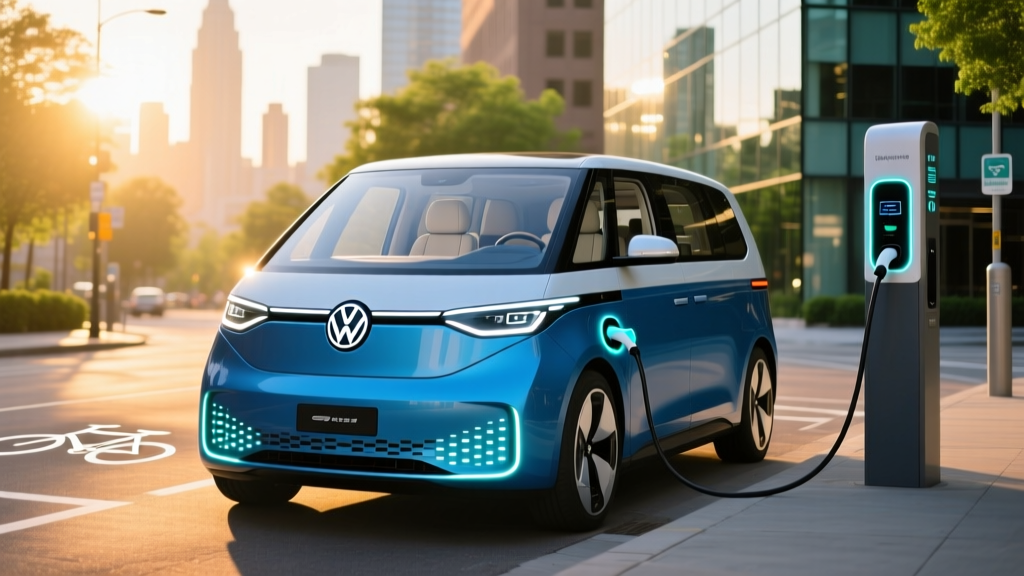
If you're searching for a microbus electric van, the 2026 Volkswagen ID. Buzz is currently the only mass-market option in the US. It offers an EPA-estimated 234 miles of range (Standard Wheelbase) or 231 miles (Long Wheelbase), seats up to seven, and starts around $59,995. Real-world highway range drops to roughly 190–210 miles, and cold weather can cut that further. It charges at up to 200 kW DC, reaching 10–80% in about 26 minutes. If you need a three-row electric people-mover with retro styling and don't regularly drive more than 200 miles between charging stops, it's a compelling choice. If you frequently road-trip 400+ miles or live in a charging desert, a three-row hybrid like the Toyota Grand Highlander Hybrid (36 MPG combined) may serve you better until DC infrastructure matures along your routes.
What Exactly Is a Microbus Electric Van in 2026?
The term "microbus" has been synonymous with the Volkswagen Type 2 since the 1950s. In 2026, the spiritual successor is the VW ID. Buzz, built on Volkswagen's MEB platform — the same architecture underpinning the ID.4 crossover. Unlike the original air-cooled flat-four, the ID. Buzz uses a rear-mounted permanent-magnet synchronous motor (282 hp, 406 lb-ft of torque in RWD form) or dual motors producing 369 hp in 4Motion AWD trims.
The US market receives two body styles:
- Standard Wheelbase (SWB): 119.3-inch wheelbase, two rows / five seats (three-row option available on select trims)
- Long Wheelbase (LWB): 127.5-inch wheelbase, standard three rows / seven seats
Both use a 91 kWh gross battery pack (approximately 86 kWh usable), employing NMC (nickel manganese cobalt) chemistry. There is no LFP option currently offered in the US-market ID. Buzz, which matters for buyers who prefer the longer cycle life and 100% daily charging tolerance of lithium iron phosphate cells.
| Spec | SWB (RWD) | LWB (RWD) | LWB (4Motion AWD) |
|---|---|---|---|
| EPA Range | 234 mi | 231 mi | 220 mi |
| Battery (gross / usable) | 91 kWh / ~86 kWh | 91 kWh / ~86 kWh | 91 kWh / ~86 kWh |
| Motor Power | 282 hp | 282 hp | 369 hp |
| 0–60 mph | ~7.9 sec | ~8.1 sec | ~5.9 sec |
| Peak DC Fast Charge | 200 kW | 200 kW | 200 kW |
| 10–80% DC Charge Time | ~26 min | ~26 min | ~26 min |
| Level 2 Charge Rate | 11 kW | 11 kW | 11 kW |
| MPGe (combined) | 87 MPGe | 85 MPGe | 82 MPGe |
| Starting MSRP | $59,995 | $63,495 | $67,995 |
Source: fueleconomy.gov and Volkswagen of America press materials. Real-world results will vary with temperature, terrain, and driving style.
Real-World Range vs. the EPA Sticker
EPA vs. Reality
EPA estimate: 234 miles (SWB RWD)
Expect in mixed real-world driving: 200–220 miles
Sustained highway (75 mph): ~185–205 miles
Cold weather (below 32°F): ~155–185 miles
The ID. Buzz is a tall, boxy vehicle with the aerodynamic profile of, well, a bus. Its drag coefficient is roughly 0.29 — respectable for the shape, but significantly worse than a sleek sedan like the Hyundai Ioniq 6 (0.21 Cd). At highway speeds, aerodynamic drag dominates energy consumption, and the ID. Buzz's efficiency drops to roughly 2.8–3.0 miles per kWh on flat interstate at 70–75 mph.
The vehicle's heat pump (standard on US trims) helps mitigate cold-weather range loss by efficiently warming the cabin without drawing heavily from the traction battery. In our experience with MEB-platform vehicles in sub-freezing conditions, the heat pump recovers roughly 15–20% of the range you'd otherwise lose compared to resistive heating. Still, expect 20–30% range reduction in sustained winter driving.
For families planning road trips, here's the practical calculus: with DC fast chargers spaced 80–120 miles apart along major interstates (the Electrify America and Tesla Supercharger networks both serve the ID. Buzz via its CCS1 port or NACS adapter), a 400-mile trip requires one 25-minute charging stop. That's competitive with a gas minivan's fuel stop when you factor in bathroom and snack breaks.
EV vs. Gas vs. Hybrid: Three-Row Family Hauler Comparison
The ID. Buzz doesn't exist in a vacuum. Most buyers cross-shop it against three-row minivans and SUVs. Here's how the numbers stack up against key alternatives:
| Metric | VW ID. Buzz LWB | Chrysler Pacifica Hybrid (PHEV) | Toyota Grand Highlander Hybrid | Kia EV9 (Land AWD) |
|---|---|---|---|---|
| Powertrain | BEV | PHEV | HEV | BEV |
| EPA Range / MPG | 231 mi / 85 MPGe | 32 mi electric + 30 MPG gas | 36 MPG combined | 280 mi / 89 MPGe |
| Seats | 7 | 7 | 7–8 | 6–7 |
| Starting MSRP | $63,495 | $51,595 | $46,120 | $59,900 |
| Est. Annual Fuel/Energy Cost | ~$650 | ~$1,100 | ~$1,650 | ~$680 |
| Home Charging Needed? | Strongly recommended | Recommended for EV mode | No | Strongly recommended |
| Maintenance (5-yr est.) | ~$1,200 | ~$2,800 | ~$2,500 | ~$1,300 |
Fuel/energy costs based on 12,000 miles/year, $0.14/kWh home charging, $3.40/gallon gas. Your costs will vary by local utility rates and gas prices. Source: fueleconomy.gov.
The key takeaway: the ID. Buzz wins on operating cost and driving refinement but loses on upfront price and range flexibility. The Pacifica Hybrid splits the difference — you get 32 miles of electric-only range for school runs and groceries, then a gas engine for road trips. The Grand Highlander Hybrid is the budget and range-anxiety pick: no plug needed, excellent fuel economy, and a lower sticker. The Kia EV9 is the ID. Buzz's closest electric rival, offering slightly more range and a more conventional SUV form factor, though it lacks the microbus's cargo versatility and cultural cachet.
The Real Cost of Microbus Electric Ownership
Sticker price is only the start. Here's a five-year total cost of ownership (TCO) breakdown assuming 12,000 miles/year, 85% home charging at $0.14/kWh, and 15% public DC fast charging at $0.40/kWh:
| Cost Category | VW ID. Buzz LWB | Toyota Grand Highlander Hybrid |
|---|---|---|
| Purchase Price (MSRP) | $63,495 | $46,120 |
| Federal Tax Credit (§30D) | Up to $7,500* | $0 (HEV ineligible) |
| Effective Purchase Price | ~$55,995* | $46,120 |
| Home Charger Install (Level 2) | $1,200–$2,500 | $0 |
| 5-Year Fuel / Energy | $3,250 | $8,250 |
| 5-Year Maintenance | $1,200 | $2,500 |
| 5-Year Insurance (est.) | $12,500 | $9,800 |
| 5-Year Depreciation (est.) | $22,000 | $14,500 |
| Approximate 5-Year Total | ~$96,145 | ~$81,170 |
*§30D tax credit eligibility depends on buyer income caps ($150K single / $300K joint), MSRP limits ($80K for vans/SUVs), and battery critical-mineral sourcing requirements. Credit may be applied at point of sale. Verify current-year rules at IRS.gov and consult a tax professional.
The ID. Buzz costs roughly $15,000 more over five years, driven primarily by higher purchase price and steeper depreciation (EVs have historically depreciated faster than Toyota hybrids, though the gap is narrowing). Where it fights back: you save approximately $5,000 on fuel and $1,300 on maintenance (no oil changes, fewer brake replacements thanks to regenerative braking, no transmission fluid). Insurance runs higher on the ID. Buzz — EV collision repair costs and parts pricing push premiums 15–25% above comparable gas vehicles, according to industry data.
If you can charge at home with cheap utility rates (below $0.12/kWh in many regions on time-of-use plans), the energy-cost advantage widens. If you're dependent on public DC fast charging at $0.35–$0.55/kWh, the cost gap narrows considerably — in some markets, public charging per mile approaches the cost of gasoline in an efficient hybrid.
Charging the ID. Buzz: Home, Public, and the Curve Reality
The ID. Buzz uses a CCS1 charge port in the US (a NACS adapter for Tesla Supercharger access is available). Here's what charging looks like across all three levels:
| Level | Power | Miles Added per Hour | Full Charge Time | Where |
|---|---|---|---|---|
| Level 1 (120V) | ~1.4 kW | ~4 mi/hr | ~61 hours | Standard outlet |
| Level 2 (240V, 48A) | 11 kW | ~32 mi/hr | ~8.5 hours | Home wallbox, public L2 |
| DC Fast Charge | Up to 200 kW | Up to ~180 mi in 10 min | 10–80% in ~26 min | Electrify America, EVgo, etc. |
Charging curve reality check: The 200 kW peak rate is not sustained across the entire session. Like all BEVs, the ID. Buzz tapers charge speed as the battery fills. Expect peak rates (175–200 kW) between roughly 10–40% state of charge, tapering to 120–140 kW through 60%, then dropping more steeply above 80%. If you're road-tripping and charge from 10–80%, you'll average roughly 150 kW — still fast enough to add 150+ miles in 20 minutes.
Preconditioning matters. The ID. Buzz will warm or cool its battery pack toward optimal charging temperature when you navigate to a DC fast charger via the built-in navigation. Arriving at a charger with a cold-soaked battery (say, after a winter highway drive) without preconditioning can reduce peak charge rates by 30–50%. Always route through the nav system when heading to a fast charger.
For home charging, a Level 2 wallbox on a 240V/60A circuit (delivering 48A continuous to the vehicle) will fully recharge the ID. Buzz overnight. Installation costs range from $800–$1,500 if your electrical panel has capacity, to $2,500–$5,000+ if you need a panel upgrade from 100A to 200A service. Get a quote from a licensed electrician before committing to a purchase — panel upgrades are the single biggest surprise cost for new EV owners.
Common Microbus Electric Misconceptions
| Myth | Fact |
|---|---|
| "Electric microbuses can't handle family road trips" | With 231 miles of range and 200 kW DC charging, a 500-mile trip takes one 25-minute stop. That's comparable to a gas minivan's fuel-and-restroom break. |
| "The battery will need expensive replacement in a few years" | VW warranties the ID. Buzz battery for 8 years / 100,000 miles against degradation below 70% capacity. MEB-platform batteries have shown strong retention data in European-market ID. vehicles, with most packs retaining 90%+ capacity after 60,000 miles. |
| "I'll save $7,500 on taxes automatically" | The §30D credit has income caps ($300K joint / $150K single filer), an MSRP cap ($80K for vans), and battery-sourcing requirements that change annually. The ID. Buzz's eligibility may shift. Always verify at IRS.gov before purchasing. |
| "I don't need home charging — public chargers are everywhere" | Public DC charging at $0.35–$0.55/kWh costs nearly as much per mile as gas in a hybrid. Home Level 2 charging at $0.10–$0.14/kWh is where the real savings live. Without home charging, the financial case for an EV weakens significantly. |
| "The ID. Buzz is self-driving with its driver-assist features" | The ID. Buzz offers Travel Assist (adaptive cruise + lane centering), which is an SAE Level 2 system. You must keep your hands on the wheel and eyes on the road at all times. It is not autonomous driving. |
Driver Assist ≠ Self-Driving
VW's Travel Assist and IQ.DRIVE suite are SAE Level 2 driver-assistance systems. The vehicle can manage steering, acceleration, and braking under certain conditions, but the driver remains fully responsible. This is the same automation level as Tesla Autopilot, Ford BlueCruise, and GM Super Cruise. True driverless operation (Level 4) is currently limited to geofenced robotaxi services like Waymo in select cities.
Decision Framework: Is a Microbus Electric Van Right for You?
Choose the VW ID. Buzz (Electric Microbus) If:
- You have access to home Level 2 charging (garage, driveway, or dedicated outlet)
- Your daily driving is under 150 miles round-trip
- You take 2–4 road trips per year of 300–500 miles and can plan one charging stop
- You value low operating costs (energy + maintenance savings of ~$1,200/year vs. gas)
- You want a distinctive, spacious three-row EV with strong cargo versatility (up to 146 cu ft with seats folded on LWB)
- You qualify for the §30D federal tax credit based on income and the vehicle's current sourcing eligibility
Choose a Hybrid Alternative (Pacifica Hybrid, Grand Highlander Hybrid) If:
- You lack reliable home charging access (apartment, street parking, no panel capacity)
- You regularly drive 400+ miles between stops in rural areas with sparse DC charging
- You live in an extremely cold climate (sustained sub-zero temps) and need maximum range certainty
- Your budget is firm below $50,000
- You want the lowest-stress ownership experience with no charging logistics to manage
Choose the Kia EV9 If:
- You want a more conventional SUV shape with slightly better highway efficiency
- You prefer a longer EPA range (up to 304 miles on the RWD Light trim)
- You want 800V architecture for faster peak charging (~240 kW)
- You don't need the microbus aesthetic or the ID. Buzz's flat-floor cargo versatility
What First-Time EV Buyers Must Know Before Purchase Day
If the ID. Buzz is your first EV, prepare for these ownership realities:
- Get your electrical panel assessed first. A licensed electrician should evaluate your panel capacity (you likely need 200A service for a 48A EVSE) and the run distance from panel to garage. Long wire runs add $500–$1,500 to installation.
- Learn your utility's time-of-use rates. Charging overnight during off-peak hours can cut your per-kWh cost to $0.06–$0.09 in many markets, versus $0.18–$0.30 during peak afternoon hours.
- Download charging apps before you need them. PlugShare, Electrify America, EVgo, and ChargePoint each serve different station networks. Having accounts set up and payment methods loaded prevents frustration on your first road trip.
- Understand the charge taper. Don't plan road-trip stops around the "200 kW" headline number. Plan around the average rate (roughly 150 kW for a 10–80% session), and never charge past 80% on a road trip unless you're at your final destination — the time cost of charging from 80–100% is enormous.
- Budget for higher insurance. Get quotes before buying. EV insurance premiums average 15–25% above comparable gas vehicles. Shop multiple carriers — some insurers now offer EV-specific policies.
- Check state and local incentives. Beyond the federal §30D credit, many states offer rebates ($1,000–$5,000), reduced registration fees, or HOV lane access. These vary by jurisdiction — check your state's energy office or DMV website.
Honest Limitations of the Electric Microbus
- Towing: The ID. Buzz is rated for 2,000 lbs — adequate for a small utility trailer, not a boat or camper. If you tow regularly, range drops 30–50%.
- Charging deserts: Rural stretches of I-10, I-40, and I-80 still have 100+ mile gaps between reliable DC fast chargers. Check PlugShare for your specific routes.
- Third-row space: The LWB third row fits adults for short trips, but it's tighter than a Pacifica or Sienna. Test-sit before committing.
- Software quirks: VW's infotainment system has drawn criticism for capacitive touch sliders and occasional lag. Test-drive and interact with the system extensively.
Frequently Asked Questions
Does the VW ID. Buzz qualify for the $7,500 federal tax credit?
Eligibility for the §30D clean vehicle credit depends on multiple factors that change periodically: your adjusted gross income must fall below $300,000 (joint) or $150,000 (single), the vehicle MSRP must be under $80,000 (vans/SUVs), and the battery must meet critical-mineral and component-sourcing thresholds set by the IRS. The ID. Buzz's eligibility status has shifted as sourcing rules tighten. Always verify the current status on fueleconomy.gov and IRS.gov before purchase. If eligible, the credit can now be transferred to the dealer at point of sale, reducing your out-of-pocket cost immediately.
How long will the ID. Buzz battery last, and what does replacement cost?
VW warranties the high-voltage battery for 8 years or 100,000 miles, guaranteeing it will retain at least 70% of original capacity. Based on data from European-market MEB vehicles (ID.3, ID.4), most packs retain 90–95% capacity after 60,000 miles. Full battery replacement, if ever needed out of warranty, is estimated at $15,000–$22,000 including labor — a significant expense, but one that the vast majority of owners will never face within the vehicle's typical lifespan.
Can I charge the ID. Buzz at Tesla Superchargers?
Yes. VW has confirmed NACS adapter compatibility for the ID. Buzz, giving you access to Tesla's Supercharger network (over 25,000 stalls in North America). The adapter typically costs $200–$300 and allows charging at Supercharger V3 stalls (up to 250 kW, though the ID. Buzz caps at 200 kW). This significantly expands your road-trip charging options, particularly in rural corridors where Tesla has denser coverage than Electrify America.
Is the electric microbus practical for daily school runs and errands?
Extremely. For daily driving under 100 miles, you'll use roughly 30–35 kWh, easily replenished overnight on a Level 2 home charger. The instant torque (406 lb-ft from 0 rpm) makes it responsive in school-zone traffic and parking lots. Regenerative braking reduces brake wear significantly — many EV owners go 80,000+ miles on original brake pads. The operating cost for a 30-mile daily round trip is roughly $0.60 in electricity versus $2.00+ in gasoline for a hybrid minivan.
What about the Chrysler Pacifica plug-in hybrid as an alternative?
The Pacifica Hybrid is a strong alternative if you need electric daily driving without range anxiety on road trips. Its 32 miles of EV-only range covers most school-and-grocery loops, and the gas engine eliminates charging logistics for long trips. However, it has only 11.5 miles of real-world electric range at highway speeds, its fuel economy once the battery depletes is a modest 30 MPG, and it requires maintenance on both an engine and an electric drivetrain. It's a bridge solution — excellent for families not ready to commit to full electric, but with higher long-term operating costs than the ID. Buzz if you have home charging.
Always verify specifications, pricing, and incentive eligibility with the manufacturer and official government sources before purchasing. EV incentive rules and vehicle specs change frequently. This guide reflects data available for the 2026 model year.