Tesla Seating Capacity at a Glance: Every 2026 Model
If you've ever typed "how many seats does a Tesla have" into a search bar, you're not alone. The answer depends entirely on which model you're looking at — and, in the case of the Model Y and Model X, which seating configuration you choose at checkout. Tesla's lineup spans a five-seat compact sedan to a seven-seat luxury SUV, and the differences in passenger space, cargo room, and third-row practicality are significant.
Below is the complete 2026 seating breakdown across every Tesla currently available for purchase in the United States, followed by the range, charging, pricing, and ownership data you need to make a real purchase decision.
| Model | Body Style | Standard Seating | Optional Seating | Third Row? |
|---|---|---|---|---|
| Model 3 | Sedan | 5 seats | None | No |
| Model Y | Crossover SUV | 5 seats | 7 seats (select trims) | Yes (optional) |
| Model S | Luxury Sedan | 5 seats | None | No |
| Model X | Luxury SUV | 5 seats | 6 or 7 seats | Yes |
| Cybertruck | Pickup Truck | 5 seats (bench) / 6 seats (front bench option) | None | No |
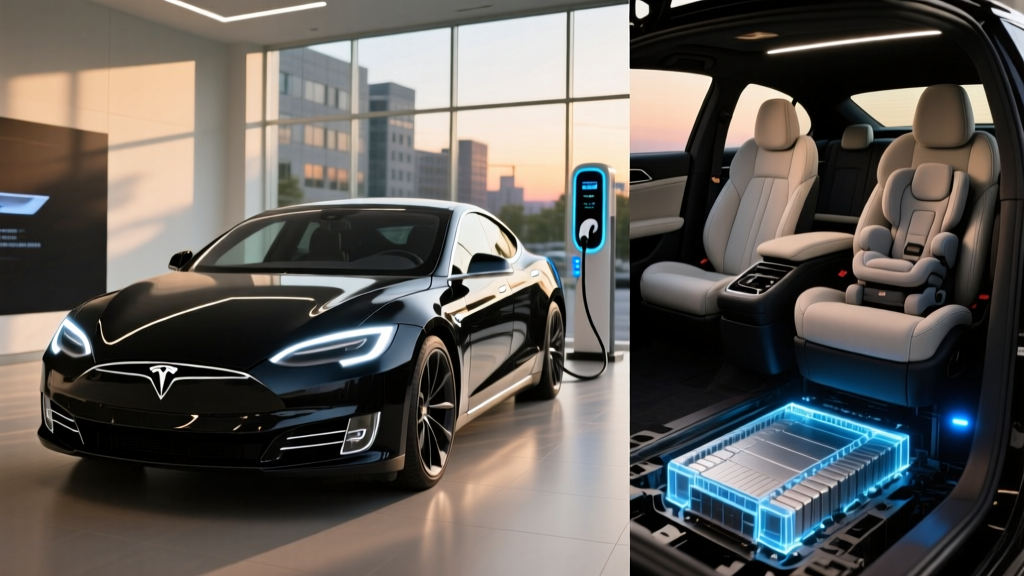
The Model Y's optional third row is best suited for children or very short trips — legroom is tight at roughly 26 inches, and it eliminates most rear cargo space when deployed. The Model X third row is genuinely usable for adults on short drives, with about 32 inches of legroom, and benefits from the vehicle's larger overall footprint. If three rows are non-negotiable for your family, the Model X is the only Tesla that delivers real utility in the back.
2026 Tesla Lineup: Range, Battery, and Charging Specs
Seating is only half the equation. Below you'll find the critical powertrain data for every current Tesla — EPA range, battery chemistry, DC fast-charging speed, and Level 2 home-charging rates. These numbers matter more than marketing claims when you're planning road trips or calculating your daily commute cost.
| Spec | Model 3 LR AWD | Model Y LR AWD | Model S LR | Model X LR | Cybertruck AWD |
|---|---|---|---|---|---|
| EPA Range | 363 mi | 320 mi | 402 mi | 335 mi | 340 mi |
| Battery (usable) | ~75 kWh | ~75 kWh | ~95 kWh | ~95 kWh | ~123 kWh |
| Chemistry | NMC (LR) / LFP (RWD) | NMC (LR) / LFP (RWD) | NMC | NMC | NMC |
| Peak DC Fast Charge | 250 kW | 250 kW | 250 kW | 250 kW | 250 kW (+30 kW via V4) |
| 10–80% DCFC Time | ~25 min | ~25 min | ~30 min | ~31 min | ~35 min |
| Level 2 Home (11.5 kW) | ~44 mi/hr | ~42 mi/hr | ~41 mi/hr | ~39 mi/hr | ~37 mi/hr |
| MPGe (combined) | 132 MPGe | 122 MPGe | 120 MPGe | 108 MPGe | 72 MPGe |
Battery Chemistry: LFP vs. NMC in Tesla's 2026 Lineup
Tesla uses two battery chemistries depending on trim. The Rear-Wheel Drive (RWD) trims of the Model 3 and Model Y use LFP (lithium iron phosphate) cells, which are heavier and offer less range but can be charged to 100% daily without accelerating degradation. The Long Range and Performance trims use NMC (nickel manganese cobalt) cells, which provide higher energy density and more range but are best kept between 20–80% for daily use to maximize longevity.
If your commute is short and you want zero range-anxiety about daily charging habits, an LFP-equipped RWD model is the pragmatic pick. If you need maximum range for road trips, NMC is the trade-off to accept.
Performance and Drivetrain: 0-60, Horsepower, and Towing
Tesla's performance credentials are well established, but the numbers vary widely across the lineup. Here's how each 2026 model stacks up in straight-line acceleration, power output, and practical utility.
| Metric | Model 3 LR AWD | Model Y LR AWD | Model S LR | Model X LR | Cybertruck AWD |
|---|---|---|---|---|---|
| 0–60 mph | 4.2 sec | 4.8 sec | 3.1 sec | 3.8 sec | 3.9 sec |
| Horsepower | ~384 hp | ~384 hp | ~670 hp | ~670 hp | ~600 hp |
| Drivetrain | Dual-Motor AWD | Dual-Motor AWD | Dual-Motor AWD | Dual-Motor AWD | Tri-Motor AWD |
| Towing Capacity | N/A | 3,500 lbs | N/A | 5,000 lbs | 11,000 lbs |
The Model S Plaid (not listed above) drops the 0–60 time to a staggering 1.99 seconds with 1,020 hp, but starts at roughly $89,990 and sacrifices some range. For most buyers, the Long Range dual-motor variants offer the best balance of acceleration, range, and price.
Pricing, Trims, and Federal Tax Credit Eligibility
Tesla's pricing has shifted considerably over the past two years. Below are the base MSRPs for each 2026 model as of early 2026, along with the federal tax credit landscape under IRS §30D rules.
| Model | Base MSRP | §30D Credit Eligible? | Est. After-Credit Price |
|---|---|---|---|
| Model 3 RWD | $38,990 | Yes — up to $7,500 | ~$31,490 |
| Model 3 LR AWD | $45,490 | Yes — up to $7,500 | ~$37,990 |
| Model Y RWD | $39,990 | Yes — up to $7,500 | ~$32,490 |
| Model Y LR AWD | $44,990 | Yes — up to $7,500 | ~$37,490 |
| Model S LR | $79,990 | No (exceeds $55K sedan cap) | $79,990 |
| Model X LR | $84,990 | No (exceeds $80K SUV cap) | $84,990 |
| Cybertruck AWD | $79,990 | Yes — up to $7,500 (under $80K truck cap) | ~$72,490 |
Cargo Space, Passenger Room, and Interior Dimensions
For buyers specifically searching how many seats a Tesla has, the interior volume behind those seats is usually the next question. Here's how the practical space breaks down.
| Model | Rear Legroom | Cargo (rear seats up) | Cargo (rear seats folded) | Frunk |
|---|---|---|---|---|
| Model 3 | 35.2 in | 23 cu ft (trunk) | ~50 cu ft (est.) | ~3.1 cu ft |
| Model Y (5-seat) | 36.5 in | 30 cu ft | 72 cu ft | ~4.1 cu ft |
| Model Y (7-seat, 3rd row up) | 26.0 in (3rd row) | ~12 cu ft (behind 3rd row) | 72 cu ft (all folded) | ~4.1 cu ft |
| Model S | 35.4 in | 28 cu ft (trunk+sub-trunk) | ~63 cu ft (est.) | ~5.3 cu ft |
| Model X (5-seat) | 37.1 in | ~43 cu ft (behind 2nd row) | ~88 cu ft | ~6.5 cu ft |
| Model X (7-seat, 3rd row up) | 32.0 in (3rd row) | ~16 cu ft (behind 3rd row) | ~88 cu ft (all folded) | ~6.5 cu ft |
| Cybertruck | ~36.0 in | ~34 cu ft (bed, closed) | N/A | ~7.0 cu ft (frunk) |
The Model Y's hatchback design gives it a decisive cargo advantage over the Model 3 sedan, despite similar exterior dimensions. The optional third row in the Model Y is strictly for small children — adults will find it cramped, and deploying it consumes nearly all rear cargo volume. For families needing genuine seven-passenger hauling with cargo space, the Model X is the only realistic Tesla option, though its $84,990+ starting price and exclusion from the federal tax credit make it a premium commitment.
Technology, Driver Assistance, and Notable Drawbacks
Infotainment and Software
Every 2026 Tesla runs on the same core software platform: a 15.4-inch center touchscreen (Model 3/Y) or 17-inch display (Model S/X/Cybertruck) controlling virtually all vehicle functions. There is no Apple CarPlay or Android Auto — Tesla's native system handles navigation, media, and phone integration via Bluetooth. The navigation system includes real-time Supercharger routing with preconditioning, which warms the battery en route to a DC fast charger for optimal charge speed.
Driver Assistance: Autopilot and FSD (Supervised)
Tesla includes basic Autopilot (traffic-aware cruise control and lane-keeping) as standard. Full Self-Driving (Supervised) is an optional add-on at approximately $8,000 or $99/month. FSD adds automatic lane changes, navigate-on-autopilot for highway interchanges, traffic light and stop sign recognition, and city-street autosteer.
Notable Drawbacks
- No Apple CarPlay / Android Auto: A dealbreaker for some buyers accustomed to phone-mirroring interfaces.
- Minimalist interior: The Model 3 and Model Y have virtually no physical buttons — wipers, mirrors, and glovebox are all screen-controlled, which frustrates some drivers.
- Panel gaps and build consistency: While improved from earlier years, Tesla's build quality still draws more owner complaints about panel alignment and interior rattles than legacy automakers at similar price points.
- No third-row option on Model 3 or Model S: If you need more than five seats, your Tesla choices narrow to Model Y (tight third row) or Model X (expensive, no tax credit).
- Insurance costs: Tesla insurance premiums tend to run 15–30% higher than comparable non-electric vehicles due to repair costs and collision data. Get a quote before purchasing.
Who Should Buy Which Tesla?
Best for Commuters & Solo Drivers
Model 3 RWD — 5 seats, 272-mile EPA range, ~$31,490 after tax credit. Lowest cost of entry, LFP battery allows daily 100% charging, and 132 MPGe combined keeps running costs minimal.
Best for Families (2 Kids or Fewer)
Model Y Long Range AWD — 5 seats (or 7 with small children), 320-mile range, 72 cu ft cargo with seats folded, ~$37,490 after credit. The best all-around Tesla for most households.
Best for Large Families (3+ Kids)
Model X Long Range — 5, 6, or 7 seats with a usable third row, 335-mile range, 5,000-lb towing. No federal tax credit, so budget $85K+ realistically. The only Tesla with genuine adult-capable third-row seating.
Best for Towing & Utility
Cybertruck AWD — 5 seats, 11,000-lb towing, 340-mile range, stainless steel exoskeleton bed. Qualifies for the $7,500 credit (under the $80K truck cap). Polarizing design, but unmatched utility in Tesla's lineup.
Tesla vs. Key Competitors: Is It Worth Buying?
The EV market in 2026 is more competitive than ever. Here's how Tesla's seating and value proposition compares against the most common cross-shopped alternatives.
| Vehicle | Seats | EPA Range | Base MSRP | §30D Credit |
|---|---|---|---|---|
| Tesla Model Y LR AWD | 5 (opt. 7) | 320 mi | $44,990 | Up to $7,500 |
| Hyundai Ioniq 5 Limited AWD | 5 | 290 mi | $52,600 | Up to $7,500 |
| Ford Mustang Mach-E Premium AWD | 5 | 300 mi | $48,995 | Up to $7,500 |
| Kia EV9 GT-Line AWD | 6 or 7 | 270 mi | $59,900 | Up to $7,500 |
| Rivian R1S Dual-Motor | 7 | 352 mi | $79,900 | Up to $7,500 (under $80K SUV cap) |
| Tesla Model X LR | 5, 6, or 7 | 335 mi | $84,990 | Not eligible (over $80K cap) |
If three-row seating is your top priority and budget is a concern, the Kia EV9 offers seven seats at nearly $25,000 less than a Model X, with a usable 270-mile range and full tax-credit eligibility. The Rivian R1S splits the difference with genuine off-road capability, seven seats, and 352 miles of range — though it pushes the $80K SUV cap boundary. The Model Y's optional third row is the most affordable seven-seat EV option in Tesla's lineup, but it's only practical for small children on short trips.
For five-seat buyers, the Tesla Model Y and Model 3 remain strong on efficiency, Supercharger network access, and over-the-air software updates — advantages that competitors are still working to match in breadth and reliability. Source: fueleconomy.gov for EPA data.
Warranty Coverage and Long-Term Ownership
Tesla's warranty structure is straightforward but not class-leading. Here's what's covered on every 2026 model:
- Basic Vehicle Limited Warranty: 4 years / 50,000 miles
- Battery & Drive Unit Warranty: 8 years / 100,000 miles (Model 3/Y RWD); 8 years / 120,000 miles (Model 3/Y Long Range & Performance, Model S, Model X)
- Battery Capacity Retention Threshold: Tesla warrants that the battery will retain at least 70% of its original capacity during the warranty period. If degradation exceeds 30%, Tesla will repair or replace the battery.
Real-world battery degradation data from owner fleets suggests most Tesla NMC batteries lose roughly 8–12% capacity over the first 100,000 miles, with the steepest drop occurring in the first 20,000 miles before leveling off. LFP batteries in the RWD trims show even slower degradation curves, making them a compelling choice for high-mileage drivers who plan to keep the vehicle long-term.
Frequently Asked Questions
How many seats does a Tesla Model Y have?
The 2026 Tesla Model Y comes standard with 5 seats. An optional third row brings the total to 7 seats, but the third row is very tight — roughly 26 inches of legroom — and is realistically only suitable for small children. With the third row deployed, rear cargo space drops to about 12 cubic feet.
Does the Tesla Model 3 have a third row?
No. The Model 3 is strictly a 5-seat sedan with no third-row option. If you need more than five seats from Tesla, you'll need to look at the Model Y (optional 7-seat) or the Model X (5, 6, or 7 seats).
Can adults sit in the Tesla Model X third row?
Yes, for short trips. The Model X third row offers about 32 inches of legroom, which is adequate for average-height adults on drives under an hour. For extended road trips, most adults will prefer the second row. The Model X is the only Tesla with a genuinely usable adult third row.
Does any Tesla qualify for the $7,500 federal tax credit?
Yes — the Model 3, Model Y, and Cybertruck (under the $80K truck MSRP cap) are eligible for up to $7,500 under IRS §30D, subject to buyer income limits ($150K single / $300K joint), battery critical-mineral sourcing requirements, and North American assembly. The Model S and Model X exceed the MSRP caps for sedans ($55K) and SUVs ($80K) respectively, and do not qualify. Always verify current rules at IRS.gov.
What is the real-world range of a Tesla on a road trip?
Expect 10–15% less than the EPA estimate during sustained highway driving at 70–75 mph, and 20–30% less in freezing temperatures. A Model 3 Long Range (363 mi EPA) will realistically deliver 280–310 highway miles in cold weather and 310–330 in mild conditions. Tesla's built-in navigation with Supercharger routing and battery preconditioning helps minimize charging time on trips.
How fast does a Tesla charge at home?
Using a Tesla Wall Connector on a 48-amp circuit (11.5 kW), you'll add roughly 37–44 miles of range per hour depending on the model. A full overnight charge (8 hours) adds 300+ miles for most trims. Installation costs typically range from $500 to $2,000 depending on your electrical panel capacity and the distance from the panel to the charger location. Always hire a licensed electrician and check whether your panel needs a 200-amp upgrade.