Quick Answer: Mercedes-Benz currently sells three main electric vehicles in the U.S.: the compact EQB SUV (from ~$54,000, EPA 251 mi), the midsize EQE Sedan/SUV (from ~$75,000, EPA 230–305 mi), and the flagship EQS Sedan/SUV (from ~$105,000, EPA 305–390 mi). None qualify for the full §30D federal tax credit in 2026 due to battery-sourcing rules, but luxury EV buyers benefit from lower fueling and maintenance costs that partially offset higher purchase prices. Real-world highway range runs 15–25% below EPA estimates depending on speed and temperature.
Mercedes-Benz Electric Vehicles: The Current Lineup
If you're researching electric vehicles Mercedes offers in the U.S. for the 2026 model year, the lineup spans three distinct platforms built for different buyer profiles. Unlike the Tesla or Hyundai/Kia approach of maximizing efficiency-per-dollar, Mercedes engineers its EVs around ride quality, cabin isolation, and brand prestige — which means heavier vehicles with higher energy consumption but noticeably more refinement.
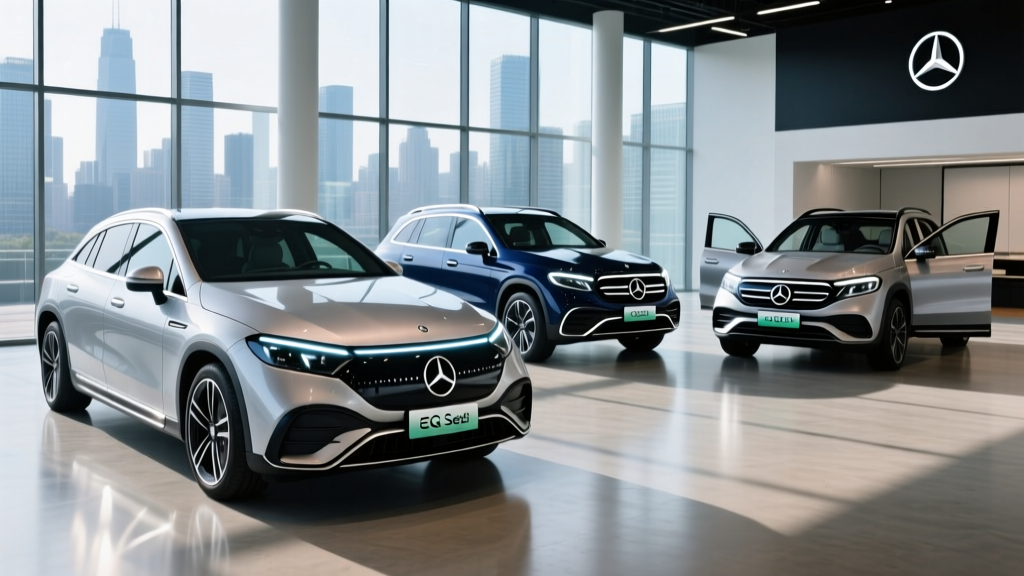
The EQB is the entry point: a compact three-row SUV sharing architecture with the GLB. The EQE occupies the midsize luxury segment as both a sedan and SUV, positioned against the BMW i5 and Audi e-tron GT. The EQS is the range-topping flagship, competing with the Tesla Model S, Lucid Air, and BMW i7.
| Model | Body Style | EPA Range | Battery (usable kWh) | Peak DC Charge | 10–80% Time | 0–60 mph | Starting MSRP |
|---|---|---|---|---|---|---|---|
| EQB 350 4MATIC | Compact SUV | 251 mi | 66.5 (NMC) | 100 kW | ~32 min | 6.0 sec | $54,150 |
| EQE 350+ Sedan | Midsize Sedan | 305 mi | 90.6 (NMC) | 170 kW | ~31 min | 6.2 sec | $75,050 |
| EQE 350 4MATIC SUV | Midsize SUV | 279 mi | 90.6 (NMC) | 170 kW | ~31 min | 6.4 sec | $78,150 |
| EQS 450+ Sedan | Full-Size Sedan | 390 mi | 118.0 (NMC) | 200 kW | ~31 min | 5.9 sec | $105,550 |
| EQS 450 4MATIC SUV | Full-Size SUV | 305 mi | 118.0 (NMC) | 200 kW | ~31 min | 5.7 sec | $106,250 |
| EQS 580 4MATIC Sedan | Full-Size Sedan | 345 mi | 118.0 (NMC) | 200 kW | ~31 min | 4.1 sec | $120,450 |
Source: fueleconomy.gov and Mercedes-Benz USA. All figures reflect 2026 model-year EPA estimates and manufacturer MSRP before destination charges.
Real-World Range Reality: EPA estimates assume mixed city/highway driving at moderate temperatures. In sustained 75-mph highway testing, expect the EQS 450+ Sedan to deliver roughly 310–330 miles, the EQE 350+ around 245–265 miles, and the EQB approximately 195–215 miles. In freezing weather (below 32°F), cabin heating and battery thermal management can reduce range an additional 20–30%, making the EQB's smaller battery a real limitation for cold-climate road trips.
Charging Speed and Infrastructure: What Mercedes EV Owners Face
Mercedes-Benz EVs use the CCS1 connector natively, though the brand has announced NACS (Tesla-style) adoption for future models. As of 2026, current EQ models can access Tesla Superchargers using a Mercedes-provided CCS-to-NACS adapter, significantly expanding the available DC fast-charging network.
| Level | Power | EQB (mi/hr) | EQE Sedan (mi/hr) | EQS Sedan (mi/hr) | Equipment Needed |
|---|---|---|---|---|---|
| Level 1 (120V) | ~1.4 kW | ~4 | ~5 | ~5 | Standard outlet (included cord) |
| Level 2 (240V, 48A) | ~11.5 kW | ~33 | ~38 | ~40 | Home wallbox or public L2 |
| DC Fast (peak) | 100–200 kW | ~150 | ~220 | ~250 | Public DCFC station |
The EQS and EQE charge at a respectable 170–200 kW peak, but the charge curve tapers significantly above 80% State of Charge (SoC). That 10–80% time of ~31 minutes is competitive, but a 10–100% session can stretch past 55 minutes. For road-trip planning, budget 35 minutes at each stop if you're charging to 80% and add buffer time for station availability.
Home Level 2 charging is essential for Mercedes EV ownership. A full EQS battery (118 kWh usable) takes roughly 11 hours on an 11.5 kW home charger — fine for overnight replenishment but slow if you arrive home nearly empty and need a full charge by morning. Most owners will rarely charge from 0–100% at home; daily driving of 30–50 miles requires only 3–5 hours of Level 2 top-up.
Mercedes EV vs. Gas Equivalent: The Cost Comparison
Luxury EV ownership economics differ from mainstream EVs. The upfront premium is substantial, but the ongoing savings on fuel and maintenance can be meaningful over a five-year horizon — especially if you charge primarily at home on residential electricity rates.
| Cost Category | EQS 450+ Sedan (EV) | S 500 4MATIC (Gas) | Difference |
|---|---|---|---|
| Purchase Price (MSRP) | $105,550 | $118,900 | EV saves $13,350 |
| Federal Tax Credit (§30D) | $0 (sourcing rules) | $0 | — |
| Fuel/Energy (15,000 mi/yr) | $6,750 (home L2 @ $0.14/kWh) | $18,000 (premium @ $4.00/gal, 22 MPG) | EV saves $11,250 |
| Maintenance (5 yr) | $2,800 | $6,500 | EV saves $3,700 |
| Insurance (avg 5 yr) | $19,500 | $16,500 | EV costs $3,000 more |
| Depreciation (est. 5 yr) | $52,000 | $48,000 | EV costs $4,000 more |
| 5-Year Total | $182,600 | $207,900 | EV saves ~$25,300 |
Assumptions: 15,000 miles/year, residential electricity at $0.14/kWh, premium gasoline at $4.00/gallon. Insurance estimates based on luxury-segment averages. Depreciation reflects current luxury-EV resale trends. Individual results vary by state, driving pattern, and electricity rate. Source: fueleconomy.gov efficiency data.
The EQS actually starts at a lower MSRP than its gas S-Class sibling, which is unusual in the luxury EV space. Combined with fuel and maintenance savings, the five-year picture favors the EV — but higher insurance premiums and steeper depreciation partially erode the advantage. If your electricity rate exceeds $0.25/kWh or you rely heavily on paid public DC fast charging ($0.40–$0.60/kWh), the fuel-cost savings narrow considerably.
Federal Tax Credit and Incentive Reality for Mercedes EVs
This is where Mercedes EV buyers face a hard truth: as of 2026, no new Mercedes-Benz electric vehicle qualifies for the full $7,500 §30D federal tax credit. The reason is battery-component and critical-mineral sourcing requirements under the Inflation Reduction Act. Mercedes-Benz battery supply chains have not yet met the thresholds that would unlock the credit for U.S. buyers.
§30D Federal EV Tax Credit Requirements (2026):
- Vehicle MSRP must not exceed $55,000 (sedans) or $80,000 (SUVs/vans/pickups) — most Mercedes EVs exceed these caps
- Buyer adjusted gross income must not exceed $150,000 (single), $225,000 (head of household), or $300,000 (joint)
- Battery components must meet U.S./FTA-country manufacturing thresholds
- Critical minerals must meet U.S./FTA-country sourcing thresholds
- Credit can be transferred to the dealer at point of sale for an instant price reduction
Source: IRS.gov — Clean Vehicle Credits. Rules are subject to change; consult a tax professional for your specific eligibility.
The EQB, priced around $54,000, technically falls under the MSRP cap for SUVs ($80,000), but the battery-sourcing disqualification still applies. Some state-level incentives (California, Colorado, New York, and others) may offer partial rebates — check your state energy office or DMV for current programs.
For used Mercedes EVs, the §25E used clean vehicle credit offers up to $4,000 (30% of sale price, capped) on vehicles priced at $25,000 or less. Given current depreciation curves, a 2023 or 2024 EQB or EQE may eventually reach that threshold, making a pre-owned Mercedes EV significantly more accessible.
Real-World Ownership: What First-Time Mercedes EV Buyers Should Know
Buying a luxury EV involves practical considerations that showroom brochures gloss over. Here's what matters once you take delivery:
Home Charging Is Non-Negotiable
Public DC fast charging at $0.48–$0.60/kWh eliminates most of the cost advantage over gasoline. A Level 2 home charger installation (240V, 48-amp circuit) typically costs $1,200–$3,500 depending on your electrical panel capacity and run length. If your home has a 100-amp panel, a $2,000–$4,000 panel upgrade to 200 amps may be required. Get a quote from a licensed electrician before purchasing the vehicle.
Tire Costs Are Higher
Mercedes EVs are heavy — the EQS tips the scales at over 5,600 lbs — and that weight plus instant torque accelerates tire wear. Expect to replace tires every 25,000–35,000 miles, and EV-optimized tires for the EQS run $300–$450 per corner. Budget $1,200–$1,800 for a tire set every 2–3 years.
Software and Feature Updates
The MBUX infotainment system receives over-the-air updates, but Mercedes has faced criticism for gating some features behind subscription paywalls (e.g., rear-axle steering activation, certain drive modes). Confirm which features are included vs. subscription-based at the point of purchase.
Depreciation Is Steeper Than Gas Equivalents
Luxury EVs have depreciated faster than their gasoline counterparts, driven by rapid technology iteration, Tesla price cuts, and buyer uncertainty about battery longevity. The EQS has seen 45–55% depreciation over three years in some market conditions, compared to roughly 35–40% for the S-Class. If you lease, this risk is transferred to the lessor — which is why over 60% of Mercedes EVs are leased rather than purchased.
| Myth | Fact |
|---|---|
| "The EQS gets 390 miles of range in real driving." | 390 mi is the EPA estimate. Sustained highway driving at 75 mph yields ~310–330 mi. Cold weather reduces this further. |
| "I'll save $7,500 with the federal tax credit." | No 2026 Mercedes EV qualifies for §30D due to battery-sourcing rules and, for sedans, MSRP caps. |
| "DC fast charging is just as cheap as home charging." | Public DCFC costs $0.40–$0.60/kWh — roughly 3–4× the cost of residential electricity at $0.14/kWh. |
| "The battery will need expensive replacement within 5 years." | Mercedes warranties the HV battery for 10 years/155,000 miles (70% capacity retention). NMC degradation data shows ~10–15% loss over 100,000 miles under normal use. |
| "Mercedes EVs can use Tesla Superchargers directly." | Current models use CCS1 and require a Mercedes-supplied adapter for NACS Supercharger access. |
Battery Longevity and Warranty Coverage
All current Mercedes-Benz EVs use NMC (nickel manganese cobalt) lithium-ion battery packs. NMC offers high energy density — essential for the EQS's 390-mile EPA rating — but is more sensitive to high-temperature degradation and frequent 100% charging than LFP chemistry.
Mercedes provides a high-voltage battery warranty of 10 years or 155,000 miles, guaranteeing a minimum of 70% state of health (SoH). If the battery drops below that threshold within the warranty period, Mercedes will repair or replace modules to restore capacity. Out-of-warranty replacement costs are substantial: estimates for a full EQS battery pack run $25,000–$35,000 including labor, though module-level repairs are less expensive.
To maximize battery longevity, Mercedes recommends:
- Setting a daily charge limit of 80% (configurable in MBUX)
- Using preconditioning when navigating to a DC fast charger (the car warms the battery for optimal charge acceptance)
- Avoiding prolonged storage at 100% SoC or below 10% SoC
- Using Level 2 charging for daily needs rather than frequent DC fast charging
Decision Framework: Which Mercedes EV Is Right for You?
Choose the EQB if:
- You want the most affordable entry into a Mercedes EV (from ~$54,000)
- You need occasional third-row seating for children
- Your daily commute is under 60 miles round-trip
- You primarily drive in urban and suburban environments
Choose the EQE Sedan if:
- You want a midsize luxury EV with 250+ real-world highway miles
- You value a traditional sedan driving position and trunk separation
- You're comparing against the BMW i5 or Audi A6 e-tron
- Performance variants (AMG EQE) interest you
Choose the EQS Sedan if:
- Maximum range is a priority (390 mi EPA, ~310–330 real-world highway)
- You frequently take 200+ mile road trips and want fewer charging stops
- Cabin silence and ride quality are paramount
- Budget allows $105,000+ and you accept steeper depreciation
Choose the EQS SUV if:
- You need full-size SUV cargo and passenger space with electric powertrain
- You want three rows and 305 miles of EPA range
- You're cross-shopping the Tesla Model X or BMW iX but prefer Mercedes interior quality
Consider a non-Mercedes EV if:
- Federal tax credit eligibility is important to your purchase math
- You want LFP battery chemistry for longer cycle life and 100% daily charging tolerance
- Charging speed is a top priority (Hyundai/Kia E-GMP vehicles charge 10–80% in ~18 min at 350 kW stations)
- You want a sub-$50,000 EV with 300+ miles of range
Frequently Asked Questions
Does Mercedes-Benz make a fully electric SUV?
Yes. Mercedes sells the EQB (compact, 3-row), EQE SUV (midsize), and EQS SUV (full-size, 3-row). All are fully electric with no gasoline engine. The G-Class EV (G 580 with EQ Technology) has also been announced for the U.S. market at approximately $160,000.
Why don't Mercedes EVs qualify for the $7,500 federal tax credit?
Two factors: the §30D credit requires battery components and critical minerals to be sourced from the U.S. or free-trade-agreement countries at specified thresholds, which Mercedes supply chains have not yet met. Additionally, the MSRP cap for sedans is $55,000 — well below the EQE and EQS pricing. The EQB falls under the $80,000 SUV cap but still fails the sourcing requirement. Check IRS.gov for current rules.
How much does it cost to charge a Mercedes EQS at home?
The EQS has 118 kWh of usable battery capacity. At the U.S. residential average of $0.14/kWh, a full 0–100% charge costs approximately $16.50. A typical daily top-up of 30 kWh (roughly 100 miles of driving) costs about $4.20. Compare that to $18–$22 for the equivalent distance in an S-Class burning premium gasoline.
Is the Mercedes EQS reliable?
Long-term reliability data for the EQS is still accumulating. The EV powertrain itself (motor, inverter, battery) has fewer moving parts than a gasoline engine and historically shows strong durability. However, early EQS models have reported software glitches in the MBUX Hyperscreen and air suspension calibration issues. NHTSA shows a small number of recalls related to software and electrical systems. As with any first-generation platform, buying a model year 2–3 years into production tends to yield better build quality.
Can I lease a Mercedes EV and still get a tax benefit?
Yes, indirectly. Under the commercial clean vehicle credit (§45W), leasing companies can claim a $7,500 credit on eligible vehicles and may pass the savings to the lessee as a capitalized-cost reduction (lowering monthly payments). This pathway bypasses the §30D buyer income, MSRP, and sourcing restrictions. Ask the Mercedes dealer whether their lease offers include "EV lease cash" or pass-through credit incentives.
What is the real-world range of the Mercedes EQE 350+ Sedan?
The EPA rates the EQE 350+ at 305 miles. In real-world highway driving at 70–75 mph in moderate temperatures (60–80°F), expect approximately 245–265 miles. In cold weather (below 32°F) with cabin heating active, that drops to roughly 200–230 miles. Efficiency is rated at 95 MPGe combined, or about 35 kWh per 100 miles.
This article reflects 2026 model-year data and current IRS §30D rules as of publication. Specifications, pricing, and incentive eligibility are subject to change. Always verify with the manufacturer, your tax professional, and fueleconomy.gov before making a purchase decision.