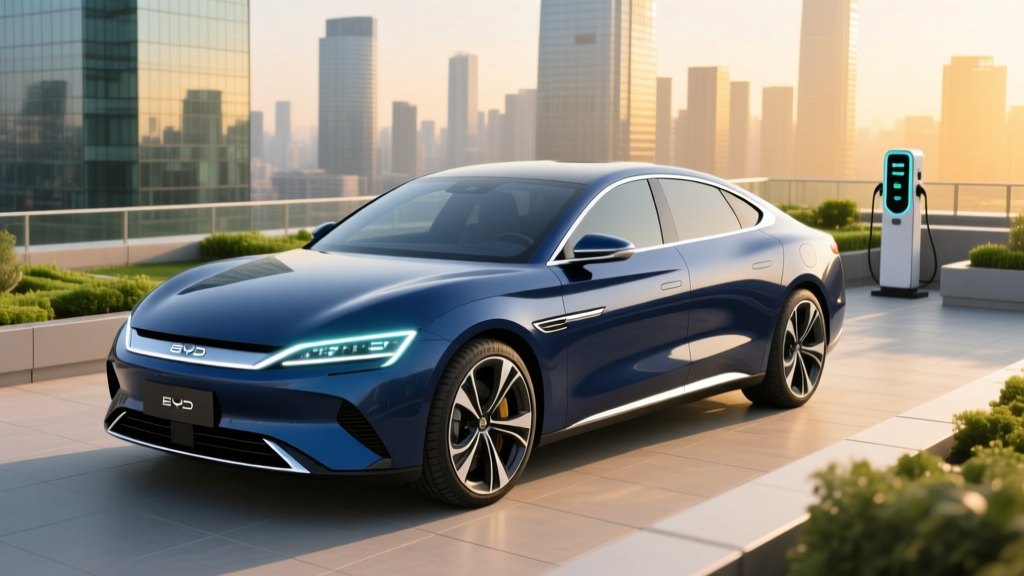
BYD has overtaken Tesla as the world's top-selling battery-electric vehicle manufacturer, and the question on every EV shopper's mind is straightforward: how much do BYD cars cost? The answer depends entirely on where you live. In China and export markets like Europe, Australia, and Southeast Asia, BYD offers some of the most aggressively priced EVs on the road. In the United States, however, the picture is far more complicated — shaped by 100% tariffs on Chinese-made EVs, federal tax-credit sourcing rules, and a market-entry strategy that remains limited as of early 2026.
This guide breaks down BYD's current global lineup with exact pricing, specs, and real-world ownership data — and explains what US buyers need to know about whether these vehicles will ever reach American driveways.
BYD's Current Global EV Lineup: Prices at a Glance
BYD's passenger vehicle range spans compact hatchbacks to premium sedans and SUVs. Below are the key models available in international markets as of 2026, with pricing converted to USD for comparison. Note that these reflect manufacturer MSRPs in their primary export markets (Australia, UK, EU) and do not include US-specific adjustments, as BYD passenger vehicles are not sold in the United States.
| Model | Body Style | Battery (kWh) | Chemistry | Range (WLTP) | Starting Price (USD equiv.) |
|---|---|---|---|---|---|
| BYD Dolphin | Compact Hatchback | 60.4 kWh | LFP (Blade) | 265 mi | ~$28,000 |
| BYD Atto 3 (Yuan Plus) | Compact SUV | 60.4 kWh | LFP (Blade) | 260 mi | ~$32,000 |
| BYD Seal | Midsize Sedan | 82.5 kWh | LFP (Blade) | 354 mi | ~$38,500 |
| BYD Seal U | Midsize SUV | 87 kWh | LFP (Blade) | 310 mi | ~$42,000 |
| BYD Han | Full-Size Sedan | 85.4 kWh | LFP (Blade) | 323 mi | ~$48,000 |
| BYD Tang | 3-Row SUV | 108.8 kWh | LFP (Blade) | 335 mi | ~$55,000 |
Pricing reflects approximate 2026 export-market MSRPs converted to USD. Actual prices vary by country due to VAT, import duties, and local incentives. Source: BYD global press materials and regional dealer listings.
BYD in the United States: Tariff Reality and Market Status
As of 2026, BYD does not sell passenger vehicles in the United States. The primary barrier is the 100% tariff on Chinese-manufactured EVs enacted in 2024 under Section 301 trade provisions, which effectively doubles the landed cost of any BYD vehicle imported from China. This tariff was designed specifically to protect the domestic auto industry from heavily subsidized Chinese EV manufacturers.
BYD has announced plans to build manufacturing plants in Mexico, Brazil, Hungary, and Thailand, which could theoretically create export pathways to the US market. However, any vehicles produced outside China would still face scrutiny under the IRS §30D federal tax credit rules, which require battery components and critical minerals to be sourced from the US or free-trade-agreement partners — effectively excluding BYD's vertically integrated Chinese supply chain from the $7,500 credit even if vehicles reached US showrooms.
Deep Dive: BYD Seal — The Model That Could Compete With Tesla
The BYD Seal is the company's most internationally prominent model and the one most frequently compared to the Tesla Model 3. Here's a full spec breakdown based on the 2026 export-spec version:
| Spec | BYD Seal (Design AWD) |
|---|---|
| Battery | 82.5 kWh usable, LFP Blade |
| WLTP Range | 323 mi (AWD) / 354 mi (RWD) |
| EPA Range (estimated if sold in US) | ~275-290 mi (AWD) / ~300-310 mi (RWD) |
| Motor | Dual-motor AWD (390 kW combined) or single-motor RWD (230 kW) |
| Horsepower | 523 hp (AWD) / 308 hp (RWD) |
| 0-60 mph | 3.8 sec (AWD) / 5.9 sec (RWD) |
| Max DC Fast Charge | 150 kW peak |
| 10-80% DC Time | ~26 minutes |
| Level 2 Home Charge | 11 kW AC (~37 mi/hr) |
| MPGe (est.) | ~110 MPGe combined |
| Length / Wheelbase | 189.0 in / 112.2 in |
| Cargo Volume | 14.1 cu ft trunk + 1.8 cu ft frunk |
| Curb Weight | 4,740 lb (AWD) |
| Warranty (EU) | 6 yr / 93,000 mi vehicle; 8 yr / 124,000 mi battery |
| Starting Price (EU) | €44,900 (~$48,500) AWD Design |
Charging Performance: BYD's Blade Battery Under Pressure
BYD's proprietary Blade Battery uses lithium iron phosphate (LFP) chemistry arranged in a cell-to-pack configuration that eliminates modules and improves volumetric energy density. The trade-off: LFP cells charge more conservatively at extreme states of charge compared to NMC chemistry.
| Charging Method | Power | Speed / Time |
|---|---|---|
| Level 1 (120V household) | ~1.4 kW | ~5 mi/hr |
| Level 2 (240V home/public AC) | 11 kW max | ~37 mi/hr; full charge in ~8 hr |
| DC Fast Charge (peak) | 150 kW | 10-80% in ~26 min |
| DC Fast Charge (sustained avg.) | ~100 kW | 10-90% in ~38 min |
The 150 kW peak charge rate is competitive but not class-leading — the Hyundai Ioniq 5 peaks at 240 kW on an 800V architecture, and the Tesla Model 3 Highland hits 250 kW on V3 Superchargers. BYD's charge curve holds near peak from roughly 10-50% SoC, then tapers progressively through 80%, and drops sharply above 90%. For road-trip charging, plan stops around the 10-80% window to maximize time efficiency.
One LFP advantage: BYD recommends periodic 100% charges to recalibrate the battery management system, unlike NMC vehicles where 80% daily limits are standard. This means daily commuters can use the full pack capacity without the same degradation concerns, though long-term cycle data on BYD's Blade packs in Western climates remains limited.
BYD Seal vs. Tesla Model 3 vs. Hyundai Ioniq 6: How They Compare
If the Seal were available in the US, here's how it would stack up against its most direct competitors on paper:
| Spec | BYD Seal AWD | Tesla Model 3 LR AWD | Hyundai Ioniq 6 LR AWD |
|---|---|---|---|
| Battery | 82.5 kWh LFP | 79 kWh NMC | 77.4 kWh NMC |
| EPA Range | ~285 mi (est.) | 346 mi | 316 mi |
| 0-60 mph | 3.8 sec | 4.2 sec | 5.1 sec |
| Peak DC Charge | 150 kW | 250 kW | 240 kW |
| 10-80% Time | ~26 min | ~15 min | ~18 min |
| Price (USD equiv.) | ~$48,500 | $47,740 | $48,550 |
| Tax Credit Eligible (US) | No | Partial ($3,750) | Yes ($7,500) |
The Seal's acceleration and build quality are genuinely competitive, but its charging speed and estimated EPA range fall behind both the Model 3 and Ioniq 6. In export markets without tariff distortions, BYD's lower pricing (the RWD Seal starts around $38,500 in several countries) makes it a compelling alternative. In the US, the tax-credit gap alone would add $7,500 to the effective cost disparity.
BYD's Blade Battery: LFP Chemistry Explained
Every BYD passenger EV uses the company's proprietary Blade Battery — an LFP (lithium iron phosphate) cell in a long, thin form factor that BYD claims passes nail-penetration tests without thermal runaway. This is a meaningful safety advantage: LFP chemistry is inherently more thermally stable than the nickel-manganese-cobalt (NMC) chemistry used in most long-range EVs from Tesla, Hyundai, and Ford.
The trade-offs are equally real:
| Factor | LFP (BYD Blade) | NMC (Industry Standard) |
|---|---|---|
| Energy Density | Lower (~160 Wh/kg cell) | Higher (~250 Wh/kg cell) |
| Thermal Stability | Excellent | Good (requires active management) |
| Cold-Weather Performance | More range loss (20-30%) | Moderate loss (15-25%) |
| Cycle Life | 3,000+ cycles | 1,500-2,000 cycles |
| Cost | ~20% cheaper per kWh | Higher (nickel/cobalt dependent) |
| SoC Calibration | Needs periodic 100% charge | Best kept 20-80% daily |
For daily commuters with home charging, LFP's longevity and cost advantages are significant. For road-trippers and cold-climate drivers, the lower energy density and winter range penalty are practical drawbacks worth weighing. BYD's Blade Battery documentation claims less than 5% degradation over 1,000 charge cycles, though independent long-term data from Western fleet operators is still emerging.
Federal Tax Credits, Tariffs, and the US Pricing Problem
Even if BYD could navigate the 100% tariff to sell in the US, the federal EV tax credit under IRS §30D would almost certainly be out of reach. Here's why:
- Battery sourcing requirements: For 2026, at least 80% of critical minerals and 100% of battery components must be sourced from the US or FTA partners to qualify for the full $7,500 credit. BYD's supply chain is overwhelmingly Chinese-domestic.
- Foreign Entity of Concern (FEOC) exclusion: Vehicles with battery components manufactured by a FEOC (which includes most Chinese state-linked companies) are categorically ineligible for any §30D credit regardless of other criteria.
- MSRP caps: Sedans must be under $55,000; SUVs/trucks under $80,000. BYD's pricing would clear this bar, but the sourcing rules make it moot.
- Buyer income limits: AGI must not exceed $300,000 (joint) / $225,000 (head of household) / $150,000 (individual). This applies regardless of the vehicle.
The practical result: a BYD Seal sold in the US would likely cost $48,000+ after tariffs, receive $0 in federal tax credits, and compete against a Hyundai Ioniq 6 that effectively costs $41,000 after the $7,500 point-of-sale credit. The math simply doesn't work for American buyers under current trade policy.
Who BYD EVs Actually Serve Best (In Markets Where They're Available)
For buyers in Europe, Australia, Southeast Asia, and Latin America where BYD operates, the brand serves several distinct use cases well:
Urban commuters with home charging: The Dolphin and Atto 3 offer 260+ WLTP miles of range, LFP longevity for daily 100% charging, and prices that undercut European and Japanese competitors by 15-25%. If your daily round-trip is under 60 miles, either model provides weeks between charges.
Value-oriented families: The Seal U and Tang offer SUV practicality with 300+ miles of range at prices that rival smaller crossovers from legacy brands. The Tang's three-row layout and 108.8 kWh battery make it viable for families needing space and range on a budget.
Fleet and rideshare operators: LFP's superior cycle life (3,000+ cycles vs. 1,500-2,000 for NMC) means BYD vehicles can endure high-mileage commercial use with less battery degradation — a critical factor for total cost of ownership calculations.
Frequently Asked Questions
Can I buy a BYD car in the United States in 2026?
No. BYD does not sell passenger vehicles in the US market. A 100% tariff on Chinese-manufactured EVs, combined with federal tax-credit sourcing exclusions, makes importing BYD vehicles economically unviable. BYD has indicated interest in future US market entry via overseas factories, but no timeline or confirmed models exist.
How much does the cheapest BYD EV cost?
The BYD Seagull (a subcompact hatchback sold in China and Latin America) starts at approximately $10,000 USD equivalent in its base Chinese-market trim. The export-spec BYD Dolphin, available in Europe and Australia, starts around $28,000 USD equivalent. Neither is available in the US.
Is BYD's Blade Battery safer than other EV batteries?
LFP chemistry, which BYD's Blade Battery uses, is inherently more thermally stable than NMC chemistry. BYD's nail-penetration test demonstrates the cell does not undergo thermal runaway when punctured — a meaningful safety advantage. However, all modern EVs from major manufacturers include robust battery management and thermal protection systems, and NHTSA crash data does not show a systemic safety gap between LFP and NMC vehicles in real-world collisions.
Why is BYD cheaper than Tesla?
BYD's cost advantage stems from vertical integration (the company manufactures its own batteries, semiconductors, and motors), Chinese government subsidies, lower labor costs, and LFP chemistry that avoids expensive nickel and cobalt. In markets without tariffs, this allows BYD to undercut Tesla by 15-30% on comparable models.
What's the real-world range of the BYD Seal?
Under WLTP testing, the BYD Seal AWD achieves 323 miles. The EPA cycle is more demanding, and the estimated EPA-equivalent range is approximately 275-290 miles for the AWD model. In cold weather (below freezing), expect 20-30% range loss due to LFP chemistry characteristics, reducing effective winter range to roughly 200-220 miles. Highway driving at sustained speeds above 70 mph will reduce range by an additional 10-15%.
Does BYD qualify for any US EV incentives?
No. Since BYD vehicles are not sold in the US, they cannot qualify for the §30D federal tax credit or any state-level incentives. Even if imported, the FEOC battery-sourcing exclusion and 100% tariff would render them ineligible for credits and prohibitively expensive.