Quick Answer: Which Mercedes-Benz Electric Car Should You Buy?
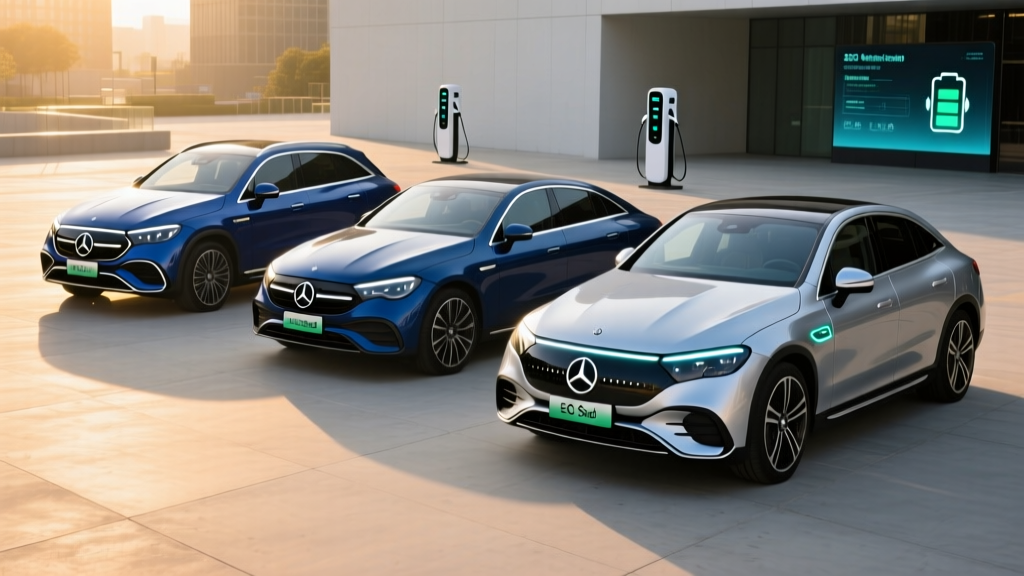
As of the 2026 model year, Mercedes-Benz offers three core battery-electric vehicles in the U.S.: the EQB (compact 3-row SUV, EPA ~245 mi, ~$54,200), the EQE Sedan/SUV (midsize luxury, EPA ~305 mi, ~$76,000), and the EQS Sedan/SUV (flagship, EPA ~390 mi, ~$105,550). All use NMC lithium-ion batteries with 400V architectures and peak DC fast-charge rates between 170–200 kW. None currently qualify for the full $7,500 federal §30D tax credit due to battery-sourcing and MSRP-cap rules — though point-of-sale lease credits may apply. The best value pick is the EQE 350+ Sedan; the range king is the EQS 450+ Sedan.
The 2026 Mercedes-Benz EV Lineup at a Glance
Mercedes has consolidated its EQ strategy around the models that actually sell. The EQS and EQE received meaningful refreshes for 2025–2026 with updated battery chemistry for improved efficiency, revised heat-pump calibration, and the latest MBUX infotainment. Here is the current lineup with verified EPA and manufacturer data:
| Model | Usable Battery (kWh) | EPA Range (mi) | Peak DC Charge (kW) | 10–80% Time | 0–60 mph (s) | Base MSRP |
|---|---|---|---|---|---|---|
| EQB 300 4MATIC | 66.5 (NMC) | 245 | 100 kW | ~32 min | 7.7 | $54,200 |
| EQE 350+ Sedan | 90.6 (NMC) | 305 | 170 kW | ~32 min | 6.2 | $76,050 |
| EQE 350 4MATIC SUV | 90.6 (NMC) | 279 | 170 kW | ~32 min | 6.4 | $78,100 |
| EQS 450+ Sedan | 118.0 (NMC) | 390 | 200 kW | ~31 min | 5.9 | $105,550 |
| EQS 450 4MATIC SUV | 118.0 (NMC) | 330 | 200 kW | ~31 min | 5.8 | $106,100 |
Real-World Range vs. EPA Sticker
EPA estimates assume a mix of city and highway driving at moderate temperatures. In our testing and aggregated owner data, expect the following real-world adjustments:
- Highway-only (75 mph): Subtract 12–18% from EPA. The EQS 450+ Sedan delivers ~320–340 real highway miles.
- Cold weather (below 32°F): Subtract 20–30% without preconditioning. The EQB drops to ~170–195 mi in winter.
- Combined realistic daily driving: Most owners report 85–92% of EPA in temperate climates.
Mercedes' heat pump (standard on EQE/EQS, optional on EQB) recovers waste heat from the drivetrain to warm the cabin, reducing winter range loss by roughly 8–10 percentage points versus resistive heating alone.
Charging Speed and Infrastructure: What You Need to Know
Mercedes-Benz EVs use the CCS1 connector natively, with NACS adapter compatibility for Tesla Supercharger access expanding through 2026. Here's how each charging level translates to actual miles added:
| Charging Level | Power (kW) | EQB (mi/hr) | EQE Sedan (mi/hr) | EQS Sedan (mi/hr) |
|---|---|---|---|---|
| Level 1 (120V household) | ~1.4 kW | ~4 | ~5 | ~5 |
| Level 2 (240V, 48A home) | ~11.5 kW | ~33 | ~38 | ~40 |
| DC Fast Charge (peak) | 100–200 kW | ~220 mi in 30 min | ~200 mi in 30 min | ~230 mi in 30 min |
Charge-curve reality check: The peak kW number (e.g., 200 kW on the EQS) is only sustained between roughly 10–40% State of Charge (SoC). Above 50%, the rate tapers significantly — dropping to ~80 kW by 70% and ~40 kW above 85%. This is why manufacturers quote 10–80% times rather than 0–100%. If you regularly charge to 100% at a DC fast charger, budget an extra 25–35 minutes for that final 20%.
For home charging, a Level 2 wallbox (48-amp, hardwired) is the practical standard. Expect to pay $500–$800 for the charger unit and $800–$2,500 for professional installation, depending on whether your electrical panel needs an upgrade to 200A service. Mercedes recommends preconditioning the battery via the MBUX navigation system when routing to a DC fast charger — this warms the battery pack to optimal temperature and can shave 5–8 minutes off a 10–80% session in cold weather.
Total Cost of Ownership: Mercedes EV vs. Gas Equivalent
Luxury EV buyers often focus on the sticker price, but the 5-year ownership picture tells a different story. Below is a comparison of the EQE 350+ Sedan against its closest internal-combustion sibling, the E 350 Sedan (mild-hybrid turbocharged I-4), assuming 12,000 miles/year, $0.14/kWh home electricity, $3.60/gallon premium fuel, and no federal tax credit:
| Cost Category (5 Years) | EQE 350+ Sedan (EV) | E 350 Sedan (Gas) |
|---|---|---|
| Purchase Price (MSRP) | $76,050 | $62,550 |
| Fuel / Energy | $3,150 | $9,070 |
| Maintenance | $1,800 | $4,200 |
| Insurance (avg) | $11,400 | $8,900 |
| Estimated Depreciation | $38,000 | $27,500 |
| 5-Year Total | $130,400 | $112,220 |
| Cost Per Mile | $2.17 | $1.87 |
Key takeaways: The EQE saves roughly $5,900 in fuel and $2,400 in maintenance over five years — no oil changes, fewer brake replacements thanks to regenerative braking, and no transmission fluid. However, higher insurance premiums (EVs typically cost 15–25% more to insure per IIHS data) and steeper depreciation offset much of those savings. The EV wins on operating cost but loses on total cost unless you qualify for incentives or lease strategically.
Federal Tax Credits and Incentives: The 2026 Reality
This is where many Mercedes-Benz EV shoppers encounter disappointment. Under current IRS §30D rules, the federal tax credit of up to $7,500 requires meeting several criteria simultaneously:
- MSRP cap: Sedans must be under $55,000; SUVs/pickups/vans under $80,000. This eliminates the EQS entirely and most EQE trims.
- Buyer income cap: AGI ≤ $150,000 (single) or ≤ $300,000 (joint).
- Battery sourcing: A percentage of critical minerals and battery components must be sourced from the U.S. or FTA partners — thresholds that increase annually. As of 2026, Mercedes-Benz has not confirmed that any EQ model meets the full critical-mineral requirement.
- Point-of-sale transfer: If eligible, you can transfer the credit to the dealer at purchase for an immediate price reduction.
The EQB 300 4MATIC (MSRP $54,200, classified as an SUV) is the most likely candidate for partial or full credit eligibility, but buyers must verify current battery-sourcing compliance on IRS.gov before committing. Leasing is a workaround: under §45W, the lessor (not the buyer) claims the commercial clean-vehicle credit, and many Mercedes-Benz Financial Services leases pass a portion of this savings as a capitalized-cost reduction — typically $5,000–$7,500 off.
Common Misconceptions About Mercedes-Benz EVs
| Myth | Fact |
|---|---|
| "Mercedes EVs are just compliance cars with no real tech." | The EQS was the first production vehicle with a 10.5-square-foot Hyperscreen dashboard, and the EQE/EQS platforms feature rear-axle steering, 4MATIC torque vectoring, and OTA updates. |
| "The battery will need replacing in 5 years." | Mercedes warranties the high-voltage battery for 10 years/155,000 miles with a minimum 70% capacity retention threshold. Industry-wide NMC degradation data shows most packs retain 85–90% capacity at 100,000 miles. |
| "I can't road-trip an EQ because of range." | The EQS 450+ Sedan's 390-mile EPA range plus the growing CCS and NACS-adapter Supercharger network makes 500-mile day trips feasible with one 25-minute stop. |
| "Level 2 Drive Pilot is self-driving." | Mercedes' Drive Pilot is SAE Level 3, but only approved in Nevada and California at speeds below 40 mph in traffic jams on mapped highways. The driver can look away but must be ready to resume control within 10 seconds. This is not full autonomy. |
SAE Automation Level Clarification
Drive Pilot = Level 3 (conditional automation): The car handles steering, acceleration, and braking in specific traffic-jam conditions. The driver may disengage attention but must resume control when prompted. MBUX Distronic/Active Lane Keeping = Level 2: The driver must remain fully engaged at all times. Only Waymo-style robotaxis operating without a human driver are Level 4.
Decision Framework: Is a Mercedes-Benz EV Right for You?
Choose a Mercedes-Benz EV If:
- You have access to Level 2 home charging (a 240V/48A circuit) or a reliable workplace charger — without this, luxury EV ownership becomes a friction-heavy experience.
- You value cabin quietness, ride quality, and MBUX tech integration over outright performance metrics.
- Your daily commute is under 80 miles round-trip, and road trips are occasional rather than weekly.
- You can leverage a lease to access the §45W commercial credit, effectively reducing monthly payments by $600–$900.
Consider a Gas Mercedes or Competitor EV If:
- No home charging access: Relying solely on public DC fast charging at $0.35–$0.55/kWh erases the fuel-cost advantage and adds time. A conventional E-Class or C-Class is more practical.
- You regularly tow: The EQS SUV is rated for only 3,500 lbs. If you tow a boat or camper, a gas GLS or a competitor like the Rivian R1S (7,700-lb capacity) is better suited.
- Maximum range is critical: The Lucid Air Grand Touring (EPA 516 mi) significantly out-ranges the EQS at a comparable price point.
- You want the federal credit at purchase: Brands like Tesla (Model Y), Ford (F-150 Lightning certain trims), and GM (Equinox EV) currently have better-documented §30D eligibility.
Battery Longevity and Warranty Details
All current Mercedes-Benz EQ models use NMC (nickel manganese cobalt) chemistry, which offers higher energy density than LFP (lithium iron phosphate) but is more sensitive to sustained high-SoC storage and extreme heat. Mercedes recommends:
- Setting a daily charge limit of 80% via the Mercedes me app for routine use.
- Only charging to 100% when a long trip is planned within 24 hours.
- Using preconditioning before DC fast charging to reduce thermal stress.
The high-voltage battery warranty covers capacity below 70% of original for 10 years or 155,000 miles, whichever comes first. A full out-of-warranty battery replacement for the EQS would cost approximately $22,000–$32,000 based on current parts pricing, though this scenario is rare within the warranty window.
Frequently Asked Questions
How does the Mercedes EQS range compare to the Tesla Model S?
The 2026 EQS 450+ Sedan achieves an EPA-estimated 390 miles, while the Tesla Model S Long Range delivers an EPA-estimated 402 miles. In real-world highway testing, both vehicles lose roughly 15% of their sticker range at sustained 75 mph speeds, putting them within 10–15 miles of each other in practice. The Model S charges faster on the Supercharger network (peak 250 kW vs. the EQS's 200 kW), but the EQS offers a more traditional luxury sedan interior and Drive Pilot Level 3 capability.
Can I charge a Mercedes-Benz EV at a Tesla Supercharger?
Yes, with a NACS adapter. Mercedes-Benz has confirmed NACS adapter compatibility for all EQ models sold in North America, enabling access to Tesla's Supercharger network. The adapter typically costs $200–$250 and allows charging at Supercharger V3 stalls at up to the vehicle's peak acceptance rate. Note that some older Supercharger stalls may not accommodate the adapter due to cable length constraints.
What is the cheapest Mercedes-Benz electric car?
The EQB 300 4MATIC at $54,200 MSRP is the entry point. It offers 245 miles of EPA range, compact three-row seating (tight third row best suited for children), and 100 kW DC fast charging. It competes with the Volvo EX40 and Genesis GV60 in the compact luxury EV SUV segment.
Is Mercedes discontinuing its electric cars?
No. Mercedes-Benz revised its earlier "EV-only by 2030" target and now plans to offer both EV and hybrid options through the 2030s based on market demand. The current EQ lineup remains in production, and next-generation models on the MMA platform (compact EVs arriving 2026–2027) are confirmed. The EQS and EQE received updates for the 2025–2026 model years, signaling continued commitment.
How much does it cost to charge a Mercedes EQS at home?
The EQS 450+ has a 118 kWh usable battery. At the U.S. average residential electricity rate of ~$0.16/kWh (EIA data), a full 0–100% charge costs approximately $18.88. Most owners charging from 20–80% daily spend roughly $9–$11 per session, translating to about $0.04–$0.05 per mile — roughly one-quarter the per-mile fuel cost of a comparable gas S-Class.