Quick Answer: The Macan EV Interior at a Glance
The 2026 Porsche Macan EV interior centers on a 12.6-inch curved digital instrument cluster, a 10.9-inch central touchscreen, and an available 10.9-inch front-passenger display — all running Porsche's latest PCM software. Build quality is class-leading with standard leatherette and available full leather or Race-Tex microfiber. Cargo space measures 18.4 cu ft behind the rear seats and roughly 48 cu ft with the rear seats folded, plus a 2.9 cu ft frunk. The cabin is notably quieter than the gas Macan thanks to acoustic glass and the absence of an engine, but the sloping roofline cuts into rear headroom and maximum cargo volume compared to boxier rivals like the Hyundai Ioniq 5 or the outgoing gas Macan.
What the Macan EV Interior Actually Offers
Porsche redesigned the Macan from the ground up on the Premium Platform Electric (PPE) architecture co-developed with Audi. That skateboard platform frees up interior volume, but Porsche prioritized a sporty driving position and sleek roofline over outright spaciousness. Here is what you get across the lineup:
Screen Layout and Infotainment
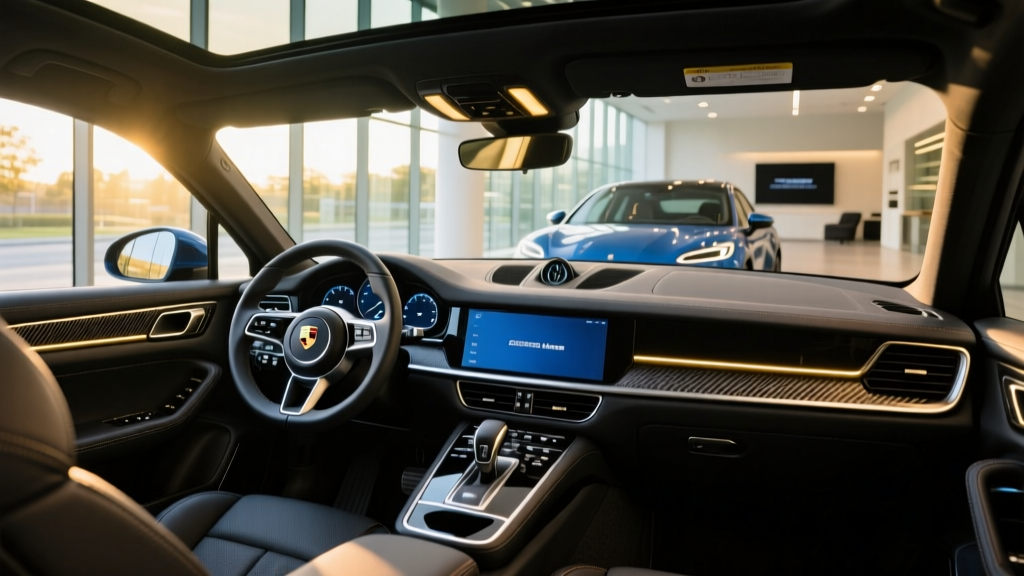
The driver faces a curved 12.6-inch digital instrument cluster mounted directly on the steering column — no traditional hood or cowl. It displays speed, range, navigation, and drive-mode information with minimal glare. The central 10.9-inch touchscreen handles climate controls, media, vehicle settings, and Apple CarPlay/Android Auto (wireless). The optional passenger display ($1,200 on most trims) lets the front-seat rider stream media or view navigation without distracting the driver, thanks to an electronic privacy filter.
An available head-up display with augmented-reality navigation overlays projects turn arrows and speed onto the windshield, which is genuinely useful on highway interchanges. The system supports over-the-air updates, so Porsche has added features like improved voice recognition and expanded app support since the 2024 launch.
Materials and Build Quality
Base Macan EV models (starting at $78,800 MSRP for the 2026 model year) come with leatherette upholstery, aluminum trim, and soft-touch surfaces on the dash and door uppers. Step up to the Macan 4 EV ($86,900) or Macan Turbo ($105,300), and you get options for full leather, Race-Tex (a suede-like microfiber), and open-pore wood or carbon-fiber trim. Panel gaps are tight, switchgear has precise detents, and nothing creaks or rattles — the interior build is a clear step above the Tesla Model Y and on par with the BMW iX.
Seating and Comfort
Front seats are 14-way power-adjustable with standard heating and available ventilation and massage. The driving position is low and sporty for an SUV, which enthusiasts appreciate but some buyers may find less commanding than a Genesis Electrified GV70. Rear seats accommodate two adults comfortably with 36.6 inches of legroom, but the sloping roofline limits headroom to 38.0 inches — taller passengers will notice. A panoramic glass roof is standard, flooding the cabin with light but offering no retractable shade, which can make the interior warm in summer parking lots.
Cargo and Storage
The Macan EV offers 18.4 cu ft behind the rear seats and approximately 48 cu ft with the 40/20/40 split rear seats folded. The front trunk (frunk) adds 2.9 cu ft — enough for a charging cable bag and a small duffel. Compared to the gas Macan (17.2 / 45.7 cu ft), the EV is marginally roomier thanks to the flat floor, but it trails the Ioniq 5 (27.2 / 59.3 cu ft) and the Tesla Model Y (30.2 / 76.2 cu ft) substantially. If cargo-hauling is a priority, the Macan EV is a compromise.
Macan EV vs. Gas Macan: Cost and Ownership Breakdown
The Macan EV is not just a different powertrain — it changes the ownership math. Below is a 5-year cost comparison between the 2026 Macan EV (base, $78,800 MSRP) and the 2025 gas Macan (base, ~$62,900 MSRP). Figures assume 12,000 miles/year, home Level 2 charging at $0.14/kWh national average, and premium gasoline at $4.10/gallon.
| Category | Macan EV (Base) | Gas Macan (Base) |
|---|---|---|
| Purchase Price (MSRP) | $78,800 | $62,900 |
| Federal Tax Credit (§30D) | $0 (exceeds SUV MSRP cap of $80,000 with options; most trims ineligible — see IRS rules) | $0 |
| Fuel/Energy (5 years) | ~$4,200 (30,000 kWh) | ~$12,300 (1,500 gal premium) |
| Maintenance (5 years) | ~$1,800 | ~$4,500 |
| Insurance (avg/yr × 5) | ~$14,500 | ~$12,000 |
| Estimated Depreciation | ~$31,500 (40%) | ~$28,300 (45%) |
| Total 5-Year Cost | ~$67,800 | ~$63,400 |
Key takeaway: The EV saves roughly $10,000 on fuel and maintenance over five years, but a higher purchase price, steeper insurance premiums, and no federal tax credit (the Macan EV typically exceeds the §30D SUV MSRP cap of $80,000 once destination and common options are added) narrow the gap. You break even around year 6 if you drive 15,000+ miles annually. Per the IRS §30D guidelines, eligibility depends on MSRP, buyer income caps ($300K joint / $150K single), and battery-mineral sourcing requirements — consult a tax professional.
Range, Charging, and Real-World Ownership
The Macan EV interior may be the reason you look, but the powertrain determines whether you stay. Here are the hard numbers by trim:
| Spec | Macan EV (Base/RWD) | Macan 4 EV | Macan Turbo |
|---|---|---|---|
| Battery (usable) | 95 kWh (NMC, ~100 kWh gross) | 95 kWh (NMC) | 95 kWh (NMC) |
| EPA Range | 308 mi | 288 mi | 270 mi |
| Real-World Highway (70 mph) | ~250-270 mi | ~235-255 mi | ~220-240 mi |
| Peak DC Charge Rate | 270 kW | 270 kW | 270 kW |
| 10-80% DC Fast Charge | ~21 min | ~21 min | ~21 min |
| Level 2 Charge Rate | 11 kW (onboard) | 11 kW | 11 kW |
| Horsepower | 335 hp | 402 hp | 630 hp (Launch Control) |
| 0-60 mph | 5.5 sec | 4.9 sec | 3.1 sec |
| Base MSRP | $78,800 | $86,900 | $105,300 |
| Battery Warranty | 8 yr / 100,000 mi | 8 yr / 100,000 mi | 8 yr / 100,000 mi |
Real-World Range Reality Check
The EPA 308-mile figure for the base RWD Macan EV is competitive, but expect 250-270 miles on sustained highway driving at 70+ mph. In cold weather (below 30°F), plan for 20-30% range reduction, bringing usable range down to roughly 185-215 miles. The heat pump (standard on all trims) mitigates this somewhat. For road trips, the 270 kW peak DC charge rate is excellent — you can add roughly 160 miles in 10 minutes at a compatible charger. However, the charge curve tapers significantly above 80%, so plan stops at 10-80% for optimal time efficiency. Porsche uses the NACS connector on 2025+ Macan EV models, granting native access to the Tesla Supercharger network (17,000+ stalls in North America) without an adapter.
Home Charging and Daily Ownership
With an 11 kW onboard charger, the Macan EV can fully replenish its 95 kWh battery in roughly 9.5 hours on a 48-amp Level 2 home charger (such as a ChargePoint Home Flex or Tesla Wall Connector). Installation costs for a Level 2 charger typically range from $800 to $2,500 depending on panel capacity and conduit run — budget for a 200-amp panel upgrade ($1,500-$3,000) if your home has an older 100-amp service. If you lack home charging access, public DC fast charging the Macan EV costs roughly $0.35-$0.50/kWh on networks like Electrify America, translating to about $35-$50 for a 10-80% session. That still undercuts premium gasoline per mile, but it erodes the EV cost advantage significantly.
Common Macan EV Misconceptions — Fact vs. Myth
| Myth | Fact |
|---|---|
| "The Macan EV qualifies for the full $7,500 federal tax credit." | Most Macan EV trims exceed the §30D SUV MSRP cap of $80,000 once destination ($1,650) and popular packages are added. Even the base RWD model is borderline. Battery critical-mineral sourcing rules further restrict eligibility. Always verify on the fueleconomy.gov tax credit database for your exact VIN. |
| "The interior is basically the same as the gas Macan." | The EV uses an entirely new PPE platform with a flat floor, a redesigned dashboard with three available screens, and a column-mounted shifter. Materials and switchgear are new-generation, and the cabin is significantly quieter due to acoustic laminated glass. |
| "It charges slower than a Tesla." | At 270 kW peak, the Macan EV actually matches or exceeds most Tesla vehicles on peak charge rate. However, sustained charge speed depends on charger availability — not all public stations deliver 270 kW. |
| "The frunk makes up for smaller cargo space." | The 2.9 cu ft frunk is useful for cables but does not compensate for the Macan EV's 48 cu ft max cargo volume vs. the Model Y's 76 cu ft or Ioniq 5's 59 cu ft. |
| "EV maintenance is essentially free." | You save on oil changes and transmission fluid, but tire replacement costs are higher (EV-specific tires, $300-$450 each), cabin air filters still need replacement, and brake fluid flushes are still required every 2 years. |
Decision Framework: Is the Macan EV Right for You?
Choose the Macan EV If:
- You prioritize interior build quality and driving dynamics over cargo space. The cabin materials, ride refinement, and steering feel are genuine Porsche benchmarks that the Model Y and Ioniq 5 cannot match.
- You have reliable home Level 2 charging. The 95 kWh battery needs overnight replenishment for daily driving. Without home charging, your fuel savings shrink and convenience suffers.
- Your typical daily drive is under 120 miles round-trip. Even in cold weather, the Macan EV handles daily commuting with range to spare, and you only need DC fast charging for road trips.
- You value the NACS connector and Supercharger network. Porsche's adoption of NACS means seamless access to the most reliable fast-charging network in North America.
- Budget is $80,000-$115,000 and you do not need the federal tax credit. At this price point, the Macan EV competes with the BMW iX, Audi Q8 e-tron, and Mercedes EQB/EQE SUV — and wins on driving engagement.
Look Elsewhere If:
- Maximum cargo volume is essential. The Model Y (76 cu ft) or Rivian R1S offer dramatically more hauling capability.
- You rely exclusively on apartment or street parking with no charging access. The Macan EV's cost advantage depends heavily on cheap home electricity.
- You need the $7,500 federal tax credit to make the math work. The Macan EV's MSRP and sourcing profile make credit eligibility uncertain at best.
- You frequently tow. The Macan EV is rated for 4,409 lbs towing — adequate for a small trailer but less than the Rivian R1S (7,700 lbs) or F-150 Lightning.
What First-Time EV Buyers Should Know About the Macan EV
If the Macan EV is your first electric vehicle, prepare for a few ownership realities that the dealership may gloss over:
- Budget $1,000-$2,500 for a home Level 2 charger installation. A licensed electrician should evaluate your panel capacity before you commit. A NEMA 14-50 outlet is the most cost-effective option if you want portability.
- Expect higher insurance premiums. EV repair costs (especially battery-related claims) push Macan EV insurance roughly 15-25% above the gas Macan. Get quotes from your carrier before purchasing.
- Plan road trips around charger locations, not gas stations. Apps like A Better Routeplanner and PlugShare are essential. The Macan EV's 270 kW peak rate means short stops, but charger reliability on non-Tesla networks still varies. NHTSA continues to monitor charging infrastructure reliability.
- Tires wear faster on EVs. The Macan EV's instant torque and heavy curb weight (~5,200 lbs) accelerate tire wear. Budget for replacement at 25,000-35,000 miles rather than the 50,000-mile intervals typical on gas vehicles.
- Preconditioning matters. Use the Porsche Connect app to precondition the battery before arriving at a DC fast charger. This warms the NMC cells to optimal temperature and enables the full 270 kW peak rate — without it, your first 10-20 minutes of charging may be limited to 100-150 kW.
Frequently Asked Questions
Does the Macan EV interior have physical buttons for climate control?
Partially. Porsche retained a small touch-sensitive control bar below the central screen for temperature and fan speed, but most secondary climate functions (seat heating, air direction, zone settings) are accessed through the touchscreen. This is less intuitive than the physical knobs in the BMW iX but more usable than the all-touch approach in the Tesla Model Y.
Is the Macan EV interior quieter than the gas Macan?
Yes, significantly. At 70 mph, the Macan EV cabin registers roughly 2-4 dB lower than the gas Macan, thanks to the absence of engine and exhaust noise, acoustic laminated windshield and side glass, and additional sound deadening in the floor. Wind and tire noise become the dominant sounds at highway speed.
How does the Macan EV interior compare to the Tesla Model Y?
The Macan EV interior uses higher-grade materials (real leather, aluminum, available carbon fiber), offers more screen options (three vs. one), and provides a more traditional luxury layout with a driver-focused instrument cluster. However, the Model Y offers vastly more cargo space (76 vs. 48 cu ft), a standard panoramic roof with shade, and a lower starting price ($47,990 vs. $78,800). The Model Y interior feels minimalist and utilitarian by comparison.
Can the Macan EV use Tesla Superchargers?
Yes. The 2025+ Macan EV comes equipped with the NACS (North American Charging Standard) connector, providing native access to Tesla Supercharger V3 and V4 stalls without an adapter. This is one of the strongest practical advantages of the Macan EV over CCS-equipped competitors that still require adapters for Supercharger access.
What is the real-world range of the Macan EV in cold weather?
In sustained temperatures below 30°F, expect 20-30% range reduction from the EPA sticker. The base Macan EV (EPA 308 mi) drops to approximately 185-215 miles of usable range. The standard heat pump helps, but cabin heating, battery warming, and reduced regenerative braking efficiency all contribute to the loss. Preconditioning while plugged in at home mitigates this significantly.
Is the Macan EV eligible for any state incentives?
Possibly — state incentives vary by jurisdiction and change frequently. States like California, Colorado, and Massachusetts offer rebates or tax credits for EV purchases, but many have income caps and MSRP limits similar to the federal rules. Check your state's energy or DMV website for current programs. These are separate from the federal §30D credit.