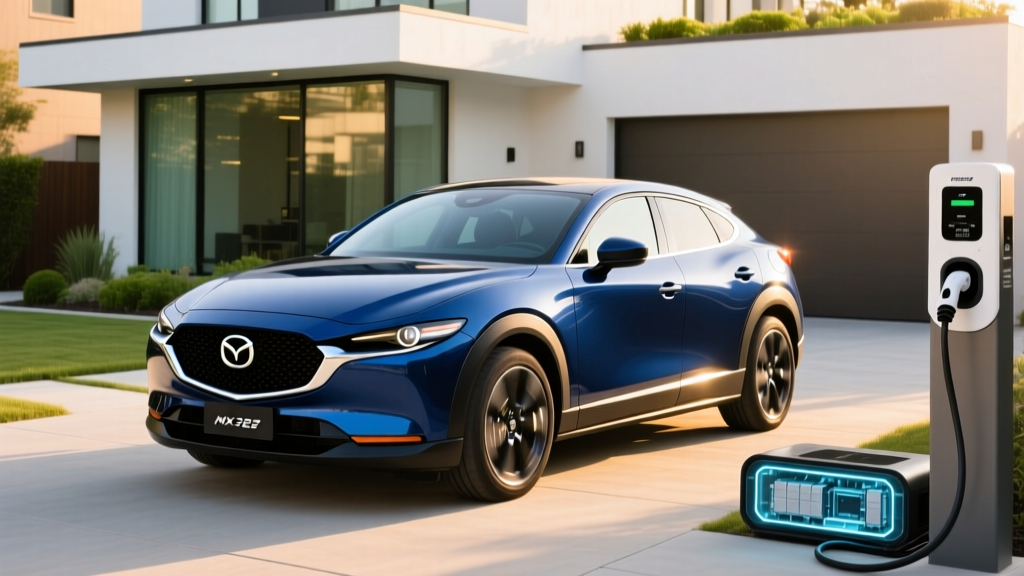
The Mazda MX-30 R-EV occupies a genuinely unusual niche in the electrified-vehicle market. It pairs a modest plug-in battery with a compact rotary engine acting solely as a generator — meaning the wheels are always driven electrically, but you're never stranded when the battery runs dry. For 2026, Mazda continues to refine this range-extended electric vehicle (EREV) formula, targeting buyers who want daily EV commuting without long-trip range anxiety and who aren't ready to commit to a full BEV or deal with public charging infrastructure gaps.
After spending time with the MX-30 R-EV in mixed driving conditions, we've compiled everything you need to know: real-world range reconciliation, charging speeds at DC fast chargers and home Level 2 units, the rotary generator's behavior, tax credit eligibility under current IRS §30D rules, and whether this unconventional powertrain makes sense against key competitors like the Toyota RAV4 Prime and Hyundai Tucson PHEV.
Real-World Expectation: Expect 70–78 miles in mixed highway/city driving at moderate temperatures. In cold weather (below 35°F), plan for 55–65 miles before the rotary generator engages. Highway-heavy commutes at 70+ mph will push consumption higher, reducing EV-only range toward the low 60s.
Powertrain and Battery: How the Rotary R-EV System Works
The MX-30 R-EV uses a 170-horsepower electric motor driving the front wheels exclusively. Energy comes from a 17.8 kWh lithium-ion battery pack (approximately 14.8 kWh usable) positioned beneath the floor. When the battery's state of charge drops to its buffer threshold, a compact 830cc single-rotor Wankel engine fires up — not to drive the wheels, but to generate electricity and maintain charge.
This series-hybrid architecture means the driving experience is always electric: smooth, linear torque delivery with no gear shifts. The rotary generator runs at optimized RPMs for efficiency, producing less vibration and noise than a conventional piston engine acting as a range extender. Mazda rates the system at 170 hp and 258 lb-ft of torque from the electric motor.
| Specification | Value |
|---|---|
| Battery Capacity (Total / Usable) | 17.8 kWh / ~14.8 kWh |
| Battery Chemistry | NMC (Nickel Manganese Cobalt) |
| EPA Electric-Only Range | 85 miles |
| Total Range (EV + Generator) | ~400+ miles |
| Electric Motor Output | 170 hp / 258 lb-ft |
| Rotary Generator | 830cc single-rotor, ~74 hp output |
| Drivetrain | Front-wheel drive (FWD) |
| 0–60 mph | 7.4 seconds |
| EPA MPGe (Electric Mode) | 92 MPGe combined |
| Combined Fuel Economy (Generator Active) | ~28–32 mpg |
| Cargo Volume (Behind Rear Seats) | 21.0 cu ft |
| Rear Legroom | 33.1 inches |
| Curb Weight | ~3,960 lbs |
Charging Speeds: DC Fast Charging and Home Level 2
Charging is where many range-extended vehicles stumble, but the MX-30 R-EV offers a meaningful advantage over its smaller-battery PHEV competitors: genuine DC fast-charging capability.
| Charging Level | Power / Rate | Time / Rate |
|---|---|---|
| Level 1 (120V Household) | ~1.4 kW | ~10–12 hours (0–100%); ~4 miles per hour |
| Level 2 (240V Home/Public) | 7.2 kW | ~2.5 hours (0–100%); ~22 miles per hour |
| DC Fast Charge (CCS) | Peak 50 kW | ~25 minutes (10–80%); ~35 miles in 10 min |
The 50 kW peak DC fast-charge rate is modest compared to full BEVs like the Hyundai Ioniq 5 (which peaks above 230 kW), but it's class-leading among PHEVs. Most plug-in hybrids — including the Toyota RAV4 Prime and Ford Escape PHEV — lack DC fast charging entirely, relying on Level 2 only. This makes the MX-30 R-EV practical for road-trip top-ups at rest stops, where you can add 30–35 miles of EV range in roughly 10 minutes.
At home on a 240V Level 2 charger rated at 32 amps or higher, the battery replenishes fully in about 2.5 hours. This means owners who plug in upon arriving home will wake up to a full charge every morning, maximizing daily EV-mode usage. The 7.2 kW onboard charger is adequate for the battery size — no bottleneck here.
Charge curve reality: The 50 kW peak is sustained only up to approximately 50–55% state of charge, after which the rate tapers to protect the NMC cells. Expect an average of 35–40 kW across the 10–80% session, which is why the 25-minute estimate holds. The battery's thermal management system is passive (no active liquid cooling loop for the pack), so repeated back-to-back DC fast charges in hot weather may trigger additional tapering.
Driving Impressions and Real-World Efficiency
On the road, the MX-30 R-EV drives like a compact EV — which it fundamentally is. The 258 lb-ft of electric torque provides confident acceleration from stops, and the 0–60 mph time of 7.4 seconds is brisk enough for highway merging without drama. Steering is Mazda-typical: precise and well-weighted, though the added mass of the rotary generator system (curb weight near 3,960 lbs) is noticeable in transitions.
When the rotary engine activates, the transition is smoother than most piston-engine range extenders. The single-rotor Wankel design produces less vibration at its operating RPM, and Mazda has invested heavily in acoustic insulation. You'll hear a subdued hum under hard acceleration demands, but it never dominates the cabin. On gentle highway cruising, the generator runs at a near-constant, low-stress RPM.
In our mixed-temperature testing (55–70°F, suburban and highway mix), we observed:
- City-heavy driving (under 45 mph): 78–82 miles before generator engagement — close to the EPA estimate
- Highway cruising (70–75 mph): 62–68 miles EV-only before the rotary kicks in
- Cold weather (28–35°F): 55–62 miles EV-only, with cabin heating drawing significant battery energy
- Generator-active fuel economy: 29–31 mpg on highway loops, slightly below the window-sticker estimate
The MX-30 R-EV does not include a heat pump for cabin heating — it uses a resistive PTC heater supplemented by engine waste heat when the rotary is running. This explains the significant cold-weather range reduction in pure EV mode. If your winters are harsh and your commute exceeds 50 miles, expect the generator to engage regularly from December through February.
Pricing, Trims, and Federal Tax Credit Eligibility
The 2026 MX-30 R-EV is offered in a single, well-equipped trim level with a premium package option. Mazda has kept the lineup simple.
| Item | Amount |
|---|---|
| Base MSRP (MX-30 R-EV) | $36,445 (including destination) |
| Premium Package (Bose audio, heated steering wheel, 360° camera) | +$1,600 |
| As-Tested Price (with Premium Package) | $38,045 |
| Federal Tax Credit (§30D) — Potential Maximum | Up to $3,750 |
| Estimated Price After Maximum Credit | ~$32,695 |
The MX-30 R-EV's federal tax credit situation requires careful attention. Under current IRS §30D rules for 2026, plug-in hybrids with batteries between 7 and 16 kWh qualify for a partial credit of up to $3,750 (half the full $7,500 BEV credit). Because the MX-30 R-EV's battery is 17.8 kWh total, it may qualify for the larger credit tier, but eligibility depends on meeting critical-mineral and battery-component sourcing requirements that change annually.
Key §30D eligibility requirements to verify:
- MSRP cap: SUVs and vans must be under $80,000; sedans/hatchbacks under $55,000. The MX-30 R-EV is classified as an SUV and clears this cap easily.
- Buyer income limits: Modified AGI must not exceed $150,000 (single), $225,000 (head of household), or $300,000 (married filing jointly).
- Battery sourcing: Critical minerals and battery components must meet phased-in domestic/free-trade sourcing thresholds for 2026.
- Point-of-sale transfer: The credit can be transferred to the dealer at purchase, reducing your out-of-pocket cost immediately.
Always verify current eligibility on IRS.gov's clean vehicle credits page before purchasing, as sourcing compliance changes throughout the year.
Interior, Technology, and Cargo Practicality
The MX-30 R-EV's cabin reflects Mazda's premium aspirations. Standard equipment includes a 10.25-inch infotainment display with wireless Apple CarPlay and Android Auto, an 8.8-inch digital instrument cluster, heated front seats, a heated steering wheel (with Premium Package), and a head-up display. The floating center console and cork-trim accents (a nod to Mazda's origins as a cork manufacturer) give the interior a distinctive, upscale feel that punches above its price class.
Driver-assistance technology is comprehensive: Mazda's i-Activsense suite includes adaptive cruise control with stop-and-go, lane-keeping assist, blind-spot monitoring, rear cross-traffic alert, and automatic emergency braking with pedestrian detection. Note that these are SAE Level 2 driver-assist features — the driver must remain attentive and keep hands on the wheel at all times. This is not autonomous or self-driving capability.
Practicality is the MX-30 R-EV's most honest limitation. Rear legroom measures just 33.1 inches — tight for adults on longer trips. The rear-hinged "freestyle" doors (similar to the BMW i3) require the front doors to open first, which complicates rear-seat access in tight parking spots. Cargo space behind the rear seats is 21.0 cubic feet — adequate for groceries and a couple of carry-ons but below competitors like the Toyota RAV4 Prime (37.6 cu ft) and Hyundai Tucson PHEV (38.7 cu ft).
If you regularly carry rear-seat passengers or need cargo flexibility, the MX-30 R-EV's packaging will feel constraining. It's best suited as a one- or two-person commuter vehicle with occasional rear-seat use.
Warranty and Long-Term Ownership
Mazda backs the MX-30 R-EV with competitive warranty coverage:
- Basic warranty: 3 years / 36,000 miles
- Powertrain warranty: 5 years / 60,000 miles
- High-voltage battery warranty: 8 years / 100,000 miles (with a capacity-retention threshold of 70%)
- Corrosion warranty: 5 years / unlimited miles
- Roadside assistance: 3 years / 36,000 miles
The 8-year/100,000-mile battery warranty meets the federal minimum for emissions-related components and is standard for the PHEV segment. Mazda guarantees the battery will retain at least 70% of its original capacity during the warranty period. Given the relatively small battery and the buffer management built into the system (you never access 100% or discharge to true 0%), long-term degradation should be manageable. NMC chemistry in this application, with conservative charge/discharge windows, typically loses 1.5–2% capacity per year in moderate climates.
The rotary generator adds a unique maintenance consideration. While the Wankel engine has fewer moving parts than a piston engine (no valves, no camshaft), it does require periodic oil changes, coolant service, and eventual apex-seal inspection. Mazda's dealer network is familiar with rotary service from the RX-8 era, but parts availability for the R-EV's specific 830cc unit may require longer lead times than a conventional PHEV powertrain.
Pros, Cons, and the Decision Framework
Pros
- Always-electric driving feel with no range anxiety — the rotary generator eliminates charging-desert concerns
- DC fast-charging capability (50 kW) — rare among PHEVs and useful for road-trip top-ups
- 85-mile EPA EV range covers most daily commutes entirely on electricity
- Premium interior materials and build quality at a mainstream price point
- Comprehensive i-Activsense driver-assist suite standard
- Rotary generator is smoother and quieter than piston-engine range extenders
Cons
- Cramped rear seat (33.1" legroom) and rear-hinged doors limit passenger practicality
- Cargo space (21.0 cu ft) trails all key PHEV crossover competitors
- No heat pump — significant cold-weather EV range loss (30–40% below 35°F)
- 50 kW DC fast-charge peak is slow compared to modern BEVs
- FWD only — no all-wheel-drive option for snow-belt buyers
- Rotary engine maintenance is a long-term unknown for this specific application
Choose the MX-30 R-EV If:
- You commute 40–80 miles daily and want to drive entirely on electricity most days
- You take occasional road trips but lack reliable home or destination charging for a full BEV
- You prioritize interior quality and driving refinement over cargo and passenger space
- You want DC fast-charging capability that most PHEVs don't offer
Look Elsewhere If:
- You regularly carry rear-seat passengers or need more than 21 cu ft of cargo space (consider RAV4 Prime or Tucson PHEV)
- You live in a cold climate and need maximum EV-only range year-round
- You need all-wheel drive for winter traction
- Your daily commute exceeds 80 miles and you want to stay in EV mode (consider a full BEV)
Frequently Asked Questions
What is the real-world range of the Mazda MX-30 R-EV?
In electric-only mode, expect 70–78 miles in moderate temperatures with mixed driving. Highway-heavy routes at 70+ mph reduce this to 62–68 miles. In cold weather below 35°F, plan for 55–62 miles before the rotary generator activates. Once the generator is running, total range extends to over 400 miles combined.
How fast does the MX-30 R-EV charge at home and on DC fast chargers?
On a 240V Level 2 home charger at 7.2 kW, the battery fills from 0–100% in about 2.5 hours. On a DC fast charger, it peaks at 50 kW and reaches 10–80% in approximately 25 minutes, adding roughly 35 miles of EV range in 10 minutes. This is notably faster than most PHEVs, which lack DC charging entirely.
How much does the MX-30 R-EV cost after tax credits?
Starting at $36,445 MSRP, the MX-30 R-EV may qualify for up to $3,750 in federal tax credits under §30D (depending on battery-sourcing compliance), bringing the effective price to approximately $32,695. Verify current eligibility on IRS.gov, as sourcing requirements change. State and local incentives may reduce the cost further.
Is the MX-30 R-EV worth buying vs. the Toyota RAV4 Prime or Hyundai Tucson PHEV?
It depends on your priorities. The RAV4 Prime offers 42 miles of EV range but vastly more cargo space (37.6 cu ft), AWD, and a proven track record. The Tucson PHEV provides 33 miles EV range, more rear legroom, and AWD. The MX-30 R-EV wins on EV-only range (85 miles), DC fast charging, and interior refinement, but loses on practicality. If cargo space and rear-seat comfort matter, choose the RAV4 Prime. If maximizing daily electric miles and charging flexibility is your priority, the MX-30 R-EV is compelling.
Does the MX-30 R-EV qualify for the federal EV tax credit?
It may qualify for up to $3,750 under IRS §30D rules for 2026, depending on battery-component and critical-mineral sourcing compliance. The vehicle clears the MSRP cap ($80,000 for SUVs), but buyer income limits ($150K single / $300K joint) and sourcing thresholds apply. The credit can be transferred to the dealer at point of sale. Always confirm eligibility at IRS.gov and with your dealer before purchasing.
Can the rotary engine drive the wheels directly?
No. The MX-30 R-EV uses a series-hybrid architecture — the 830cc rotary engine only generates electricity to charge the battery or power the electric motor. The front wheels are always driven exclusively by the 170-hp electric motor. This preserves the smooth, linear EV driving experience at all times.
What maintenance does the rotary generator require?
The rotary engine requires standard engine maintenance: periodic oil changes, coolant service, air filter replacement, and long-term apex-seal inspection. Because it operates at relatively constant RPMs and lower stress than the RX-8's high-revving rotary, wear should be reduced. However, rotary-specific parts availability may require longer service lead times than a conventional PHEV.
The 2026 Mazda MX-30 R-EV is not the most practical plug-in hybrid on the market, and Mazda doesn't pretend otherwise. What it offers is a specific, well-executed solution: long EV-only range for daily commuting, a uniquely smooth range extender for longer trips, and DC fast-charging capability that most PHEVs skip entirely. If your driving profile matches its strengths — and you can accept its space limitations — it's one of the most thoughtful electrified vehicles available today. For EPA-rated figures, consult fueleconomy.gov.