The Quick Answer: Is the Mazda MX-30 EV Right for You?
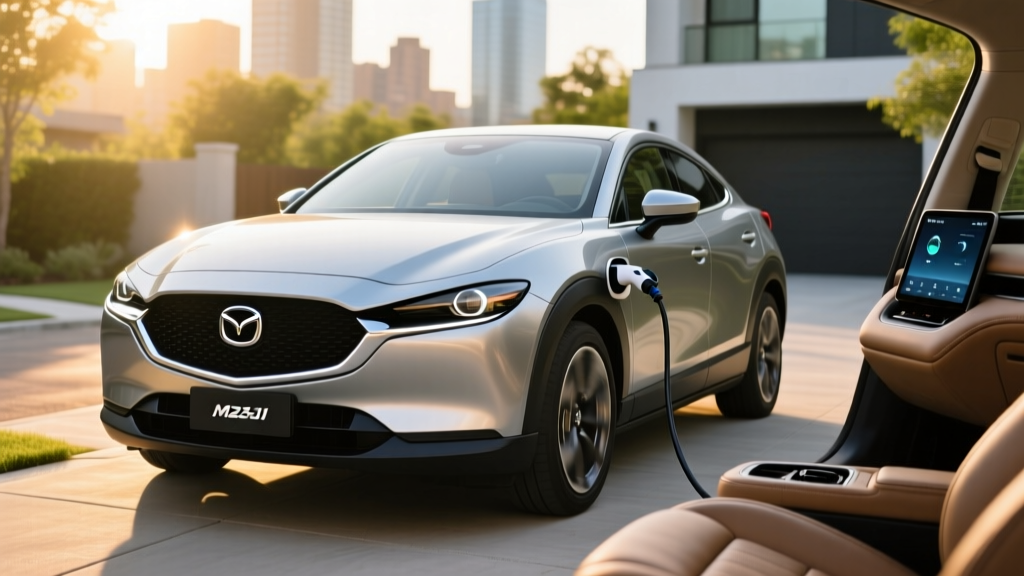
The 2026 Mazda MX-30 EV offers an EPA-estimated 100 miles of range from its 35.5 kWh battery, starting around $35,480. It charges at up to 50 kW DC fast charging (10–80% in ~36 minutes) and 7.2 kW on Level 2. It qualifies for up to $3,750 of the federal §30D tax credit depending on your income and battery sourcing. Buy it if you have reliable home charging, drive under 60 miles daily, and value distinctive styling and premium interior materials over range. Pass on it if you regularly drive more than 70 miles one-way, live in an apartment without charging, or need a single-vehicle household solution.
Range and Efficiency: The MX-30's Defining Constraint
The Mazda MX-30 EV's 35.5 kWh lithium-ion battery (NMC chemistry) delivers an EPA-estimated 100 miles of combined range and 124 MPGe combined (city 145 / highway 101) according to fueleconomy.gov. Mazda made a deliberate engineering choice to keep the battery small, arguing that a lighter pack reduces lifecycle emissions — a philosophy that works only if your driving patterns align with it.
Real-World Range Expectations
EPA Sticker: 100 miles combined
Real-World Highway (70 mph, mild weather): ~80–88 miles
Real-World City (mixed stop-and-go, mild weather): ~95–105 miles
Cold Weather (below 32°F, highway): ~60–75 miles
The MX-30's small battery means cold-weather range loss hits harder in percentage terms. A 30% winter drop on 100 miles leaves you with just 70 usable miles — plan accordingly if you live north of the Mason-Dixon line.
| Spec | Value |
|---|---|
| EPA Range (combined) | 100 miles |
| Battery Capacity (usable) | 35.5 kWh (NMC) |
| Efficiency (MPGe combined) | 124 MPGe |
| DC Fast Charge (peak) | 50 kW |
| 10–80% DC Fast Charge | ~36 minutes |
| Level 2 Charge Rate | 7.2 kW (240V) |
| Level 2 Full Charge Time | ~5 hours |
| Horsepower | 143 hp |
| Torque | 200 lb-ft |
| 0–60 mph | ~8.7 seconds |
| Connector | CCS1 |
| Base MSRP | $35,480 |
| Battery Warranty | 8 years / 100,000 miles |
Charging: Home Setup Is Non-Negotiable
With only 100 miles of range, the MX-30 lives or dies by your charging routine. Public DC fast charging at 50 kW is adequate but not competitive — many rivals charge at 150–250 kW, making road-trip stops significantly longer in the MX-30.
| Charging Level | Power | Miles Added per Hour | Best For |
|---|---|---|---|
| Level 1 (120V standard outlet) | ~1.2 kW | ~4–5 miles/hr | Overnight top-off only |
| Level 2 (240V home charger) | 7.2 kW | ~25–28 miles/hr | Daily full recharge (~5 hrs) |
| DC Fast Charge (CCS) | 50 kW peak | ~120+ miles/hr (tapers above 80%) | Emergency mid-trip top-up |
Level 1 charging on a standard 120V outlet adds roughly 4–5 miles per hour. Over a 10-hour overnight window, that's 40–50 miles — enough for many daily commutes but cutting it close. A Level 2 home charger is practically mandatory for this vehicle. Expect to pay $800–$2,000 for a quality Level 2 unit plus $500–$2,000 for professional electrical installation, depending on your panel capacity and run distance. If your home's electrical panel needs an upgrade to 200A, add $1,500–$3,000 to that budget.
On public CCS networks like Electrify America or EVgo, the MX-30's 50 kW peak means a 10–80% session takes roughly 36 minutes. That's workable for a lunch stop but noticeably slower than competitors like the Hyundai Ioniq 5 (18 minutes at 240 kW) or Tesla Model 3 (15–20 minutes at 250 kW). For a vehicle with 100 miles of range, those charging sessions will be frequent on any trip beyond your local area.
MX-30 EV vs. Gas and Hybrid Alternatives: The Numbers
How does the MX-30 stack up against internal combustion and hybrid options at similar price points? Let's look at the data.
| Metric | Mazda MX-30 EV | Mazda CX-30 (Gas AWD) | Toyota Corolla Cross Hybrid |
|---|---|---|---|
| Base MSRP | $35,480 | $29,390 | $31,090 |
| Est. Federal Tax Credit | Up to $3,750* | $0 | $0 |
| Effective Purchase Price | ~$31,730 | $29,390 | $31,090 |
| Fuel/Energy Cost per Mile | ~$0.04 (home L2)** | ~$0.14 | ~$0.09 |
| 5-Year Fuel/Energy (60k mi) | ~$2,400 | ~$8,400 | ~$5,400 |
| 5-Year Maintenance (est.) | ~$1,800 | ~$4,200 | ~$3,500 |
| 5-Year Total Operating Cost | ~$4,200 | ~$12,600 | ~$8,900 |
* §30D tax credit eligibility depends on income caps, battery sourcing, and MSRP limits per IRS guidelines. The MX-30's partial credit reflects current critical-mineral sourcing requirements — verify your eligibility before purchase.
** Based on $0.16/kWh national average electricity rate. Public DC fast charging costs 2–3× more.
The MX-30's lower fuel and maintenance costs partially offset its higher sticker price. Over five years and 60,000 miles, you'd save roughly $8,400 in operating costs versus the gas CX-30 and $4,700 versus the Corolla Cross Hybrid. However, those savings assume consistent home charging at residential electricity rates. If you rely on public DC fast charging exclusively (at $0.35–$0.50/kWh), your per-mile cost jumps to $0.09–$0.12 — erasing much of the advantage.
Real Ownership Costs: The Full Picture
Purchase price and fuel savings tell only part of the story. Here's what a realistic five-year ownership budget looks like for the MX-30.
| Cost Category | Estimated 5-Year Cost | Notes |
|---|---|---|
| Purchase (after tax credit) | $31,730 | Assumes $3,750 credit; verify eligibility |
| Home Level 2 Charger Install | $1,200–$3,500 | Varies by panel capacity and run length |
| Electricity (60,000 mi, home charging) | $2,400 | At $0.16/kWh average |
| Insurance (5-year est.) | $8,500–$10,500 | EV premiums run 15–25% above gas equivalents |
| Maintenance & Repairs | $1,800 | No oil changes; tire wear, cabin filter, wipers |
| Depreciation (est.) | $16,000–$19,000 | Short-range EVs depreciate faster than long-range |
| 5-Year Total | ~$62,000–$68,000 | Including depreciation and purchase |
Insurance is a meaningful line item. EV insurance premiums average 15–25% higher than equivalent gas vehicles due to higher repair costs and battery replacement risk. Get quotes before signing a purchase agreement — the difference could be $200–$400/year.
Depreciation deserves particular attention. Short-range EVs like the MX-30 have historically depreciated faster than long-range competitors because the used-EV market increasingly demands 200+ miles of range. If you plan to sell or trade in after 3–5 years, expect the MX-30 to retain a smaller percentage of its value than, say, a Tesla Model 3 or Hyundai Ioniq 5.
Federal Tax Credit: What You'll Actually Get
The MX-30's tax credit situation requires careful attention. Under current IRS §30D rules, the maximum federal credit for a new EV is $7,500, split into two components:
- $3,750 — Battery Components: Requires a percentage of battery components manufactured or assembled in North America. The MX-30, built in Japan, has historically met only partial requirements.
- $3,750 — Critical Minerals: Requires critical minerals sourced from the U.S. or FTA partners. Mazda's supply chain eligibility varies by model year.
- MSRP Cap: The MX-30 (base ~$35,480) is well under the $55,000 sedan cap.
- Income Caps: AGI must not exceed $150,000 (single), $225,000 (head of household), or $300,000 (joint filing).
- Point-of-Sale Transfer: Eligible buyers can apply the credit as a down payment reduction at the dealership rather than waiting for a tax refund.
As of the 2026 model year, expect the MX-30 to qualify for $3,750 (one of the two halves), not the full $7,500. Confirm current sourcing compliance with your dealer and consult a tax professional — these rules shift with supply-chain updates and regulatory changes.
Common Misconceptions About the MX-30
| Myth | Fact |
|---|---|
| "100 miles of range is useless." | The average American drives ~37 miles/day (FHWA data). For single-commute households with home charging, 100 miles covers most days with buffer. The issue is flexibility, not daily viability. |
| "I can just use public chargers." | At 50 kW peak and 100 miles of range, you'd stop every 70–80 miles for ~36 minutes on road trips. Public charging works as a supplement, not a primary strategy for this vehicle. |
| "The small battery is bad for the environment." | Mazda's lifecycle analysis argues that a smaller battery has a lower manufacturing carbon footprint. If your electricity is clean and your driving stays local, the MX-30's total lifecycle emissions can be competitive with larger-battery EVs driven long distances. |
| "EV batteries won't last." | Mazda covers the MX-30 battery for 8 years/100,000 miles against defects and excessive capacity loss (typically below 70% state of health). NMC batteries in moderate climates with regular Level 2 charging typically retain 85–90% capacity after 5 years. |
| "It qualifies for the full $7,500 tax credit." | Due to battery sourcing and assembly requirements, the MX-30 currently qualifies for a partial credit (~$3,750). Always verify on the IRS qualified vehicle list before purchase. |
Decision Framework: Should You Buy the Mazda MX-30 EV?
Choose the MX-30 EV If:
- Your daily round-trip drive is under 60 miles (leaving a comfortable buffer)
- You have a garage or driveway where a Level 2 charger can be installed
- This will be a second vehicle in a multi-car household
- You value distinctive design (freestyle "suicide" doors, cork-trim interior, premium build quality) over maximum utility
- You live in a mild climate where cold-weather range loss is minimal
- You want a lower entry price into EV ownership and can use the $3,750 credit
Look Elsewhere If:
- You regularly drive more than 70 miles one-way
- You live in an apartment or condo without dedicated charging access
- This is your only vehicle and you take road trips more than once or twice a year
- You live in a region with harsh winters (expect 30%+ range loss below freezing)
- You need rear-seat practicality (the MX-30's rear-hinged doors and tight back seat limit usability)
- You want DC fast charging that keeps pace with modern rivals (150+ kW)
Consider These Alternatives:
- Hyundai Ioniq 5 — 303 miles EPA range, 240 kW DC charging, starting ~$42,600
- Chevrolet Equinox EV — 315 miles EPA range, starting ~$33,000 after credit
- Toyota bZ4X — 252 miles EPA range, starting ~$38,465
- Toyota Prius Prime (PHEV) — 44 miles electric-only + 52 MPG hybrid, no range anxiety, starting ~$33,445
What First-Time EV Buyers Must Know
If the MX-30 is your first EV, understand these ownership realities before signing:
1. Charging infrastructure is your responsibility. Unlike gas stations, your "fuel" comes from your home electrical system. Budget for a Level 2 installation and get a quote from a licensed electrician before purchasing. If your home has a 100A electrical panel, you may need a panel upgrade ($1,500–$3,000) to safely add a 40A EV circuit.
2. kW and kWh are not interchangeable. The MX-30's battery holds 35.5 kWh (kilowatt-hours) of energy — that's the "tank size." It charges at up to 50 kW (kilowatts) — that's the "pump speed." Confusing these is the most common mistake new EV buyers make when comparing vehicles.
3. The charge curve matters. The MX-30 won't sustain 50 kW for the entire charging session. Like all EVs, charging speed tapers significantly above 80% state of charge to protect battery health. That 10–80% time of ~36 minutes is the practical window — charging from 80–100% on DC fast charge can take an additional 20+ minutes.
4. Plan for winter. Lithium-ion batteries lose efficiency in cold temperatures. The MX-30's heat pump (standard equipment) helps, but expect 20–30% range reduction in sustained sub-freezing weather. If your 50-mile commute already uses half your range in summer, winter will make it uncomfortably tight.
5. Maintenance is minimal but not zero. You'll save on oil changes, spark plugs, and transmission fluid. But tires wear faster on EVs due to instant torque and extra weight, cabin air filters need replacement, and brake fluid still requires periodic service. Budget ~$300–$400/year for basic EV maintenance.
Frequently Asked Questions
Is the Mazda MX-30 EV still sold in the United States?
Mazda initially limited the MX-30 EV to California dealerships. For the 2026 model year, check with your local Mazda dealer for availability in your state, as distribution has been gradually expanding but remains limited compared to mainstream EV rivals.
How long does it take to fully charge the MX-30 at home?
On a Level 2 home charger (240V, 7.2 kW), a full 0–100% charge takes approximately 5 hours. On a standard 120V Level 1 outlet, a full charge takes roughly 24–30 hours — impractical for daily use if you deplete the battery significantly.
Can I road-trip in the Mazda MX-30?
Technically yes, but it requires careful planning. With ~80 miles of real-world highway range and 36-minute DC fast-charge stops, a 300-mile trip that takes 4.5 hours in a gas car will take roughly 7–8 hours in the MX-30 with two charging stops. It's a capable road-tripper for patient drivers but not competitive with 250+ mile range EVs.
Does the MX-30 have all-wheel drive?
No. The 2026 MX-30 EV is front-wheel drive only, with a single electric motor producing 143 hp and 200 lb-ft of torque. If AWD is a priority, consider the Hyundai Ioniq 5 or Kia EV6, both available with dual-motor AWD.
What is the MX-30's cargo space?
The MX-30 offers approximately 21.0 cubic feet behind the rear seats and 41.6 cubic feet with the rear seats folded. That's competitive with subcompact crossovers but less than rivals like the Ioniq 5 (27.2 cu ft / 59.3 cu ft).
What safety ratings does the MX-30 have?
Check NHTSA and IIHS for the latest crash-test ratings. The MX-30 comes standard with Mazda's i-Activsense safety suite including automatic emergency braking, lane-keeping assist, adaptive cruise control, and blind-spot monitoring — all Level 2 driver-assist features that require active driver supervision.
Will the MX-30 battery need replacement?
Battery replacement is rare within the first 10 years of ownership. Mazda's 8-year/100,000-mile battery warranty covers defects and excessive degradation. Out-of-warranty replacement costs for the 35.5 kWh pack are estimated at $6,000–$9,000 based on current pricing, though battery costs continue to decline. Most owners will sell the vehicle before facing this expense.