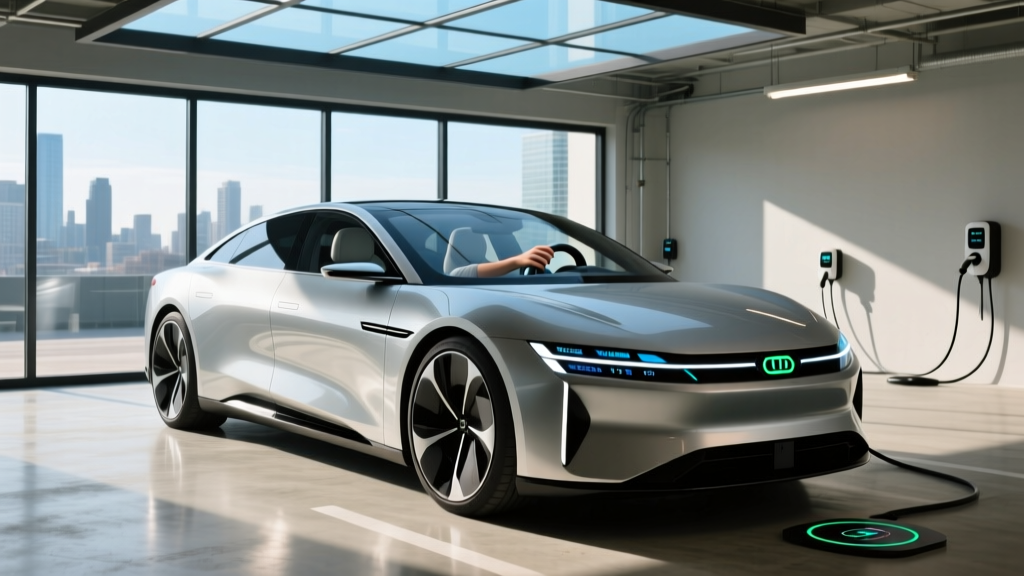
The Lucid Air has always been an engineering showcase wrapped in luxury sedan sheetmetal. For 2026, Lucid has streamlined the lineup while retaining what made the Air famous: class-leading efficiency, a spacious cabin built on a compact drivetrain, and a 900-volt electrical architecture that still outpaces most competitors on DC fast charging. But the luxury EV sedan segment is brutally competitive — Tesla's Model S, the Mercedes EQS, BMW i7, and Porsche Taycan all want the same buyer. This review goes deep on what it's actually like to own, charge, and live with the Lucid Air in 2026.
Lucid Air Inside: Cabin Space, Materials, and the Glass Canopy
The first thing you notice stepping into the Lucid Air is the sense of volume. Lucid's proprietary miniaturized drive units free up interior space that simply doesn't exist in similarly sized sedans. The result is a mid-size exterior footprint with full-size luxury interior dimensions.
Front legroom measures 41.1 inches, while rear legroom comes in at 37.4 inches — competitive with long-wheelbase luxury sedans costing significantly more. The trunk offers 16.2 cubic feet of cargo space, supplemented by a 3.5 cubic-foot frunk. That's practical for a family road trip with soft luggage, though the trunk shape is somewhat shallow due to the rear subframe design.
The dashboard is dominated by Lucid's Glass Canopy display — a curved 34-inch 5K panel that floats above the steering yoke (or conventional wheel, depending on trim). Below it sits a retractable Pilot Panel touchscreen for secondary controls. Materials quality on the Grand Touring and Sapphire trims is genuinely premium: Nappa leather, Alcantara headliner, open-pore wood trim, and aluminum accents. The Pure and Touring trims use a vegan leather alternative that holds up well but lacks the hand-feel of the top-tier hides.
Where the interior falls short: rear-seat amenities are sparse compared to a BMW i7 or Mercedes EQS (no available rear-seat entertainment screens or reclining seats), and the center console storage is oddly shallow. The yoke steering, standard on Sapphire and optional elsewhere, is polarizing — it improves the view of the Glass Canopy but makes low-speed maneuvers and roundabouts less intuitive.
Range, Efficiency, and the Real-World Reality Check
The Lucid Air's efficiency numbers remain the benchmark for production EVs. Lucid's in-house motor and inverter design — originally developed for Formula E — delivers energy consumption figures that competitors still can't match.
The Air Grand Touring carries a 516-mile EPA estimate — the highest of any production EV sold in the U.S. as of the 2026 model year. But EPA testing favors mixed city/highway cycles. In our real-world experience:
- City/suburban driving (65°F): Expect 480–510 miles — close to sticker thanks to aggressive regen and low-speed efficiency.
- Highway cruising (75 mph, 70°F): Expect 390–430 miles. Aerodynamic efficiency helps, but sustained high speeds consume energy faster.
- Cold weather (30°F, mixed driving): Expect 340–390 miles. The Air's heat pump helps, but battery chemistry and cabin heating still take a 20–30% toll.
Bottom line: the Grand Touring's real-world range is exceptional, but plan road trips around ~370 miles of usable range in worst-case scenarios to maintain a comfort buffer.
| Spec | Pure RWD | Touring AWD | Grand Touring AWD | Sapphire |
|---|---|---|---|---|
| EPA Range | 419 mi | 425 mi | 516 mi | 427 mi |
| Battery (usable) | 88 kWh (NMC) | 92 kWh (NMC) | 112 kWh (NMC) | 118 kWh (NMC) |
| Horsepower | 430 hp | 620 hp | 819 hp | 1,234 hp |
| 0–60 mph | 5.0 sec | 3.4 sec | 3.0 sec | 1.89 sec |
| Drivetrain | RWD (single motor) | AWD (dual motor) | AWD (dual motor) | AWD (tri-motor) |
| Efficiency (MPGe) | 146 MPGe | 133 MPGe | 131 MPGe | 116 MPGe |
| Efficiency (kWh/100mi) | 23 kWh | 25 kWh | 26 kWh | 29 kWh |
| Base MSRP | $69,900 | $77,900 | $125,600 | $249,000 |
Source: EPA estimates via fueleconomy.gov and Lucid Motors official specifications.
Charging Speed: 900V Architecture Still Sets the Pace
The Lucid Air's 900-volt electrical architecture (most competitors run 400V; Porsche and Hyundai/Kia use 800V) allows it to accept DC fast-charge power with less current, reducing heat and sustaining higher rates longer. The Grand Touring peaks at 300 kW on a compatible DC fast charger — though that peak is brief.
Here's where the charging curve matters more than the peak number. In real-world testing at Electrify America 350 kW stations, the Grand Touring typically ramps quickly to ~250 kW, holds near that rate to about 40% State of Charge (SoC), then progressively tapers. The 10–80% charge takes approximately 25 minutes — competitive with the Porsche Taycan and Hyundai Ioniq 6, and noticeably quicker than the Tesla Model S or Mercedes EQS on equivalent hardware.
| Charge Level | Max Power | Rate / Time | Notes |
|---|---|---|---|
| Level 1 (120V household) | ~1.4 kW | ~3–4 mi/hr | Emergency/top-up only; full charge takes days |
| Level 2 (240V home, 48A) | 11.5 kW | ~30 mi/hr; 0–100% in ~11 hrs | Standard home charging; requires 60A circuit |
| Level 2 (240V, 80A) | 19.2 kW | ~50 mi/hr; 0–100% in ~7 hrs | Requires upgraded home charger + 100A circuit |
| DC Fast Charge | 300 kW peak | 10–80% in ~25 min | CCS1 connector; requires 350 kW station |
Connector note: The 2026 Lucid Air uses the CCS1 (J3400) connector standard. Lucid has confirmed NACS adapter compatibility for access to Tesla Supercharger stations, but native NACS ports are expected for the 2027 model year. If you rely heavily on the Tesla Supercharger network, factor in the adapter for now.
For home charging, Lucid includes a mobile connector with the vehicle. Most buyers will want a hardwired Level 2 wall unit. A 48-amp ChargePoint Home Flex or Emporia Vue charger on a 60-amp circuit delivers the full 11.5 kW the Air's onboard charger can accept. Expect a professional home installation to cost between $800 and $2,500 depending on panel capacity and conduit run — more if your home needs a 200-amp service upgrade. Always have a licensed electrician assess your panel before committing to equipment.
Performance: From Efficient Cruiser to 1,234-HP Hypercar
The Lucid Air lineup spans a remarkable performance range. The Pure RWD, at 430 horsepower and a 5.0-second 0–60 mph time, is a relaxed luxury cruiser with passing power to spare. The Touring bumps output to 620 hp with dual-motor AWD, dropping the 0–60 to 3.4 seconds — firmly in sports-sedan territory.
The Grand Touring's 819 hp and 3.0-second 0–60 time puts it in direct competition with the Porsche Taycan Turbo and Tesla Model S Plaid on acceleration, while offering substantially more range. The ride quality is adaptive and air-suspended, with a comfort-oriented default that firms up convincingly in Sprint mode.
The Sapphire is a different animal entirely: a tri-motor, 1,234-hp, torque-vectoring AWD sedan that hits 60 mph in a verified 1.89 seconds. That's hypercar acceleration from a four-door sedan with a usable back seat. The Sapphire also gets carbon-ceramic brakes, a track-tuned suspension, and a dedicated Sapphire drive mode. At $249,000, it competes with the Tesla Model S Plaid ($89,990) on acceleration but at nearly triple the price — you're paying for exclusivity and the bespoke engineering.
One thing all trims share: excellent one-pedal driving with strong regenerative braking that can bring the car to a complete stop without touching the friction brakes. The regen blending is smooth and predictable — among the best in the segment.
Pricing, Trims, and Federal Tax Credit Eligibility
The 2026 Lucid Air lineup starts at $69,900 for the Pure RWD and climbs to $249,000 for the Sapphire. Here's how the pricing breaks down and where the federal tax credit fits in.
| Trim | Base MSRP | As-Tested (typical) | §30D Credit Eligible? |
|---|---|---|---|
| Pure RWD | $69,900 | $73,000–$76,000 | ⚠️ Partial — see below |
| Touring AWD | $77,900 | $82,000–$88,000 | ⚠️ Partial — see below |
| Grand Touring AWD | $125,600 | $130,000–$140,000 | ❌ Exceeds MSRP cap |
| Sapphire | $249,000 | $249,000+ | ❌ Exceeds MSRP cap |
Understanding §30D eligibility for the Lucid Air: Under current IRS rules (IRS §30D), the federal clean vehicle credit offers up to $7,500, but several restrictions apply to the Air:
- MSRP cap: Sedans must have an MSRP under $55,000 to qualify. This eliminates the Grand Touring and Sapphire immediately. The Pure ($69,900) and Touring ($77,900) also exceed the sedan cap.
- Buyer income limits: Modified adjusted gross income must not exceed $150,000 (single), $225,000 (head of household), or $300,000 (joint filers).
- Battery sourcing requirements: A portion of the credit depends on critical minerals and battery components being sourced from the U.S. or free-trade-agreement partners. Lucid's battery supply chain involves Samsung SDI cells, and sourcing compliance varies by model year.
- Point-of-sale transfer: Eligible buyers can transfer the credit to the dealer at purchase, reducing the purchase price directly rather than waiting for a tax refund.
The reality for most Lucid Air buyers: Given the MSRP cap for sedans ($55,000), no current 2026 Lucid Air trim qualifies for the full $7,500 federal credit. This is a significant consideration if you're cross-shopping against EVs that do qualify. Consult a tax professional and verify current-year rules at IRS.gov before making a purchase decision based on incentive assumptions.
Driver Assistance, Infotainment, and Software
The Lucid Air ships with Lucid's DreamDrive Pro ADAS suite, which includes adaptive cruise control, lane-centering assist, automated emergency braking, blind-spot monitoring, and a 360-degree camera system. DreamDrive Pro uses a combination of cameras, radar, and LiDAR (on Grand Touring and Sapphire trims) for sensor fusion.
DreamDrive Pro is an SAE Level 2 driver-assistance system. This means the driver must remain fully engaged — hands on or near the wheel, eyes on the road — at all times. It is not a self-driving system. Lucid does not currently offer a hands-free highway driving feature comparable to GM's Super Cruise or Ford's BlueCruise, though over-the-air updates continue to refine the system's capabilities.
The infotainment system runs on Lucid's proprietary software, which has improved substantially since the Air's 2021 launch. The Glass Canopy display is sharp and responsive, and the system supports wireless Apple CarPlay and Android Auto, over-the-air updates, and a built-in navigation system with real-time charging station routing. Audio options include a standard 10-speaker system and an available 21-speaker Surreal Sound Pro system with Dolby Atmos that is genuinely one of the best in-car audio experiences available.
Software remains a relative weak point compared to Tesla's ecosystem. The app experience is functional but not as polished, and some owners report occasional OTA update delays. Lucid has been steadily improving this, but it's an area where buyers accustomed to Tesla's software-first approach may notice a gap.
Warranty, Ownership Costs, and Long-Term Outlook
Lucid backs the Air with a competitive warranty package:
- Basic vehicle warranty: 4 years / 50,000 miles
- Battery and powertrain: 8 years / 100,000 miles (covers capacity retention below 70% of original)
- Corrosion warranty: 12 years / unlimited miles
The 8-year/100,000-mile battery warranty with a 70% capacity retention threshold is industry-standard, matching Tesla, BMW, and Mercedes. Lucid's NMC battery chemistry is proven, and early 2022–2024 Air owners are reporting minimal degradation — typically 3–5% loss over the first 30,000–40,000 miles based on owner community data. The Air's sophisticated thermal management system, which includes a heat pump and liquid cooling, should support long-term battery health.
Insurance costs are a real consideration. The Air's high repair costs (aluminum and composite body panels, specialized drivetrain) push premiums higher than comparable ICE luxury sedans. Expect annual insurance costs of $3,200–$5,500 depending on trim, location, and driving history. The Sapphire, given its $249,000 price and 1,234 hp output, commands premiums well above $7,000 annually in most markets.
Maintenance is minimal — no oil changes, no transmission fluid, brake pad replacement is infrequent thanks to aggressive regen. Lucid offers mobile service in many metro areas and has been expanding its service center network, though coverage remains thinner than Tesla's or traditional luxury brands' dealer networks. This is worth researching based on your location before purchasing.
Lucid Air vs. the Competition: How Does It Compare?
- Maximum range is your top priority (516 mi EPA on Grand Touring)
- You value interior volume in a mid-size sedan footprint
- You want 900V fast-charging architecture
- Exclusivity and bespoke engineering appeal to you
- You primarily drive in moderate climates
- You need hands-free highway driving (GM Super Cruise, Ford BlueCruise)
- Federal tax credit eligibility is critical to your purchase math
- You want the most mature service/charging network (Tesla Model S)
- Rear-seat luxury amenities matter (BMW i7, Mercedes EQS)
- Budget is under $70K and you need AWD (Tesla Model S, BMW i5)
Against the Tesla Model S ($74,990–$89,990), the Air trades the Supercharger network and software polish for superior range, a more luxurious interior, and a more traditional luxury-sedan driving character. The Model S Plaid undercuts the Sapphire on price dramatically while offering similar acceleration.
Against the BMW i7 ($105,700–$168,700) and Mercedes EQS ($104,400–$127,350), the Air offers more range and efficiency, but the German competitors win on rear-seat luxury, dealer service networks, and available hands-free driving features. The i7's interior in particular is a class above in terms of rear-passenger experience.
Against the Porsche Taycan ($99,400–$187,400), the Air trades the Porsche's sharper handling dynamics and 800V charging (similar in practice) for substantially more range, more interior space, and a lower starting price on the Pure trim.
Frequently Asked Questions
What is the real-world range of the Lucid Air?
The Grand Touring's EPA rating is 516 miles. In real-world mixed driving at moderate temperatures, expect 450–490 miles. Highway-only driving at 75 mph drops this to roughly 390–430 miles, and cold weather (below freezing) can reduce range by 20–30%, yielding 340–390 miles. The Pure RWD's 419-mile EPA rating translates to roughly 350–380 miles in real-world mixed use.
How fast does the Lucid Air charge?
On a 350 kW DC fast charger, the Grand Touring peaks at 300 kW and charges from 10–80% in approximately 25 minutes. At home on a Level 2 charger (240V, 48A), it adds roughly 30 miles of range per hour, with a full 0–100% charge taking about 11 hours. The Pure and Touring have slightly smaller batteries and charge somewhat faster in absolute time due to lower total capacity.
Does the Lucid Air qualify for the $7,500 federal EV tax credit?
As of the 2026 model year, no Lucid Air trim qualifies for the full $7,500 §30D federal clean vehicle credit. The sedan MSRP cap of $55,000 excludes all Air trims (Pure starts at $69,900). Always verify current rules at IRS.gov, as incentive structures can change.
Is the Lucid Air worth buying over a Tesla Model S?
It depends on your priorities. The Air wins on range (516 vs. 402 miles EPA), interior luxury, and exclusivity. The Model S wins on Supercharger network access, software maturity, and price (starting ~$5,000 lower for comparable performance). If you road-trip frequently and value charging infrastructure, Tesla still has an edge. If you want the longest-range EV available and a more traditional luxury experience, the Air is the stronger choice.
What are the biggest drawbacks of the Lucid Air?
The main criticisms: (1) No trim qualifies for the federal tax credit due to MSRP caps. (2) The service center network is still growing — rural owners may face long tow distances for warranty work. (3) Rear-seat amenities lag behind German competitors. (4) Software and app polish trail Tesla. (5) Insurance premiums are high relative to ICE luxury sedans. (6) The yoke steering option is divisive.
Who is the Lucid Air best suited for?
The Air is ideal for tech-forward luxury sedan buyers who prioritize range above all else, commute or road-trip in moderate climates, have reliable home charging access, and value a spacious, well-appointed cabin. The Pure trim suits budget-conscious luxury EV buyers; the Grand Touring is the range king for road trippers; the Sapphire is a collector-grade performance machine. It's less ideal for buyers who need hands-free driving, extensive dealer service networks, or who depend on federal tax incentives to make the math work.