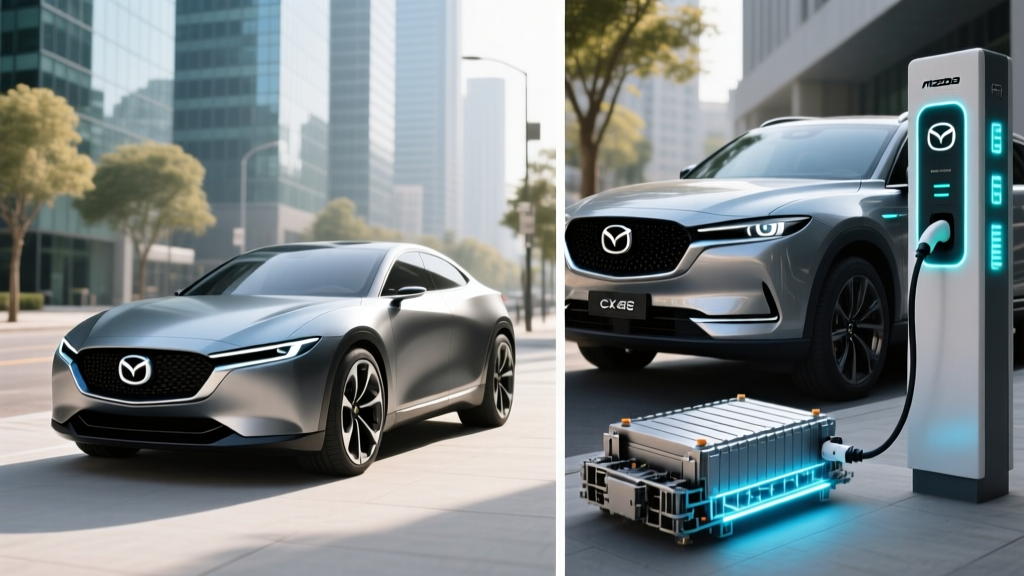
Short answer: Mazda's EV lineup in 2026 spans the compact MX-30 (EPA 100 mi range, ~$34,000 base) and the plug-in hybrid CX-60e/CX-70e (up to 38 mi electric-only). Mazda prioritizes driving dynamics and interior quality over maximum range, making their electrified models best suited for commuters with reliable home charging and daily drives under 40 miles. If you need 300+ miles of range or frequent road-trip capability, competitors like the Hyundai Ioniq 5 or Tesla Model Y are stronger fits. If you want a premium-feeling daily driver with modest electric commuting and the option of a PHEV bridge, Mazda deserves a serious look.
Mazda's Electrified Lineup: What's Available in 2026
Mazda has taken a more measured path to electrification than many rivals. Rather than rushing a full battery-electric portfolio, the Hiroshima automaker has focused on a single BEV (the MX-30) and plug-in hybrid versions of its larger crossover platforms. Here's what you can actually buy in the U.S. market right now:
| Model | Type | Battery (kWh) | EPA Electric Range | EPA MPGe / MPG | 0-60 mph | Base MSRP |
|---|---|---|---|---|---|---|
| MX-30 EV | BEV | 35.5 (usable ~32) | 100 mi | 92 MPGe combined | 9.1 sec | $34,110 |
| CX-70e PHEV | PHEV | 17.8 (usable ~14.5) | 26 mi electric | 56 MPGe / 25 MPG | 6.3 sec | $54,500 |
| CX-90e PHEV | PHEV | 17.8 (usable ~14.5) | 26 mi electric | 56 MPGe / 25 MPG | 6.5 sec | $57,500 |
Mazda has also announced a next-generation dedicated EV platform (expected to underpin a compact crossover by late 2026 or 2027), but as of this writing, specs remain preliminary and no U.S. pricing has been confirmed. We'll update this guide when those models become available for purchase.
MX-30: Real-World Range, Charging, and Honest Limitations
The MX-30 is Mazda's only pure battery-electric vehicle sold in the U.S., and it demands an honest conversation about range. The EPA rates it at 100 miles on a full charge — the lowest of any new BEV currently on the American market. That number is not a typo, and it's the single biggest factor in any purchase decision.
EPA Range: 100 miles
Real-world expectation: 80–90 miles at highway speeds (70+ mph); 65–75 miles in cold weather (below 32°F) with cabin heat. Around-town driving with mild regenerative braking can stretch it to 105–110 miles in ideal conditions.
Charging Speeds
The MX-30 uses a CCS1 connector and supports the following charge rates:
| Level | Power | Time / Rate | Notes |
|---|---|---|---|
| Level 1 (120V) | ~1.2 kW | ~27 hours 0–100% | Emergency/trickle only |
| Level 2 (240V, 32A) | ~7.2 kW | ~5 hours 0–100% | Standard home charging |
| DC Fast Charge | Peak 50 kW | 10–80% in ~36 min | CCS1; tapers sharply above 80% |
A 50 kW peak DC charge rate means the MX-30 adds roughly 80–90 miles in a half-hour session at a public fast charger — adequate for topping up, but not competitive with the 150–250 kW peak rates of rivals like the Ioniq 5 or Tesla Model Y. On a road trip, this is a meaningful limitation.
Battery Chemistry and Warranty
The MX-30 uses a lithium-ion battery pack with NMC (nickel manganese cobalt) chemistry. Mazda provides an 8-year/100,000-mile battery warranty covering defects and capacity loss below a specified threshold (typically 70% state of health). The smaller battery size means lower embedded emissions and lower eventual replacement cost — estimated at $6,000–$9,000 out of warranty, compared to $12,000–$20,000 for larger packs.
PHEV Option: CX-70e and CX-90e for Buyers Not Ready to Go Full EV
If 100 miles of BEV range doesn't fit your life, Mazda's plug-in hybrid crossovers offer a compelling middle ground. Both the CX-70e and CX-90e pair a 2.5-liter inline-four with an electric motor and a 17.8 kWh battery, delivering 323 combined horsepower and 26 miles of electric-only driving (EPA rated).
Here's the practical math: if your daily commute is under 26 miles round-trip and you charge at home overnight, you could drive months without burning gasoline. When the battery depletes, the 2.5L engine takes over at an EPA-rated 25 MPG combined — competitive with non-hybrid midsize crossovers but below the efficiency of dedicated hybrid platforms like Toyota's.
PHEV Charging
Both PHEV models charge via a J1772 connector (Level 2 only — no DC fast charging):
- Level 1 (120V): ~1.2 kW, approximately 12 hours for a full charge
- Level 2 (240V): ~3.3 kW onboard charger, approximately 4.5 hours 0–100%
The 3.3 kW onboard charger is a notable limitation — many PHEV competitors now offer 6.6 kW or higher. If you're charging between errands at a public Level 2 station, you'll add roughly 10–12 miles of range per hour rather than the 20+ miles some rivals manage.
Mazda EV vs Gas vs Competing EVs: Cost Comparison
Numbers matter. Let's compare the total cost picture for a Mazda MX-30 against a typical gas-powered compact crossover and a longer-range competing EV over five years and 60,000 miles.
| Cost Factor | MX-30 EV | Gas Crossover (28 MPG) | Competing EV (270 mi range) |
|---|---|---|---|
| Base MSRP | $34,110 | $29,000 | $42,000 |
| Fed. Tax Credit (§30D)* | $0 (does not qualify) | $0 | Up to $7,500 |
| Net Purchase | $34,110 | $29,000 | ~$34,500 |
| Fuel/Energy (60k mi) | ~$3,600** | ~$8,570*** | ~$3,240** |
| Maintenance (60k mi) | ~$1,200 | ~$3,500 | ~$1,200 |
| Insurance (5-yr avg) | ~$9,500 | ~$7,800 | ~$10,200 |
| 5-Year Total | $48,870 | ~$49,140 |
*MX-30 does not meet §30D battery sourcing requirements per IRS guidelines. Competing EV credit eligibility depends on MSRP caps, buyer income, and critical-mineral sourcing — consult a tax professional.
**Based on $0.15/kWh national average home charging, 3.2 mi/kWh efficiency.
***Based on $3.50/gal and 28 MPG combined.
The MX-30's low purchase price but zero federal tax credit eligibility means it lands in a similar five-year cost bracket as both a gas crossover and a higher-priced EV that qualifies for the full $7,500 credit. Your local electricity rates, state incentives, and annual mileage will shift these numbers — higher mileage heavily favors the EV options.
Home Charging Setup: What Mazda Buyers Need to Know
Owning any Mazda electrified vehicle is dramatically more convenient — and cheaper — with a home Level 2 charger. Here's what to budget for installation:
| Component | Cost Range | Notes |
|---|---|---|
| Level 2 Charger (hardware) | $300–$700 | ChargePoint Home Flex, Emporia Vue, Wallbox Pulsar |
| Electrician (240V/40A circuit) | $800–$2,500 | Varies by distance from panel; conduit runs add cost |
| Panel upgrade (if needed) | $1,500–$4,000 | Required if existing panel lacks capacity for a 40A circuit |
| Permits | $50–$250 | Varies by municipality |
| Total Typical Install | $1,150–$3,450 | Most homes with 200A panels need no upgrade |
For the MX-30's 7.2 kW onboard charger, a 32A circuit is sufficient — this can reduce electrician costs compared to the 48A circuits some higher-powered EVs require. The PHEV models only need a 16A circuit given their 3.3 kW onboard charger, making installation even simpler.
Critical reality check: If you live in an apartment, condo, or street-parking situation without reliable overnight charging access, the MX-30's 100-mile range becomes a significant daily constraint. The PHEV models are far more practical for charging-limited buyers, since the gas engine eliminates range dependence on charging.
Common Mazda EV Misconceptions
| Myth | Fact |
|---|---|
| "The MX-30 can't handle road trips" | It can, but expect a charge stop every 70–80 miles on the highway at a DC fast charger adding 30–40 minutes each time. For frequent road trippers, a PHEV or longer-range BEV is more practical. |
| "Mazda's EVs qualify for the $7,500 federal tax credit" | The MX-30 does not currently qualify under §30D due to battery component and critical-mineral sourcing requirements. PHEV models may qualify for partial credits depending on the tax year — verify at fueleconomy.gov before purchasing. |
| "EV batteries need replacing every few years" | Modern lithium-ion packs are designed for 150,000+ miles with manageable degradation. Mazda's 8-year/100,000-mile warranty provides coverage. Expect 10–15% capacity loss over 8–10 years under normal use. |
| "PHEVs are pointless — just buy a full EV or a gas car" | For drivers with short commutes and limited charging access, PHEVs offer electric daily driving with gas-engine flexibility. They eliminate range anxiety while still reducing fuel consumption by 40–60% for typical commutes. |
| "Mazda EVs charge as fast as Teslas" | The MX-30 peaks at 50 kW DC; the Tesla Model Y peaks at 250 kW. At a Supercharger, the Model Y adds ~200 miles in 15 minutes. The MX-30 adds ~50 miles in the same time at a compatible fast charger. |
Decision Framework: Which Mazda Electrified Vehicle Fits You?
Choose the MX-30 EV if:
- Your daily round-trip commute is under 60 miles
- You have reliable Level 2 home charging
- You rarely take road trips over 150 miles (or have a second gas car)
- You value Mazda's driving dynamics and interior quality over maximum range
- You want the lowest entry price in Mazda's electrified lineup
Choose the CX-70e / CX-90e PHEV if:
- Your commute is under 26 miles and you can charge at home
- You need family-hauler space and 5,000-lb towing (CX-90e)
- You take regular road trips and don't want to plan around charging
- You want to reduce gasoline use without full EV commitment
- You need AWD and all-weather capability
Look at competing brands if:
- You need 250+ miles of BEV range (consider Hyundai Ioniq 5, Tesla Model Y, Chevrolet Equinox EV)
- Federal tax credit eligibility is essential to your budget
- You need DC fast charging above 100 kW for frequent highway travel
- You need three-row seating in a BEV (Kia EV9)
Frequently Asked Questions
Is Mazda releasing a longer-range EV?
Mazda has announced plans for a dedicated EV platform with models expected by 2027–2028, targeting 250+ miles of range. However, no U.S.-market model with those specs is currently available for purchase. If range is your priority, current competitors already deliver it.
Does the MX-30 work in cold climates?
It works, but expect significant range reduction. In sub-freezing temperatures, the MX-30's already-limited 100-mile EPA range drops to roughly 65–75 miles due to battery chemistry limitations and cabin heating demands. The MX-30 does include a heat pump (on higher trims), which mitigates some cold-weather loss, but the small battery means there's less energy to work with overall.
Can I charge a Mazda PHEV at a public DC fast charger?
No. The CX-70e and CX-90e only accept Level 1 (120V) and Level 2 (240V) AC charging via a J1772 connector. They cannot use DC fast charging stations. Plan on home charging or public Level 2 destination chargers.
What's the actual cost to charge the MX-30 at home?
With the national average electricity rate of ~$0.15/kWh and the MX-30's efficiency of approximately 3.2 miles per kWh, a full charge (32 kWh usable) costs about $4.80 for 100 miles of range — roughly $0.048 per mile. A comparable gas car at 28 MPG and $3.50/gallon costs $0.125 per mile. Over 12,000 annual miles, that's $576 in electricity vs $1,500 in gasoline — a savings of ~$924/year.
Does Mazda's driver-assistance system make the MX-30 self-driving?
No. Mazda's i-Activsense suite is an SAE Level 2 driver-assistance system providing adaptive cruise control, lane-keeping, and automatic emergency braking. The driver must remain fully engaged at all times. This is comparable to Toyota Safety Sense or Honda Sensing — helpful, but not autonomous.
What about Mazda's rotary-engine range extender?
Mazda has offered a rotary range-extender variant of the MX-30 in Japan and Europe (MX-30 R-EV), which uses a small rotary engine as a generator to extend range. As of 2026, this variant is not available in the U.S. market. Mazda has not announced U.S. availability.
Sources: EPA Fuel Economy — Mazda MX-30, IRS §30D Clean Vehicle Credit Rules, fueleconomy.gov Tax Credit Lookup