Search "how to get a Tesla for free" and you'll find a graveyard of clickbait: referral-code schemes, sweepstakes, and influencer fantasies. The truth is both less sensational and more useful. You cannot legally acquire a 2026 Tesla for $0 out of pocket without winning a contest or inheriting one. But you can structure a purchase or lease so that incentives, fuel savings, and depreciation math effectively neutralize the cost of ownership over a 5-year horizon — and in some narrow cases, drive the first month's payment to zero on a lease.
Below, we use the 2026 Tesla Model 3 Rear-Wheel Drive (the cheapest new Tesla you can buy) as the test case. We'll walk through every lever — federal tax credits, state rebates, lease point-of-sale reductions, solar bundles, and total cost of ownership — and show exactly where the "free Tesla" claim holds up and where it falls apart.
The Baseline: 2026 Tesla Model 3 RWD at a Glance
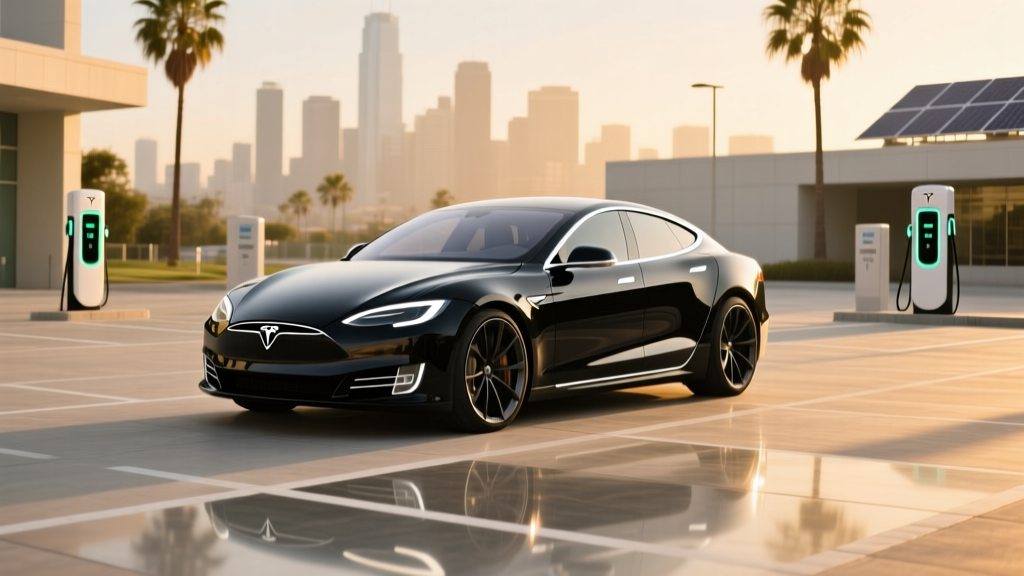
Before we engineer a deal, we need to know what we're buying. The 2026 Model 3 RWD (Highland refresh, second generation) remains Tesla's entry point and one of the most efficient EVs sold in the United States.
| Spec | Value |
|---|---|
| Base MSRP (incl. destination) | $38,990 |
| EPA-estimated range | 363 miles |
| Battery capacity (usable) | ~60 kWh, LFP chemistry |
| Drivetrain | Rear-Wheel Drive (single motor) |
| Horsepower | 271 hp |
| 0-60 mph | 5.8 seconds |
| MPGe (combined) | 132 MPGe |
| Efficiency | 25 kWh/100 mi |
| Max DC fast charge | 170 kW peak |
| 10-80% DCFC time | ~25 minutes |
| Level 2 home charge rate | 11.5 kW / ~44 mi/hr |
| Cargo (trunk + frunk) | 23 cu ft rear + ~3 cu ft frunk |
| Rear legroom | 35.3 in |
| Battery & drivetrain warranty | 8 years / 100,000 miles |
| Basic vehicle warranty | 4 years / 50,000 miles |
The EPA 363-mile figure is among the best in the segment, but real-world results depend heavily on conditions. In mixed suburban/highway driving at 70°F, owners typically report 320–340 miles on a full charge. Sustained 75-80 mph highway runs in summer drop that to ~290 miles. In sub-30°F winter weather without preconditioning, expect 220–260 miles — a 28–38% reduction typical of LFP packs without a heat pump workaround. The Model 3 Highland does include a heat pump (standard since 2024), which partially mitigates cold losses.
Federal Tax Credit: The $7,500 Lever
The single biggest reason the "free Tesla" myth persists is the IRS §30D Clean Vehicle Credit, which can reduce your federal tax liability by up to $7,500. For 2026, the Model 3 RWD has consistently qualified for the full amount, thanks in part to Tesla's North American battery sourcing and the LFP pack's critical-mineral supply chain. But qualification is not automatic.
- MSRP cap: Vehicle must have an MSRP under $55,000 (sedans). The Model 3 RWD at $38,990 clears this easily.
- Buyer income cap (MAGI): $150,000 single / $225,000 head of household / $300,000 joint filers. Exceed these and the credit phases out to $0.
- Battery sourcing: At least 60% of critical minerals must be sourced from the U.S. or FTA-partner nations; at least 75% of battery components must be manufactured or assembled in North America (2026 thresholds). Tesla's Fremont-built packs with CATL-sourced LFP cells have historically met these thresholds, but the IRS updates the qualified-vehicle list periodically — always verify at fueleconomy.gov before signing.
- Point-of-sale transfer: Since 2024, you can transfer the credit to the dealer at purchase, reducing your out-of-pocket by $7,500 on day one — even if your tax liability is lower than $7,500. This is the closest thing to "free money" in the EV world.
| Line Item | Amount |
|---|---|
| Base MSRP (incl. destination) | $38,990 |
| Federal §30D credit (point-of-sale) | -$7,500 |
| Effective purchase price | $31,490 |
| Example state rebate (CA CVRP, income-dependent) | -$2,000 to -$7,500 |
| Best-case effective price (CA, low-income) | ~$23,990 |
State incentives vary widely and change frequently. Always verify current amounts with your state energy office or the AFDC state law database.
The Lease Loophole: Where "Free" Gets Closest
Tesla reintroduced leasing on the Model 3 in late 2024, and the structure exploits a quirk in the tax code. Under §45W, the lessor (Tesla's financing arm) claims the $7,500 commercial clean vehicle credit — and typically passes it through as a capitalized-cost reduction. Combined with no down payment and a 36-month term, the first month's payment on a Model 3 RWD lease has occasionally been advertised at $0 during promotional periods.
Here's a realistic 2026 lease structure:
- 36 months / 10,000 miles per year
- $0 due at signing (first month waived, no cap reduction, no security deposit)
- Monthly payment: ~$349–$399 depending on money factor and residual
- Total paid over 36 months: ~$12,200–$14,000
That's not free. But compared to a $38,990 purchase, it dramatically reduces upfront capital. The catch: you don't own the car at the end, Tesla's lease-end buyout terms have historically been restrictive, and excess-mileage charges run $0.20–$0.25/mi. For drivers who can commit to a 3-year cycle, the lease is the path of least resistance.
Solar Bundle: The "Pay With Your Roof" Strategy
Tesla has periodically offered promotional bundles pairing a Model 3 purchase with a Tesla Solar Roof or solar panel + Powerwall installation. The math works like this: a 10 kW solar system with Powerwall in 2026 costs roughly $30,000–$40,000 before the 30% federal solar ITC (which reduces it to ~$21,000–$28,000). The system generates enough electricity to cover both household loads and ~12,000 miles of Model 3 charging per year.
If you were already planning a solar installation, bundling effectively makes the car's "fuel" free for 25+ years. This doesn't eliminate the vehicle's purchase price, but it eliminates the ongoing energy cost — which, at $0.16/kWh national average and 25 kWh/100 mi, runs about $480/year for 12,000 miles. Over 5 years, that's $2,400 in avoided fuel costs.
Total Cost of Ownership: The 5-Year Reconciliation
The most intellectually honest version of "how to get a Tesla for free" is the TCO argument: the combined savings in fuel, maintenance, and tax credits offset the purchase premium over a comparable gas sedan. Let's compare the Model 3 RWD against a 2026 Toyota Camry LE (the segment benchmark) over 5 years / 60,000 miles.
| Category | Model 3 RWD | Camry LE (ICE) |
|---|---|---|
| Purchase price (after incentives) | $31,490 | $28,500 |
| Fuel/energy (60k mi) | $2,400 (home charging) | $7,200 (30 MPG, $3.60/gal) |
| Maintenance (5 yr) | $1,200 | $3,600 |
| Insurance (5 yr avg) | $9,500 | $7,000 |
| Estimated depreciation | $12,000 | $10,500 |
| Total 5-yr cost | $56,590 | $56,800 |
The Model 3 wins on TCO by a narrow margin — not because the car is free, but because fuel and maintenance savings offset the higher purchase price and insurance premiums. The gap widens significantly in states with high gas prices (California, Washington, New York) or where additional state rebates stack on top of the federal credit.
Charging Speed: The 170 kW Reality
The Model 3 RWD's LFP battery accepts a peak of 170 kW on DC fast chargers. That's modest compared to the 250 kW available on Long Range and Performance trims (which use NMC chemistry). In practice, the LFP pack sustains ~150 kW from 10–40% SoC, then tapers progressively. A 10–80% session takes approximately 25 minutes at a V3 Supercharger or equivalent 150+ kW station.
| Level | Power | Speed | Use Case |
|---|---|---|---|
| Level 1 (120V household) | ~1.4 kW | ~5 mi/hr | Emergency / overnight trickle |
| Level 2 (240V, 48A home) | 11.5 kW | ~44 mi/hr | Daily home charging |
| DC Fast Charge (V3 Supercharger) | 170 kW peak | 10-80% in ~25 min | Road trips |
One underappreciated LFP advantage: Tesla recommends charging to 100% regularly (unlike NMC packs, which prefer an 80% daily ceiling). This means your usable daily range is closer to the full 363 EPA miles, not a derated 80% figure. For commuters who can charge at home nightly, the LFP Model 3 effectively delivers its sticker range every day.
Standout Tech, Drawbacks, and Who Should Buy
Pros
- Best-in-class efficiency (132 MPGe / 25 kWh/100mi)
- Access to Tesla Supercharger network — the most reliable DCFC ecosystem in North America
- LFP battery allows daily 100% charging with minimal degradation concern
- Over-the-air updates continuously add features
- Strong safety ratings (IIHS Top Safety Pick+, NHTSA 5-star)
- Heat pump standard for cold-climate efficiency
Cons
- Rear seat legroom (35.3 in) is tight for tall adults on long trips
- No physical instrument cluster — all info on 15.4" center screen
- Turn signals on steering wheel yoke (if equipped) remain controversial
- Insurance costs 25–40% higher than comparable ICE sedans
- FSD (Supervised) is a $8,000 add-on and remains SAE Level 2 — you must supervise at all times
- Limited dealer-style service network; mobile service coverage varies by region
Who it suits best: The Model 3 RWD is ideal for single drivers or couples who commute 30–80 miles daily, have access to home Level 2 charging, and prioritize low running costs over rear-seat space. It's a strong road-trip car thanks to Supercharger access and 363-mile range, though winter road-trippers in the Northern Plains should plan for more frequent stops. Families needing three-across car seats or regular rear-passenger hauling should look at the Model Y or Hyundai Ioniq 5 instead.
Every 2026 Tesla ships with basic Autopilot (adaptive cruise + lane centering). Full Self-Driving (Supervised) adds automated lane changes, traffic-light recognition, and city-street navigation — but it remains SAE Level 2, meaning the driver must remain fully engaged, hands on wheel, eyes on road. No Tesla sold today is Level 4 driverless. Only Waymo and Zoox robotaxis currently operate at Level 4 in limited geofenced areas.
Frequently Asked Questions
Can I actually get a Tesla for $0 out of pocket?
Not through any standard purchase or lease program. The closest scenario is a $0-down lease with the first month's payment waived during a promotional period, combined with the $7,500 federal credit applied as a cap-cost reduction. You'll still pay $349–$399/month. Outright "free" Teslas exist only in giveaways, employer compensation packages, or as prizes — none of which are reproducible strategies.
Does the 2026 Model 3 RWD qualify for the full $7,500 federal tax credit?
As of early 2026, yes — the Model 3 RWD qualifies for the full $7,500 under §30D, provided the buyer meets income caps ($150K single / $300K joint) and the vehicle's battery sourcing continues to meet critical-mineral and component thresholds. You can transfer the credit to the dealer at point of sale, reducing your purchase price by $7,500 on day one. Always verify current eligibility at fueleconomy.gov before signing, as the IRS periodically updates the qualified-vehicle list.
How much does a Model 3 cost after all incentives?
The base MSRP is $38,990. After the $7,500 federal credit, the effective price is $31,490. In states with additional rebates (California's CVRP can add up to $7,500 for lower-income buyers; Colorado offers $5,000; New York offers $2,000), the effective price can drop to $23,990–$29,490. These figures exclude any dealer fees, optional paint/wheels, or FSD add-ons.
What's the real-world range of the Model 3 RWD?
EPA-estimated: 363 miles. Real-world: expect 320–340 miles in temperate mixed driving, ~290 miles at sustained highway speeds in summer, and 220–260 miles in sub-30°F winter conditions. The standard heat pump helps, but LFP chemistry is more sensitive to cold than NMC.
Is the Model 3 RWD worth buying over competitors?
Against the Hyundai Ioniq 6 (EPA 361 mi, ~$39,500), the Model 3 wins on Supercharger access and software, while the Ioniq 6 offers faster DC charging (up to 240 kW on 800V architecture) and a more traditional interior. Against the Chevrolet Equinox EV (EPA 319 mi, ~$33,000), the Model 3 offers superior range and efficiency at a higher price. The Model 3 remains the default recommendation for buyers who prioritize range, efficiency, and charging-network reliability — but it's no longer the only credible option.
Does Tesla offer any $0-down financing?
Tesla's financing arm periodically offers $0-down loan and lease structures, typically requiring excellent credit (740+). A $0-down 72-month loan at 6.5% APR on a $31,490 effective price (after credit) yields ~$529/month. A $0-down 36-month lease yields ~$349–$399/month. Neither is free, but both eliminate upfront capital.
The Verdict: Free Is a Myth, but Affordable Is Real
The honest answer to "how to get a Tesla for free" is that you can't — not through any reliable, reproducible mechanism. What you can do in 2026 is purchase a Model 3 RWD for an effective $31,490 after the federal credit (or as low as ~$24,000 with stacked state incentives), lease one for $0 down and ~$379/month, and own it at a 5-year total cost that matches or beats a comparable gas sedan. The "free Tesla" is a marketing myth. The economically rational Tesla — one that pays for itself in fuel savings, tax credits, and maintenance reduction — is a real, calculable outcome for the right buyer in the right state.