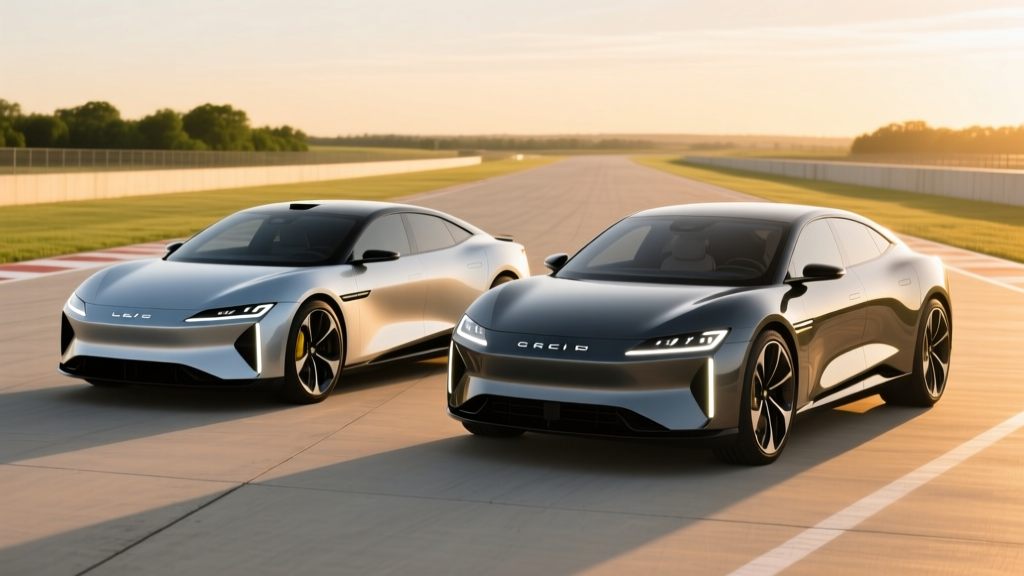
For years, Lucid Motors has been the boutique EV maker with the best range and efficiency in the business — and the worst delivery timelines. But as Lucid Motors production ramps up through 2025 and into 2026, the calculus is shifting. The flagship Air sedan is now reaching buyers faster, and the all-new Gravity three-row SUV is finally in driveways after a long-delayed launch. The question is no longer whether Lucid can build a world-class EV. It's whether the company can build enough of them, and whether the ownership experience matches the engineering.
We've spent time with both the 2026 Lucid Air and the 2026 Lucid Gravity to bring you a data-driven look at what these vehicles actually deliver — range, charging speed, real-world efficiency, and total cost — now that availability is improving.
2026 Lucid Air: The Range King Holds Its Crown
The Lucid Air remains the most efficient long-range electric sedan on the market. Its 900-volt architecture, proprietary miniaturized drive units, and aerodynamic drag coefficient of 0.20 Cd combine to deliver EPA range figures that still embarrass competitors two model years after the car's debut.
| Spec | Pure (RWD) | Touring (AWD) | Grand Touring (AWD) | Sapphire (AWD) |
|---|---|---|---|---|
| EPA Range | 419 mi | 425 mi | 516 mi | 427 mi |
| Battery (usable) | 88 kWh (NMC) | 112 kWh (NMC) | 112 kWh (NMC) | 118 kWh (NMC) |
| Horsepower | 430 hp | 620 hp | 819 hp | 1,234 hp |
| 0–60 mph | 5.0 sec | 3.4 sec | 3.0 sec | 1.89 sec |
| Drivetrain | RWD, single motor | AWD, dual motor | AWD, dual motor | AWD, tri-motor |
| MPGe (combined) | 146 MPGe | 131 MPGe | 131 MPGe | 109 MPGe |
| Efficiency | 23 kWh/100mi | 26 kWh/100mi | 26 kWh/100mi | 31 kWh/100mi |
| Base MSRP | $69,900 | $78,900 | $110,900 | $249,000 |
Source: EPA fueleconomy.gov, Lucid Motors official specifications.
Real-World Range: What to Actually Expect
EPA sticker: 516 miles (Grand Touring) / 419 miles (Pure)
Real-world highway (70 mph, 72°F): Expect ~380–410 miles in the Grand Touring and ~340–360 miles in the Pure. Lucid's efficiency is exceptional, but the EPA test cycle favors low-speed urban driving.
Cold weather (20°F, highway): Reduce expectations by 20–30%. The Grand Touring drops to roughly 300–340 miles; the Pure to ~260–290 miles. Lucid's heat pump and thermal management help, but physics still wins in deep cold.
Bottom line: The Air Grand Touring is one of the few EVs where you can realistically plan a 350-mile single-charge highway trip in moderate weather without anxiety.
2026 Lucid Gravity: The Three-Row SUV Arrives
The Gravity is Lucid's volume play — a three-row electric SUV aimed directly at the Tesla Model X, Rivian R1S, and upcoming competitors. After multiple production delays, Lucid began customer deliveries of the Gravity in late 2024 and has been scaling output through 2025 and into 2026. The Gravity shares the Air's 900V electrical architecture and drive-unit technology, adapted for a larger, heavier vehicle.
| Spec | Gravity Touring (AWD) | Gravity Grand Touring (AWD) |
|---|---|---|
| EPA Range | 400 mi (est.) | 440 mi (est.) |
| Battery (usable) | 112 kWh (NMC) | 118 kWh (NMC) |
| Horsepower | 620 hp | 820+ hp |
| 0–60 mph | 3.5 sec | ~3.0 sec |
| Seating | 7 passengers (3 rows) | 7 passengers (3 rows) |
| Cargo (behind 3rd row) | ~20 cu ft | ~20 cu ft |
| Cargo (3rd row folded) | ~60 cu ft | ~60 cu ft |
| Base MSRP | $80,000 | $100,000+ |
Source: Lucid Motors official specifications and Lucid Gravity product page. Some figures are manufacturer estimates pending final EPA certification for select trims.
The Gravity's standout feature is interior space utilization. Thanks to Lucid's compact drive units, the cabin is remarkably spacious for its footprint, with genuine third-row legroom (~32 inches) that accommodates adults on shorter trips. The available glass canopy roof creates an airy feel, though it does reduce headroom slightly compared to a conventional steel roof.
Charging Speed: 900V Architecture Pays Off
Lucid's 900-volt electrical system isn't just a marketing bullet — it enables some of the fastest DC fast-charging speeds available from any production EV. Here's what the numbers look like across both models:
| Charging Method | Air Grand Touring | Air Pure | Gravity |
|---|---|---|---|
| Max DC Fast Charge | 300 kW peak | 200 kW peak | 300 kW peak |
| 10–80% DC Time | ~20 minutes | ~25 minutes | ~22 minutes |
| Sustained DC Rate (10–50%) | ~250 kW avg | ~170 kW avg | ~240 kW avg |
| Level 2 Home (19.2 kW) | ~80 mi/hr added | ~68 mi/hr added | ~75 mi/hr added |
| Level 2 Home (11.5 kW / 48A) | ~48 mi/hr added | ~41 mi/hr added | ~45 mi/hr added |
| Level 1 (120V / 12A) | ~3.5 mi/hr | ~3.5 mi/hr | ~3.5 mi/hr |
| Charging Port | CCS1 (NACS adapter avail.) | CCS1 (NACS adapter avail.) | CCS1 (NACS adapter avail.) |
What this means in practice: At a 350 kW Electrify America or Tesla Supercharger (V4 with CCS/NACS magic dock) station, the Air Grand Touring and Gravity can add roughly 200 miles of range in 12 minutes under ideal conditions. However, the charge curve tapers significantly above 80% State of Charge — charging from 80–100% can take nearly as long as 10–80%. For road trips, plan to charge to 80% and keep moving.
Home charging note: The Air and Gravity can accept up to 19.2 kW on Level 2 AC, which is higher than most competitors (many cap at 11.5 kW). However, a 19.2 kW home charger requires a dedicated 100-amp circuit and likely a 200-amp (or larger) electrical panel. Budget $1,500–$3,500 for a full professional installation at this rate, or opt for a standard 48-amp/11.5 kW setup (~$600–$1,200 installed) which still refills either vehicle overnight.
Lucid's Production Ramp-Up: What Buyers Should Know
Lucid's factory in Casa Grande, Arizona, has a stated capacity of roughly 150,000 vehicles annually at full buildout, but actual output has trailed projections significantly. In 2024, Lucid produced approximately 9,000 vehicles against an original target of 14,000. The company has since secured additional capital — including a major investment from Saudi Arabia's Public Investment Fund (PIF), its largest shareholder — and has been adding shifts and improving supply-chain throughput.
As of early 2026, wait times for an Air Pure or Touring have dropped to roughly 4–8 weeks for configured orders, a dramatic improvement from the 6–12 month waits of 2023. Gravity production is still ramping, with delivery estimates of 6–12 weeks for new orders. The Sapphire and Grand Touring trims tend to have shorter waits due to lower demand at those price points.
For buyers, this production ramp has two practical implications:
- Better availability means you can test-drive, configure, and take delivery in a reasonable timeline rather than speculating on a reservation.
- Lucid's service network is still thin. The company operates roughly 30+ service centers and is expanding mobile service, but owners in rural areas or smaller metro markets may face longer service turnaround times compared to Tesla or legacy luxury brands.
Pricing, Trims, and Federal Tax Credit Eligibility
Lucid positions the Air against the Mercedes EQS, BMW i7, and Tesla Model S. The Gravity targets the Model X, Rivian R1S, and BMW iX (though the iX is a two-row). Here's how pricing breaks down and how the federal EV tax credit applies:
| Trim | Base MSRP | MSRP Cap (§30D) | Eligible for $7,500 Credit? | Est. Net Price* |
|---|---|---|---|---|
| Air Pure | $69,900 | $55,000 (sedans) | No — exceeds MSRP cap | $69,900 |
| Air Touring | $78,900 | $55,000 (sedans) | No — exceeds MSRP cap | $78,900 |
| Air Grand Touring | $110,900 | $55,000 (sedans) | No — exceeds MSRP cap | $110,900 |
| Air Sapphire | $249,000 | $55,000 (sedans) | No — exceeds MSRP cap | $249,000 |
| Gravity Touring | $80,000 | $80,000 (SUVs/vans) | Possible — at cap limit** | ~$72,500 |
| Gravity Grand Touring | $100,000+ | $80,000 (SUVs/vans) | No — exceeds MSRP cap | $100,000+ |
Critical caveats on the §30D credit (per IRS guidelines):
- Income caps apply: Modified AGI must not exceed $300,000 (joint), $225,000 (head of household), or $150,000 (single).
- MSRP caps: Sedans are capped at $55,000; SUVs/vans/pickups at $80,000. This disqualifies nearly the entire Lucid lineup except the base Gravity Touring — and only if its MSRP stays at or under $80,000 after options.
- Battery sourcing rules: The vehicle must meet critical minerals and battery component sourcing requirements that tighten annually. Lucid's battery cell supply chain (sourced from partners including Samsung SDI and LG Energy Solution) must satisfy these thresholds for the credit to apply.
- Point-of-sale transfer: Eligible buyers can transfer the credit to the dealer at purchase, reducing the purchase price directly rather than waiting for a tax refund.
*Est. Net Price assumes full $7,500 credit eligibility where noted. Consult a tax professional for your specific situation. **Verify Gravity Touring MSRP and classification at purchase — options can push it over the $80,000 SUV cap.
Interior, Tech, and Daily Livability
Lucid's interior design philosophy emphasizes space, light, and a curved glass "canopy" display that stretches across the dashboard. The 34-inch curved glass cockpit display in the Air (and a similar large-format setup in the Gravity) handles instrumentation, navigation, and media. A separate lower touchscreen manages climate and secondary vehicle functions.
Standout tech features:
- DreamDrive Pro ADAS: Lucid's driver-assistance suite includes adaptive cruise control, lane centering, automated parking, and a 32-sensor array (including LiDAR on higher trims). This is an SAE Level 2 system — the driver must remain engaged and hands-on at all times. It is not self-driving.
- Over-the-air updates: Lucid regularly pushes software improvements, including efficiency optimizations and new features.
- Frunk + trunk space: The Air offers ~10 cu ft in the frunk and ~22 cu ft in the rear trunk (32 cu ft combined), competitive with the Mercedes EQS.
- Rear-seat space: The Air's rear legroom is ~36.6 inches — generous for a sedan, though the sloping roofline limits headroom for taller passengers.
- Gravity cargo versatility: With all rows folded, the Gravity offers over 100 cu ft of cargo space, plus a substantial front trunk.
Notable drawbacks:
- Infotainment learning curve: The dual-screen interface lacks physical buttons for climate or volume, which some drivers find distracting. Apple CarPlay and Android Auto are available wirelessly.
- Service center density: As noted, Lucid's service footprint is still growing. Mobile service handles many issues, but body repair and major warranty work may require travel to a regional center.
- Visibility: The Air's sleek roofline and thick rear pillars create blind spots; the Gravity's large glass area helps but adds solar heat load in hot climates.
- Resale uncertainty: As a young luxury brand, Lucid's long-term depreciation curves are unproven compared to Porsche, BMW, or Mercedes.
Battery, Warranty, and Long-Term Ownership
Lucid uses NMC (nickel manganese cobalt) lithium-ion cells sourced from Samsung SDI and LG Energy Solution. The battery pack is structurally integrated into the vehicle floor and features active liquid thermal management — critical for sustaining fast-charge speeds and minimizing degradation.
| Coverage | Term |
|---|---|
| Basic Vehicle Warranty | 4 years / 50,000 miles |
| Battery & Powertrain Warranty | 8 years / 100,000 miles |
| Battery Capacity Retention | ≥70% over 8 years / 100,000 miles |
The 70% capacity retention threshold over 8 years is industry-standard, matching Tesla, Hyundai, and most competitors. Real-world degradation data on Lucid vehicles is still emerging given the Air's 2021 launch, but early owner reports and the robust thermal management system suggest degradation will track favorably with other liquid-cooled NMC packs. For context, typical NMC degradation is ~10–15% over the first 100,000 miles under normal use patterns (avoiding repeated 100% charges and frequent DC fast-charging in extreme heat).
Battery replacement cost: Lucid has not published official out-of-warranty replacement pricing. Based on comparable 112–118 kWh NMC packs from competitors, expect $18,000–$28,000 if replacement is ever needed outside warranty coverage. This is a long-term ownership risk worth factoring in for high-mileage buyers or second owners.
Air vs. Gravity vs. Competitors: Which Should You Buy?
Decision Framework
Choose the Lucid Air if:
- You prioritize maximum range and efficiency above all else (516 mi EPA in the Grand Touring is unmatched)
- You want a luxury sport sedan that rivals the Mercedes EQS and Porsche Taycan on refinement but crushes them on range
- You primarily commute or take road trips with 1–2 passengers and don't need three rows
- You value a 300 kW peak charge rate for fast highway charging
Choose the Lucid Gravity if:
- You need three-row seating for a family and want an EV that doesn't compromise on range
- You want Tesla Model X-level performance with better build quality and a more conventional interior
- The base Gravity Touring at ~$80,000 potentially qualifies for the $7,500 §30D tax credit (verify at purchase)
- You can accept a newer model with less long-term reliability data
Look at competitors if:
- Service network proximity is critical — Tesla, BMW, and Mercedes have far more service locations
- You want proven long-term depreciation data — Porsche and BMW have established luxury resale tracks
- You need a pickup-truck form factor (Rivian R1T) or off-road capability (Rivian R1S, Rivian R1T)
Pros and Cons at a Glance
✅ Pros
- Class-leading EPA range (up to 516 mi on Air Grand Touring)
- Industry-best efficiency: 131 MPGe combined, 26 kWh/100mi
- 300 kW peak DC fast charging with strong sustained curve
- Spacious interiors thanks to compact drive-unit packaging
- 900V architecture future-proofs for next-gen charging infrastructure
- Production ramp-up is reducing delivery wait times significantly
- Competitive 8-year/100,000-mile battery warranty
❌ Cons
- Most trims exceed §30D MSRP caps — no federal tax credit for Air or upper Gravity trims
- Service center network is still limited outside major metros
- Long-term depreciation data is unproven for the brand
- Infotainment relies heavily on touchscreens with minimal physical controls
- Gravity is a first-year model with potential early-production teething issues
- Air rear headroom is compromised by the aerodynamic roofline
- Resale value uncertainty compared to established luxury marques
Frequently Asked Questions
What is the real-world range of the Lucid Air?
The EPA rates the Air Grand Touring at 516 miles and the Air Pure at 419 miles. In real-world highway driving at 70 mph in moderate temperatures, expect roughly 380–410 miles from the Grand Touring and 340–360 miles from the Pure. In cold weather (below 30°F), subtract 20–30%. Lucid's efficiency is genuinely best-in-class, so real-world numbers still outperform most competitors' EPA stickers.
How fast does the Lucid Air and Gravity charge?
The Air Grand Touring and Gravity can accept up to 300 kW peak DC fast charging, achieving a 10–80% charge in roughly 20–22 minutes at a compatible 350 kW station. The Air Pure peaks at 200 kW (10–80% in ~25 minutes). On Level 2 home charging, both accept up to 19.2 kW (adding ~75–80 miles of range per hour) if your electrical panel supports a 100-amp dedicated circuit. A standard 48-amp Level 2 charger adds ~45 miles per hour.
How much does a Lucid cost after tax credits?
Most Lucid models do not qualify for the $7,500 federal §30D tax credit because they exceed the MSRP caps ($55,000 for sedans, $80,000 for SUVs). The Air Pure at $69,900 is well above the sedan cap. The base Gravity Touring at $80,000 sits right at the SUV cap and may qualify if options don't push it over, and if the buyer meets income limits and battery-sourcing requirements. Always verify eligibility with your tax professional and the IRS clean vehicle credit page before purchasing.
Is Lucid worth buying vs. Tesla, Mercedes, or BMW?
If range and efficiency are your top priorities, the Lucid Air Grand Touring is objectively superior to the Mercedes EQS (350 mi EPA), BMW i7 (318 mi EPA), and Tesla Model S (402 mi EPA). The Gravity competes well with the Tesla Model X on space and performance, with arguably better interior quality. However, Tesla's Supercharger network, service infrastructure, and proven software ecosystem remain advantages. BMW and Mercedes offer more established dealer networks and resale predictability. Your decision should weigh range/efficiency gains against service access and brand maturity.
Does the Lucid Air or Gravity qualify for the federal EV tax credit?
Under current IRS §30D rules, the sedan MSRP cap of $55,000 disqualifies all Air trims. The SUV cap of $80,000 means the Gravity Touring at its base MSRP may qualify — but adding options, destination charges, or certain packages could push it over. Additionally, the buyer must meet income caps ($300K joint / $150K single), and the vehicle's battery must satisfy critical-mineral and component-sourcing requirements. The credit can be transferred at the point of sale to reduce your purchase price directly. Always confirm with the dealer and your tax advisor at the time of purchase, as rules can change.
How reliable are Lucid vehicles?
Long-term reliability data is still limited — the Air launched in late 2021 and the Gravity in late 2024. Early Air owners have reported issues with panel gaps, software glitches, and occasional drive-unit noise, though Lucid has addressed many through OTA updates and service campaigns. The 8-year/100,000-mile battery and powertrain warranty provides substantial coverage. As production ramps and Lucid matures its manufacturing processes, build quality is expected to improve, but this remains a newer brand without the multi-decade track record of established luxury automakers.
Where can I get a Lucid serviced?
Lucid operates service centers in major metro areas (roughly 30+ locations as of early 2026) and offers mobile service vans for many routine repairs and diagnostics. For collision repair, Lucid has certified a growing network of third-party body shops. If you live outside a major metro, check Lucid's service locator before purchasing to ensure reasonable access. This is one area where Tesla, BMW, and Mercedes still hold a clear advantage in coverage density.