The Elephant in the Showroom: Lucid's Financial Health in 2026
Search "lucid motors financial troubles" and you'll find a steady drumbeat of headlines: quarterly losses exceeding $600 million, production numbers trailing guidance, cash reserves burning faster than revenue accumulates, and multiple capital raises diluting shareholders. For a company building what is arguably the most efficient luxury electric sedan on the market, the balance sheet tells a tense story.
But for buyers — not investors — the question isn't whether Lucid's stock is a buy. It's whether the Lucid Air is still a smart purchase in 2026 given the company's uncertain trajectory. Will parts be available in five years? Will the service network hold up? Will software updates keep coming? These are legitimate ownership concerns that deserve data-driven answers, not dismissal.
This review evaluates the 2026 Lucid Air lineup on its engineering merits while addressing the financial risk head-on. We'll cover real-world range, charging performance, pricing after federal tax credits, and how the Air stacks up against the Mercedes EQS, Tesla Model S, and BMW i7.
2026 Lucid Air: Core Specifications at a Glance
| Spec | Air Pure | Air Touring | Air Grand Touring | Air Sapphire |
|---|---|---|---|---|
| Base MSRP | $69,900 | $87,400 | $125,650 | $249,000 |
| Drivetrain | RWD (single motor) | AWD (dual motor) | AWD (dual motor) | AWD (tri-motor) |
| Horsepower | 430 hp | 620 hp | 1,050 hp | 1,234 hp |
| 0-60 mph | 5.0 sec | 3.4 sec | 3.0 sec | 1.89 sec |
| Battery (usable) | 88 kWh (NMC) | 112 kWh (NMC) | 112 kWh (NMC) | 118 kWh (NMC) |
| EPA Range | 419 mi | 425 mi | 516 mi | 427 mi |
| MPGe (combined) | 140 MPGe | 134 MPGe | 131 MPGe | 110 MPGe |
| Efficiency | 24 kWh/100mi | 25 kWh/100mi | 26 kWh/100mi | 30 kWh/100mi |
| Max DC Charge Rate | 200 kW | 300 kW | 300 kW | 300 kW |
| 10-80% DC Time | ~25 min | ~15 min | ~15 min | ~17 min |
| Level 2 Home Rate | 11.5 kW (~46 mi/hr) | 19.2 kW (~77 mi/hr) | 19.2 kW (~77 mi/hr) | 19.2 kW (~77 mi/hr) |
| Cargo (trunk + frunk) | 32 cu ft total | 32 cu ft total | 32 cu ft total | 32 cu ft total |
| Rear Legroom | 36.6 in | 36.6 in | 36.6 in | 36.6 in |
Range and Efficiency: The Air's Undeniable Strength
EPA Sticker: 516 miles
Real-World Highway (70-75 mph, moderate climate): ~410-440 miles
Real-World Cold Weather (below 32°F, mixed driving): ~340-380 miles
City/Commuter Driving (regenerative braking active): ~470-500 miles
Lucid's industry-leading efficiency (measured in kWh per mile) means the Air loses less energy to heat and drivetrain losses than competitors. But physics still applies: sustained highway speeds above 70 mph and sub-freezing temperatures reduce any EV's range by 15-30%. The Air's advantage is that its starting point is so high that even a 25% reduction leaves you with 380+ miles — more than most EVs achieve at their EPA peak.
The Air Grand Touring's 516-mile EPA figure remains the highest of any production EV sold in the United States as of the 2026 model year, per fueleconomy.gov. That number is not marketing fiction — it reflects Lucid's proprietary miniaturized drive units, low-drag aerodynamics (Cd of 0.197), and a heat pump that efficiently manages cabin and battery thermal loads.
The Air Pure's 419 miles on a smaller 88 kWh pack is equally impressive from an efficiency standpoint. It achieves 140 MPGe combined — meaning it extracts more miles per kilowatt-hour than nearly every other EV on the market. For context, the Tesla Model S Long Range achieves 124 MPGe combined, and the Mercedes EQS 580 manages just 97 MPGe.
Chemistry note: Lucid uses NMC (nickel manganese cobalt) lithium-ion cells across the lineup, sourced primarily from Samsung SDI and LG Energy Solution. NMC offers higher energy density than LFP (lithium iron phosphate), which is essential for fitting 112+ usable kWh into a sedan floorpan. The trade-off is that NMC cells degrade slightly faster over time and are more sensitive to sustained 100% state-of-charge storage — so daily charging to 80-90% is recommended, with 100% reserved for road trips.
Charging Performance: 300 kW Peak, But Read the Curve
| Charging Level | Power / Rate | Miles Added | Use Case |
|---|---|---|---|
| Level 1 (120V household) | ~1.4 kW | ~3-4 mi/hr | Emergency / overnight trickle |
| Level 2 (240V home, 48A) | 11.5 kW (Pure) / 19.2 kW (Touring+) | 46-77 mi/hr | Daily home charging |
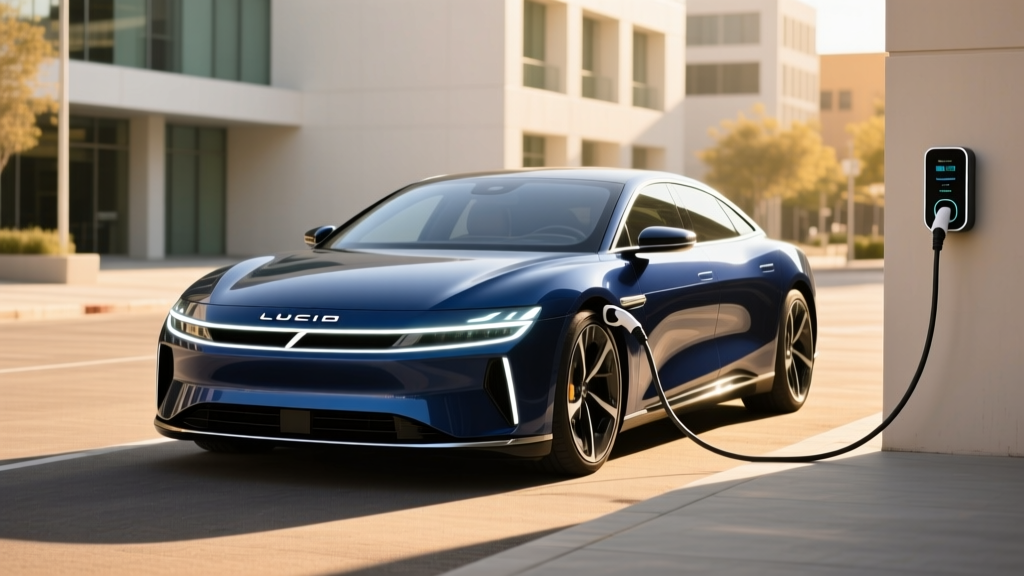
| DC Fast Charge (Touring/GT/Sapphire) | Peak 300 kW | ~200 mi in 12 min | Road trips (Electrify America, etc.) |
| DC Fast Charge (Pure) | Peak 200 kW | ~150 mi in 15 min | Road trips |
The Touring, Grand Touring, and Sapphire trims support up to 300 kW peak DC fast charging on CCS-equipped networks (Electrify America, EVgo, and others via adapter). Under ideal conditions — battery preconditioned to optimal temperature, starting at a low state of charge — the Air can add roughly 200 miles in about 12 minutes on a 350 kW-capable station.
However, the charging curve matters more than peak kW. Like all EVs, the Air's charge rate tapers significantly above 80% state of charge to protect battery health. A 10-80% session takes approximately 15 minutes on Touring and Grand Touring trims. The final 20% (80-100%) can add another 20-25 minutes. For road-trip planning, plan your stops around the 10-80% window and skip topping off unless you're at your final destination.
At home, the Touring and above trims accept up to 19.2 kW on Level 2 — that requires a hardwired 80-amp circuit or a high-amperage wall connector. Most residential installations use a 60-amp circuit delivering 48 amps (11.5 kW), which still replenishes the Grand Touring's 112 kWh pack from empty in roughly 10-11 hours. The Air Pure, limited to 11.5 kW onboard, fills its smaller 88 kWh pack in about 8 hours on that same circuit.
Connector note: The 2026 Air ships with a CCS1 port. Lucid provides a NACS adapter for access to Tesla Supercharger stations (now open to non-Tesla vehicles). Plan for adapter management on road trips — it's one extra piece of gear, but Supercharger network reliability remains superior to most CCS-only stations in rural corridors.
Performance, Interior, and Technology
Even the base Air Pure delivers 430 horsepower and a 5.0-second 0-60 mph time — figures that would have defined a sports sedan a decade ago. The Grand Touring's 1,050 hp and 3.0-second sprint place it firmly in supercar territory, while the Sapphire's 1,234 hp and sub-2-second 0-60 make it one of the quickest production cars ever built.
All trims feature Lucid's custom-designed permanent-magnet motors with proprietary stator winding technology. The motors are physically smaller than competitors' units, freeing up cabin and cargo space. The result is a full-size luxury sedan with a spacious rear seat (36.6 inches of legroom) and a combined 32 cubic feet of cargo volume between the rear trunk and front trunk (frunk).
Interior and Tech: The cabin centers on a 34-inch curved glass "cockpit display" spanning the driver's field of view, supplemented by a lower touchscreen for climate and secondary controls. The interface is visually stunning but has drawn criticism for burying some functions behind too many taps. Wireless Apple CarPlay and Android Auto are standard. A 21-speaker Surreal Sound Pro audio system (Touring and above) delivers immersive spatial audio.
Driver Assistance: Lucid's DreamDrive Pro system uses 32 sensors including lidar, radar, and cameras to provide adaptive cruise control, lane centering, automatic emergency braking, and blind-spot monitoring. This is an SAE Level 2 driver-assistance system — meaning the driver must remain fully engaged with hands on or near the wheel and eyes on the road at all times. It is not autonomous driving. The system is competent for highway cruising but does not offer hands-free operation like GM's Super Cruise or Ford's BlueCruise on mapped highways.
Pricing, Tax Credits, and Total Cost of Ownership
| Trim | MSRP | §30D Federal Credit | Effective Price | Eligibility Notes |
|---|---|---|---|---|
| Air Pure | $69,900 | Up to $7,500 | ~$62,400 | MSRP under $55K sedan cap? NO — exceeds cap. Credit likely unavailable.* |
| Air Touring | $87,400 | $0 | $87,400 | Exceeds $55K sedan MSRP cap |
| Air Grand Touring | $125,650 | $0 | $125,650 | Exceeds $55K sedan MSRP cap |
| Air Sapphire | $249,000 | $0 | $249,000 | Exceeds $55K sedan MSRP cap |
*Critical tax credit note: Under IRS §30D rules, the federal EV tax credit for sedans is capped at vehicles with an MSRP of $55,000 or less. Every Lucid Air trim exceeds this threshold, meaning no Air currently qualifies for the $7,500 new-vehicle federal tax credit, regardless of buyer income or battery sourcing. This is a significant disadvantage against competitors priced below the cap (e.g., Tesla Model 3, Hyundai Ioniq 6). Always verify current rules at irs.gov, as legislation can change MSRP caps.
Additionally, the §30D credit has buyer income limits ($150K single / $300K joint for 2026) and strict battery component and critical mineral sourcing requirements. Even if Lucid introduced a sub-$55K trim, battery sourcing compliance would need separate verification.
Warranty: Lucid covers the Air with a 4-year/50,000-mile basic warranty and an 8-year/100,000-mile battery and powertrain warranty, with a capacity retention threshold of 70% during the warranty period. This matches industry norms (Tesla, BMW) but falls short of Hyundai's 10-year/100,000-mile powertrain coverage.
Addressing the Financial Risk: Should You Buy From Lucid?
Let's directly address the reason many readers searched for this article. Lucid Motors has posted cumulative losses exceeding $7 billion since its founding. The company's cash burn has required repeated capital injections — including significant investment from Saudi Arabia's Public Investment Fund (PIF), which holds a roughly 60% stake. Production volumes have consistently trailed projections, and the planned Gravity SUV launch has faced delays.
What this means for buyers:
- Service network: Lucid operates roughly 20 service centers and a growing mobile service fleet nationwide as of early 2026. Coverage is concentrated in coastal metro areas. Rural owners may face long tow distances for major repairs.
- Parts availability: Lucid designs many proprietary components (motors, battery modules, glass roof). If production halts or the company restructures, aftermarket parts supply could be constrained for years.
- Software updates: Lucid's OTA (over-the-air) update cadence has been slower than Tesla's, with some promised features delayed. A financially strained company may deprioritize software R&D.
- Resale value: Uncertainty depresses used values. Early Lucid Air models have seen steeper depreciation than comparable Tesla Model S or Porsche Taycan listings, per used-market data.
- PIF backing as a buffer: The Saudi sovereign wealth fund's deep pockets make outright bankruptcy less likely in the near term. PIF has strategic reasons (Saudi EV manufacturing ambitions, the Ceer Motors joint venture) to keep Lucid operational. This is not a guarantee, but it is a meaningful backstop.
Lucid Air vs. Key Competitors: Which Luxury EV Sedan Wins?
| Attribute | Lucid Air GT | Tesla Model S LR | Mercedes EQS 580 | BMW i7 xDrive50 |
|---|---|---|---|---|
| Price | $125,650 | $79,990 | $125,950 | $119,300 |
| EPA Range | 516 mi | 402 mi | 371 mi | 318 mi |
| Efficiency (kWh/100mi) | 26 | 28 | 34 | 35 |
| 0-60 mph | 3.0 sec | 3.1 sec | 4.1 sec | 4.5 sec |
| Max DC Charge kW | 300 kW | 250 kW | 200 kW | 195 kW |
| 10-80% DC Time | ~15 min | ~18 min | ~22 min | ~24 min |
| Supercharger / Network | NACS adapter | Native NACS | CCS + adapter | CCS + adapter |
| Service Network Size | ~20 centers | 200+ centers | 350+ dealers | 350+ dealers |
| Brand Financial Risk | HIGH | LOW | VERY LOW | VERY LOW |
- Class-leading 516-mile EPA range (Grand Touring)
- Best-in-class efficiency (kWh per mile)
- Fastest DC charging in the luxury sedan segment (300 kW peak)
- Spacious interior with excellent rear legroom and 32 cu ft cargo
- Stunning design and glass canopy roof
- Supercar-level performance in GT and Sapphire trims
- No federal tax credit eligibility (all trims over $55K MSRP cap)
- Company financial instability poses long-term ownership risk
- Limited service center footprint outside major metros
- Driver-assist (DreamDrive Pro) lags Tesla Autopilot and GM Super Cruise in capability
- Infotainment learning curve — some functions buried in menus
- Steeper depreciation than legacy luxury competitors
Who Should Buy the Lucid Air — And Who Shouldn't?
- Maximum range is your top priority and you regularly drive 300+ miles between charges
- You live near a Lucid service center or in a major metro (LA, SF, NYC, Miami, Houston)
- You value efficiency and charging speed over brand heritage and dealer networks
- You're leasing (which transfers long-term residual risk to the lessor)
- You want a luxury sedan that stands apart from the ubiquitous Tesla fleet
- You live in a rural area far from Lucid service and need dealer-level support
- You want the strongest possible resale value and brand stability
- Federal tax credit eligibility matters to your purchase math
- You want best-in-class autonomous driving features (Tesla FSD, GM Super Cruise)
- You prefer a traditional dealership experience with loaner cars and walk-in service
Frequently Asked Questions
What is the real-world range of the Lucid Air?
The Grand Touring's EPA rating is 516 miles. In real-world highway driving at 70-75 mph, expect 410-440 miles. In cold weather (below 32°F), expect 340-380 miles. The Air Pure delivers a real-world 330-360 miles on the highway from its 419-mile EPA rating.
How fast does the Lucid Air charge at home and on the road?
At home on Level 2 (240V, 48A), the Air Touring and above charge at up to 19.2 kW, adding roughly 77 miles per hour. On DC fast chargers, Touring/GT/Sapphire trims peak at 300 kW, achieving a 10-80% charge in approximately 15 minutes. The Air Pure peaks at 200 kW DC and 11.5 kW Level 2.
Does the Lucid Air qualify for the federal EV tax credit?
No. Under current IRS §30D rules, the new-vehicle EV tax credit is capped at sedans with an MSRP of $55,000 or less. Every Lucid Air trim starts above $69,000, making none eligible regardless of buyer income or battery sourcing. Verify current rules at irs.gov.
Is buying a Lucid Air risky given the company's financial troubles?
There is genuine risk. Lucid's cash burn, low production volumes, and limited service network are legitimate concerns for long-term ownership. However, the Saudi PIF's majority stake provides a significant financial backstop. Leasing rather than buying can mitigate depreciation and residual-value risk. If you buy, prioritize proximity to a service center and consider an extended warranty.
How does the Lucid Air compare to the Tesla Model S?
The Air Grand Touring beats the Model S Long Range on range (516 vs. 402 mi), efficiency (26 vs. 28 kWh/100mi), and DC charging speed (300 vs. 250 kW). The Model S wins on service infrastructure (200+ centers vs. ~20), native Supercharger access, Autopilot/FSD capability, and resale value. Price-wise, the Model S LR is also significantly cheaper at ~$79,990.
What is the Lucid Air's battery warranty?
Lucid covers the battery and powertrain for 8 years or 100,000 miles, whichever comes first, with a capacity retention guarantee of at least 70% during the warranty period. This is standard for the luxury EV segment.