The Short Answer: Does Rivian Have CarPlay?
No. As of the 2026 model year, neither the Rivian R1S (three-row SUV) nor the Rivian R1T (pickup truck) supports Apple CarPlay or Android Auto — wired or wireless. Rivian builds its entire infotainment stack in-house on a custom Linux-based operating system, and the company has consistently declined to cede its screen real estate to phone-mirroring protocols.
That decision is one of the most polarizing aspects of Rivian ownership. Fans argue the native UI is cleaner and more deeply integrated with vehicle systems (range prediction, camp kitchen controls, Gear Tunnel access, driver profiles). Critics counter that Apple Maps, Spotify, and Waze integration is non-negotiable for daily driving. If CarPlay is a hard requirement for your next EV purchase, Rivian is off the table — and you should look at the Ford F-150 Lightning, Chevrolet Silverado EV, or Hyundai Ioniq 5 instead.
But infotainment is only one variable. Below, we break down everything else that matters: real-world range, charging speed, battery chemistry, tax credit math, and whether the R1S/R1T platform is worth the premium in 2026.
2026 Rivian R1S and R1T: Core Specifications
| Spec | R1S Dual-Motor Standard | R1S Tri-Motor Max | R1T Dual-Motor Standard | R1T Tri-Motor Max |
|---|---|---|---|---|
| EPA Range | ~270 mi | ~410 mi | ~270 mi | ~420 mi |
| Battery (usable, est.) | ~92 kWh (LFP) | ~141 kWh (NMC) | ~92 kWh (LFP) | ~141 kWh (NMC) |
| Horsepower | 533 hp | 850 hp | 533 hp | 850 hp |
| 0-60 mph | ~4.5 sec | ~2.9 sec | ~4.5 sec | ~2.9 sec |
| Drivetrain | AWD (dual-motor) | AWD (tri-motor) | AWD (dual-motor) | AWD (tri-motor) |
| Max DC Fast Charge | ~200 kW | ~220 kW | ~200 kW | ~220 kW |
| 10-80% DC Time | ~28 min | ~42 min | ~28 min | ~42 min |
| Level 2 Home Charge | 11.5 kW (~25 mi/hr) | 11.5 kW (~25 mi/hr) | 11.5 kW (~25 mi/hr) | 11.5 kW (~25 mi/hr) |
| Efficiency (MPGe) | ~73 MPGe | ~70 MPGe | ~73 MPGe | ~70 MPGe |
| Base MSRP | $79,900 | $105,900 | $71,700 | $99,700 |
Source: fueleconomy.gov and Rivian spec sheets. Figures reflect 2025-2026 Gen 2 platform updates. Verify exact trims at purchase.
Real-World Range: What the EPA Sticker Doesn't Tell You
Rivian's range estimator in the native navigation system is among the best in the industry — it factors elevation, temperature, speed, and HVAC load dynamically. This is one reason Rivian resists CarPlay: Apple Maps has no access to Rivian's thermal-management telemetry, so its range predictions would be less accurate than the native system.
Efficiency hovers around 46-48 kWh per 100 miles for the dual-motor trims, which is respectable for a 6,000+ lb adventure vehicle but trails the Tesla Model X (~38 kWh/100mi) and Hyundai Ioniq 5 (~30 kWh/100mi). If efficiency-per-mile is your top priority, Rivian is not the optimal pick. If you need ground clearance, wading depth, and a Gear Tunnel, it is.
Charging Speed and Network Access
Rivian's Gen 2 platform (introduced for 2025) upgraded the electrical architecture to support faster DC charging and added native NACS (Tesla Supercharger) compatibility without an adapter on newer builds. Earlier Gen 1 vehicles require a CCS-to-NACS adapter for Supercharger access.
| Charging Level | Power | Miles Added per Hour | Notes |
|---|---|---|---|
| Level 1 (120V) | ~1.4 kW | ~3-4 mi/hr | Emergency/trickle only |
| Level 2 (240V, 48A) | 11.5 kW | ~25 mi/hr | Full charge overnight (~10-12 hrs for Max) |
| DC Fast (peak) | 200-220 kW | ~500+ mi/hr (at peak) | 10-80% in 28-42 min; tapers hard above 80% |
The charge curve matters. Rivian's Max pack sustains ~180-200 kW through roughly 40% SoC, then steps down. Don't expect the peak number to hold. For road-trip planning, budget ~30 minutes per stop on the Standard pack and ~45 minutes on the Max pack (10-80%). Charging from 80-100% adds another 25+ minutes and is rarely worth the wait unless you're parked overnight at a destination charger.
The Rivian Adventure Network — the company's own DC fast-charging corridor near national parks and adventure destinations — remains a differentiator for the overlanding use case, though coverage is far smaller than Tesla's Supercharger network or Electrify America.
Infotainment Without CarPlay: What You Get Instead
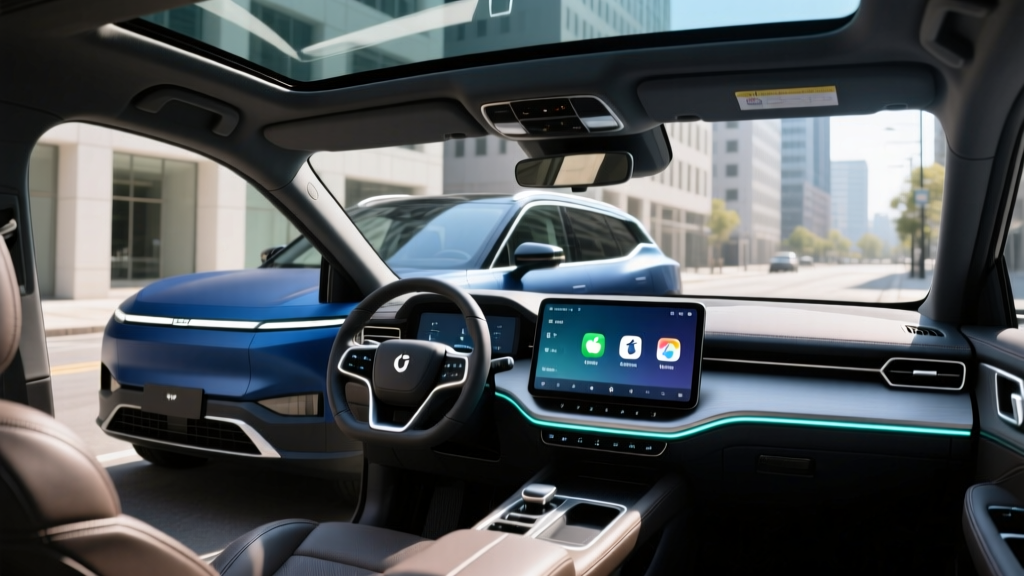
Rivian's 15.6-inch center touchscreen runs a custom OS with native navigation (powered by Mapbox), streaming media (Spotify, Apple Music, TuneIn), and over-the-air updates that add features quarterly. The UI is responsive, the graphics are crisp, and the system integrates deeply with vehicle controls — you can adjust suspension height, drive modes, regen strength, and camp kitchen settings from the same interface.
What you lose without CarPlay:
- Apple Maps: Rivian's native nav is good but lacks Apple Maps' Look Around and some POI depth.
- Siri voice control: Rivian uses its own voice assistant; it handles vehicle commands well but doesn't control your phone's messages or calendar.
- Third-party apps: No Waze, no WhatsApp audio playback, no seamless podcast app handoff from phone to truck.
- Familiarity: If you've spent a decade in CarPlay, the Rivian OS has a ~2-week learning curve.
Rivian's position is that phone-mirroring creates a fragmented experience and slows OTA innovation. Whether that's a valid engineering trade-off or corporate stubbornness depends on your priorities.
Pricing, Trims, and Federal Tax Credit Eligibility
| Model / Trim | Base MSRP | As-Tested (typical) | §30D Credit Eligible? |
|---|---|---|---|
| R1T Dual-Motor Standard | $71,700 | $76,000-$82,000 | Partial — see rules below |
| R1T Tri-Motor Max | $99,700 | $105,000-$115,000 | No — exceeds $80,000 MSRP cap |
| R1S Dual-Motor Standard | $79,900 | $84,000-$90,000 | Yes — SUV cap is $80,000 |
| R1S Tri-Motor Max | $105,900 | $112,000-$125,000 | No — exceeds $80,000 MSRP cap |
Critical tax credit caveats (per IRS §30D rules):
- MSRP caps: $80,000 for SUVs/pickups/vans; $55,000 for sedans. The R1S Dual-Motor Standard qualifies on MSRP; the R1T Dual-Motor Standard at $71,700 qualifies as a pickup. Tri-Motor Max trims exceed the cap.
- Buyer income caps: AGI ≤ $300,000 (joint), $225,000 (head of household), $150,000 (single).
- Battery sourcing: Critical minerals and battery components must meet escalating domestic-content thresholds each year. Verify current-year compliance with your dealer before purchase.
- Point-of-sale transfer: Eligible buyers can apply the credit as a down-payment reduction at the dealer rather than waiting for tax filing.
Max-pack buyers will not see a federal credit. Budget accordingly — and consult a tax professional. State incentives (Colorado, California, etc.) may apply independently; check your local energy office.
Warranty, Battery Longevity, and Ownership Costs
Rivian provides an 8-year / 175,000-mile battery and drive-unit warranty for the Max (NMC) pack and 8-year / 120,000-mile for the Standard (LFP) pack, retaining at least 70% capacity over the term. The LFP chemistry in the Standard pack offers superior cycle life and is less sensitive to regular 100% charging, making it a pragmatic pick for daily commuters who don't need 400+ miles.
Bumper-to-bumper coverage is 5 years / 60,000 miles. Rivian's mobile service fleet handles many repairs at your home or office, reducing dealership friction — a real ownership advantage over legacy OEMs still building out EV service bays.
Insurance premiums run 15-25% higher than comparable ICE trucks due to repair costs for aluminum body panels and sensor arrays. Get a quote before ordering.
Who the Rivian R1S and R1T Are For
Choose Rivian if: you need genuine off-road capability (8.9" ground clearance, 36" wading), want a three-row EV SUV (R1S) or an EV pickup with a lockable Gear Tunnel (R1T), value OTA-driven feature updates, and accept a proprietary infotainment system without CarPlay.
Look elsewhere if: CarPlay/Android Auto is non-negotiable, you want the lowest possible cost-per-mile of efficiency (Ioniq 5, Tesla Model Y), you need maximum towing at lowest price (F-150 Lightning), or your budget can't absorb a $75K+ vehicle without a tax credit.
Pros and Cons
- Best-in-class adventure/off-road capability for an EV
- 410-mile Max pack range is among the longest available
- Native NACS Supercharger access on Gen 2
- Deep OTA updates add real features post-purchase
- Mobile service reduces dealer dependency
- 8-yr / 175,000-mi Max battery warranty
- No Apple CarPlay or Android Auto
- High MSRP — most trims ineligible for §30D credit
- Efficiency trails unibody EV crossovers
- Insurance costs above segment average
- Third-row R1S space is tight for adults on long trips
- Service center footprint still expanding
Frequently Asked Questions
Can I add CarPlay to a Rivian aftermarket?
Not officially. Third-party CarPlay adapter boxes exist but introduce latency, reliability issues, and may void portions of your infotainment warranty. Rivian has not signaled any plan to add native CarPlay support.
What is the real-world range of the Rivian R1T Max?
EPA rates it at ~420 miles. Real-world highway driving at 70 mph yields ~330-360 miles. Cold weather (below freezing) reduces that to ~270-300 miles. Plan conservatively.
How fast does the R1S charge at home?
On an 11.5 kW Level 2 home charger (48A, 240V), you'll add ~25 miles of range per hour. A full charge of the Max pack takes roughly 12-14 hours from near-empty — overnight is sufficient for daily use.
Does Rivian qualify for the federal EV tax credit?
Only specific trims. The R1S Dual-Motor Standard (MSRP under the $80,000 SUV cap) and R1T Dual-Motor Standard (under the $80,000 pickup cap) can qualify, subject to buyer income limits and battery-sourcing requirements. Tri-Motor Max trims exceed MSRP caps and are ineligible. Always verify on IRS.gov before purchasing.
Is the Rivian R1S a good family SUV vs. the Tesla Model X?
The R1S wins on off-road capability, build quality perception, and adventure-oriented design. The Model X wins on charging speed, Supercharger network density, efficiency, and — yes — CarPlay-equivalent Tesla app integration. The R1S third row is tighter than the Model X. Test both with your family in the seats before deciding.
Will Rivian ever add CarPlay via an OTA update?
Rivian's CEO has publicly stated the company believes its native OS delivers a better, more integrated experience. While never say never, there is no announced roadmap for CarPlay support as of 2026.