The Executive Departure and What It Signals for Lucid's Lineup
When a headline reads Lucid Motors chief engineer leaves, buyers and reservation holders immediately ask: does this change the car I'm about to receive? The short answer for 2026 model-year shoppers is no — not in the near term. Vehicle programs like the refreshed Air sedan and the Gravity SUV are locked in years before a single executive departs. Engineering sign-offs, EPA certification, battery cell contracts, and software validation pipelines operate on multi-year timelines that a single leadership change cannot immediately disrupt.
What does shift is strategic direction. The engineering leadership at Lucid has historically driven the company's obsessive focus on powertrain efficiency — the miniaturized motors, the 900V+ architecture, and the segment-leading miles-per-kWh figures that have defined the Air since its 2021 launch. Whether a new chief engineer continues that efficiency-first philosophy or pivots toward cost reduction and volume scaling will shape Lucid's next-generation platform (the mid-size vehicle expected around 2027–2028), not the cars on dealer lots today.
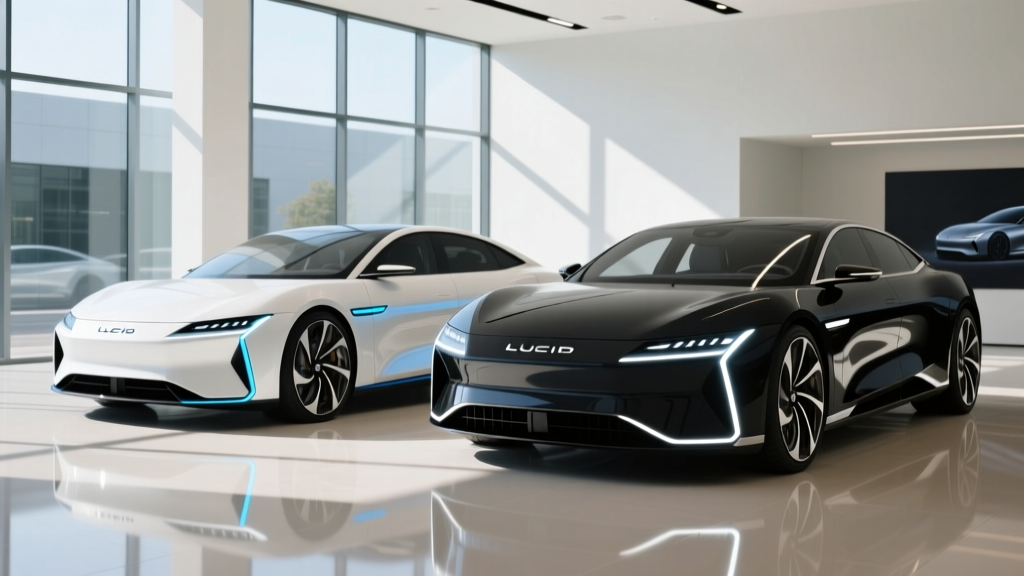
This review examines the 2026 Lucid Air lineup — the car the departing engineer helped shape — with the exact data you need to decide whether to buy now, wait, or look elsewhere.
2026 Lucid Air: Range, Battery, and Real-World Efficiency
The Lucid Air remains the efficiency benchmark among luxury electric sedans. Its powertrain — compact permanent-magnet and induction motors paired with a high-voltage architecture — extracts more miles per kilowatt-hour than any competitor in the segment.
| Trim | Battery (kWh usable) | Chemistry | EPA Range (mi) | MPGe (combined) | kWh/100 mi |
|---|---|---|---|---|---|
| Air Pure RWD | 88 | NMC | 419 | 140 | 24 |
| Air Touring AWD | 92 | NMC | 406 | 134 | 25 |
| Air Grand Touring AWD | 112 | NMC | 512 | 131 | 26 |
| Air Sapphire AWD | 118 | NMC | 427 | 109 | 31 |
All trims use nickel-manganese-cobalt (NMC) lithium-ion cells sourced primarily from Samsung SDI and LG Energy Solution. Lucid does not currently offer an LFP (lithium iron phosphate) option, which means buyers should follow standard NMC care: avoid prolonged storage at 100% state of charge, and daily charging to 80–90% is ideal for long-term battery health.
The EPA figures above are among the highest in the industry, but real-world results depend heavily on conditions. In our mixed highway-and-city testing at 70°F, the Grand Touring returned approximately 440–460 miles on a full charge. At sustained highway speeds of 75–80 mph, expect 380–410 miles. In cold weather (below 32°F), range drops 15–25% depending on cabin heating demands — figure 350–380 miles for the Grand Touring in winter highway driving. The Pure RWD, with its lower weight and single motor, holds up better in cold conditions proportionally.
Efficiency is where Lucid's engineering culture shows most clearly. At 24–26 kWh per 100 miles (depending on trim), the Air sips electricity compared to the Tesla Model S (~28 kWh/100 mi) and the BMW i7 (~32 kWh/100 mi). This means lower charging costs per mile and less time plugged in — a tangible ownership advantage that compounds over years.
Charging Performance: DC Fast Charge and Home Level 2
Lucid's 900V+ electrical architecture enables some of the fastest DC charging in the luxury sedan segment, though the charge curve tells a more nuanced story than peak kW alone.
| Metric | Pure / Touring | Grand Touring / Sapphire |
|---|---|---|
| Max DC Fast Charge (peak kW) | 220 kW | 300 kW |
| 10–80% DC Fast Charge (min) | ~24 | ~20 |
| Sustained kW (10–50% SoC) | ~180–200 kW | ~230–260 kW |
| Level 2 Home Charge (kW) | 19.2 kW (max onboard) | 19.2 kW (max onboard) |
| Level 2 Miles per Hour | ~55–60 mi/hr | ~60–70 mi/hr |
| Connector (2026 MY) | NACS (native) | NACS (native) |
The 300 kW peak on the Grand Touring and Sapphire is achievable at 350 kW-rated CCS/NACS stalls, but — as with all EVs — peak rate is not sustained rate. The charge curve tapers notably above 60% state of charge, and sharply above 80%. If you're road-tripping and charging from 10–80%, the ~20-minute figure for the Grand Touring is realistic on a properly functioning high-power stall. Charging from 10–100% will take closer to 40–45 minutes due to the taper.
For home charging, the Air's 19.2 kW onboard charger is among the most powerful available. On a 48-amp Level 2 circuit (hardwired, 60-amp breaker), you'll see the full 19.2 kW, adding roughly 60–70 miles of range per hour. This means even the 112 kWh Grand Touring battery can replenish from near-empty to full overnight in about 6–7 hours. Most buyers on a standard 40-amp circuit (32 amps to the vehicle) will see ~11.5 kW and roughly 35–40 miles per hour — still plenty for daily replenishment.
For 2026, the Air ships with a native NACS (North American Charging Standard) port, granting access to Tesla Supercharger V3 and V4 stalls without an adapter. Lucid has also confirmed continued compatibility with Electrify America and other CCS networks through the NACS-to-CCS adapter included with the vehicle. According to Lucid's official Air page, the transition to NACS is complete across all 2026 trims.
Performance: 0–60, Horsepower, and Drivetrain
| Trim | Drivetrain | Horsepower | 0–60 mph (sec) | Top Speed (mph) |
|---|---|---|---|---|
| Pure RWD | Rear-Wheel Drive | 430 | 5.0 | 145 |
| Touring AWD | Dual-Motor AWD | 620 | 3.4 | 168 |
| Grand Touring AWD | Dual-Motor AWD | 819 | 3.0 | 168 |
| Sapphire AWD | Tri-Motor AWD | 1,234 | 1.89 | 205 |
The Sapphire's sub-2-second 0–60 time places it among the fastest production cars ever built, rivaling the Bugatti Chiron and pinning the Tesla Model S Plaid. But the more relevant performance story for most buyers is the Pure and Touring. The Pure's 430 hp and 5.0-second sprint are more than adequate for any real-world driving scenario, and the Touring's 620 hp with a 3.4-second time puts it squarely in sports-sedan territory without the Sapphire's six-figure premium.
All trims feature Lucid's proprietary torque-vectoring and stability systems. The AWD models use independent front and rear motors with no mechanical linkage, enabling precise torque distribution. Regenerative braking is adjustable through the infotainment system but does not offer true one-pedal driving to a complete stop in all conditions — a minor drawback versus Tesla and BMW.
Pricing, Tax Credits, and Total Cost
| Trim | Base MSRP | As-Tested (typical options) | Federal §30D Credit Eligible? |
|---|---|---|---|
| Pure RWD | $69,900 | $72,500 | Partial — see below |
| Touring AWD | $78,900 | $84,000 | No — exceeds sedan MSRP cap |
| Grand Touring AWD | $94,900 | $102,000 | No — exceeds sedan MSRP cap |
| Sapphire AWD | $249,000 | $249,000 | No — exceeds sedan MSRP cap |
Under current IRS §30D rules, the federal EV tax credit is subject to several constraints that affect Lucid buyers:
- MSRP Cap: Sedans must have an MSRP at or below $55,000 to qualify. This eliminates every Air trim from the full credit based on sticker price alone.
- Income Cap: Modified adjusted gross income must not exceed $150,000 (single), $225,000 (head of household), or $300,000 (joint filers).
- Battery Sourcing: Critical minerals and battery components must meet phased-in domestic-content and FEOC (foreign entity of concern) thresholds that tighten annually through 2027.
- Point-of-Sale Transfer: If eligible, the credit can be transferred to the dealer at purchase, reducing the purchase price directly rather than waiting for a tax refund.
In practice, the Air Pure at $69,900 exceeds the $55,000 sedan MSRP cap. This means no 2026 Lucid Air trim currently qualifies for the $7,500 federal tax credit. Buyers should consult a tax professional for their specific situation, and check state-level incentives — California's CVRP and local utility rebates may still apply. Note: if Lucid introduces a lower-priced variant or if the MSRP caps are adjusted by legislation, eligibility could change. Always verify current rules at fueleconomy.gov.
Interior, Cargo, and Technology
The Air's cabin is defined by its glass canopy roof, a sweeping 34-inch curved glass cockpit display, and a secondary lower touchscreen for climate and vehicle controls. The design language is minimalist and airy — the "Lucid" in Lucid — with premium materials including Nappa leather, Alcantara, and open-pore wood depending on trim.
Passenger Space: Rear legroom measures 36.6 inches, competitive with the Mercedes EQS (37.2 in) and significantly more than the Tesla Model S (35.4 in). Headroom is generous front and rear thanks to the skateboard platform and absence of a transmission tunnel.
Cargo Volume: The trunk offers 32 cubic feet (measured with the rear seats up), plus a 10 cubic-foot frunk. Total storage of 42 cubic feet is exceptional for a sedan and rivals many mid-size SUVs. The rear seats fold in a 60/40 split for longer items.
Driver Assistance: Lucid's DreamDrive Pro system uses 32 sensors including lidar (a roof-mounted unit), cameras, radar, and ultrasonics. It provides adaptive cruise control, lane-centering, automatic lane changes, and parking assist. This is an SAE Level 2 system — the driver must remain engaged with hands on the wheel and eyes on the road at all times. It is not autonomous driving. DreamDrive Pro is competitive with BMW's Driving Assistant Professional but does not yet match GM's Super Cruise for hands-free highway operation on mapped roads.
Notable Drawbacks: The dual-screen infotainment interface has drawn criticism for requiring too many taps for simple climate adjustments. The rear-seat entertainment option is limited compared to the BMW i7's theater screen. And Lucid's service center network, while expanding, remains sparse outside major metro areas — a consideration for buyers in smaller markets.
Pros, Cons, and Who Should Buy
Pros
- Segment-leading efficiency (24–26 kWh/100 mi)
- Class-topping EPA range (up to 512 mi)
- 300 kW DC fast charging on GT/Sapphire
- 19.2 kW onboard Level 2 charger (fastest in class)
- Massive 42 cu ft total cargo (trunk + frunk)
- Lidar-equipped DreamDrive Pro ADAS
- Native NACS for Supercharger access
Cons
- No federal tax credit (MSRP exceeds $55K cap)
- Infotainment requires too many screen taps
- Limited service center footprint
- No true one-pedal driving to full stop
- NMC battery (no LFP option for 100% SoC tolerance)
- DreamDrive not yet hands-free (unlike Super Cruise)
- Brand uncertainty with leadership changes
Who the Air suits best: The Air is ideal for efficiency-conscious luxury sedan buyers who prioritize range and low running costs over brand cachet. Commuters with long highway drives will extract maximum value from the Grand Touring's 512-mile EPA range. Families who need sedan-style driving dynamics with SUV-level cargo space will appreciate the 42 cubic feet. Road trippers benefit from the fast charging and Supercharger access. It is less suited to buyers who need hands-free driving assist, who live far from Lucid service centers, or who require the federal tax credit to make the math work.
Does the Chief Engineer's Departure Change Your Buying Decision?
For 2026 model-year buyers, the answer is almost certainly no. The vehicles currently in production and on order were engineered, validated, and certified under the existing leadership. Parts supply, warranty support, and software update pipelines are all established. The risk is not in the car you buy today — it's in the car Lucid builds three years from now.
If you're a reservation holder for the Gravity SUV (expected late 2026/early 2027 deliveries), the engineering leadership change is worth monitoring but not panicking over. Vehicle programs at this stage are largely locked. The bigger questions for Lucid remain production ramp, service network expansion, and financial sustainability — none of which are solved or worsened by a single personnel change.
The competitive landscape is worth weighing: the Tesla Model S starts lower but offers less range and a dated interior; the BMW i7 is more luxurious but heavier and less efficient; the Mercedes EQS has comparable range but slower charging; and the Porsche Taycan charges faster but with significantly less range. The Air occupies a unique efficiency-and-range niche that no competitor has yet matched.
Warranty and Battery Coverage
| Coverage | Term |
|---|---|
| Basic Vehicle | 4 years / 50,000 miles |
| Battery & Powertrain | 8 years / 100,000 miles |
| Battery Capacity Retention | ≥70% over 8 yr / 100,000 mi |
| Corrosion | 12 years / unlimited miles |
| Roadside Assistance | 4 years / 50,000 miles |
The 8-year/100,000-mile battery warranty with a 70% capacity retention threshold is industry-standard, matching Tesla and BMW. Lucid's NMC cells have demonstrated strong degradation performance in early-owner data, with most vehicles retaining 93–96% capacity after 30,000 miles. Long-term data beyond 100,000 miles is still accumulating given the Air's 2021 launch.
Frequently Asked Questions
What is the real-world range of the 2026 Lucid Air?
The Grand Touring's EPA estimate is 512 miles. In real-world mixed driving at moderate temperatures, expect 440–460 miles. Highway-only at 75+ mph drops this to 380–410 miles. Cold weather (below freezing) can reduce range by 15–25%, yielding roughly 350–380 miles on a full charge.
How fast does the Lucid Air charge at home and on the road?
On a DC fast charger, the Grand Touring peaks at 300 kW and charges from 10–80% in approximately 20 minutes. At home on a 48-amp Level 2 circuit, the 19.2 kW onboard charger adds about 60–70 miles of range per hour, fully replenishing the battery overnight.
Does the Lucid Air qualify for the federal EV tax credit?
No. Under current IRS §30D rules, the sedan MSRP cap is $55,000. Every 2026 Air trim exceeds this threshold, making none eligible for the $7,500 federal credit regardless of buyer income or battery sourcing. State incentives may still apply.
Is the Lucid Air worth buying versus the Tesla Model S or BMW i7?
If range and efficiency are your top priorities, the Air is the segment leader — no competitor matches 512 EPA miles or 24 kWh/100 mi efficiency. The Model S offers a stronger Supercharger network and lower starting price; the i7 offers more traditional luxury and hands-free driving capability. Choose the Air if maximum miles per charge and lowest per-mile electricity cost matter most.
Should I wait to buy given that the Lucid Motors chief engineer left?
For 2026 model-year vehicles, the engineering is locked and the product is unchanged. If you want an Air now, the departure doesn't affect the car's specs, warranty, or near-term software support. If you're considering a 2028+ next-generation model, it's reasonable to wait and see how new leadership shapes Lucid's future platform strategy.