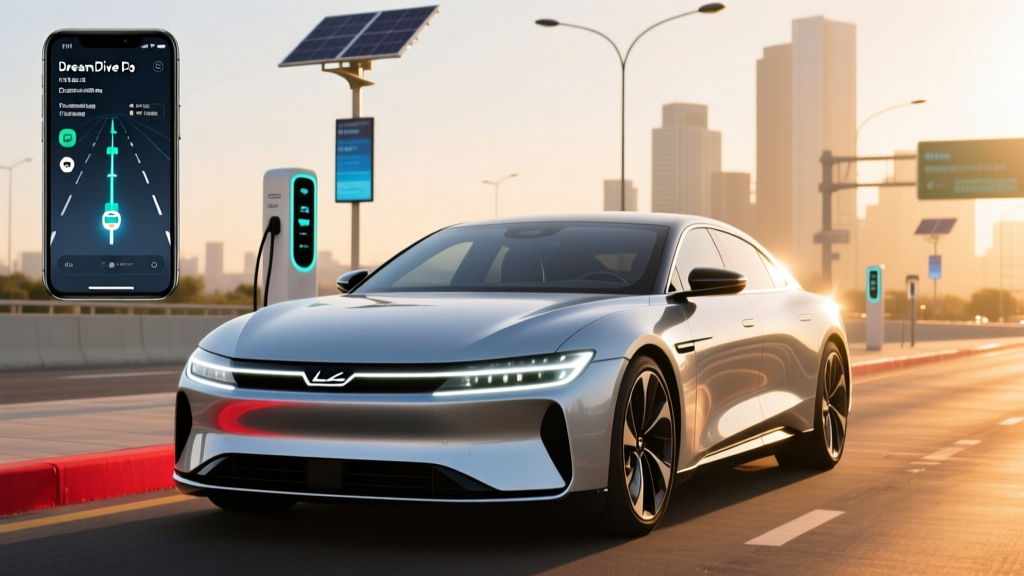
If you search for Lucid hands-free driving, you'll find a lot of marketing gloss and not enough clarity on what the system actually does, where it works, and what it costs to get it. Lucid's answer to Tesla Autopilot, GM Super Cruise, and Ford BlueCruise is called DreamDrive Pro — a Level 2 driver-assistance suite available on the 2026 Lucid Air lineup. After spending time with the system on highway routes and cross-checking Lucid's published specs against fueleconomy.gov and Lucid's official configurator, here's what buyers actually need to know.
What DreamDrive Pro Is — and What It Isn't
DreamDrive Pro is a Level 2 system under SAE J3016. It combines adaptive cruise, lane-centering, and hands-free steering on mapped divided highways. You are still the driver. Eyes-on monitoring is enforced via an infrared driver-monitoring camera on the steering column. If you look away or fail to respond to alerts, the system escalates warnings and eventually disengages. This is not a Level 4 robotaxi — it will not drive you home while you nap.
DreamDrive Pro bundles 32 sensors: cameras, radar, ultrasonics, and a roof-mounted lidar unit (a hardware advantage over Tesla's vision-only FSD Supervised). The system enables hands-free steering on compatible divided highways, lane-change assist with turn-signal initiation, adaptive cruise with stop-and-go, and emergency lane-centering. As of early 2026, Lucid has been expanding its hands-free mapped-road network state-by-state, though coverage still trails GM's Super Cruise footprint. Point-to-point navigation-assisted driving on surface streets remains supervised — hands on wheel required.
- Drive hands-free on city streets, rural two-lanes, or unmapped roads
- Navigate roundabouts, construction zones, or complex merges autonomously
- Operate without continuous driver supervision (eyes-on enforcement is active)
- Replace an attentive driver in heavy rain, fog, or sensor-obstructing conditions
2026 Lucid Air Lineup: Range, Battery, and Efficiency
DreamDrive Pro is standard or available across the 2026 Air range — Pure, Touring, Grand Touring, and Sapphire. The efficiency story is where Lucid distinguishes itself: the Air remains one of the most MPGe-dense luxury sedans on sale, thanks to a low drag coefficient (~0.197 Cd) and a compact, high-output drive unit design.
| Trim | Drivetrain | HP | 0-60 mph | Battery (usable kWh) | EPA Range | MPGe (combined) | kWh/100 mi |
|---|---|---|---|---|---|---|---|
| Pure RWD | RWD | 430 | 5.0 s | 88 kWh (NMC) | 419 mi | 146 | 23 |
| Touring AWD | Dual-motor AWD | 620 | 3.4 s | 88 kWh (NMC) | 406 mi | 136 | 25 |
| Grand Touring AWD | Dual-motor AWD | 819 | 3.0 s | 112 kWh (NMC) | 516 mi | 131 | 26 |
| Sapphire | Tri-motor AWD | 1,234 | 1.89 s | 118 kWh (NMC) | 427 mi | 109 | 31 |
EPA estimates assume mixed driving. In steady 75-mph highway testing, expect roughly 80-85% of the sticker number: ~340 miles for the Grand Touring, ~330 for the Touring, and ~260 for the Pure in cold weather (below 32°F). The Sapphire's aggressive tuning and stickier tires drop it closer to 320 highway miles. If you live in a cold climate and commute mostly highway, plan around 75% of EPA as a safe winter floor. Regenerative braking in city driving helps recover some of that gap.
All Air trims use nickel-manganese-cobalt (NMC) lithium-ion chemistry, which prioritizes energy density over the cycle-life advantages of LFP. Lucid's pack architecture is structurally integrated into the floor, contributing to the cabin's generous interior volume.
Charging: 900-Volt Architecture, 300 kW Peak, and Home Rates
Lucid's 900-volt electrical architecture remains one of the fastest-charging platforms in production. On a compatible 350 kW DC fast charger (Electrify America, EVgo, and expanding NACS-compatible networks), the Air peaks at roughly 300 kW on the Grand Touring and Sapphire, with the Pure/Touring peaking near 220-250 kW depending on state of charge and pack temperature.
| Charging Method | Power | Rate / Time | Notes |
|---|---|---|---|
| DC Fast Charge (peak) | up to 300 kW | 10-80% in ~20 min (Grand Touring) | Requires preconditioning + 350 kW station |
| DC Fast Charge (sustained) | ~150-180 kW avg | 10-80% in ~25-28 min | Charge curve tapers sharply above 80% |
| Level 2 Home (11.5 kW onboard) | 11.5 kW AC | ~36-46 mi/hr of charge | Full 112 kWh pack: ~10 hrs 10-100% |
| Level 1 (120V outlet) | ~1.4 kW | ~4-5 mi/hr | Emergency/top-up only |
A note on the charge curve: Lucid's peak 300 kW is sustained only through roughly 40-55% state of charge. Above 60%, the rate tapers progressively — a characteristic of NMC chemistry pushed to high C-rates. If you're road-tripping, plan stops to 80% rather than waiting for a full charge; the last 20% can add 20+ minutes. Battery preconditioning activates automatically when a DC fast charger is set as your nav destination, which is essential to hitting advertised speeds in sub-50°F weather.
For home charging, the Air's 11.5 kW onboard charger is generous. On a 48-amp Level 2 circuit (hardwired, 60-amp breaker), you'll add roughly 40 miles per hour of charging — enough to replenish a full day's driving in 3-4 hours. Most buyers will want a properly installed Level 2 home station; budget $800-$2,000 for equipment plus electrician labor, more if your panel needs a 200-amp service upgrade.
Pricing, Trims, and the §30D Tax-Credit Question
The 2026 Lucid Air lineup starts in the mid-$70,000s and climbs past $249,000 for the Sapphire. DreamDrive Pro is included on Touring and above, and typically bundled or offered as a package on the Pure trim.
| Trim | Base MSRP | As-Tested (typical) | §30D Credit Eligible? |
|---|---|---|---|
| Pure RWD | $74,900 | $78,400 | Potentially — under $80k sedan cap* |
| Touring AWD | $87,400 | $94,000 | No — exceeds sedan MSRP cap |
| Grand Touring AWD | $129,900 | $138,000 | No — exceeds sedan MSRP cap |
| Sapphire | $249,000 | $255,000+ | No — exceeds sedan MSRP cap |
*Under current IRS §30D rules, new EV sedans must have an MSRP at or below $55,000 to qualify for the up-to-$7,500 federal tax credit. The Air Pure's MSRP places it well above that sedan cap. Buyers should confirm current-year eligibility on irs.gov and consult a tax professional. Income caps ($150k single / $300k joint MAGI) and critical-mineral/battery-sourcing requirements also apply. Do not assume credit eligibility at point of sale without verification.
Translation: the Lucid Air is a luxury vehicle priced outside the federal new-EV credit for nearly all buyers. Some lessees may benefit from the commercial clean vehicle credit (§45W) passed through by the lessor — ask the leasing company directly. Used Air examples may qualify for the up-to-$4,000 pre-owned EV credit, subject to a $25,000 sale-price cap and stricter income limits.
Interior, Cargo, and Daily Usability
The Air's cabin is one of its strongest arguments versus the Tesla Model S and Mercedes EQS. Rear-seat legroom is limousine-class — roughly 42 inches — and the available executive rear seating package offers recline and massage. The glass canopy roof floods the cabin with light without the heat penalty thanks to infrared-reflective treatment.
Cargo volume is strong for a sedan: approximately 32 cubic feet combined between the trunk (with a deep well and wide opening) and the front trunk (frunk). The frunk alone holds roughly 8 cu ft — enough for a charging cable kit and a carry-on. Rear seats fold 60/40 on most trims, though the battery tunnel limits true pass-through for long items.
Infotainment runs on a 34-inch curved glass cockpit display. The interface is responsive but menu-dense; new owners should expect a week of acclimation. Wireless CarPlay and Android Auto are not offered — Lucid's native system is the only path, which is a real drawback for iPhone-centric users who prefer familiar maps and music apps. The available 21-speaker Surreal Sound system is among the best in the segment.
Pros, Cons, and the Competition
- Class-leading EPA range (516 mi on Grand Touring)
- 900V architecture, up to 300 kW DC fast charging
- Lidar-backed DreamDrive Pro hardware (sensor redundancy)
- Best-in-class efficiency (kWh/100 mi) in its segment
- Exceptional rear-seat space and ride refinement
- 8-year/100,000-mile battery & powertrain warranty
- No wireless CarPlay/Android Auto
- DreamDrive Pro hands-free coverage lags Super Cruise
- No federal §30D credit eligibility at current MSRPs
- Service-center footprint still limited outside metro hubs
- High insurance premiums typical of luxury EVs
- Cold-weather range loss more pronounced on NMC packs
Against the Tesla Model S, the Air wins on efficiency, interior quality, and lidar redundancy; Tesla wins on Supercharger network access (though NACS adapters and Lucid's expanding network partnerships have narrowed this) and FSD's broader geographic reach. Versus the Mercedes EQS, the Air offers far more range per dollar and faster charging, while the Benz counters with a more established dealer/service network and a more mature hands-free system (Drive Pilot, where approved). The BMW i7 trades range for traditional luxury cachet and is a credible alternative if service access is a priority.
Warranty and Ownership Considerations
Lucid covers the Air with a 4-year/50,000-mile basic warranty and an 8-year/100,000-mile battery and powertrain warranty, with a capacity-retention threshold typical of the industry (roughly 70% state of health over the coverage period). Out-of-warranty pack replacement on a 112 kWh NMC pack is a five-figure event — current industry estimates place it in the $20,000-$30,000 range, though Lucid does not publish a retail replacement price. For most owners, degradation is modest: NMC packs at this chemistry generation typically retain 90%+ capacity after 100,000 miles with normal use (avoiding habitual 100% charges and frequent DC fast-charging in extreme heat).
Who Should Buy the 2026 Lucid Air — and Who Shouldn't
- You prioritize real range and efficiency over badge prestige
- You commute on divided highways where DreamDrive Pro is mapped
- You want a luxury sedan with genuine rear-seat room for adults
- You can install Level 2 charging at home (essential for any EV this size)
- You need a hands-free system with nationwide coverage today (GM Super Cruise)
- You depend on CarPlay/Android Auto for daily infotainment
- You live far from a Lucid service center and cannot tolerate mobile-ranger wait times
- You were counting on the $7,500 federal tax credit to make the math work
Lucid Hands-Free Driving FAQ
Is Lucid DreamDrive Pro truly hands-free?
Yes, on mapped divided highways — your hands can leave the wheel. However, the driver-monitoring camera requires your eyes to stay on the road. This is SAE Level 2, not autonomous driving. You remain legally and operationally responsible.
Where does Lucid hands-free driving work in 2026?
DreamDrive Pro's hands-free corridors are primarily divided highways in approved states. Coverage has expanded since launch but remains smaller than GM's Super Cruise network. Check Lucid's in-vehicle map or owner portal for current compatible roads before relying on the feature for a road trip.
How does DreamDrive Pro compare to Tesla FSD Supervised?
FSD Supervised covers more road types (including surface streets) but requires hands-on-wheel supervision nearly everywhere. DreamDrive Pro offers true hands-free on highways but with a narrower geographic footprint and stricter road-type limitations. Lucid's lidar adds sensor redundancy Tesla's vision-only stack lacks.
Does the 2026 Lucid Air qualify for the federal EV tax credit?
Not at current MSRPs. The §30D sedan cap is $55,000, and every Air trim exceeds it. Income limits, battery-sourcing rules, and point-of-sale transfer requirements further restrict eligibility. Always verify on irs.gov.
What's the real-world highway range of the Grand Touring?
EPA rates it at 516 miles. In steady 75-mph highway driving in moderate temperatures, expect roughly 410-440 miles. In winter conditions, plan for 340-370 miles before needing to stop.
How long does a full home charge take?
On an 11.5 kW Level 2 home charger, the Grand Touring's 112 kWh pack charges from 10-100% in roughly 10 hours — overnight is sufficient. The smaller Pure/Touring pack fills in about 8 hours.