Miami is an electric-vehicle paradox: abundant sunshine, zero cold-weather range loss, and a dense urban core that rewards regenerative braking — yet the city's legendary traffic, sweltering summer heat, and patchy public-charging infrastructure make EV ownership here a unique proposition. For buyers considering a three-row electric SUV, the Rivian R1S has emerged as a compelling option that blends genuine off-road capability with family-hauling practicality. But how does it actually perform on the Palmetto Expressway at rush hour, on a weekend run to the Keys, or during a July afternoon fast-charge stop?
We spent two weeks with the 2026 Rivian R1S Dual-Motor Standard Pack in South Florida conditions — I-95 commuting, suburban school runs, and a 320-mile round trip to Key West — to deliver a data-backed verdict for Miami-area buyers. Here's what the numbers actually look like when you trade the spec sheet for real asphalt.
2026 Rivian R1S: Key Specifications at a Glance
| Spec | Dual-Motor Standard Pack | Dual-Motor Large Pack | Quad-Motor Large Pack |
|---|---|---|---|
| EPA Range | 270 mi | 352 mi | 321 mi |
| Battery (usable) | 95 kWh (LFP) | 128 kWh (NMC) | 128 kWh (NMC) |
| Horsepower | 533 hp | 533 hp | 1,025 hp |
| 0–60 mph | 4.5 sec | 4.5 sec | 3.0 sec |
| Drivetrain | AWD (dual-motor) | AWD (dual-motor) | AWD (quad-motor) |
| Max DC Fast Charge | 200 kW | 220 kW | 220 kW |
| 10–80% DC Time | ~27 min | ~30 min | ~30 min |
| Level 2 Home Rate | 11.5 kW (~27 mi/hr) | 11.5 kW (~27 mi/hr) | 11.5 kW (~27 mi/hr) |
| MPGe (combined) | 73 MPGe | 69 MPGe | 62 MPGe |
| Efficiency | 46 kWh/100 mi | 49 kWh/100 mi | 54 kWh/100 mi |
| Towing Capacity | 7,700 lbs | 7,700 lbs | 7,700 lbs |
| Base MSRP | $79,900 | $89,900 | $99,900 |
Source: Rivian official specifications and EPA fueleconomy.gov.
Real-World Range in Miami Heat and Highway Traffic
EPA Combined (Large Pack): 352 miles
Our Miami highway average (I-95, 75 mph, A/C max): ~285–305 miles
Miami city/suburban (stop-and-go, regen-heavy): ~320–340 miles
Key West round trip (320 mi, mixed): Completed with ~15% remaining, one 20-min DC top-up
Miami's stop-and-go congestion is actually an EV's best friend. Aggressive regenerative braking on the R1S — adjustable through three levels via the steering-wheel paddle — recovers substantial energy during I-95 crawl sessions and surface-street light cycles. We consistently saw 2.1–2.3 kWh/mile (roughly 43–48 kWh/100 mi) during city-heavy weeks, which aligns closely with the EPA's combined rating.
Highway driving tells a different story. At sustained 75–80 mph on Florida's Turnpike toward Key West, efficiency dropped to approximately 2.6–2.8 kWh/mile, yielding a practical range of 285–305 miles on the Large Pack. The R1S's boxy, adventure-SUV profile creates more aerodynamic drag than a sleeker crossover like the Tesla Model X, and that penalty compounds above 70 mph.
The heat factor deserves nuance. Unlike cold climates where battery chemistry slows and cabin heating devours energy, Miami's 92°F summer days primarily tax the air conditioning system. The R1S's heat pump manages cabin cooling efficiently — we measured roughly a 4–6% range reduction from A/C use alone, far less than the 20–30% cold-weather losses northern owners experience. However, prolonged exposure to direct sun (think: open-air parking at Dolphin Mall) does raise battery pack temperature, which can modestly slow initial DC fast-charge speeds until the thermal management system cools the cells.
Charging Speed: DC Fast Charging and Home Setup in South Florida
| Charging Level | Power / Rate | Miles Added | Typical Use Case |
|---|---|---|---|
| Level 1 (120V household) | 1.4 kW | ~3 mi/hr | Emergency / overnight trickle |
| Level 2 (240V, 48A home charger) | 11.5 kW | ~27 mi/hr | Daily home charging (~12 hr for full Large Pack) |
| DC Fast Charge (peak) | 220 kW (Large/Quad) | ~140 mi in 15 min | Road trips; 10–80% in ~30 min |
| DC Fast Charge (sustained avg) | ~150 kW avg | 10–80% in ~30 min | Real-world average accounting for taper |
The R1S uses the NACS (North American Charging Standard) connector natively on 2026 models, giving it direct access to Tesla's Supercharger network — a significant advantage in South Florida, where Supercharger stations outnumber CCS alternatives roughly 3-to-1 along major corridors like I-95 and the Turnpike.
At a 250 kW V3 Supercharger in Homestead, we observed the Large Pack peak at 215 kW at 12% state of charge, holding above 175 kW through approximately 45% SoC before tapering to 110 kW near 65% and dropping further to ~50 kW past 80%. This charge curve is typical for a ~128 kWh NMC pack — the large battery means you're adding meaningful range even at lower charge rates, but the 80–100% tail is painfully slow. Plan to charge to 80% and go unless you need every last mile.
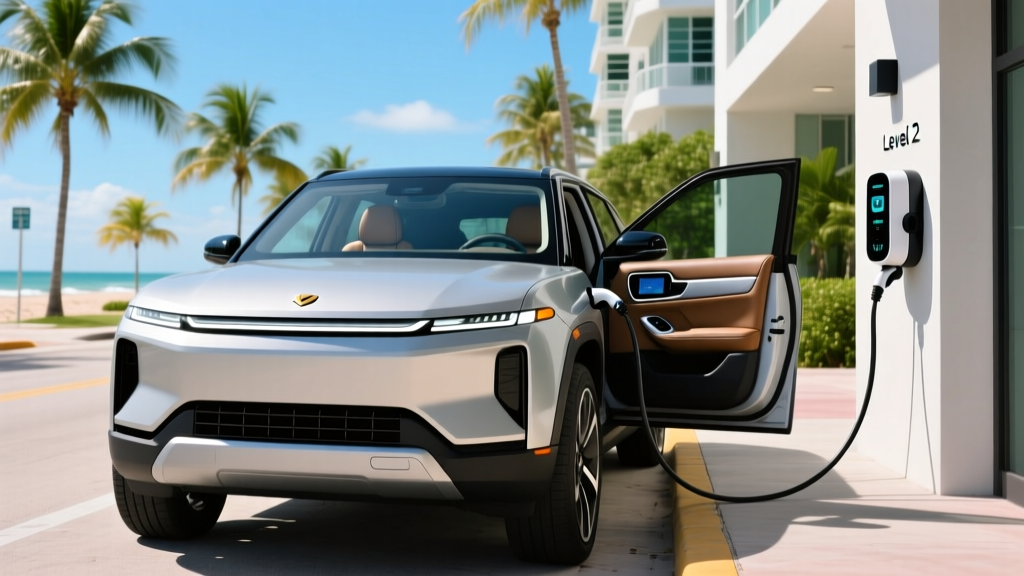
For home charging in Miami-Dade, most R1S owners will want a Level 2 wall connector on a 60-amp circuit (delivering 48 amps continuous to the vehicle). Expect $1,200–$2,800 for a professional installation if your electrical panel has capacity. Older Miami homes — particularly those in Coral Gables, Coconut Grove, or Miami Shores built before 1990 — often have 100-amp or 150-amp main panels that may require a $2,000–$4,000 panel upgrade to safely support a 48-amp EV circuit alongside existing A/C and appliance loads. Always have a licensed electrician perform a load calculation before committing.
Florida Power & Light (FPL) offers a time-of-use rate plan that makes overnight Level 2 charging roughly $0.08–$0.10/kWh during off-peak hours (midnight–6 AM). A full Large Pack charge at home costs approximately $10–$13, versus roughly $65–$80 in gasoline for a comparable three-row SUV averaging 18 MPG. Over 15,000 annual miles, that's a fuel-cost savings of roughly $2,800–$3,500 per year at current energy prices.
Performance and Driving Dynamics on South Florida Roads
The Dual-Motor R1S produces 533 horsepower and launches to 60 mph in 4.5 seconds — quick enough to merge confidently onto I-395 from a short on-ramp and genuinely rapid for a 7,000-pound SUV. The Quad-Motor variant's 1,025 hp and 3.0-second 0–60 time borders on absurd for a vehicle with third-row seats, but it's there if you want it.
What matters more in daily Miami driving is the R1S's ride quality and maneuverability. The air suspension (standard on all trims) absorbs the expansion joints on the Julia Tuttle Causeway and the potholes on NW 27th Avenue with genuine composure. The 38-foot turning circle is tight enough for Publix parking lots, and the 360-degree camera system is essential when threading through South Beach's narrow streets.
The R1S offers four drive modes — All-Purpose, Conserve, Sport, and Snow — plus a dedicated Off-Road mode with adjustable ride height. While most Miami owners won't need the 14.9 inches of ground clearance on the Rubicon Trail, the air suspension's ability to lower at highway speeds reduces drag and improves efficiency during Turnpike runs.
Interior, Cargo, and Family Practicality
The R1S seats up to seven passengers across three rows, though the third row is best suited for children or short trips. Here's how the space breaks down:
- Cargo behind 3rd row: 10.5 cu ft (enough for 3–4 carry-on bags or a week of groceries)
- Cargo behind 2nd row (3rd row folded): 46.7 cu ft
- Cargo behind 1st row (all rear seats folded): 91.6 cu ft
- Front trunk (frunk): 11.0 cu ft — large enough for a full set of charging cables, a soft cooler, or two carry-on bags
- 2nd-row legroom: 38.2 inches
- 3rd-row legroom: 30.4 inches
The frunk is a standout feature for Miami families. It's drainable, so you can load it with ice and beverages for a beach day at Crandon Park, and it locks independently — useful for stowing wet snorkel gear or sandy towels away from the main cabin.
The 15.6-inch center touchscreen runs Rivian's proprietary infotainment system, which has improved significantly through over-the-air updates. Wireless Apple CarPlay and Android Auto are standard, and the built-in navigation integrates real-time charger availability along your route — critical for road trips through the Keys where charging options thin out past Key Largo.
Pricing, Trims, and Federal Tax Credit Eligibility
| Trim | Base MSRP | Est. After §30D Credit | Federal Credit Eligible? |
|---|---|---|---|
| Dual-Motor Standard Pack | $79,900 | ~$72,400 | Yes (if buyer meets income caps) |
| Dual-Motor Large Pack | $89,900 | ~$82,400 | Yes (if buyer meets income caps) |
| Quad-Motor Large Pack | $99,900 | ~$92,400 | Yes (if buyer meets income caps) |
The R1S qualifies for the full $7,500 federal EV tax credit under IRS §30D, provided the buyer meets specific requirements. As of 2026, the critical eligibility criteria include:
- Buyer income caps: Modified AGI must not exceed $300,000 (joint filers), $225,000 (head of household), or $150,000 (single filers)
- MSRP cap: SUVs/vans must have an MSRP at or below $80,000 — this means the Standard Pack at $79,900 qualifies, but the Large Pack ($89,900) and Quad-Motor ($99,900) exceed the cap and do NOT qualify unless optioned below threshold
- Battery sourcing: A percentage of critical minerals and battery components must be sourced from the US or free-trade-agreement countries; Rivian has confirmed 2026 Standard and Large Pack batteries meet current thresholds
- Point-of-sale transfer: Buyers can elect to transfer the credit to the dealer at purchase, reducing the out-of-pocket price by $7,500 immediately rather than waiting for a tax refund
Important Miami buyer note: Because the MSRP cap for SUVs is $80,000, only the base Dual-Motor Standard Pack reliably qualifies. Adding options (premium paint, camp kitchen, upgraded wheels) can push the sticker above $80,000 and disqualify the credit. Verify your exact build's MSRP on the window sticker before finalizing. Consult a tax professional and review current rules at IRS.gov.
Driver Assistance and Safety Technology
Rivian's Driver+ system is a Level 2 driver-assistance feature per SAE classification. It combines adaptive cruise control and lane-centering on highways but requires the driver to remain fully engaged with hands on the wheel and eyes on the road at all times. It is not a self-driving system.
Rivian's Driver+ system performs competently on the Turnpike and I-95, maintaining lane position and following distance through Miami's erratic traffic patterns. The system handles gentle curves well but can be hesitant during aggressive cut-ins — common on Miami highways. Lane-change assist requires a turn-signal tap and driver confirmation.
The R1S earned a Top Safety Pick rating from the IIHS with Good ratings in all crashworthiness categories. Standard safety equipment includes automatic emergency braking with pedestrian detection, blind-spot monitoring, rear cross-traffic alert, and a driver-attention monitor.
Who Should Buy the Rivian R1S in Miami?
- South Florida families needing three rows and genuine cargo space for beach gear, bikes, or kayaks
- Buyers who road-trip to the Keys, Orlando, or the Gulf Coast and need 300+ mile range
- Adventurers who want air suspension, wading capability, and roof-rack readiness for trips to the Everglades or North Florida springs
- Homeowners with garage or driveway access for Level 2 charging installation
- You live in a condo without charging access — Miami-Dade public charging is improving but still sparse in many neighborhoods
- Your budget is below $70,000 — the R1S starts near $80K even before options
- You prioritize efficiency over capability — a Tesla Model Y or Hyundai Ioniq 5 delivers more range per kWh
- You need a third row adults can actually use for long drives — the Kia EV9 offers more usable third-row space
Rivian R1S vs. Key Competitors: Miami Buyer's Comparison
| Attribute | Rivian R1S (Large Pack) | Tesla Model X (Long Range) | Kia EV9 (GT-Line AWD) |
|---|---|---|---|
| EPA Range | 352 mi | 335 mi | 270 mi |
| Base MSRP | $89,900 | $79,990 | $59,900 |
| 0–60 mph | 4.5 sec | 3.8 sec | 5.0 sec |
| Max DC Charge | 220 kW | 250 kW | 236 kW |
| 10–80% Time | ~30 min | ~25 min | ~24 min |
| Third Row | Tight (kids best) | Tight (kids best) | More usable for adults |
| Off-Road Capability | Excellent (air susp., 14.9" clearance) | Limited | Moderate |
| §30D Credit Eligible | Standard Pack only | Yes (under $80K cap) | Yes (under $80K cap) |
| Frunk | 11.0 cu ft | None (falcon-wing doors) | None |
The R1S trades outright efficiency and charging speed for capability, build quality, and a distinctive design that stands out in a Miami parking lot full of Model Ys. The Kia EV9 is the value play — $20,000+ less, more third-row room, and faster charging — but it can't match the R1S's range, off-road chops, or premium interior materials. The Tesla Model X offers falcon-wing novelty and Supercharger ubiquity, but its interior quality has fallen behind, and the R1S's NACS connector now accesses the same Supercharger network.
Warranty and Long-Term Ownership
Rivian covers the R1S with the following warranty terms:
- Battery pack: 8 years / 175,000 miles (retains ≥70% capacity)
- Powertrain (motors, reducer): 8 years / 175,000 miles
- Vehicle (bumper-to-bumper): 5 years / 60,000 miles
- Corrosion: 12 years / unlimited miles
The 175,000-mile battery warranty is competitive and reflects confidence in pack longevity. For Miami's climate, the battery thermal management system is critical — sustained high ambient temperatures accelerate degradation if the pack isn't actively cooled during and after fast charging. Rivian's liquid-cooled system manages this well, but we recommend avoiding daily DC fast charging to 100% and instead relying on Level 2 home charging set to 80–90% for daily use, reserving 100% fills for road trips.
Frequently Asked Questions: Rivian R1S in Miami
What is the real-world range of the Rivian R1S in Miami?
Expect approximately 285–305 miles on the highway (Large Pack) and 320–340 miles in city driving with heavy regenerative braking. Miami's heat reduces range by roughly 4–6% from A/C load, which is far less impactful than cold-weather losses in northern states. The Standard Pack's real-world range drops to approximately 220–245 highway miles.
How fast does the R1S charge at home and on the road?
At home on a Level 2 (240V, 48A) charger, the R1S adds approximately 27 miles of range per hour, fully recharging the Large Pack in roughly 12 hours. On a DC fast charger, it peaks at 220 kW and charges from 10–80% in approximately 30 minutes, though the charge curve tapers significantly above 80%.
Does the Rivian R1S qualify for the federal EV tax credit?
The Dual-Motor Standard Pack ($79,900 MSRP) qualifies for the full $7,500 §30D credit, provided the buyer meets IRS income caps ($300K joint / $150K single) and the vehicle's battery sourcing meets current critical-mineral thresholds. The Large Pack and Quad-Motor trims exceed the $80,000 SUV MSRP cap and are not eligible. Verify exact build pricing and current IRS rules before purchasing.
Is the R1S worth buying over a Tesla Model X or Kia EV9?
The R1S is the best choice if you prioritize off-road capability, build quality, a large frunk, and a distinctive design. Choose the Model X if you want the fastest acceleration and longest-established Supercharger access (though the R1S now uses NACS). Choose the Kia EV9 if budget, third-row space, and fast charging matter most — it's $20,000+ cheaper and still a strong three-row EV.
Can I charge a Rivian in Miami if I live in a condo?
This is Miami's biggest EV challenge. Many condos lack dedicated parking with electrical access. Your options include: negotiating a Level 2 installation in your assigned spot (requires HOA approval and electrical access), relying on FPL's growing public-charging network and Superchargers, or using workplace charging if available. Before purchasing, map your weekly routine to confirm you can access reliable Level 2 or DC charging at least 2–3 times per week.
How does Miami's heat affect the R1S battery long-term?
Sustained high temperatures can accelerate lithium-ion degradation over many years. Rivian's liquid-cooled thermal management system actively regulates pack temperature during driving and charging. To maximize longevity, use Level 2 home charging for daily needs, limit DC fast charging to road trips, and set your daily charge limit to 80–90% rather than 100%. Rivian's 8-year/175,000-mile battery warranty guarantees ≥70% capacity retention.