Quick Verdict: The Efficiency King of Luxury EVs
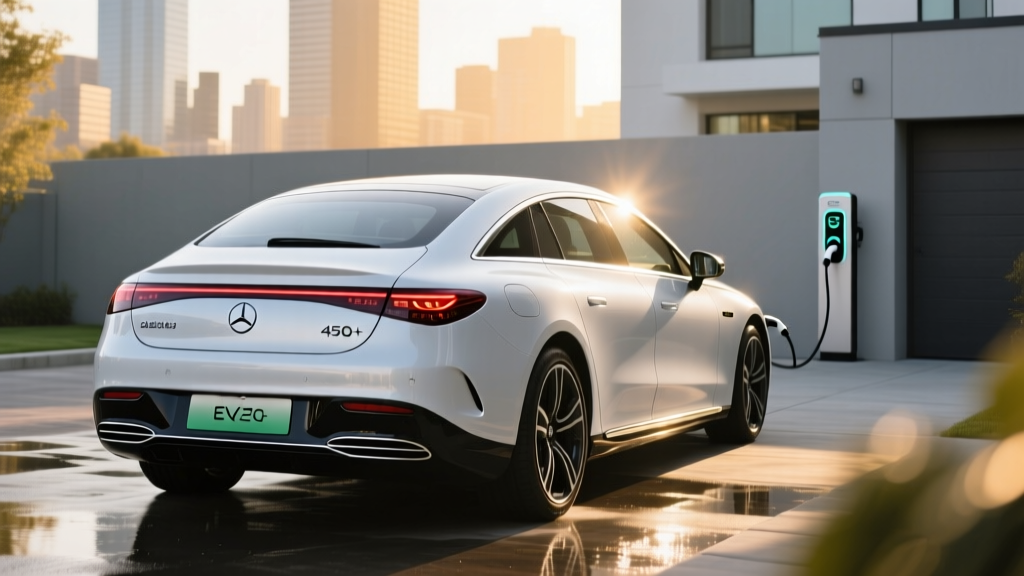
The 2023 Mercedes-Benz EQS 450+ remains one of the most aerodynamically efficient electric vehicles ever sold, and its 107.8 kWh battery delivers range figures that still compete with the best in 2026. But buying a two-year-old flagship luxury EV requires clear eyes: the real-world range falls short of the EPA sticker on highway runs, the DC fast-charging curve tapers aggressively above 80%, and federal tax credit eligibility for new purchases has shifted under current IRS §30D rules. This review breaks down exactly what you get — and what you give up — when stepping into the EQS 450+.
EPA Estimated: 350 miles (EQS 450+ Sedan, 19" wheels)
Real-World Expectation: 280–310 miles on mixed highway driving at 70+ mph; 240–270 miles in sub-40°F winter conditions with cabin heating. City driving with regen can approach or exceed the EPA figure. The 20" and 21" AMG wheel options reduce EPA range to approximately 330 and 305 miles respectively.
Battery, Powertrain & Performance Specs
| Specification | 2023 EQS 450+ Sedan |
|---|---|
| Battery (Usable) | 107.8 kWh, NMC (nickel manganese cobalt) |
| Drivetrain | Rear-wheel drive, single motor |
| Horsepower | 329 hp (245 kW) |
| Torque | 406 lb-ft |
| 0–60 mph | 5.9 seconds (manufacturer) |
| Top Speed | 130 mph (electronically limited) |
| EPA Efficiency | 97 MPGe combined / 35 kWh per 100 miles |
| EPA Range (19" wheels) | 350 miles |
| Curb Weight | ~5,600 lbs |
| Drag Coefficient | 0.20 Cd (lowest production sedan at launch) |
The EQS 450+ uses a permanently excited synchronous motor on the rear axle. That single-motor RWD layout prioritizes efficiency over the brute-force acceleration of the dual-motor EQS 580 4MATIC (516 hp, 4.1s to 60). For most luxury sedan buyers, the 450+ powertrain is more than adequate — highway passing is effortless, and the torque delivery is smooth and linear. The NMC chemistry provides high energy density, which is why Mercedes can package over 107 usable kWh without making the vehicle heavier than competitors. However, NMC cells are more sensitive to sustained high state-of-charge storage than LFP packs, so daily charging to 80% is recommended for longevity.
Charging Speed: DC Fast, Level 2 & Home Setup
Charging is where the EQS 450+ reveals both its strengths and a notable limitation. The peak DC fast-charge rate of 200 kW is respectable but trails the 250–350 kW peaks offered by Hyundai's E-GMP platform and Porsche's 800V Taycan. More importantly, the charge curve tapers early.
| Charging Method | Power / Rate | Time / Range Added |
|---|---|---|
| DC Fast Charge (peak) | 200 kW (CCS1 connector) | 10–80% in ~31 minutes |
| DC Fast Charge (sustained avg.) | ~140 kW average to 80% | 180 miles in ~20 min |
| Level 2 (home / public AC) | 9.6 kW (40A) onboard charger | ~27 miles per hour of charging |
| Level 2 (full 0–100%) | 9.6 kW | ~11.5 hours |
| Level 1 (120V household) | ~1.4 kW | ~4 miles per hour |
What this means in practice: On a 300-mile road trip, you'll add roughly 180 miles in a 20-minute stop at a 150+ kW Electrify America or EVgo station — enough to continue comfortably. But the taper above 80% is steep; charging from 80–100% on DC can take nearly as long as the 10–80% session. Preconditioning the battery (via the MBUX navigation system's route planner) is essential to hitting peak charge rates in cold weather. Without it, expect your first DC stop to peak closer to 100–120 kW until the pack warms up.
For home charging, a 48A Level 2 wall connector on a 60A circuit delivers the full 9.6 kW, replenishing the pack overnight. Most owners will never need DC fast charging for daily use. Budget $800–$1,500 for a quality Level 2 home station and professional installation (panel upgrade may add $1,000–$2,500 if your home has a 100A service).
Interior, Cargo & the Hyperscreen Experience
The EQS 450+ cabin is built around the available MBUX Hyperscreen — a 56-inch curved glass panel spanning the full dashboard width, integrating a 17.7-inch OLED center display, a 12.3-inch passenger screen, and a 12.3-inch driver cluster. It's visually stunning, though the capacitive touch climate controls and haptic slider volume bar frustrate some drivers who prefer physical knobs.
Passenger space: The EQS rides on a dedicated EVA2 platform with a flat floor, yielding generous interior volume. Rear legroom measures 41.9 inches — limousine-class and significantly more than a Tesla Model S (39.6 in). Front legroom is 41.7 inches. Headroom is adequate but not generous, due to the sloping roofline that gives the car its 0.20 Cd drag figure.
Cargo capacity: 22.0 cubic feet behind the rear seats, expanding to 63.0 cu ft with the 60/40 split rear seats folded. The trunk is a liftback design (not a sedan notchback), which makes loading practical. However, there is no front trunk (frunk) — the space under the hood is occupied by HVAC and power electronics, a packaging choice that costs the EQS roughly 3–5 cu ft of storage versus rivals like the Lucid Air or Tesla Model S.
Driver assistance: The EQS comes standard with Mercedes' Driver Assistance Package, which includes adaptive cruise control with stop-and-go, active lane-keeping, and evasive steering assist. This is an SAE Level 2 system — the driver must keep hands on the wheel and remain fully engaged. It is not self-driving. The optional DRIVE PILOT system (available in select markets) can achieve conditional Level 3 operation at speeds up to 40 mph in heavy highway traffic, but availability in the US remains limited to Nevada and California on approved roads.
Pricing, Trims & Federal Tax Credit Eligibility
The 2023 EQS 450+ launched with a base MSRP of $104,400 (sedan). The SUV body style (EQS 450+ SUV) started at $104,400 as well. Key trims for the 450+ sedan included the Premium ($104,400), Exclusive ($107,950), and Pinnacle ($111,300) lines, with options like the Hyperscreen ($8,500), AMG Line exterior package, and rear-axle steering adding substantially to the sticker. A well-equipped 2023 EQS 450+ typically transacted between $115,000 and $130,000.
As a used vehicle in 2026, expect pricing in the $55,000–$78,000 range depending on mileage, condition, and equipment — a significant depreciation curve typical of six-figure luxury EVs.
| Scenario | Amount | Notes |
|---|---|---|
| Original 2023 MSRP (base) | $104,400 | Before options, destination |
| Federal §30D Credit (new, 2023) | $0–$7,500 | Subject to MSRP cap ($55K sedans), income cap, battery sourcing — EQS sedan MSRP exceeded the cap, making most new buyers ineligible |
| Used EV Credit (§25E, 2026) | Up to $4,000 | 30% of sale price, max $4,000; buyer income caps apply ($75K single / $150K joint); vehicle must be >2 model years old and sold by a dealer |
| Estimated 2026 Used Price | $55,000–$78,000 | Varies by trim, mileage, market |
Tax credit reality check: When new, the EQS 450+ sedan was largely ineligible for the full $7,500 federal credit under IRS §30D because its MSRP exceeded the $55,000 sedan cap. The EQS SUV (classified as an SUV for tax purposes, with a $80,000 MSRP cap) had better eligibility, though critical-mineral and battery-component sourcing requirements further restricted qualification depending on the purchase date. For 2026 buyers purchasing a used 2023 EQS, the §25E used clean vehicle credit offers up to $4,000 (30% of sale price) if you meet income thresholds and buy from a licensed dealer. Always verify current-year rules with a tax professional or the IRS.
Warranty & Long-Term Battery Outlook
Mercedes-Benz covers the 2023 EQS 450+ with the following warranties:
- New Vehicle Limited Warranty: 4 years / 50,000 miles
- High-Voltage Battery Warranty: 8 years / 100,000 miles (capacity retention threshold: 70% of original usable capacity)
- Powertrain (e-motor, reducer): Covered under the HV battery warranty period
- Corrosion Perforation: 6 years / unlimited miles
The 70% capacity retention guarantee is industry-standard (matching Tesla, BMW, and Hyundai), though some competitors like Rivian offer 8 years / 175,000 miles on the battery. NMC degradation data from the EVA2 platform suggests roughly 8–12% loss over the first 100,000 miles under normal use patterns, based on fleet data from European EQS taxis. Avoiding routine 100% charges and DC fast-charging in extreme heat will extend pack life. A full battery replacement out of warranty would cost an estimated $20,000–$28,000 at current parts pricing — a figure worth keeping in mind for long-term ownership planning.
How It Stacks Up: EQS 450+ vs. Key Competitors
The 2023 EQS 450+ competes in the full-size luxury EV sedan segment. Here's how it measures up against the most direct alternatives:
| Metric | 2023 EQS 450+ | 2023 Tesla Model S LR | 2023 Lucid Air Pure | 2023 BMW i7 xDrive60 |
|---|---|---|---|---|
| EPA Range | 350 mi | 405 mi | 419 mi | 318 mi |
| Battery (usable) | 107.8 kWh (NMC) | ~100 kWh (NMC) | 112 kWh (NMC) | 101.7 kWh (NMC) |
| 0–60 mph | 5.9 sec | 3.1 sec | 5.2 sec | 4.5 sec |
| Peak DC Charge | 200 kW | 250 kW | 220 kW | 195 kW |
| 10–80% DC Time | ~31 min | ~27 min | ~30 min | ~34 min |
| Base MSRP (2023) | $104,400 | $89,990 | $87,400 | $119,300 |
| Rear Legroom | 41.9 in | 39.6 in | 41.4 in | 40.5 in |
The EQS wins on aerodynamic efficiency (kWh/100mi), cabin quietness, and rear-seat comfort. It loses to the Model S on range and acceleration, to the Lucid Air on range and value, and to the i7 on sheer executive luxury feel. Its 200 kW charging peak is the weakest among these four.
- Best-in-class aerodynamic efficiency (35 kWh/100mi)
- Exceptionally quiet cabin at highway speeds
- Class-leading rear legroom (41.9 in)
- Massive 107.8 kWh battery with strong range buffer
- Standard air suspension delivers superb ride quality
- Hyperscreen is genuinely impressive when functioning well
- Liftback trunk with 63 cu ft max cargo
- DC fast-charge peak of 200 kW trails rivals
- Charge curve tapers steeply above 80% SoC
- No frunk — loses 3–5 cu ft of practical storage
- MSRP exceeded §30D sedan cap when new (limited credit access)
- Capacitive touch controls frustrate some drivers
- Heavy depreciation — expect 40–50% loss in 3 years
- Real-world highway range ~280–310 mi, not 350
Who Should Buy the 2023 EQS 450+
Best for: Luxury commuters and executive sedan buyers who prioritize ride comfort, cabin silence, and rear-seat space over outright performance. The 350-mile EPA range handles daily commutes and moderate road trips without drama. The EQS 450+ is ideal if you have reliable home Level 2 charging and take road trips of 200–250 miles between stops.
Look elsewhere if: You want maximum range (Lucid Air Pure, Tesla Model S), blistering acceleration (Model S Plaid, EQS 580), the fastest possible DC charging (Hyundai Ioniq 6, Porsche Taycan), or need to tow (the EQS is rated for just 1,650 lbs — not a tow vehicle).
As a used purchase in 2026, the EQS 450+ offers remarkable value: a six-figure flagship with 107.8 kWh of battery, air suspension, and a whisper-quiet cabin at roughly half its original price. Just budget for premium insurance, potential out-of-warranty battery cost down the road, and the reality that 200 kW DC charging will feel increasingly slow as 350+ kW chargers proliferate.
Frequently Asked Questions
What is the real-world range of the 2023 EQS 450+?
Expect 280–310 miles on highway trips at 70–80 mph and 320–350 miles in city driving with regenerative braking. In cold weather (below 40°F), range drops to roughly 240–270 miles due to cabin heating demand and increased battery resistance. The EPA rates it at 350 miles on the combined cycle with 19-inch wheels.
How fast does the EQS 450+ charge at home and on the road?
On DC fast charging, it peaks at 200 kW (CCS1 connector) and reaches 10–80% in approximately 31 minutes, though the sustained average is closer to 140 kW due to taper. At home on a 9.6 kW Level 2 charger, a full charge takes about 11.5 hours, adding roughly 27 miles per hour of charging.
Does the 2023 EQS 450+ qualify for the federal EV tax credit?
When sold new, the EQS 450+ sedan's MSRP ($104,400 base) exceeded the IRS §30D sedan cap of $55,000, making it ineligible for the new-vehicle credit. The EQS SUV version (with an $80,000 SUV cap) had partial eligibility depending on battery sourcing. In 2026, a used 2023 EQS may qualify for the §25E used EV credit of up to $4,000 if buyer income is under $75,000 (single) or $150,000 (joint) and the vehicle is purchased from a dealer.
Is the EQS 450+ worth buying over a Tesla Model S or Lucid Air?
Choose the EQS 450+ if ride comfort, cabin quietness, and Mercedes brand prestige are your priorities. Choose the Model S if you need 405 miles of range, 250 kW Supercharger access, and faster acceleration. Choose the Lucid Air Pure for 419 miles of range and a lower starting price. The EQS trades performance and range leadership for refinement.
What battery chemistry does the EQS 450+ use?
The 2023 EQS 450+ uses NMC (nickel manganese cobalt) lithium-ion cells with 107.8 kWh of usable capacity. NMC offers high energy density (enabling the 350-mile range in a sedan form factor) but is more sensitive to heat and high state-of-charge storage than LFP chemistry. Daily charging to 80% and avoiding extended 100% storage will maximize longevity.
How much does it cost to maintain the EQS 450+?
EV maintenance is minimal — no oil changes, no spark plugs, no transmission fluid. Budget for cabin air filter replacement (~$150/year), tire rotation and replacement (the heavy sedan wears tires faster; expect $1,200–$1,800 for a set of premium tires every 25,000–35,000 miles), and brake fluid service every 2 years. Mercedes prepaid maintenance plans are available. Insurance premiums run $2,500–$4,000 annually depending on your profile and state.
Sources: EPA fuel economy data via fueleconomy.gov, Mercedes-Benz USA specifications, IRS clean vehicle credit guidance at irs.gov.