The Lucid Gravity didn't just launch — it evaporated. Within weeks of the first deliveries in late 2025, reservation holders snapped up available build slots well into mid-2026, leaving new customers staring at estimated delivery windows stretching 8 to 14 months out. If you've searched for a Lucid Gravity on dealer lots or online inventory and come up empty, you're not alone. The Lucid Gravity inventory sell-out is real, and it's reshaping how buyers approach the luxury electric SUV segment.
But does the Gravity actually justify the wait? After spending time with the specs, EPA data, and early owner reports, we're breaking down exactly what this three-row electric SUV delivers — and where it falls short — so you can decide whether to hold your reservation or pivot to a competitor with available stock.
Lucid Gravity at a Glance: 2026 Specs and Pricing
| Specification | Value |
|---|---|
| EPA Estimated Range | 440 miles (Grand Touring) |
| Battery Capacity (Usable) | ~112 kWh, NMC lithium-ion |
| Drivetrain | Dual-motor AWD |
| Horsepower | 828 hp |
| 0–60 mph | 3.5 seconds |
| Max DC Fast Charge Rate | 300 kW (peak) |
| 10–80% DC Fast Charge Time | ~22 minutes (estimated) |
| Level 2 Home Charging (AC) | 19.2 kW / ~70 miles per hour |
| Efficiency | ~118 MPGe combined / ~29 kWh/100 mi |
| Seating | Up to 7 passengers (3 rows) |
| Cargo Volume (behind 3rd row) | ~32 cu ft |
| Cargo Volume (3rd row folded) | ~72 cu ft |
| Max Cargo (all rows folded) | ~112 cu ft (with frunk) |
| Towing Capacity | 6,000 lbs (estimated) |
| Battery/Powertrain Warranty | 8 years / 100,000 miles |
| Base MSRP (Pure RWD) | ~$79,900 |
| Grand Touring AWD MSRP | ~$94,900 |
Lucid's approach mirrors what worked with the Air sedan: prioritize energy efficiency above all else. The Gravity's slippery aerodynamics and compact, high-output motor design translate into range numbers that embarrass most competitors — and that efficiency advantage is the core reason inventory is so tight.
Range Reality: EPA Sticker vs. Real-World Miles
Real-World Expectation: ~350–380 miles on mixed highway driving at 70–75 mph; expect ~300–330 miles in sustained cold weather (below 30°F) with cabin heat. City and suburban driving with regen braking recovers closer to the EPA figure, around 400–420 miles.
The 440-mile EPA figure is extraordinary for a three-row SUV. For context, the Rivian R1S (Dual-Motor, Large Battery) delivers around 352 miles EPA, and the Tesla Model X Long Range lands at roughly 348 miles. The Gravity's advantage comes from Lucid's obsessive focus on drivetrain efficiency — the same miniaturized motor technology and low-drag architecture that gave the Air sedan its class-leading numbers.
However, no EV consistently matches its EPA sticker in real-world highway driving. At sustained speeds above 70 mph, aerodynamic drag increases exponentially, and the Gravity, despite its efficiency, is still a large, heavy SUV. Early owner reports and independent testing suggest highway range settles around 350–380 miles at legal interstate speeds. That's still best-in-class by a wide margin, but buyers planning cross-country road trips should budget charging stops using 350 miles as a practical baseline, not 440.
Cold weather compounds the reduction. Lithium-ion batteries lose efficiency in low temperatures, and cabin heating draws significant energy. Expect a 20–30% range reduction in sub-freezing conditions, putting winter highway range closer to 300–330 miles. The Gravity's available heat pump helps mitigate this, but physics is physics.
Charging Speed: 300 kW Peak and the Curve That Matters
Lucid engineered the Gravity's 900-volt electrical architecture to accept up to 300 kW at a DC fast charger — placing it among the fastest-charging production EVs available. But peak kW tells only part of the story. What matters for road trips is the sustained charge rate and the full 10–80% session time.
| Charging Method | Power (kW) | Miles Added per Hour | Notes |
|---|---|---|---|
| Level 1 (120V household) | ~1.4 kW | ~3–4 mi/hr | Emergency/trickle only |
| Level 2 (240V, 48A home charger) | ~11.5 kW | ~42 mi/hr | Standard home setup |
| Level 2 (240V, 80A hardwired) | ~19.2 kW | ~70 mi/hr | Full overnight recharge in ~6 hrs |
| DC Fast Charge (peak) | 300 kW | ~1,000+ mi/hr (peak) | Short burst at low SoC |
| DC Fast Charge (10–80%) | ~200 kW avg sustained | — | ~22 minutes (est.) |
The 900V architecture is the key differentiator. Most competing SUVs — the Model X, R1S, Kia EV9 — run 400V systems (Porsche's Macan EV and Hyundai/Kia's E-GMP platform are notable 800V exceptions). Higher voltage allows the Gravity to push more power at lower current, reducing heat buildup and sustaining higher charge rates deeper into the session.
Expect the Gravity to hold above 250 kW from roughly 10% to 40% state of charge, then taper gradually through the 50–80% range. The full 10–80% session should take approximately 22 minutes at a functioning 350 kW charger — competitive with the best in the segment. However, this assumes you're charging at a station capable of delivering 300+ kW consistently. Many Electrify America and EVgo stations cap at 150–175 kW in practice, which would extend the session to roughly 30–35 minutes.
For home charging, the Gravity's 19.2 kW onboard AC charger is a standout. Most competitors max out at 11.5 kW (48 amps) on Level 2, meaning the Gravity recovers range roughly 65% faster overnight if you install an 80-amp hardwired Wall Connector or equivalent. A full charge from near-empty takes about 6 hours at 19.2 kW — easily achievable while you sleep. Note that an 80-amp circuit requires a 100-amp breaker and likely a panel upgrade if your home has a 100-amp main service. Budget $500–$2,000+ for professional installation depending on your electrical panel's capacity and the run distance from panel to charger location. Always consult a licensed electrician for final specifications.
Performance and Driving Dynamics
The Grand Touring AWD's 828 horsepower and 3.5-second 0–60 time put the Gravity in sports-car territory, which is absurd for a vehicle with three rows and over 110 cubic feet of maximum cargo space. Even the base Pure RWD model (expected ~620 hp, ~3.8 seconds to 60) outperforms most performance SUVs from the internal-combustion era.
Lucid's dual-motor AWD system provides torque vectoring between the front and rear axles, and the low center of gravity from the floor-mounted battery pack keeps body roll surprisingly controlled for a vehicle of this size. The air suspension adapts ride height for highway efficiency, off-road clearance, or easy loading access.
The regenerative braking system supports one-pedal driving in most conditions, and Lucid's tuning is among the smoothest in the industry — no abrupt grab at low speeds, a complaint we've had with some competitors.
Interior, Tech, and the Glass Canopy Display
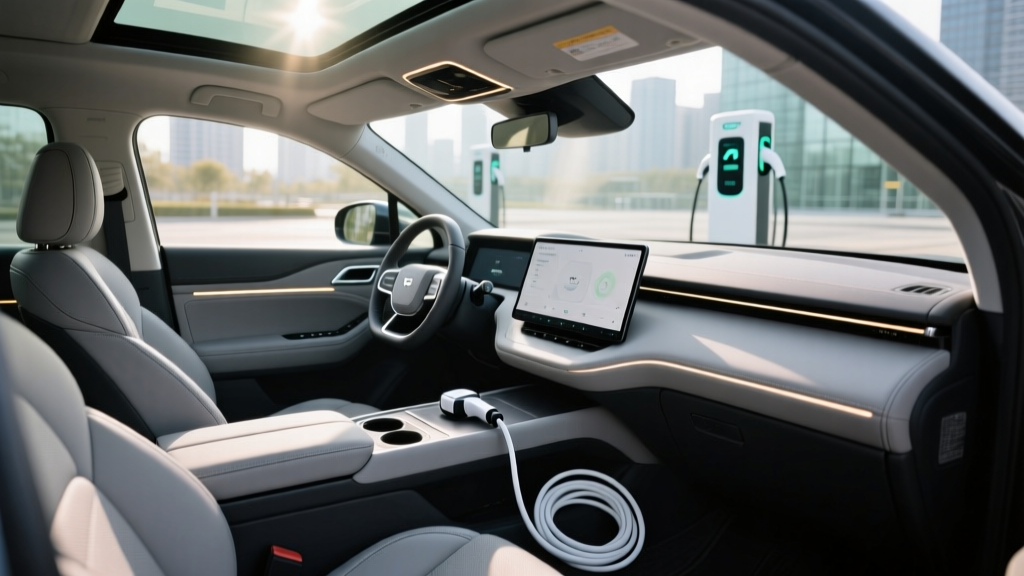
The Gravity's interior is anchored by the Glass Canopy — a sweeping 34-inch curved display that spans the full width of the dashboard. It replaces the traditional instrument cluster and infotainment screen with a single, high-resolution panel running Lucid's proprietary operating system.
Standout technology features include:
- Lucid DreamDrive Pro: SAE Level 2 driver-assistance suite with adaptive cruise control, lane centering, automatic lane changes, and highway driving assist. Uses a combination of cameras, radar, and LiDAR (on Grand Touring). This is not autonomous driving — the driver must remain engaged at all times.
- Over-the-air updates: Lucid regularly pushes software improvements to range estimation, charging optimization, and infotainment features.
- Phone-as-key: Ultra-wideband (UWB) technology for seamless entry and start without fumbling for a fob.
- Available Executive Rear Seating: Reclining, heated, and ventilated second-row captain's chairs with dedicated climate controls and entertainment screens.
- Vehicle-to-load (V2L): Power external devices from the battery — useful for camping, tailgating, or emergency backup.
The third row is genuinely usable for adults on shorter trips, a claim few competitors can make. With the third row in place, you still get approximately 32 cubic feet of cargo space — enough for several suitcases or a week's groceries for a large family. Fold the third row and cargo volume expands to roughly 72 cubic feet, and with both rear rows flat, you approach 112 cubic feet including the front trunk (frunk).
Notable drawbacks: the Glass Canopy display, while visually striking, has drawn some criticism for glare in direct sunlight and for burying certain climate and vehicle controls in touchscreen menus. Lucid has addressed some of these complaints via OTA updates, adding physical shortcut buttons on the steering wheel, but it's not as intuitive as dedicated physical controls for HVAC. Additionally, Lucid's service center network remains limited compared to Tesla or legacy automakers — owners in rural areas may face long drives for warranty service.
Pricing, Tax Credits, and Total Cost
The 2026 Lucid Gravity lineup is structured across three main trims:
| Trim | Base MSRP | Federal §30D Credit | Effective Price (if eligible) |
|---|---|---|---|
| Pure (RWD) | ~$79,900 | Up to $7,500* | ~$72,400 |
| Touring (AWD) | ~$87,400 | Up to $7,500* | ~$79,900 |
| Grand Touring (AWD) | ~$94,900 | Up to $7,500* | ~$87,400 |
*Federal tax credit eligibility under IRS §30D is subject to multiple requirements that change periodically. Key rules for 2026 include:
- MSRP cap: SUVs must have a manufacturer's suggested retail price at or below $80,000 to qualify. The Pure trim qualifies; the Touring and Grand Touring exceed the cap and are not eligible for the new-vehicle credit.
- Buyer income cap: Modified adjusted gross income must not exceed $300,000 (joint filers), $225,000 (head of household), or $150,000 (single filers).
- Battery sourcing: The battery's critical minerals and components must meet escalating domestic-content and free-trade-agreement thresholds that tighten each year. Lucid has worked to qualify, but specific eligibility can change — verify current status on fueleconomy.gov before purchasing.
- Point-of-sale transfer: Eligible buyers can transfer the credit to the dealer at purchase, reducing the out-of-pocket price immediately rather than waiting for a tax refund.
This MSRP cap is the critical detail many buyers miss. Only the base Pure RWD trim falls under the $80,000 SUV cap. If you've configured a Touring or Grand Touring — the trims generating the most demand and driving the inventory sell-out — you will not receive the federal credit. Some buyers may qualify for state or utility incentives that have no MSRP cap, but those vary by jurisdiction. Consult a tax professional to confirm your personal eligibility.
On efficiency and running costs, the Gravity's ~29 kWh/100 mi translates to roughly $0.04–$0.06 per mile on average U.S. electricity rates ($0.14–$0.16/kWh), compared to $0.12–$0.18 per mile for a comparable gas-powered luxury SUV at current fuel prices. Over 15,000 miles per year, that's a fuel savings of approximately $1,200–$1,800 annually, depending on local energy costs.
Why the Lucid Gravity Inventory Sell-Out Happened
The sell-out wasn't accidental. Several factors converged to create a supply-demand mismatch:
- Limited production ramp: Lucid's Casa Grande, Arizona factory is scaling Gravity production alongside continued Air sedan manufacturing. Initial output is constrained by supply chain ramp-up, particularly for the large-format battery cells and the Gravity's complex air suspension components.
- Reservation conversion surge: Lucid had thousands of Gravity reservations (with $1,000 deposits) dating back to 2023. When production began in late 2025, those early reservation holders locked in build slots rapidly, consuming most of the first two quarters of 2026 output.
- No direct range competitor: No other three-row electric SUV on the market comes within 80 miles of the Gravity's 440-mile EPA range. Buyers who prioritize range above all else have essentially one option.
- Luxury EV demand shift: The luxury SUV segment is electrifying faster than sedans, and buyers trading out of BMW X5s, Mercedes GLEs, and Porsche Cayennes want something that doesn't compromise on range or tech.
If you're placing a new order today, expect delivery estimates in the late 2026 to early 2027 window, depending on trim and configuration. Lucid has not announced plans for a second production shift or a dedicated Gravity factory, so supply constraints are likely to persist through most of 2026.
Lucid Gravity vs. Key Competitors
For buyers who can't wait — or who want to cross-shop before committing — here's how the Gravity stacks up against the three-row EV SUV alternatives with better availability:
| Attribute | Lucid Gravity GT | Tesla Model X LR | Rivian R1S (Dual Large) | Kia EV9 GT-Line |
|---|---|---|---|---|
| EPA Range | 440 mi | ~348 mi | ~352 mi | ~270 mi |
| Battery (kWh) | ~112 | ~100 | ~128.9 (usable) | ~99.8 |
| 0–60 mph | 3.5 sec | 3.8 sec | 4.5 sec | 5.0 sec |
| Max DC Charge | 300 kW | 250 kW | 200+ kW | 210 kW |
| 10–80% Time | ~22 min | ~30 min | ~35 min | ~24 min |
| Seating | 7 | 7 (optional) | 7 | 7 |
| Base MSRP | ~$79,900 | ~$79,990 | ~$79,900 | ~$73,900 |
| Availability | Waitlisted | Available | Available | Available |
The Gravity wins on range and charging speed by a significant margin, but the Model X, R1S, and EV9 are available now and offer competitive feature sets. The R1S particularly stands out for off-road capability and adventure use, while the Model X offers access to the Supercharger network (though NACS adoption is closing that gap for all manufacturers).
- Maximum range is your top priority and you're willing to wait 8–14 months
- You value class-leading efficiency and charging speed
- You want a luxury three-row SUV that doesn't feel like a compromise on range
- You need a vehicle within the next 1–3 months
- Off-road capability matters (Rivian R1S)
- Supercharger network access is critical and you're not near NACS-compatible stations (Tesla Model X)
- You want a lower entry price with available inventory (Kia EV9)
Pros, Cons, and the Verdict
- Class-leading 440-mile EPA range — 90+ miles more than nearest competitor
- 300 kW DC fast charging with 900V architecture
- 19.2 kW Level 2 AC charging (fastest in class for home)
- Genuine 7-passenger seating with usable third row
- 828 hp and 3.5-second 0–60 in Grand Touring trim
- Excellent energy efficiency (~29 kWh/100 mi)
- Spacious cargo area with front trunk
- 8-year/100,000-mile battery and powertrain warranty
- Inventory sell-out: 8–14 month wait for new orders
- Touring and Grand Touring trims exceed §30D MSRP cap — no federal credit
- Limited Lucid service center network outside major metros
- Glass Canopy display can suffer from glare; limited physical controls
- Real-world highway range drops to ~350–380 mi (still best-in-class)
- No Apple CarPlay or Android Auto (Lucid's proprietary system only)
- Brand is young; long-term reliability data is limited
The Lucid Gravity is, on paper and in early practice, the most capable three-row electric SUV available. Its range and efficiency are genuinely unmatched, and the charging speed means road trips are practical, not painful. The inventory sell-out is a testament to that capability — but it's also a real barrier. If you can wait, the Gravity delivers. If you can't, the R1S and Model X are strong alternatives that won't leave you on a waitlist.
Frequently Asked Questions
What is the real-world range of the Lucid Gravity?
The EPA rates the Grand Touring AWD at 440 miles. In real-world highway driving at 70–75 mph, expect approximately 350–380 miles. In cold weather (below 30°F), highway range may drop to 300–330 miles. City and mixed driving with regenerative braking recovers closer to the EPA figure.
How fast does the Lucid Gravity charge at home and on the road?
At a DC fast charger, the Gravity peaks at 300 kW and charges from 10–80% in approximately 22 minutes. At home on a 240V/80A Level 2 charger, it adds roughly 70 miles of range per hour, fully recharging in about 6 hours. On a standard 48A Level 2 setup, it adds about 42 miles per hour.
How much does the Lucid Gravity cost after tax credits?
The base Pure RWD starts around $79,900 and may qualify for the full $7,500 federal credit, bringing the effective price to ~$72,400 — if you meet income and battery-sourcing requirements. However, the Touring (~$87,400) and Grand Touring (~$94,900) exceed the $80,000 SUV MSRP cap and do not qualify for the federal new-vehicle credit. State and utility incentives may still apply.
Does the Lucid Gravity qualify for the federal EV tax credit?
Only the base Pure RWD trim (under $80,000 MSRP) is potentially eligible for the IRS §30D credit of up to $7,500. Eligibility also depends on buyer income limits, battery critical-mineral sourcing requirements, and point-of-sale transfer rules. The higher Touring and Grand Touring trims exceed the MSRP cap and are ineligible. Always verify current eligibility on fueleconomy.gov and consult a tax professional.
Is the Lucid Gravity worth buying vs. the Tesla Model X or Rivian R1S?
If range and charging speed are your top priorities and you can tolerate a long wait, the Gravity is the clear winner. If you need a vehicle immediately, want off-road capability (R1S), or prioritize Supercharger network access (Model X), the competitors are strong choices with available inventory today.
What are the biggest drawbacks of the Lucid Gravity?
The primary drawbacks are the extended wait time due to inventory constraints, the MSRP cap excluding higher trims from the federal tax credit, limited service center coverage in many regions, a proprietary infotainment system without Apple CarPlay or Android Auto, and the Glass Canopy display's occasional glare issues.
What warranty coverage does the Lucid Gravity include?
Lucid provides an 8-year/100,000-mile warranty on the battery pack and powertrain, with a minimum 70% capacity retention guarantee over that period. The basic vehicle warranty covers 4 years/50,000 miles. This is competitive with Tesla, Rivian, and legacy luxury automakers in the EV space.