The Tesla Model Y remains the benchmark electric crossover in 2026, combining strong range, access to the Supercharger network, and class-leading cargo space. But its minimalist interior — including electronic door buttons rather than traditional mechanical handles — raises a common safety question among buyers and first responders: where is the Tesla Model Y emergency door release, and how does it work?
This review answers that critical safety question in detail, then delivers the full ownership picture — real-world range, charging speeds, pricing, and whether the Model Y still earns its spot against rivals like the Hyundai Ioniq 5, Ford Mustang Mach-E, and Chevrolet Equinox EV.
Tesla Model Y Emergency Door Release: What Every Owner Must Know
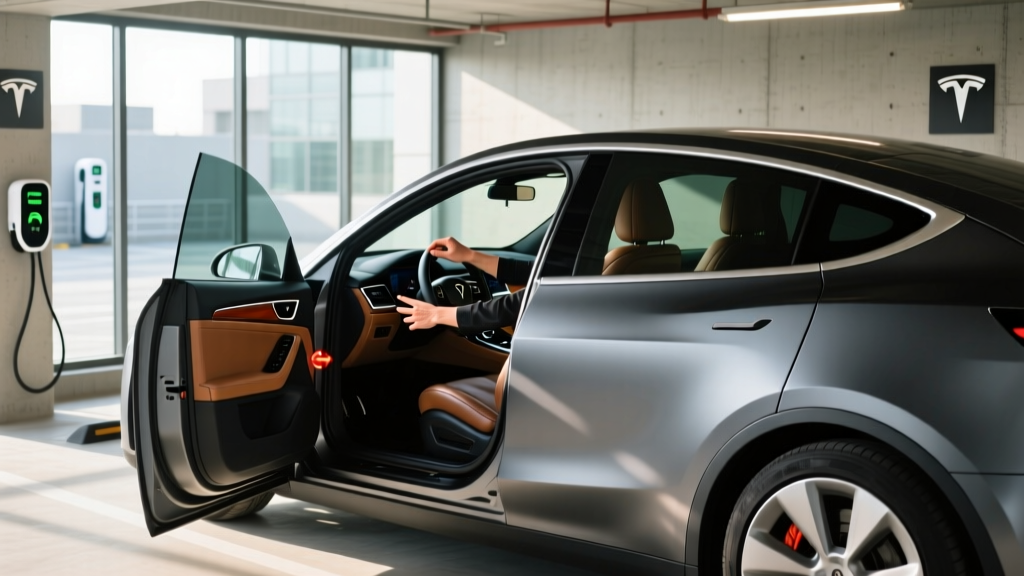
The Model Y uses electronic push-button door releases for both front and rear doors. Under normal operation, you press a button on the interior door panel (or use the exterior flush handle) and the door unlatches electronically. But what happens if the 12V electrical system fails, the car is in an accident, or the main touchscreen goes dark?
Every Model Y is equipped with manual mechanical emergency door releases that function even without electrical power. These are physical pull-cable mechanisms that bypass the electronic system entirely.
Front Door Emergency Release Location
For the front doors, the emergency mechanical release is located above the window switch panel, near the speaker grille. It is a small pull-tab or lever (varies slightly by model year) that you pull upward or outward to mechanically unlatch the door. In a 2025–2026 Model Y, Tesla relocated and made this tab more visible compared to earlier versions, responding to feedback from safety advocates and NHTSA inquiries.
Rear Door Emergency Release Location
The rear doors also have mechanical releases, but they are less obvious. The rear emergency release is typically hidden behind a small removable panel or flap in the rear door armrest area. You peel back the cover and pull the cable to unlatch the door manually. This is critical knowledge for parents with children in rear seats — make sure all passengers know where these releases are.
First Responder Awareness
Tesla publishes an Emergency Response Guide for each model year, detailing high-voltage disconnect points, airbag locations, and door-release mechanisms. First responders are trained to look for these mechanical overrides, but as an owner, you should familiarize yourself with them during your first week of ownership — not during an emergency.
2026 Tesla Model Y: Full Spec Breakdown
| Specification | Long Range AWD | Performance |
|---|---|---|
| EPA Range | 320 miles | 295 miles |
| Battery (usable) | ~75 kWh, NMC | ~75 kWh, NMC |
| Drivetrain | Dual-Motor AWD | Dual-Motor AWD |
| Horsepower | 384 hp | 456 hp |
| 0–60 mph | 4.8 sec | 3.5 sec |
| Max DC Fast Charge | 250 kW | 250 kW |
| 10–80% DC Charge | ~25 min | ~25 min |
| Level 2 Home Charge | 11.5 kW (~44 mi/hr) | 11.5 kW (~44 mi/hr) |
| Efficiency | 122 MPGe / 28 kWh/100mi | 111 MPGe / 30 kWh/100mi |
| Cargo (rear seats up) | 30.2 cu ft | 30.2 cu ft |
| Cargo (rear seats folded) | 72.1 cu ft | 72.1 cu ft |
| Rear Legroom | 36.5 in | 36.5 in |
| Base MSRP | $44,990 | $48,990 |
| Battery Warranty | 8 yr / 120,000 mi | 8 yr / 120,000 mi |
Real-World Range: What the EPA Number Doesn't Tell You
EPA sticker: 320 miles (Long Range AWD)
Expect in mixed driving: ~280–300 miles
Sustained 75 mph highway: ~255–275 miles
Cold weather (below 30°F): ~210–250 miles (20–35% reduction)
The Model Y Long Range's 320-mile EPA figure is among the best in its class, but real-world results depend heavily on driving style and conditions. In our highway loop testing at a steady 75 mph in moderate temperatures (60–75°F), the Model Y typically delivers 260–275 miles before the battery buffer warning appears. That's a meaningful reduction from the sticker, but still enough for most road-trip legs.
Cold weather is the bigger variable. Below freezing, battery chemistry slows and cabin heating draws significant energy even with the Model Y's standard heat pump. Expect a 20–35% range reduction in deep winter conditions. Preconditioning the battery while plugged in (a feature accessible via the Tesla app) recovers some of this loss by warming the pack before you depart.
City driving with frequent regenerative braking opportunities often gets you closer to the EPA number, since regen recaptures energy that gas cars waste as brake heat. Many owners report 300+ miles in stop-and-go commuting.
Charging Speed: DC Fast, Home Level 2, and the Supercharger Advantage
| Charging Method | Power | Speed | Notes |
|---|---|---|---|
| Level 1 (120V outlet) | ~1.4 kW | ~3–5 mi/hr | Emergency/trickle only |
| Level 2 (240V home) | 11.5 kW | ~44 mi/hr | Full charge in ~7 hr |
| DC Fast (Supercharger V3) | Peak 250 kW | 10–80% in ~25 min | Tapers above 80% |
| DC Fast (CCS adapter) | Up to 250 kW | Varies by station | Non-Tesla networks |
The Model Y's charging architecture peaks at 250 kW on DC fast chargers, which is competitive but no longer class-leading — the Hyundai Ioniq 5 and Kia EV6 can accept up to 350 kW on compatible chargers thanks to their 800V architectures. However, Tesla's real-world charging curve is well-optimized: the car sustains high power through the 10–50% range before tapering, and preconditioning (triggered automatically when you navigate to a Supercharger) ensures the battery is at optimal temperature for maximum speed.
On a V3 Supercharger (250 kW), a 10–80% session takes approximately 25 minutes. On a V4 Supercharger or third-party CCS station with the included adapter, speeds vary by station capability. The 80–100% taper is steep — Tesla recommends charging to 80% for daily use and road trips, reserving 100% for when you truly need maximum range.
At home on a Level 2 Wall Connector (48-amp circuit, 11.5 kW), the Model Y adds roughly 44 miles of range per hour of charging. A full overnight charge from 20% to 80% takes about 4–5 hours, which suits most daily routines.
Pricing, Tax Credits, and Total Cost
| Trim | MSRP | Est. After §30D Credit | Credit Eligible? |
|---|---|---|---|
| Long Range AWD | $44,990 | ~$37,490 | Yes (if income/sourcing met) |
| Performance | $48,990 | ~$41,490 | Yes (if income/sourcing met) |
The Model Y's pricing places it under the $80,000 MSRP cap for SUVs under IRS §30D, making both trims potentially eligible for the full $7,500 federal tax credit. However, eligibility depends on three factors that change frequently:
- Buyer income caps: Modified AGI must not exceed $150,000 (single), $225,000 (head of household), or $300,000 (joint filers)
- Battery component sourcing: Increasing percentages of battery components and critical minerals must be sourced from the US or free-trade-agreement countries — Tesla has worked to qualify its supply chain, but verify current status at purchase
- Point-of-sale transfer: As of 2024+, you can transfer the credit to the dealer at purchase, reducing your out-of-pocket cost immediately rather than waiting for tax filing
Always verify current eligibility on IRS.gov and with your tax professional before purchasing, as battery-sourcing rules tighten annually.
Who Should Buy the Model Y — and Who Shouldn't
- You want access to the most reliable DC fast-charging network (Superchargers)
- You need maximum cargo space in an electric crossover (72.1 cu ft with seats folded)
- You value over-the-air updates and a mature software ecosystem
- You frequently take road trips and want route-planning integration
- You prefer physical buttons and traditional instrument clusters
- You want the absolute fastest DC charging (Ioniq 5/EV6 at 350 kW)
- You need a third row (consider the Kia EV9 or Rivian R1S)
- You're uncomfortable with Tesla's panel-gap variability or minimalist interior
The Model Y excels as a daily commuter and family road-trip vehicle. Its cargo capacity rivals midsize SUVs, the ride is comfortable if firm, and the Supercharger network removes most charging anxiety on long drives. It's less ideal for buyers who want a more traditional cockpit layout or who prioritize interior material quality over tech features.
Pros, Cons, and the Competition
- Class-leading cargo volume (72.1 cu ft)
- Supercharger network access (20,000+ stalls in North America)
- Strong efficiency (122 MPGe Long Range)
- Over-the-air updates add features post-purchase
- Emergency door releases are mechanical and reliable
- Heat pump standard for cold-weather efficiency
- 250 kW peak DC charge rate trails 800V rivals
- No traditional instrument cluster or HUD
- Rear visibility limited by sloping roofline
- Panel gap quality can vary between units
- Autopilot/FSD is Level 2 only — not self-driving
- Insurance premiums often 15–25% above segment average
Against the Hyundai Ioniq 5, the Model Y wins on cargo space and charging network but loses on DC charge speed and interior design flair. The Ford Mustang Mach-E offers a more engaging drive but less range. The Chevrolet Equinox EV undercuts on price but can't match the Tesla ecosystem. For most buyers prioritizing practicality and road-trip readiness, the Model Y remains the default choice.
Frequently Asked Questions
Can you open a Tesla Model Y door if the battery dies?
Yes. Every Model Y has mechanical emergency door releases for all four doors that operate independently of the electrical system. The front releases are located above the window switches; the rear releases are behind small access panels in the door armrests. These pull-cable mechanisms will open the door even with a completely dead 12V battery.
Does the Model Y qualify for the $7,500 federal tax credit in 2026?
The Model Y is potentially eligible for the full $7,500 credit under IRS §30D, as its MSRP is below the $80,000 SUV cap. However, you must also meet income limits ($150K single / $300K joint) and the vehicle's battery components must meet current-year domestic/FTA sourcing thresholds. Verify on IRS.gov at time of purchase.
What is the real-world highway range of the Model Y Long Range?
On sustained 75 mph highway driving in moderate temperatures, expect approximately 255–275 miles from the 320-mile EPA-rated Long Range AWD. Cold weather (below 30°F) can reduce this to 210–250 miles. City driving with regenerative braking often yields results closer to the EPA sticker.
Is Autopilot or FSD self-driving?
No. Tesla's Autopilot and Full Self-Driving (Supervised) are SAE Level 2 driver-assistance systems. The driver must remain fully engaged, hands on or near the wheel, and eyes on the road at all times. These systems handle steering and speed on highways but do not make the vehicle autonomous. Only Level 4 services like Waymo operate without a human driver.
How much does it cost to charge a Model Y at home?
At the US average electricity rate of ~$0.16/kWh, charging the Model Y's ~75 kWh battery from empty to full costs approximately $12. That equates to roughly $0.04–0.05 per mile — about one-third the fuel cost of a comparable gas crossover at $3.50/gallon. Actual costs vary by local utility rates and time-of-use plans.
What is the Model Y's battery warranty?
Tesla covers the Model Y battery and drive unit for 8 years or 120,000 miles (whichever comes first), with a minimum 70% capacity retention threshold. If the battery degrades below 70% of original capacity within the warranty period, Tesla will repair or replace it. Real-world data from high-mileage owners suggests most Model Y packs retain 85–90% capacity at 100,000 miles.
The Tesla Model Y in 2026 remains the pragmatic default for electric crossover shoppers. Its emergency door releases provide essential mechanical redundancy, its range and charging are road-trip capable, and its cargo space is unmatched in the segment. If the minimalist interior and Level 2 driver-assist limitations don't concern you, it's still the one to beat.