The Kia EV9's V2H Capability Changes the Home-Backup Conversation
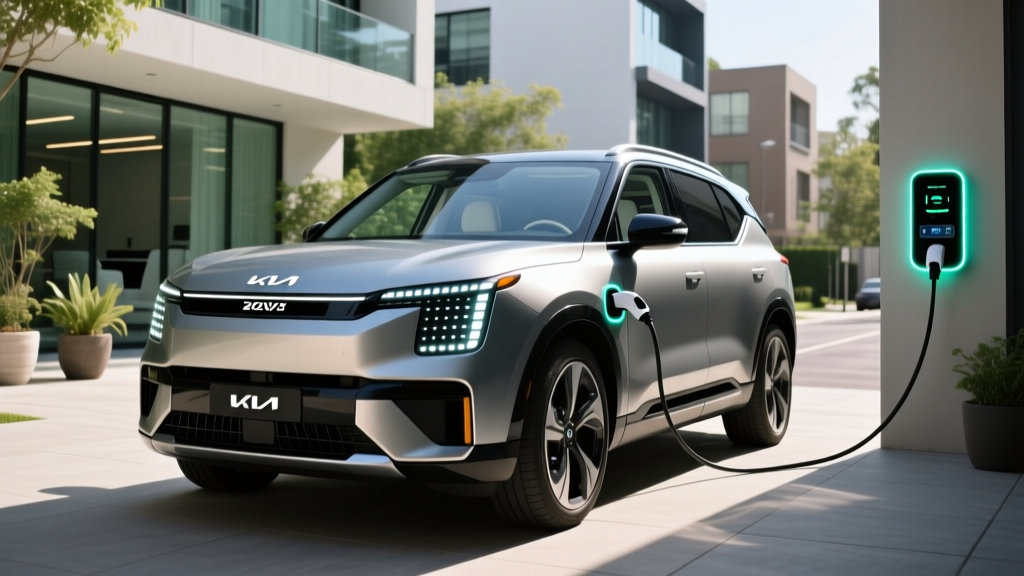
Three-row electric SUVs remain a thin segment, and the Kia EV9 continues to dominate it heading into the 2026 model year. But beyond its 304-mile EPA range and genuinely usable third row, the EV9 carries a feature that most competitors still lack: Vehicle-to-Home (V2H) bi-directional charging. Paired with the right home energy equipment, the EV9's 99.8 kWh battery can power an average American home for multiple days during an outage — effectively turning your SUV into a rolling generator with zero fuel, zero emissions at the tailpipe, and zero noise.
This review covers the 2026 Kia EV9 with a specific focus on its V2H capability, alongside the range, charging, pricing, and ownership data you need before signing a purchase agreement.
Range, Battery, and Real-World Efficiency
The 2026 Kia EV9 uses a 99.8 kWh (usable) nickel-manganese-cobalt (NMC) lithium-ion battery pack across all trims. NMC chemistry gives the EV9 higher energy density than LFP alternatives — critical for fitting nearly 100 kWh into a three-row SUV without excessive weight — though it does mean Kia recommends capping daily charges at 80% to maximize long-term cell health.
| Configuration | EPA Est. Range | Real-World Highway (70 mph) | Cold Weather (20°F, highway) |
|---|---|---|---|
| Light RWD (single motor) | 304 mi | ~260–280 mi | ~210–240 mi |
| Wind/Land AWD (dual motor) | 270–282 mi | ~230–255 mi | ~185–210 mi |
EPA estimates assume a mix of city and highway driving at moderate temperatures. Sustained 70+ mph highway driving and cold weather both reduce range materially. Plan charging stops accordingly on road trips — a 282-mile AWD EV9 realistically delivers 230–255 miles before you'll want to stop.
Efficiency varies by drivetrain. The Light RWD achieves an EPA-rated 88 MPGe combined (roughly 38 kWh/100 mi), while the dual-motor AWD models drop to 83 MPGe combined (~40 kWh/100 mi). For a 5,000+ lb three-row SUV, these are competitive figures — the Rivian R1S, for comparison, sits around 73–76 MPGe depending on configuration.
Charging Speeds: DC Fast, Level 2, and V2H Output
The EV9's 800-volt architecture remains one of its strongest technical advantages. This platform enables peak DC fast-charge rates up to 210 kW, translating to a 10–80% charge in approximately 24 minutes at a compatible 350 kW charger. The charge curve holds above 150 kW through roughly 55% State of Charge before tapering — a more sustained curve than many 400V competitors that spike to a peak and immediately drop off.
| Charging Level | Power / Rate | What You Get |
|---|---|---|
| DC Fast Charge (800V) | Peak 210 kW | 10–80% in ~24 min |
| DC Fast Charge (50 kW station) | ~50 kW | 10–80% in ~85 min |
| Level 2 Home (240V, 48A) | 11.5 kW | ~25 mi/hr; 0–100% in ~9 hrs |
| Level 1 (120V, 12A) | 1.4 kW | ~3 mi/hr; emergency/trickle only |
| V2H Output | Up to 3.6 kW (120V) / 7.2 kW (240V) | Home backup power during outages |
Understanding V2H on the EV9: Vehicle-to-Home allows the EV9 to send power from its traction battery back through a compatible bi-directional wall connector and into your home's electrical panel. At up to 7.2 kW output through a 240V connection, the EV9 can run essential circuits — refrigerator, lights, HVAC fan, internet router, sump pump — simultaneously. With a 99.8 kWh battery and an average U.S. home consuming roughly 30 kWh/day, you're looking at approximately 3 days of whole-home backup (longer if you manage loads carefully).
V2H requires Kia's approved bi-directional charger hardware and a transfer switch or energy management system installed by a licensed electrician. Expect the equipment and installation to add $3,000–$6,000 on top of the vehicle cost, depending on your panel capacity and whether a 200A service upgrade is needed. Kia uses the CCS1 connector for DC charging on current EV9 models, with NACS (Tesla-style) adoption expected for future model years.
Performance and Drivetrain
| Spec | Light RWD | Wind / Land AWD | GT-Line AWD |
|---|---|---|---|
| Motor Config | Single rear | Dual (front + rear) | Dual (front + rear) |
| Horsepower | 215 hp | 379 hp | 379 hp |
| Torque | 258 lb-ft | 516 lb-ft | 516 lb-ft |
| 0–60 mph | ~7.5 sec | ~4.5 sec | ~4.5 sec |
| Towing Capacity | 2,000 lbs | 5,000 lbs | 5,000 lbs |
| EPA Range | 304 mi | 270–282 mi | 270 mi |
The dual-motor AWD EV9 is genuinely quick for its size. The 4.5-second 0–60 time puts it in sports-sedan territory from a decade ago, and the instant torque delivery makes merging and passing effortless. Regenerative braking offers multiple levels via steering-wheel paddles, including a near one-pedal driving mode (i-Pedal) that can bring the EV9 to a complete stop without touching the brake pedal.
The 5,000-lb towing capacity (AWD) is best-in-class for three-row electric SUVs and sufficient for a mid-size camper, boat, or utility trailer. Note that towing at highway speeds will cut range by 35–50% — plan on 140–170 real-world miles between charges when pulling a heavy load.
Interior, Cargo, and Family Practicality
The EV9's cabin is where Kia's packaging engineering pays dividends. Unlike many three-row SUVs where the third row is punishment, the EV9 offers genuine adult-capable space in the back:
- Legroom: 41.4 in (front) / 42.8 in (second row) / 32.0 in (third row)
- Cargo behind 3rd row: 20.2 cu ft (groceries, strollers, a few suitcases)
- Cargo behind 2nd row: 43.5 cu ft (weekend gear for a family of four)
- Max cargo (2nd and 3rd folded): 81.7 cu ft (near minivan territory)
- Frunk (front trunk): 1.8 cu ft (RWD) / 0.9 cu ft (AWD) — enough for a charging cable bag
Higher trims (Land, GT-Line) offer second-row captain's chairs with power recline and relaxation mode — a standout feature for road-trip rest stops. The dual 12.3-inch panoramic displays run Kia's latest infotainment with wireless Apple CarPlay and Android Auto. Physical buttons for climate control are retained, a decision that deserves praise.
On the ADAS front, the EV9 includes Highway Driving Assist 2 (HDA2), a Level 2 driver-assist system combining adaptive cruise control with lane centering and automatic lane changes on divided highways. This is not self-driving — you must keep hands on the wheel and eyes on the road at all times per SAE Level 2 requirements. It's competent and comparable to Hyundai's HDA2, though not as aggressive in capability as GM's Super Cruise or Ford's BlueCruise on approved highways.
Pricing, Trims, and Federal Tax Credit
The 2026 Kia EV9 starts at $54,900 for the Light RWD and climbs to roughly $73,900 for a fully loaded GT-Line AWD. Here's the trim ladder:
| Trim | MSRP | Drivetrain | Key Features |
|---|---|---|---|
| Light | $54,900 | RWD | Base tech, 304-mi range, 19" wheels |
| Wind | $60,600 | AWD | Dual motor, heated/ventilated front seats, HDA2 |
| Land | $65,400 | AWD | Captain's chairs, premium audio, 20" wheels |
| GT-Line | $69,400–$73,900 | AWD | Sport styling, digital mirrors (opt), full ADAS suite |
| Requirement | EV9 Status (2026) |
|---|---|
| MSRP Cap (SUVs: ≤$80,000) | ✅ All trims qualify (max ~$73,900) |
| Buyer Income Cap (Joint: ≤$300K AGI) | Varies by buyer |
| Battery Component Mfg. (N. America) | ⚠️ Verify current-year sourcing — rules tighten annually |
| Critical Minerals Sourcing | ⚠️ Verify current-year sourcing — rules tighten annually |
| Max Credit | Up to $7,500 (partial $3,750 if only one requirement met) |
| Point-of-Sale Transfer | ✅ Available — reduces purchase price at dealership |
Source: IRS §30D Clean Vehicle Credit. Battery sourcing requirements change annually. Confirm eligibility with your dealer and tax professional before purchase.
With the full $7,500 credit applied at point of sale, a Wind AWD drops from $60,600 to an effective $53,100 — competitive with mid-trim Tesla Model X pricing but with more interior versatility and V2H capability the Tesla doesn't offer.
V2H Setup: What Homeowners Actually Need
Kia's V2H implementation on the EV9 is not as simple as plugging an extension cord into the charge port. Here's the practical breakdown:
- Bi-directional wall connector: You need Kia's approved V2H-capable charger (typically a Wallbox Quasar 2 or equivalent CCS bi-directional unit). Budget $2,000–$3,500 for the hardware.
- Electrical panel assessment: Your home needs a 200A+ service panel. Older homes with 100A or 150A panels will need an upgrade ($1,500–$4,000).
- Transfer switch / energy management system: A critical safety device that prevents backfeeding power to the grid during an outage (which could endanger utility workers). Budget $500–$1,500.
- Professional installation: Licensed electrician required. Total install cost (labor + materials + permits): $1,500–$3,500.
Total V2H setup cost: approximately $5,000–$10,000 depending on your home's existing electrical infrastructure. This is a meaningful investment, but compare it to a whole-home natural gas generator ($8,000–$15,000 installed) or a dedicated home battery system like the Tesla Powerwall ($12,000–$18,000 installed, ~13.5 kWh). The EV9 gives you 99.8 kWh of mobile storage that also happens to be a family SUV.
Warranty and Long-Term Ownership
Kia backs the EV9 with one of the strongest warranties in the segment:
- Battery & Drive Unit: 10 years / 100,000 miles (capacity retention guaranteed above 70% of original)
- Limited Vehicle Warranty: 5 years / 60,000 miles
- Roadside Assistance: 5 years / 60,000 miles
The 10-year battery warranty is particularly important for V2H users. Bi-directional charging does add charge/discharge cycles to the battery. Kia has stated that V2H use within specified parameters does not void the battery warranty, but owners should confirm this in writing at purchase and monitor State of Health (SoH) through the vehicle's diagnostics or the Kia Connect app.
Insurance costs for the EV9 run 10–20% higher than comparable ICE three-row SUVs, consistent with the EV segment average. Expect $1,800–$2,600 annually for a clean-record driver, varying significantly by ZIP code and coverage level.
- V2H bi-directional charging — genuine home backup from a 99.8 kWh battery
- 800V architecture: 210 kW peak, 10–80% in ~24 min
- Best-in-class three-row space and cargo (81.7 cu ft max)
- 10-yr/100,000-mi battery warranty
- 5,000-lb towing (AWD trims)
- All trims under the $80K §30D MSRP cap
- V2H hardware/install adds $5K–$10K on top of vehicle cost
- AWD range drops to 270–282 mi EPA; real-world highway ~230–255 mi
- CCS1 connector (no native NACS yet — adapter or future model-year change)
- Third-row legroom (32 in) tight for adults on long trips
- Frunk space minimal, especially on AWD (0.9 cu ft)
- ADAS is Level 2 only — no hands-free highway driving
How the EV9 V2H Stacks Up Against Competitors
The three-row EV SUV segment is growing, but V2H capability narrows the field considerably:
| Vehicle | EPA Range | V2H / V2L | Peak DC kW | Starting MSRP |
|---|---|---|---|---|
| 2026 Kia EV9 | 270–304 mi | V2H ✅ (with hardware) | 210 kW | $54,900 |
| Hyundai Ioniq 9 | ~300 mi (est.) | V2L only | ~200 kW | ~$55,000 |
| Rivian R1S | 270–410 mi | No V2H/V2L | 200+ kW | $75,900 |
| Tesla Model X | 308–335 mi | No V2H/V2L | 250 kW | $79,990 |
| Ford Explorer EV (3-row) | TBD | TBD | TBD | TBD |
The EV9 is currently the most affordable and most complete three-row EV SUV with true V2H capability. Rivian offers more range on its Max Pack but costs significantly more and lacks bi-directional power. The Tesla Model X has more range and faster charging but no V2H and a starting price above the §30D MSRP cap.
- Buy the EV9 if: You need a three-row family SUV, want home backup power without a separate generator or battery system, value fast 800V charging for road trips, and your budget is $55K–$75K before incentives.
- Look elsewhere if: You don't need three rows (the Ioniq 5 or EV6 are cheaper), you want 350+ miles of range (consider the Rivian R1S Max or Lucid Gravity), or you prefer hands-free highway driving (GM Super Cruise vehicles).
Frequently Asked Questions
What is the real-world range of the Kia EV9?
The EPA rates the EV9 at 304 miles (Light RWD) and 270–282 miles (AWD trims). In real-world highway driving at 70 mph, expect roughly 260–280 miles from the RWD and 230–255 miles from the AWD. Cold weather (below freezing) can reduce these figures by an additional 15–25%. The EPA's fueleconomy.gov listing provides official per-trim data.
How fast does the EV9 charge at home and on the road?
On a DC fast charger, the EV9 peaks at 210 kW and charges from 10–80% in approximately 24 minutes. At home on a Level 2 (240V, 48A) charger, it pulls up to 11.5 kW, adding roughly 25 miles of range per hour — a full overnight charge from near-empty takes about 9 hours.
How much does the Kia EV9 cost after tax credits?
With the full $7,500 federal §30D credit applied at point of sale, the Light RWD drops to an effective $47,400 and the Wind AWD to $53,100. Eligibility depends on your AGI (≤$300K joint, ≤$150K single), the vehicle's battery sourcing compliance, and MSRP (all trims qualify under the $80K SUV cap). Always verify with the IRS guidelines and your tax professional.
Does V2H use damage the EV9's battery?
Kia has designed V2H operation within defined parameters that do not void the 10-year/100,000-mile battery warranty. V2H draws are relatively modest (3.6–7.2 kW) compared to DC fast charging (210 kW), and the total energy discharged during a typical outage (20–40 kWh over 1–2 days) represents a fraction of the battery's capacity. Long-term degradation data specific to V2H usage is still emerging.
Can I use the EV9's V2H to power my entire house?
At 7.2 kW through a 240V connection, the EV9 can power essential circuits and most of a typical home's baseline load. It will not simultaneously run a central AC compressor, electric oven, and electric dryer — you'll need to manage loads or use an energy management system that prioritizes critical circuits. For most outage scenarios (lights, fridge, HVAC fan, internet, devices), 7.2 kW is sufficient.
Is the Kia EV9 worth buying over the Rivian R1S or Tesla Model X?
The EV9 wins on value, V2H capability, and warranty coverage. The Rivian R1S offers more range (up to 410 mi with Max Pack) and more off-road capability but starts $20K+ higher and lacks bi-directional power. The Tesla Model X has superior range and Supercharger access but costs more, exceeds the §30D MSRP cap on most trims, and offers no V2H. For families prioritizing practicality, home backup, and cost, the EV9 is the strongest choice in the segment.