The Lucid Air has always sold on a simple promise: Tesla-beating efficiency wrapped in a cabin that actually feels like a six-figure luxury sedan. For 2026, the Air lineup spans the entry-level Pure to the 1,234-hp Sapphire, with EPA range stretching from 419 to 516 miles. But luxury EV buyers spend most of their time inside the car — not staring at a range readout. This review focuses on what the Lucid Air is like to live with: the interior materials, the Glass Canopy display, the DreamDrive ADAS suite, cargo practicality, and the real-world ownership numbers that matter once the showroom thrill fades.
Quick Verdict: Who the Lucid Air Is For
The 2026 Lucid Air is the efficiency king of the luxury EV sedan segment and one of the most spacious. It suits tech-forward executives, long-distance commuters, and families who want rear-seat comfort without stepping into an SUV. It is not the right pick if you need maximum ground clearance, frequent towing, or the plug-and-play reliability of Tesla's Supercharger network without an adapter. If your priority is interior space per dollar and class-leading MPGe, the Air is hard to beat.
Look elsewhere if: You need SUV cargo height, you rely on CHAdeMO, or you want hands-free Level 3 driving (the Air is SAE Level 2 only).
Lucid Air 2026 Spec Table: Range, Battery, Charging & Price
| Spec | Pure (RWD) | Touring (AWD) | Grand Touring (AWD) | Sapphire (AWD) |
|---|---|---|---|---|
| EPA Range | 419 mi | 425 mi | 516 mi | 427 mi |
| Battery (usable) | 88 kWh (NMC) | 112 kWh (NMC) | 112 kWh (NMC) | 118 kWh (NMC) |
| Horsepower | 430 hp | 620 hp | 819 hp | 1,234 hp |
| 0-60 mph | 5.0 sec | 3.4 sec | 3.0 sec | 1.89 sec |
| Drivetrain | RWD, single motor | Dual-motor AWD | Dual-motor AWD | Tri-motor AWD |
| Peak DC Charge | 220 kW | 300 kW | 300 kW | 300 kW |
| 10-80% DC Time | ~30 min | ~25 min | ~25 min | ~25 min |
| Level 2 Rate | 19.2 kW (~75 mi/hr) | 19.2 kW (~75 mi/hr) | 19.2 kW (~75 mi/hr) | 19.2 kW (~75 mi/hr) |
| MPGe (combined) | 146 MPGe | 131 MPGe | 131 MPGe | 116 MPGe |
| Base MSRP | $69,900 | $87,400 | $125,600 | $249,000 |
Source: EPA fueleconomy.gov, Lucid Motors. Specs reflect 2025/2026 model year; verify with dealer for mid-year updates.
Inside the Lucid Air: Cabin, Glass Canopy & the "Lucid Car Inside" Experience
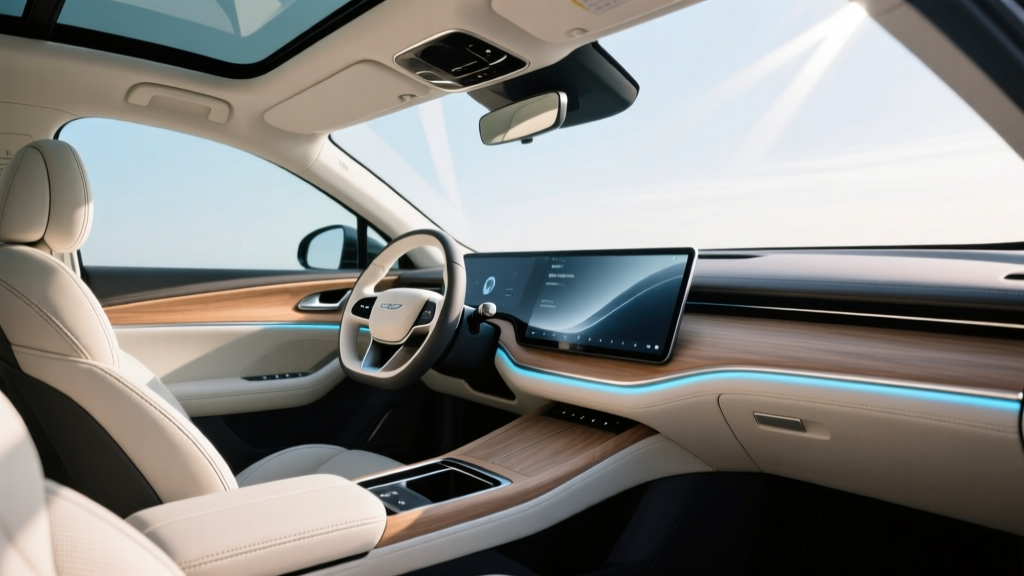
Step inside the Lucid Air and the first thing you notice is the light. The optional Glass Canopy roof (standard on Grand Touring and Sapphire) extends from the windshield to behind the rear seats, creating an almost greenhouse-like openness that no rival sedan — not the Mercedes EQS, not the BMW i7 — quite matches. The trade-off is solar heat load on hot days; Lucid mitigates this with a powered retractable sunshade on most trims, but the Pure's standard aluminum roof keeps the cabin cooler by default.
The 34-Inch Glass Cockpit Display
The centerpiece is a curved 34-inch 5K "Glass Cockpit" display that floats above the dash rather than being embedded in it. It houses the instrument cluster, navigation, and media in one continuous panel, with a secondary lower touchscreen for climate and vehicle controls. Resolution is excellent, but the lower screen's haptic-only buttons for fan speed and seat heating require a glance away from the road — a real annoyance on long trips where physical knobs would be faster.
Materials & Build Quality
Upper trims (Grand Touring, Sapphire) use Nappa leather, open-pore wood, and bridge-of-weave wool-blend textiles that compete credibly with Mercedes and BMW. The Pure and Touring use a premium vegan "Alpine" upholstery that feels durable but less luxurious to the touch. Panel gaps on 2025-2026 builds have improved significantly over early 2022 cars, though some owners still report minor rattles in the rear parcel shelf — check this on any test drive.
Space: The Air's Hidden Advantage
Because Lucid miniaturized its drive units, the Air offers midsize-sedan exterior dimensions with full-size interior volume:
- Rear legroom: 41.6 inches (more than the Mercedes S-Class)
- Front legroom: 41.2 inches
- Trunk: 22.1 cu ft (rear) + 7.4 cu ft frunk = ~29.5 cu ft total
- Rear seat: Three-across seating with real adult comfort; outboard seats are heated/ventilated on GT+
For context, the Tesla Model S offers 28 cu ft of cargo and tighter rear headroom. If you regularly carry adults in back, the Air wins this segment.
Range & Efficiency: EPA Numbers vs. Real-World Driving
Real-World Expectation: 340-380 mi highway at 70 mph in mild weather; drop 15-25% in freezing temps or at sustained 80+ mph speeds.
Efficiency: The Grand Touring's 131 MPGe (26 kWh/100 mi) is among the best of any large luxury sedan — it sips electrons thanks to Lucid's 900V+ architecture and low-drag design.
Lucid's engineering edge is real: the Air achieves its range not by stuffing in the biggest battery, but through motor efficiency and aerodynamics (Cd 0.197). In independent highway testing, the Grand Touring has delivered 3.8-4.1 mi/kWh at 70 mph — translating to roughly 360-380 real miles before you'd want to stop. In winter (sub-30°F), expect that to fall to 280-310 miles unless you precondition the battery while plugged in, which the Air's app scheduling supports.
The Pure's 88 kWh pack is smaller, so its 419-mile EPA figure relies on lighter weight and RWD efficiency; real-world highway runs typically net 340-360 miles. Still exceptional, but don't plan a 400-mile single-stretch trip without a backup charger.
Charging: 300 kW Peaks, But Watch the Curve
| Charging Level | Power / Rate | What You Get |
|---|---|---|
| Level 1 (120V household) | ~1.4 kW | ~4-5 miles per hour |
| Level 2 (240V home, 48A) | 11.5 kW | ~46 miles per hour |
| Level 2 (240V, 80A hardwired) | 19.2 kW | ~75 miles per hour — full overnight refill |
| DC Fast Charge (peak) | Up to 300 kW (Touring+) | 10-80% in ~25 min at compatible stations |
| DC Fast Charge (sustained avg) | ~180-220 kW avg | Real-world 10-80% closer to 28-32 min due to taper above 80% |
The Air's 900V+ architecture lets it accept up to 300 kW at Electrify America's latest 350 kW stalls and, via the included NACS adapter (standard since late 2024), at Tesla Supercharger V4 sites. The catch: peak 300 kW is a brief window between roughly 10-40% State of Charge (SoC). Above 60%, the curve tapers to ~150 kW, and above 80% it drops below 50 kW. This is normal lithium-ion behavior, but it means the "25-minute" claim assumes you stop charging at 80%. Charging to 100% on DC adds another 25-35 minutes.
For home charging, the Air's 19.2 kW onboard charger is one of the fastest in the segment — but you'll need a hardwired 80-amp circuit and a panel that can support it. Many homes need a service upgrade from 100A to 200A (budget $1,500-$3,000 for the electrician work). Always get a licensed electrician's assessment before purchase.
Driver Assistance: DreamDrive Pro (SAE Level 2)
Lucid's DreamDrive Pro uses 32 sensors (including LiDAR on Grand Touring and above) to deliver adaptive cruise, lane-centering, automatic lane changes, and parking assist. It's smooth and conservative — closer to GM's Super Cruise in behavior than Tesla's more aggressive FSD Supervised. However, it lacks hands-free operation on mapped highways (a feature Lucid has previewed but not yet shipped as of early 2026). For buyers who want true hands-off driving on approved roads, the BMW i7 with Highway Assistant or Ford's BlueCruise still offer more permissive Level 2+ behavior.
Pricing, Trims & Federal Tax Credit (IRS §30D)
| Trim | Base MSRP | Federal Credit Eligible? | Effective Price (if eligible) |
|---|---|---|---|
| Pure RWD | $69,900 | Yes (sedan cap $55,000 does NOT apply — see note) | Varies; see rules below |
| Touring AWD | $87,400 | Subject to battery sourcing rules | Varies |
| Grand Touring | $125,600 | Exceeds MSRP cap — NOT eligible | $125,600 |
| Sapphire | $249,000 | Exceeds MSRP cap — NOT eligible | $249,000 |
Tax credit reality check: Under IRS §30D, new EVs qualify for up to $7,500 only if they meet ALL of the following:
- MSRP cap: Sedans must be ≤ $55,000. (The Air Pure at $69,900 exceeds this, making it ineligible for the new-vehicle credit as of current IRS guidance. Verify with a tax professional — classification can shift if Lucid reconfigures trims.)
- Buyer income cap: MAGI ≤ $150,000 single / $300,000 joint
- Battery sourcing: Critical minerals and battery components must meet phased-in North American/free-trade requirements
- Point-of-sale transfer: Eligible buyers can apply the credit at purchase rather than waiting for tax filing
Bottom line: Most Lucid Air buyers will not qualify for the federal credit due to MSRP pricing. The IRS §30D rules change periodically — confirm current eligibility with your tax advisor before relying on the credit in your budget.
Pros & Cons: The Honest Take
- Class-leading EPA range (516 mi Grand Touring)
- Best-in-class rear-seat legroom and cabin openness
- 300 kW DC fast charging with NACS adapter access to Superchargers
- 19.2 kW Level 2 onboard charger (faster than most rivals)
- Outstanding efficiency (26 kWh/100 mi GT)
- LiDAR-equipped DreamDrive on upper trims
- Base MSRP exceeds §30D sedan cap — no federal credit for most buyers
- Service center network still thin outside major metros
- Lower touchscreen controls are distracting while driving
- Hands-free DreamDrive feature not yet shipped
- Resale value data still limited vs. Tesla/Mercedes
- Cold-weather range loss (~20%) is real and under-communicated
Lucid Air vs. the Competition
Stacked against the Mercedes EQS 450+ (350 mi EPA, ~$105k), BMW i7 eDrive50 (318 mi, ~$106k), and Tesla Model S Long Range (402 mi, ~$79,990), the Air Grand Touring offers more range and more rear-seat space than any of them. The Model S undercuts on price and wins on Supercharger native access and software maturity, but its rear cabin feels cramped by comparison and its interior materials no longer justify the badge. The EQS is more luxurious in trim but less efficient and slower to charge. If cabin space and range-per-dollar dominate your spreadsheet, the Air wins. If dealer support and brand cachet matter more, the Germans still have an edge.
Warranty & Long-Term Ownership
- Basic vehicle: 4 years / 50,000 miles
- Battery & powertrain: 8 years / 100,000 miles (capacity retention ≥ 70%)
- Roadside assistance: 4 years / 50,000 miles
Lucid's battery warranty is standard for the segment. The NMC packs have proven durable in early fleet data, but long-term (10+ year) degradation curves are still being established. Budget roughly $15,000-$22,000 for an out-of-warranty battery replacement — though most owners will never need one if they avoid habitual 100% charges and frequent DC fast charging in extreme heat.
FAQ: Living With a Lucid Air
What is the real-world range of the Lucid Air?
Expect 340-380 highway miles in mild weather for the Grand Touring (516 EPA), and 280-310 miles in freezing conditions. The Pure delivers roughly 340-360 real miles. Always plan charging stops around 70-80% of the EPA figure for safety margin.
How fast does the Lucid Air charge at home and on the road?
At home on a hardwired 80A Level 2, you'll add ~75 miles per hour — enough to fully refill overnight. On a 300 kW DC fast charger, 10-80% takes ~25 minutes, but expect 28-32 minutes in real-world conditions due to charge-curve taper.
Does the Lucid Air qualify for the federal EV tax credit?
Most trims do not. The §30D sedan MSRP cap is $55,000, and even the base Pure starts at $69,900. Battery-sourcing and buyer-income rules further restrict eligibility. Consult a tax professional and check IRS.gov for current-year rules.
Is the Lucid Air worth buying vs. a Tesla Model S or Mercedes EQS?
If interior space, range, and efficiency are your top three priorities, yes. If you need native Supercharger access (without an adapter), hands-free Level 2+ driving today, or a dense service-center network, the Model S or EQS may serve you better short-term.
Can the Lucid Air use Tesla Superchargers?
Yes. Since late 2024, the Air ships with a NACS charge port (or an included CCS-to-NACS adapter on earlier builds), giving access to Tesla's Supercharger network — currently the most reliable DC network in the U.S.
What's the biggest complaint from real Lucid Air owners?
Service availability. Lucid's service center footprint is growing but still sparse in the Mountain West, Southeast, and rural areas. Mobile service handles many software and minor hardware issues, but body or high-voltage work may require a tow to the nearest metro center.
Always verify current pricing, incentives, and specs with Lucid Motors and a licensed tax professional before purchasing. Rules under IRS §30D and state incentive programs change frequently.