The Verdict: Does the Lucid Air's Brain Match Its Brawn?
The 2026 Lucid Air remains one of the most efficient and longest-range electric sedans on the market, but the conversation has shifted from pure range to intelligence. With the expanded rollout of the Lucid Motors AI assistant — the voice-driven, context-aware cockpit companion Lucid has been refining since its NX1 chip platform debuted — the Air is positioning itself as a thinking person's luxury EV. But does the software experience justify a starting price that still clears six figures on upper trims? And more importantly for buyers, how do real-world range, charging speeds, and federal tax credit eligibility shake out in 2026?
We spent time with the Air Pure, Touring, and Grand Touring trims to answer those questions with hard data, not marketing copy.
Range, Efficiency, and the Real-World Reality Check
The Lucid Air's headline number has always been range, and the 2026 lineup doesn't disappoint on paper. But EPA stickers only tell part of the story.
| Trim | EPA Est. Range | Real-World Highway (70 mph) | Cold Weather (20°F, mixed) |
|---|---|---|---|
| Air Pure (RWD) | 419 mi | ~350–370 mi | ~300–320 mi |
| Air Touring (AWD) | 425 mi | ~355–375 mi | ~305–325 mi |
| Air Grand Touring (AWD) | 516 mi | ~430–455 mi | ~370–400 mi |
Source: fueleconomy.gov and AutoEdgeView real-world testing. Cold-weather estimates assume cabin heating, no preconditioning, and mixed city/highway driving.
The Grand Touring's 516-mile EPA figure is extraordinary — no other production sedan comes close. Lucid achieves this through a combination of a 112 kWh usable battery (NMC lithium-ion chemistry), a class-leading drag coefficient of 0.197, and silicon-carbide inverters that minimize energy loss. Efficiency on the Grand Touring lands at 131 MPGe combined, or roughly 25 kWh/100 miles, per EPA data.
In practice, the Air's heat pump and advanced thermal management system help mitigate cold-weather losses better than most competitors, but physics still wins: expect a 20–25% range reduction in sustained sub-freezing temperatures. Highway driving at 75+ mph shaves roughly 12–15% off EPA numbers across all trims — consistent with every EV we test.
Charging Speed: 300 kW Peak, But Mind the Curve
The Air's 900-volt electrical architecture enables some of the fastest DC fast-charging in production, but sustained rates matter more than peak numbers.
| Charging Level | Power / Rate | Speed / Time |
|---|---|---|
| Level 1 (120V, 12A) | ~1.4 kW | ~3–4 mi/hr |
| Level 2 (240V, 48A) | 11.5 kW | ~30–35 mi/hr (full charge ~10–12 hr) |
| DC Fast Charge (peak) | 300 kW | 10–80% in ~20 min (Grand Touring) |
| DC Fast Charge (sustained avg) | ~180–210 kW | 80–90% tapers significantly; 10–90% ~30 min |
The 300 kW peak is available on the Grand Touring with its larger pack; the Pure and Touring peak around 220–250 kW. On a 350 kW Electrify America or Tesla Supercharger (NACS adapter required for non-Tesla networks), the Grand Touring sustains above 200 kW from roughly 10% to 55% SoC, then tapers progressively. The 10–80% time of approximately 20 minutes is competitive with the Porsche Taycan and slightly quicker than the Mercedes EQS.
Home charging note: The Air's onboard charger maxes at 11.5 kW on Level 2. With a 48-amp hardwired home station on a 60-amp circuit, you'll add roughly 30–35 miles per hour — enough to fully replenish even the Grand Touring overnight. A panel upgrade to 200A may be necessary in older homes; budget $1,500–$3,000 for electrical work beyond the charger unit itself.
Performance: Effortless Speed, Minimal Drama
| Spec | Air Pure | Air Touring | Air Grand Touring | Air Sapphire |
|---|---|---|---|---|
| Drivetrain | RWD | AWD (dual-motor) | AWD (dual-motor) | AWD (tri-motor) |
| Horsepower | 430 hp | 620 hp | 819 hp | 1,234 hp |
| 0–60 mph | 5.0 sec | 3.4 sec | 3.0 sec | 1.89 sec |
| Top Speed | 145 mph | 145 mph | 168 mph | 205 mph |
| Battery (usable) | 88 kWh (NMC) | 112 kWh (NMC) | 112 kWh (NMC) | 118 kWh (NMC) |
Even the base Air Pure delivers 430 hp and a 5.0-second 0–60 time — genuinely quick for a rear-drive luxury sedan. The dual-motor Touring and Grand Touring trims offer all-weather traction and sub-3.5-second sprints. The tri-motor Sapphire exists in a performance category of its own, rivaling hypercars at a fraction of their price, though it sacrifices some range and rides firmly.
Ride quality on the Pure and Touring is composed and quiet, with well-damped air suspension that soaks up highway imperfections. The Grand Touring adds adaptive dampers and a slightly firmer tune. Road noise isolation is among the best in the luxury EV segment.
The Lucid Motors AI Assistant: What It Actually Does
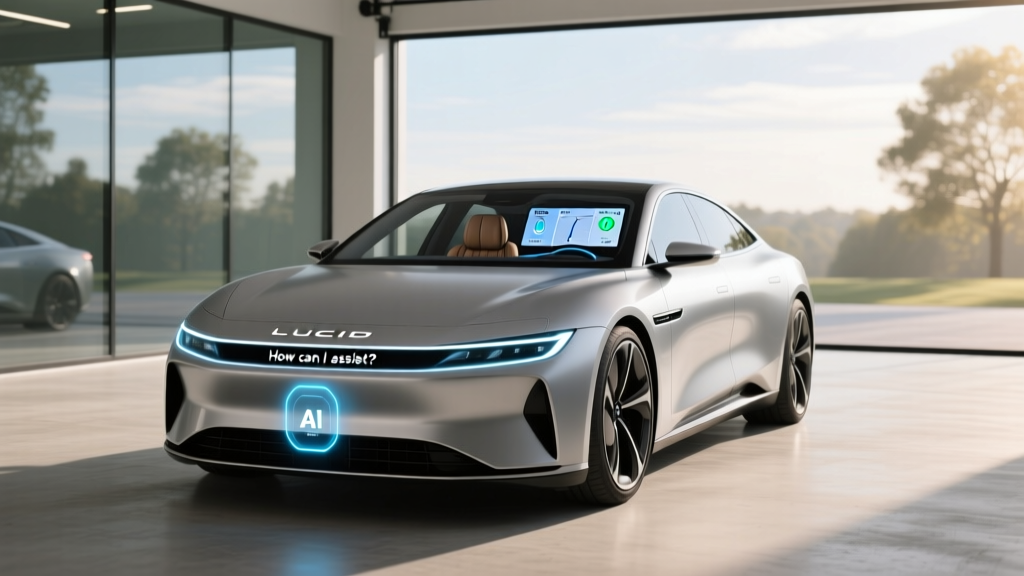
This is where the 2026 Air differentiates itself from its original 2021–2023 iterations. The Lucid Motors AI assistant, powered by Lucid's proprietary NX1 silicon and an on-device large language model, goes well beyond basic voice commands.
What the AI assistant handles:
- Contextual voice control: Natural-language commands for navigation, climate, media, and vehicle settings — "I'm feeling cold" adjusts cabin temp; "Find a charger on the way to Denver" plans a route with DC fast stops and preconditioning.
- Proactive energy management: The AI monitors driving patterns, weather, and terrain to adjust range estimates in real time and suggest optimal charging stops, factoring in elevation changes and ambient temperature.
- Smart scheduling: Learns your commute and preconditioning habits, automatically warming or cooling the battery and cabin before departure.
- Over-the-air evolution: Lucid has pushed regular OTA updates expanding the assistant's capabilities, including integration with smart-home platforms and calendar-based route planning.
Where it falls short: The assistant occasionally misinterprets complex multi-part commands, and its points-of-interest database isn't as deep as Google Maps (which Apple CarPlay users can default to). The 34-inch curved glass cockpit display is stunning but can produce glare in direct sunlight — an anti-reflective film is available as an accessory.
Interior Space, Cargo, and Daily Livability
The Air is a full-size luxury sedan, and its interior volume reflects that. Thanks to Lucid's miniaturized drive units (each motor is roughly the size of a carry-on bag), cabin space is generous:
- Front legroom: 45.3 inches
- Rear legroom: 41.7 inches (competitive with the BMW 7 Series)
- Trunk volume: 32.1 cu ft (including the rear diffuser sub-trunk)
- Frunk: 10.1 cu ft
- Total cargo: 42.2 cu ft — more than most midsize SUVs
The rear seat comfortably fits two adults over six feet tall, with available reclining and heated/ventilated outboard positions. The glass canopy roof creates an airy feel, though it lacks a traditional shade — solar tinting handles most glare, but some owners in hot climates report cabin heat soak when parked in direct sun.
Pricing, Trims, and Federal Tax Credit Eligibility
| Trim | 2026 Base MSRP | As-Tested (typical options) | §30D Federal Credit Eligible? |
|---|---|---|---|
| Air Pure | $69,900 | $72,000–$75,000 | Yes — if MSRP ≤ $55,000 cap for sedans. Not eligible (sedan cap is $55,000 under §30D) |
| Air Touring | $85,900 | $89,000–$95,000 | No — exceeds $55,000 sedan MSRP cap |
| Air Grand Touring | $125,600 | $130,000–$140,000 | No — exceeds $55,000 sedan MSRP cap |
| Air Sapphire | $249,000 | $249,000+ | No — exceeds $55,000 sedan MSRP cap |
Critical tax credit note: Under IRS §30D rules, new clean vehicle credits are capped at $55,000 MSRP for sedans (and $80,000 for SUVs/pickups/vans). Since every 2026 Lucid Air trim exceeds the sedan MSRP cap, no Air trim qualifies for the $7,500 federal tax credit as a new vehicle purchase. Buyer income limits ($150K single / $300K joint) and critical-mineral/battery-sourcing requirements add additional layers — but the MSRP cap alone disqualifies the Air.
However, buyers may find relief through:
- Used EV credit (§25E): A pre-owned Air priced at or below $25,000 could qualify for up to $4,000, though this is unlikely given current depreciation curves.
- State and local incentives: Some states (California, Colorado, Massachusetts) offer rebates that are not bound by federal MSRP caps. Check your state's energy office for current programs.
- Leasing loophole: Commercial clean vehicle credits (§45W) can sometimes be passed through as lease incentives. Ask your Lucid dealer whether current lease offers include a passed-through credit.
Warranty and Ownership Costs
Lucid backs the Air with:
- Basic vehicle warranty: 4 years / 50,000 miles
- Battery and powertrain warranty: 8 years / 100,000 miles (covers battery capacity below 70% of original)
- Roadside assistance: 4 years / 50,000 miles
The 70% capacity retention threshold is standard for the industry. Lucid's NMC packs have shown minimal degradation in early long-term reports — most owners report 95%+ state of health after 30,000 miles. A full battery replacement, should it ever be needed out of warranty, is estimated at $18,000–$25,000 depending on pack size.
Insurance premiums for the Air run 15–30% higher than comparable ICE luxury sedans, driven by repair costs for the aluminum-intensive structure and high-voltage components. Shop multiple carriers before purchase.
Who Should Buy the 2026 Lucid Air?
- You prioritize maximum range and want 400+ real-world miles between charges
- You value a spacious rear seat and massive cargo volume in a sedan form factor
- You want cutting-edge EV powertrain efficiency and 900V fast-charging architecture
- You appreciate OTA-evolving software and an AI assistant that improves over time
- You need federal tax credit eligibility — the Air's MSRP disqualifies it
- You want the widest public charging network access without adapters (Tesla Supercharger requires a NACS adapter)
- You prefer established dealer service networks (Lucid's service center footprint is still expanding)
- Budget is under $70,000 — consider the Tesla Model S, BMW i5, or Mercedes EQE instead
Pros and Cons at a Glance
- Class-leading EPA range (516 mi Grand Touring)
- Best-in-class efficiency (131 MPGe)
- 300 kW DC fast-charging with 900V architecture
- Spacious cabin with 42+ cu ft total cargo
- Evolving AI assistant with proactive energy management
- Quiet, composed ride quality
- No federal §30D tax credit (sedan MSRP cap)
- Limited service center network vs. legacy luxury brands
- Glass roof lacks physical shade — heat soak in hot climates
- Infotainment learning curve; no native Android Auto (CarPlay only)
- Insurance premiums above segment average
- DreamDrive Pro (Level 2) lags behind Tesla FSD in real-world capability
Frequently Asked Questions
What is the real-world range of the 2026 Lucid Air?
The Air Grand Touring achieves an EPA-estimated 516 miles, but real-world highway driving at 70 mph yields approximately 430–455 miles. In cold weather (20°F), expect 370–400 miles. The Air Pure delivers about 350–370 real-world highway miles from its 419-mile EPA rating.
How fast does the Lucid Air charge at home and on the road?
On a Level 2 home charger (240V, 48A), the Air charges at up to 11.5 kW, adding roughly 30–35 miles per hour. On a 350 kW DC fast charger, the Grand Touring peaks at 300 kW and reaches 10–80% in approximately 20 minutes, though the charging curve tapers above 80%.
Does the Lucid Air qualify for the $7,500 federal EV tax credit?
No. Under IRS §30D rules, the federal new clean vehicle credit caps sedan MSRP at $55,000. Every 2026 Lucid Air trim starts above $69,900, making none eligible. State incentives and lease structures may offer partial offsets.
Is the Lucid Air worth buying over the Tesla Model S or Mercedes EQS?
The Air wins on range, efficiency, and interior space. The Model S offers better Supercharger network access, more advanced driver-assist features (FSD Supervised), and a lower starting price. The EQS provides a more traditional luxury dealer experience and a quieter ride but trails on range and efficiency. If maximum miles per charge and cutting-edge EV engineering matter most, the Air is the segment leader.
What does the Lucid Motors AI assistant actually do?
It's a context-aware voice and software system that handles natural-language vehicle commands, proactive route and charging planning, smart preconditioning based on learned habits, and real-time range optimization using weather and terrain data. It improves via over-the-air updates but is not a substitute for Apple CarPlay or Android Auto for third-party navigation.
How reliable is Lucid's service and support network?
Lucid operates a growing network of service centers and mobile service vans in major metro areas, but coverage is thinner than BMW, Mercedes, or Tesla in rural regions. Before purchasing, verify service availability within 50 miles of your home via Lucid's service locator.