The 2024 Tesla Model Y remains one of the best-selling electric vehicles in the United States, and for good reason: it blends practicality, efficiency, and access to the Supercharger network in a crossover package. But buyers researching the 2024 Tesla Model Y interior often want specifics beyond marketing gloss — exactly how much room is in the back seat, what the cabin materials feel like after two years of ownership, and whether the minimalist dashboard holds up in daily use. This review covers the cabin, cargo, and tech in detail, while also delivering the exact range, charging, and pricing numbers you need to make a purchase decision in 2026.
Quick Verdict: Who the 2024 Model Y Is For
The 2024 Model Y is best suited for two-adult households with occasional rear passengers who prioritize efficiency, software integration, and road-trip charging convenience over plush materials or traditional switchgear. Families with rear-facing car seats will find the second row tight. Solo commuters and couples will find it nearly ideal. If you need a luxury-feeling cabin at this price point, competitors like the Hyundai Ioniq 5 or Ford Mustang Mach-E offer more tactile interiors — but none match Tesla's charging network advantage or energy efficiency.
Range, Battery & Efficiency: The Numbers That Matter
EPA estimates: 310 miles (Long Range AWD) / 330 miles (Long Range RWD) / 279 miles (Performance).
What to expect: Plan for ~250–270 miles on sustained 70+ mph highway driving, and as low as ~220–240 miles in sub-freezing winter conditions without preconditioning. City driving with regenerative braking recovers range closer to the EPA sticker. These figures reflect real-world testing patterns consistent with EPA EV testing methodology.
| Spec | Long Range AWD | Long Range RWD | Performance |
|---|---|---|---|
| EPA Range | 310 mi | 330 mi | 279 mi |
| Battery (usable, est.) | ~75 kWh (NMC) | ~75 kWh (NMC) | ~75 kWh (NMC) |
| MPGe (combined) | 122 MPGe | 125 MPGe | 111 MPGe |
| Efficiency | 28 kWh/100 mi | 27 kWh/100 mi | 30 kWh/100 mi |
| 0–60 mph | 4.8 sec | 5.0 sec | 3.5 sec |
| Drivetrain | Dual-motor AWD | Single-motor RWD | Dual-motor AWD |
| Peak DC Charge Rate | 250 kW | 250 kW | 250 kW |
| 10–80% DC Time | ~27 min | ~27 min | ~27 min |
The 2024 Model Y uses an NMC (nickel manganese cobalt) lithium-ion battery pack. NMC chemistry offers higher energy density than LFP (lithium iron phosphate), which is why Tesla reserves LFP for the Standard Range variants in other markets. For daily driving, Tesla recommends charging NMC packs to 80% and only taking them to 100% for longer trips — this practice helps preserve long-term battery health.
Charging Speeds: Home and DC Fast Charging
| Level | Power / Rate | Miles Added per Hour | Notes |
|---|---|---|---|
| Level 1 (120V) | ~1.4 kW | ~3–5 mi/hr | Emergency / overnight trickle only |
| Level 2 (240V, 48A) | 11.5 kW | ~37–44 mi/hr | Home Wall Connector or equivalent |
| DC Fast (Supercharger V3) | Peak 250 kW | ~175 mi in 15 min (peak) | Tapers significantly above 80% SoC |
A critical detail many spec sheets gloss over: the 250 kW peak rate is not sustained. The Model Y's charge curve peaks near 250 kW at low state of charge (roughly 5–15% SoC) and tapers progressively. By 50% SoC, expect roughly 120–150 kW; above 80%, the rate drops to under 50 kW. This is why the 10–80% time is the most useful real-world metric, and ~27 minutes is competitive for 2024 architecture, though newer 800V platforms from Hyundai/Kia and Porsche charge faster.
At home on a Level 2 Tesla Wall Connector (hardwired, 60A breaker), you'll add roughly 40 miles of range per hour. A full overnight charge from 20% to 80% takes about 5–6 hours. Home installation costs typically run $500–$2,000 depending on panel capacity and run length — budget for a potential panel upgrade if you're on a 100A service.
Inside the 2024 Tesla Model Y Interior: Cabin, Cargo & Comfort
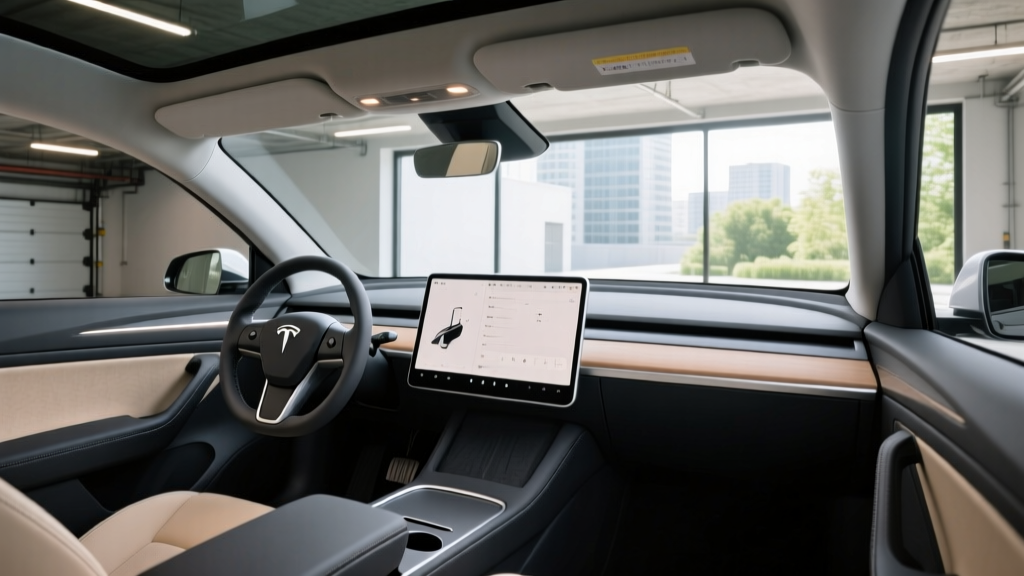
The 2024 Model Y interior follows Tesla's signature minimalist approach: a single 15-inch landscape touchscreen handles virtually all vehicle functions, climate controls, and media. There is no traditional instrument cluster — speed and navigation appear in the top-left corner of the center display. The steering wheel is a flat-bottom design with two scroll wheels and minimal physical buttons.
Materials and Build Quality
Tesla upgraded the Model Y's cabin for the 2024 model year with soft-touch materials on the dashboard and door panels, ambient lighting, and improved seat cushioning. The synthetic leather ("vegan leather") upholstery is durable and wipes clean easily, though it lacks the breathability of cloth or perforated options in competitors. Panel gaps have improved over earlier Model Y years, though they still vary unit-to-unit — inspect any delivery carefully. The headliner is a single piece of Alcantara-style material that gives the cabin an upscale feel despite the sparse design.
Passenger Space
| Measurement | Front | Second Row | Optional Third Row |
|---|---|---|---|
| Headroom | 41.0 in | 38.7 in | 34.6 in |
| Legroom | 41.8 in | 36.5 in | 26.5 in |
| Shoulder Room | 58.4 in | 54.0 in | N/A |
The front seats are comfortable for long drives with adequate lateral support, though taller drivers (6'2"+) may wish for more seat-track travel. The second row is the cabin's compromise: 36.5 inches of legroom is adequate for adults on shorter trips but tight for rear-facing child seats, which can push the front passenger's knees against the glovebox. The optional third row is best described as child-only — 26.5 inches of legroom is unusable for anyone over about 5'0". Most buyers should treat the Model Y as a five-seat vehicle and skip the third-row option.
Cargo Capacity
Behind the second row: 30.2 cubic feet. With the second row folded flat: 72.1 cubic feet. The front trunk (frunk) adds 4.1 cubic feet — enough for a charging cable bag, groceries, or a small carry-on. The cargo floor is relatively flat when seats are folded, and the hatch opening is wide enough for furniture-box-sized items. This cargo volume is competitive with the Ford Mustang Mach-E (29.9 / 59.7 cu ft) and slightly less than the Hyundai Ioniq 5 (27.2 / 59.3 cu ft, though the Ioniq's boxier shape makes it feel roomier).
Technology, Driver Assistance & Standout Features
Tesla Autopilot and Full Self-Driving (Supervised) are SAE Level 2 driver-assistance systems. The driver must remain fully engaged, hands on or near the wheel, and eyes on the road at all times. These systems do not make the vehicle self-driving. Only Level 4 services like Waymo operate without a human driver in defined areas.
The 2024 Model Y's tech stack is among the most integrated in any EV. Key features include:
- 15-inch center touchscreen with embedded navigation, streaming media, and over-the-air (OTA) software updates
- Tesla Autopilot (standard): adaptive cruise control, lane centering, automatic emergency braking, blind-spot monitoring
- Full Self-Driving (Supervised) ($8,000 add-on or $99/mo subscription): adds automatic lane changes, Navigate on Autopilot, traffic-light and stop-sign recognition, and assisted parking — still Level 2, driver responsible
- Sentry Mode: 360° camera-based security system that records events around the parked vehicle
- Dashcam: built-in recording from front, rear, and side cameras
- Tesla app integration: remote climate control, location tracking, software update scheduling, and Summon (low-speed remote parking)
- HEPA air filtration ("Bioweapon Defense Mode"): hospital-grade cabin air filter
FSD does not drive the car autonomously. It requires continuous driver supervision and can make errors at construction zones, unmapped intersections, and in heavy rain or snow. Treat it as an advanced cruise-control system, not a chauffeur. NHTSA continues to investigate Autopilot-related incidents — stay informed at nhtsa.gov.
The biggest tech drawback is the absence of Apple CarPlay and Android Auto. Tesla's native infotainment is capable (Spotify, Tidal, Netflix/YouTube while parked, built-in navigation), but if you rely on phone-mirroring for daily use, this is a genuine friction point. The Model Y also lacks a heads-up display, which competitors at this price increasingly offer.
Pricing, Trims & Federal Tax Credit Eligibility (2026 Update)
| Trim | Base MSRP | Est. After §30D Credit* | Key Features |
|---|---|---|---|
| Long Range RWD | $44,990 | ~$37,490 | 330 mi range, single motor, Autopilot |
| Long Range AWD | $47,990 | ~$40,490 | 310 mi range, dual motor, Autopilot |
| Performance | $51,490 | ~$43,990 | 279 mi range, dual motor, 3.5s 0–60 |
*Federal tax credit eligibility is not guaranteed. Pricing reflects MSRP at the time of the 2024 model year. Actual out-of-pocket cost depends on your tax situation and point-of-sale transfer availability.
- MSRP cap: SUVs/crossovers must be under $80,000 (all Model Y trims qualify)
- Buyer income cap: AGI ≤ $150,000 (single) / $225,000 (head of household) / $300,000 (joint)
- Battery sourcing: Critical minerals and battery components must meet phased-in percentage thresholds from US/FTA countries — Tesla's supply chain has largely met these, but confirm at point of sale
- Point-of-sale transfer: Eligible buyers can apply the credit as an instant discount at purchase rather than waiting for tax filing
- Verify current rules: Check IRS.gov §30D guidance before purchasing — sourcing requirements tighten annually
As-tested pricing climbs quickly with options: FSD adds $8,000 (or $99/mo), premium colors add $1,000–$2,500, 20-inch wheels add $2,000 (and reduce range by ~5%), and the third-row seat adds $2,500. A fully loaded Long Range AWD with FSD can approach $62,000 before incentives.
Warranty, Ownership Costs & Longevity
Tesla's warranty coverage for the 2024 Model Y:
- Basic vehicle: 4 years / 50,000 miles
- Battery & drive unit: 8 years / 120,000 miles (Long Range & Performance AWD); 8 years / 100,000 miles (RWD variants)
- Battery capacity retention: Tesla warrants a minimum of 70% capacity retention during the warranty period
Real-world degradation data from Tesla fleet reports and third-party tracking (including Tesla's annual Impact Report) shows Model Y packs typically retain ~90% capacity at 100,000 miles under normal use. NMC packs degrade more in the first 20,000 miles and then stabilize. Following Tesla's 80% daily charge recommendation and avoiding frequent DC fast-charging to 100% will maximize longevity.
Insurance costs are a known pain point: the Model Y's average annual premium runs $2,200–$3,200 depending on state, driver profile, and coverage level — roughly 20–40% higher than a comparably priced gas crossover. Get quotes before purchasing. Maintenance costs are low (no oil changes, minimal brake wear due to regen), but tire replacement comes sooner than gas vehicles due to the Model Y's weight and instant torque — budget for a set of EV-rated tires every 25,000–35,000 miles at roughly $1,200–$1,800 for a set of four.
2024 Model Y vs. Key Competitors
| Spec | Tesla Model Y LR AWD | Hyundai Ioniq 5 SEL AWD | Ford Mach-E Premium AWD |
|---|---|---|---|
| EPA Range | 310 mi | 290 mi | 290 mi |
| Efficiency | 28 kWh/100 mi | 32 kWh/100 mi | 33 kWh/100 mi |
| Peak DC Charge | 250 kW | 240 kW (10–80% in 18 min) | 150 kW |
| 0–60 mph | 4.8 sec | 5.1 sec | 5.1 sec |
| Cargo (rear up) | 30.2 cu ft | 27.2 cu ft | 29.7 cu ft |
| Base MSRP | $47,990 | $49,500 | $48,995 |
| Apple CarPlay | No | Yes (wireless) | Yes (wireless) |
| Charging Network | Supercharger (native) | NACS adapter needed | NACS adapter needed |
Choose the Model Y if: You value maximum range per kWh, seamless Supercharger access without adapters, Tesla's software ecosystem, and best-in-class efficiency for road trips.
Choose the Ioniq 5 if: You want faster 10–80% charging (800V architecture), Apple CarPlay/Android Auto, a more conventional and tactile interior, and V2L (vehicle-to-load) capability for powering devices.
Choose the Mach-E if: You prefer a more traditional crossover driving feel, want Apple CarPlay, and value Ford's dealer network for service accessibility.
Pros, Cons & Final Take
- Best-in-class energy efficiency (28 kWh/100 mi)
- Native Supercharger network access — no adapter needed
- Class-leading cargo space (30.2 cu ft rear up)
- Over-the-air updates continuously add features
- Strong real-world battery degradation record
- Eligible for full §30D credit (confirm sourcing annually)
- No Apple CarPlay or Android Auto
- Second-row legroom tight with rear-facing car seats
- Third-row seat is impractical for anyone but small children
- Insurance premiums 20–40% above segment average
- Ride quality firm on rough pavement (especially with 20" wheels)
- FSD remains Level 2 — not autonomous despite the name
The 2024 Model Y interior won't win luxury awards, but it delivers exactly what Tesla's target buyer wants: a clean, screen-centric cabin with best-in-class efficiency, genuine five-seat practicality (skip the third row), and unmatched charging-infrastructure access. If the minimalist philosophy and lack of CarPlay don't bother you, it remains the default electric crossover recommendation for 2026 buyers.
Frequently Asked Questions
What is the real-world range of the 2024 Tesla Model Y?
EPA estimates are 310 miles (Long Range AWD), 330 miles (Long Range RWD), and 279 miles (Performance). In real-world highway driving at 70–75 mph, expect 250–270 miles. In cold weather (below 32°F), range can drop to 220–240 miles without preconditioning. Use the Tesla app to precondition the battery before departure to minimize cold-weather loss.
How fast does the 2024 Model Y charge at home and on DC fast chargers?
On a Level 2 home charger (11.5 kW / 48A), the Model Y adds roughly 37–44 miles of range per hour — a full 20–80% charge takes about 5–6 hours. On a Tesla Supercharger V3 (250 kW peak), a 10–80% charge takes approximately 27 minutes, though the rate tapers significantly above 80% SoC. CCS adapters allow access to non-Tesla DC fast chargers at similar peak rates.
Does the 2024 Model Y qualify for the $7,500 federal EV tax credit?
Most buyers will qualify, but eligibility depends on your adjusted gross income (≤$150K single / $300K joint), the vehicle's MSRP (under $80K — all trims qualify), and battery-sourcing requirements that tighten annually. The credit can be transferred at point of sale as an instant discount. Confirm current eligibility at IRS.gov before purchasing.
Is the 2024 Model Y worth buying over the Hyundai Ioniq 5 or Ford Mach-E?
The Model Y wins on efficiency, range, and native Supercharger access. The Ioniq 5 wins on charging speed (800V architecture, 10–80% in ~18 min), interior tactility, and CarPlay support. The Mach-E offers a more conventional crossover feel and Ford's dealer network. If road-trip charging convenience is your top priority, the Model Y's ecosystem advantage is significant.
How much cargo space does the 2024 Model Y have?
30.2 cubic feet behind the second row and 72.1 cubic feet with the second row folded. The frunk adds 4.1 cubic feet. This is competitive with or exceeds most electric crossovers in its class and handles family road-trip luggage comfortably for a family of four.
What is the battery warranty on the 2024 Model Y?
Tesla covers the battery and drive unit for 8 years / 120,000 miles on AWD trims and 8 years / 100,000 miles on RWD trims, with a minimum 70% capacity retention guarantee during the warranty period. Real-world fleet data suggests most packs retain ~90% capacity at 100,000 miles under normal charging habits.